



If you have the budget and no time to manage another marketing channel, hire a roofer-specialist SEO agency. If you have more time than money and can commit two to three hours a week for the next 90 days, a prioritized DIY checklist will get you most of the way there. Roofer SEO works differently than general local SEO because roofing searches are high-ticket, often reactive after a storm, and clustered around insurance claims. That means your first moves should target Google Business Profile (GBP) and one strong service-area page, not a blog post nobody asked for.
Here’s what to do in the next 48 to 72 hours:
- Claim and fully complete your GBP: correct categories, service list, service area, hours, and phone number.
- Ask every completed job from the past 30 days for a review, and respond to every existing review within 48 hours.
- Publish or rewrite one service-area page for your busiest territory, with real photos and a clear call-to-action.
| Point | Details |
|---|---|
| Verdict | Hire a specialist agency if budget allows; otherwise follow a prioritized DIY plan starting with GBP. |
| Fastest win | GBP completeness and review velocity move the map pack faster than any other single lever. |
| Timeline | Expect early GBP movement in weeks, booked-job consistency in 6 to 12 months. |
Key Takeaways
Roofer SEO succeeds when GBP optimization, real service-area pages, project galleries, and verified-lead measurement work together on a 6 to 12 month timeline.
| Point | Details |
|---|---|
| Start with GBP | Complete categories, service list, and upload photos weekly since 100+ photos correlate with a 520% jump in calls. |
| Build real service pages | One genuine page per service area, not a templated city-name swap, matches actual buyer intent. |
| Measure verified leads | Track cost per verified lead using call tracking and intent scoring instead of raw sessions or rank position. |
| Expect a real timeline | Early GBP movement in weeks, consistent booked jobs typically take 6 to 12 months. |
| Vet agencies carefully | Wizerunekwsieci runs roofing-specific audits covering GBP, service pages, conversion setup, and verified-lead reporting. |
Where to Verify These Benchmarks Yourself
For technical fundamentals like sitemaps, canonicalization, and crawlability, Google’s SEO starter guide remains the primary reference. For roofing-specific timeline and budget benchmarks, PipelineOn’s roofing SEO breakdown covers realistic expectations in detail. For measurement frameworks built around verified leads rather than raw traffic, Elevarus’s roofing SEO framework is worth a closer read. And for local search behavior data that justifies GBP investment, Statista’s local business search statistics offer the underlying numbers.
Table of Contents
- What Does Roofer SEO Actually Include?
- How Do You Optimize Google Business Profile for Roofers?
- What Website Elements Convert Roofing Traffic Into Leads?
- What Content Should Roofing Companies Publish?
- What Technical SEO Issues Hurt Roofing Websites?
- How Do Reviews and Local Citations Improve Roofer Rankings?
- Which Tools and Metrics Actually Prove SEO Is Working?
- How Long Does Roofing SEO Take and What Does It Cost?
- How Do You Vet a Roofer SEO Agency Before Signing?
- Get a Roofing SEO Audit Built Around Verified Leads
- Frequently Asked Questions
- Sources
What Does Roofer SEO Actually Include?
Roofer SEO is not one task. It’s a set of interlocking pieces that work together to get your business found by a homeowner searching for a roof repair and then convert that search into a booked estimate. Skip one piece and the whole system underperforms, no matter how good your website looks.
The core pillars are:
- Google Business Profile — the single highest-leverage asset for local visibility.
- Service and location pages — one real page per service and per territory you actually work.
- Project galleries — photo proof of completed jobs, ideally geotagged and captioned.
- Insurance-claim and storm-response content — addresses the specific, high-intent searches roofers get after weather events.
- Reviews and citations — trust signals that influence both rankings and click-through.
- Technical SEO — the plumbing that keeps your site crawlable and fast.
- Conversion optimization — turning traffic into a phone call or a submitted form.
- Measurement — tracking verified leads, not just clicks.
Roofing searches skew differently than, say, a local bakery. A homeowner Googling “roof leak repair near me” at 9 p.m. during a storm wants a phone number now, not a blog post about roofing materials. That reactive, high-ticket nature is why ServiceTitan’s roofing SEO guide stresses matching page intent to buyer intent rather than optimizing generic pages and hoping they convert.
A practical process flow looks like this: audit your current site and GBP, fix technical and GBP gaps first, build out service-area pages and galleries, push review velocity, then layer in ongoing content and measurement. Skipping straight to blog content before your GBP and service pages are solid is one of the most common mistakes roofing companies make.
How Do You Optimize Google Business Profile for Roofers?
A Local Map Pack placement captures a disproportionate share of clicks for searches like “roofer near me,” which is exactly why PipelineOn’s roofing SEO research treats GBP optimization as the single highest-leverage activity available to a roofing company. If you only fix one thing this month, fix this.
Start with the fundamentals: accurate categories (Roofing Contractor as primary, plus relevant secondary categories), a complete service list, a precise service area that matches where you actually work, correct hours, and one consistent phone number across every listing. Inconsistent NAP (name, address, phone) data across the web quietly undermines rankings even when your GBP itself looks perfect.
Photos matter more than most roofers assume. PipelineOn’s data shows GBP profiles with 100 or more photos generate a 520% increase in calls compared to profiles with only a handful of images. That’s not a rounding error. Upload new project photos weekly, not once and forget it, and pair that with an automated review request sent within 24 hours of job completion.
For map-pack movement specifically:
- Post weekly GBP updates (completed jobs, seasonal tips, storm-prep reminders).
- Seed your own Q&A section with the questions homeowners actually ask.
- List every relevant service as a GBP “service” entry, not just in your description.
- Audit citation consistency across the top data aggregators quarterly.
Pro Tip: Set a recurring calendar reminder for “GBP Friday.” Ten minutes a week uploading photos and answering reviews compounds into a stronger profile than a one-time overhaul ever will.
Grade your own profile right now: Do you have 50+ photos? Are all categories filled? If you answered no to any of these, you’ve found your starting point. Our Google Business Profile optimization guide walks through the setup in more detail.
What Website Elements Convert Roofing Traffic Into Leads?
Ranking well and converting well are two different problems, and a lot of roofing sites solve only the first one. Traffic that doesn’t convert is just a vanity metric with a nicer name.
Every service page needs a clear headline, a specific service description, a visible phone number, and a call-to-action above the fold, not buried after three paragraphs of company history. Trust signals belong near the CTA: license numbers, warranty terms, manufacturer certifications (GAF, Owens Corning, CertainTeed), and before/after photos from real jobs in that service area.

Mobile-first design isn’t optional. Most roofing searches happen on a phone, often mid-emergency, so page speed and thumb-friendly click-to-call buttons decide whether a visitor becomes a lead or bounces to a competitor. A scheduling widget or click-to-call button fixed in the header outperforms a contact form buried at the bottom of the page every time.
Build this conversion checklist into every service and location page:
- Click-to-call button visible without scrolling.
- Call tracking number so every lead source is attributable.
- Before/after photo gallery specific to that service.
- A cost range or pricing guidance for high-intent pages like “roof replacement cost.”
- Form fields kept to name, phone, and a one-line project description.
Pro Tip: A vague “contact us” form converts worse than a specific “get a free roof inspection estimate” button. Match the CTA language to what the searcher just typed.
For a deeper look at lead capture mechanics, our guide on capturing leads from your website covers the same principles in more detail.
What Content Should Roofing Companies Publish?
Content strategy for roofers isn’t about publishing volume. It’s about matching real search intent with real pages, and that starts with resisting the template-page temptation.
Build one genuine page per service area you actually work in, not a swapped-out city name on an identical template. Google’s own guidance on creating helpful, people-first content specifically warns against exactly this kind of scaled, low-value duplication, and roofers get caught by it constantly.
Beyond your core service pages, prioritize three high-intent content clusters:
- Insurance-claim pages that explain your process for storm-damage claims, documentation, and adjuster meetings.
- Storm-response pages built ahead of storm season, not written reactively after the fact.
- Emergency repair pages targeting “roof leak,” “emergency roof repair,” and similar urgent queries.
Each of these should run 600 to 1,000 words, include local project photos, and answer the two or three questions a homeowner in that situation actually has. GAF’s roofing SEO best practices recommend exactly this kind of focused, useful content over generic keyword-stuffed pages.
For AI overview and featured-snippet visibility, lead every FAQ answer with a direct, self-contained sentence before adding detail, and mark it up with FAQ schema. A publishing cadence of one GBP post a week and one blog or FAQ addition every two weeks, paired with ongoing gallery updates, keeps the site active without demanding a full-time content team.
What Technical SEO Issues Hurt Roofing Websites?
Technical problems are invisible to homeowners but very visible to Google, and they quietly cap how much of your good content and GBP work ever gets seen. Start with a crawl of your entire site to catch indexation errors, broken canonical tags, and an inaccurate sitemap or robots.txt file, following the fundamentals in Google’s SEO starter guide.
Page speed deserves specific attention on roofing sites because project galleries are often the biggest speed killer. Large, unoptimized photos with bulky EXIF data slow load times significantly, so compress every image, strip unnecessary metadata, and lazy-load gallery images below the fold.
Structured data is worth getting right, not just checking off:
- LocalBusiness schema to reinforce your name, address, phone, and service area.
- Service schema on each service page to clarify exactly what you offer.
- FAQ schema on pages with genuine question-and-answer content.
- Project or review schema where your platform supports it, to reinforce social proof.
Pro Tip: Run a free crawl with a tool like Google Search Console before touching anything else. Fixing an indexation error that’s blocking your best service page can outperform a month of new content.
Run this audit quarterly at minimum. Roofing sites that add galleries and blog content regularly without rechecking technical health tend to accumulate speed and crawl issues that quietly erode the gains from everything else you’re doing.
How Do Reviews and Local Citations Improve Roofer Rankings?
Off-page signals for roofers boil down to three things: how many reviews you have, how consistent your business information looks across the web, and where your links come from. Get these wrong and even a perfect website struggles to rank.
Review velocity matters more than total review count. A profile with 40 reviews spread evenly over two years signals ongoing customer satisfaction better than 200 reviews that all landed in one month three years ago. Automate the ask (a text or email sent within a day of job completion), and respond to every review, especially the negative ones, within 48 hours.
Citation consistency means your business name, address, and phone number match exactly across directories like Google, Bing Places, Apple Maps, and industry-specific listings. Run an audit of the major data aggregators at least twice a year, since outdated citations from a past address or old phone number can quietly confuse both users and search engines.
For link-building, roofers have better options than most industries realize:
- Manufacturer partner or “find a contractor” pages (GAF, Owens Corning certified installer listings).
- Local press coverage of storm response or community projects.
- Chamber of commerce and trade association directories.
- Supplier and distributor partner pages.
Avoid fake reviews, paid review farms, and spammy directory submissions entirely. These tactics can trigger a suspension of your GBP listing, which erases months of legitimate work overnight. For readers who want a third-party view on roofer-specific service offerings, Baby Love Growth’s roofer SEO overview covers similar territory from an agency perspective.
Which Tools and Metrics Actually Prove SEO Is Working?
You need four core tools: Google Search Console for indexation and query data, GA4 for traffic behavior, a call-tracking platform, and a rank tracker focused specifically on local, geo-modified terms rather than vanity national keywords.
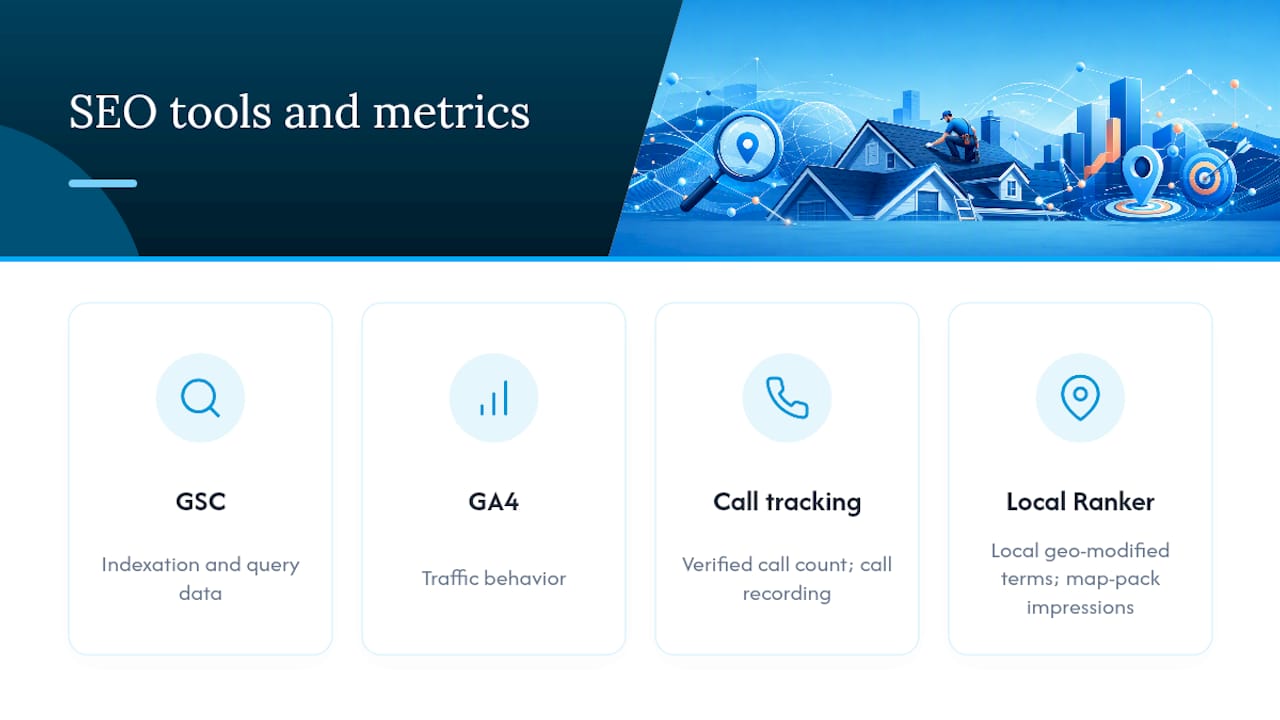
The metrics that matter are cost per verified lead, verified call count, map-pack impressions, and GBP photo and review velocity over time. Raw sessions and keyword rank position look good in a report but don’t pay the bills.
Verification is the piece most roofing companies skip. Add call recording, an OTP or phone-verification step on forms, and a simple intent-scoring process that filters out-of-area or clearly unqualified submissions. Elevarus’s framework for roofing SEO argues this verified-lead layer is what makes an SEO budget genuinely comparable to other marketing spend, instead of a black box of “leads” that half turn out to be unreachable or outside your service area.
How Long Does Roofing SEO Take and What Does It Cost?
Expect early GBP movement within 4 to 12 weeks once you fix categories, photos, and review velocity. Service-area pages typically get indexed and start ranking within 3 to 6 months. Consistent, predictable booked jobs from organic search generally take 6 to 12 months, according to PipelineOn’s reporting on roofing SEO programs that combine GBP, service pages, galleries, and insurance-claim content.
Budget scales with market competitiveness and territory size, not just company size.
| Campaign scope | Typical monthly range | Best for |
|---|---|---|
| Small-market starter | Entry-level retainer for a single-territory business | New or small roofing companies in low-competition markets |
| Multi-city campaign | Mid-range retainer covering several service areas | Established roofers expanding into new territories |
| Major-metro competitive | Higher retainer reflecting intense local competition | Roofers competing in dense metro markets against many rivals |
Judge value by cost per verified lead, not by sessions or rank position alone. A campaign that generates fewer total clicks but consistently produces reachable, in-area homeowners who book estimates is worth more than one flooding your inbox with unqualified form fills. If you’re weighing SEO against buying leads outright, our breakdown of roofing lead generation strategy compares the tradeoffs directly.
How Do You Vet a Roofer SEO Agency Before Signing?
Not every agency that says “we do local SEO” understands roofing. Ask to see case studies specific to roofing or trades, not restaurants or law firms, since the intent and conversion patterns are genuinely different.
Before signing anything, ask these questions directly:
- How do you measure a verified lead, specifically?
- What’s your process for GBP photo uploads and review requests?
- Who owns the content and pages once the contract ends?
- What are the contract terms and cancellation notice period?
- Can I see a sample dashboard from a current roofing client?
Transparent pricing and clear deliverables (GBP management, a set number of service-area pages, gallery builds, monthly reporting) are table stakes. If an agency won’t put deliverables in writing, that’s your answer.
Watch for these red flags:
- Promises of leads or top rankings in 30 to 60 days. Real roofing SEO takes months, not weeks.
- Templated city pages with the city name swapped and nothing else changed.
- No call tracking or lead-verification process at all.
- Vague deliverables like “ongoing optimization” with no specifics attached.
Pro Tip: Ask for one reference client in a similar-sized market. A good agency will connect you; a weak one will stall.
Our page on SEO for roofing companies in Chicago walks through the kind of localized, roofing-specific approach worth comparing against any agency’s pitch.
What Does a Real Roofer SEO Campaign Look Like?
A mid-size roofing company came to us with a complete but stagnant GBP profile and only three thin service pages. The prioritized fix order was GBP photo and review velocity first, then five real service-area pages built around actual project photos, then a gallery expansion. Within a few months, the profile moved into the map pack for its core service terms, and verified job bookings tracked back to organic search increased measurably.
Our process for roofing clients runs the same way every time: audit, GBP velocity push, local page buildout, gallery expansion, then ongoing measurement against verified leads. Engaging a specialist agency should get you a documented audit, a prioritized fix list, and a reporting cadence tied to real calls and jobs, not just rankings.
What We Do Differently for Roofing Clients
We build one real page per service area a roofer actually works, not a templated swap-in. Every gallery uses the contractor’s actual project photos, and every lead gets measured against a verified-call standard, not a raw form-fill count. That focus on durable local authority, rather than a storm-chasing, content-only play, is what separates a campaign that compounds over years from one that spikes after a storm and fades.
Get a Roofing SEO Audit Built Around Verified Leads
Most roofing companies don’t need more traffic. They need more verified calls from homeowners in their actual service area, and that only happens when GBP, service pages, galleries, and measurement work together instead of in isolation.
Wizerunekwsieci runs a free audit specifically for roofing companies that checks your GBP completeness, reviews your existing service-area pages against real buyer intent, grades your site’s conversion setup, and evaluates your current photo and review cadence. You walk away with a prioritized list, not a generic report. From there, an initial engagement typically includes a full technical and GBP audit, a set number of rebuilt or new service-area pages, a gallery buildout, and a reporting dashboard tied to verified calls rather than vanity traffic numbers. If your current site can’t support that kind of conversion tracking, our website design services can rebuild it around lead capture from the ground up. Reach out for a scoped proposal and see exactly what a prioritized fix list looks like for your market.
Frequently Asked Questions
Is roofer SEO different from general local SEO?
Yes. Roofing searches skew high-ticket and reactive, often spiking after storms, which means insurance-claim content and emergency-repair pages matter more here than in most other local service categories.
How much should I budget for roofing SEO?
Budgets scale with market competitiveness. A single-territory business in a low-competition market spends far less than a company competing across a major metro, and pricing should always tie back to cost per verified lead rather than a flat monthly number.
Can I do roofer SEO myself?
Yes, if you can commit consistent weekly time to GBP updates, review requests, and building real service-area pages. The DIY checklist in this guide mirrors what a specialist agency prioritizes, just executed on your own schedule.
How do I know if an SEO agency is actually helping?
Check whether they report on verified leads and calls, not just rankings or sessions, and confirm they’ve built real, non-templated service-area pages tied to your actual territories.
What’s the fastest way to improve my roofing company’s Google ranking?
Complete and actively maintain your Google Business Profile. It typically shows movement faster than any other single tactic, especially when paired with a steady stream of new project photos and fresh reviews.
Sources
- Online local business search frequency in the U.S. and Canada | Statista