


What is digital marketing for real estate developers and why is it worth implementing?
Digital marketing for developers (marketing internetowy dla deweloperów) is a set of online activities that help construction and development companies increase the visibility of their projects, acquire high-quality leads, and accelerate the sale of apartments or houses.
Here are the key elements of effective real estate marketing in brief:
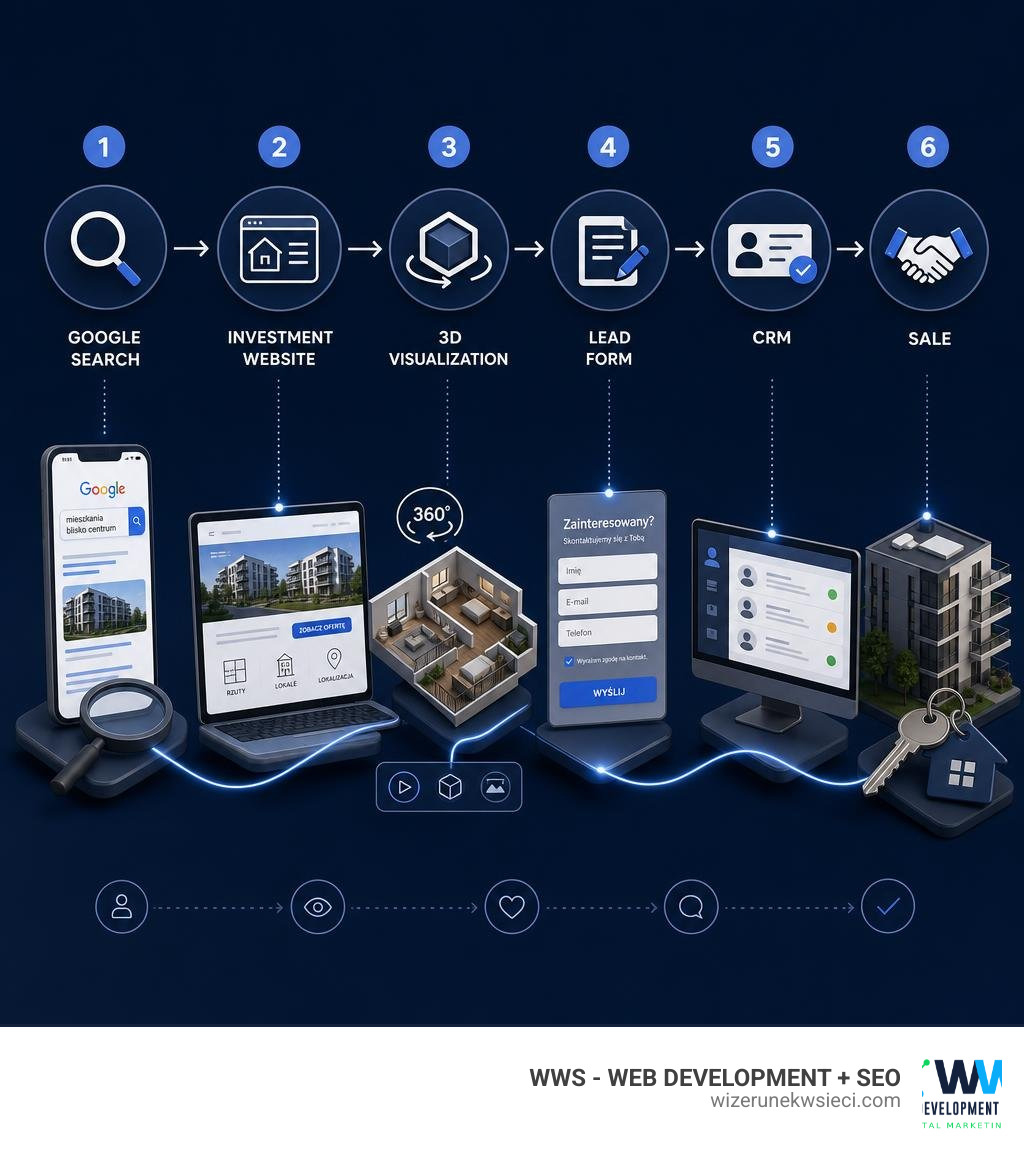
- Development website – a lead generation hub with floor plans, property search engines, and contact forms
- Google Ads and SEO – reaching buyers actively searching for apartments on Google
- Facebook and Instagram Ads – building interest and capturing leads from passive audiences
- 3D visualizations and virtual tours – presenting the development before the first building is even constructed
- CRM integration – automatic updates of property availability and lead management
- Listing portals (Zillow, Redfin) – a supplement to the strategy, not its foundation
- Content marketing and local SEO – a long-term source of organic traffic
Just a few years ago, it was enough to post an ad on a portal and put up a sign at the construction site. Today, that is definitely not enough.
Potential buyers start their search on Google. They browse visualizations, read reviews, and compare dozens of developments—before they even contact a sales representative. If your development does not appear where customers are looking, it simply does not exist in their decision-making process.
What’s more, buying real estate is one of the biggest financial decisions in a person’s life. Customers need time, information, and trust—all of which are built through a consistent online presence.
I am Tomasz Lasota, Director of Digital Development and Technology with over 22 years of experience in designing and implementing digital solutions—including digital marketing for developers (marketing internetowy dla deweloperów) strategies that combine UX, SEO, paid campaigns, and sales automation. In this guide, I will walk you through everything you need to successfully promote a real estate development in 2026.
Why digital marketing for developers is the key to success in 2026?
Nowadays, especially in highly competitive markets like Chicago, Des Plaines, or Illinois in general, traditional real estate sales methods are becoming obsolete. In the past, a developer’s success depended mainly on location and price. Today, in June 2026, the key factor determining the pace of selling out a development is how effectively you can tell its story online.
The customer buying process in the real estate market is long, complex, and full of anxiety. Buyers do not make impulse decisions. Before signing a development contract, they spend long hours analyzing available options. They look for information about the standard of finish, local infrastructure, and the developer’s credibility.
In this context, digital marketing for developers (marketing internetowy dla deweloperów) becomes the only tool that allows you to control this process from the first click to the key handover. Through well-thought-out activities, we build organic visibility that attracts users at an early stage of their search, as well as precise paid campaigns that generate high-intent leads. If you want to learn how to set up this process step-by-step, it is worth reading the Complete guide to real estate marketing, which discusses these mechanisms in detail.
Elements of an effective marketing strategy for real estate developments
Building a marketing strategy for a new residential development in Illinois is like planning the construction itself—without solid foundations, the whole thing will quickly collapse. An effective action plan must be based on three main pillars:
- Competitor and business environment analysis: Before launching the first ad, we must carefully analyze what other developers in the area (e.g., in the Des Plaines area or in specific Chicago neighborhoods) are offering. We study their strengths and weaknesses, pricing structure, and social media communication methods.
- Setting SMART goals: Our goals cannot be general. Instead of “we want to sell apartments,” we set measurable and time-bound goals—for example: “acquiring 150 qualified leads within the next 3 months” or “increasing organic traffic to the website by 40% by the end of the quarter.”
- Budget planning by stages: The marketing budget should be flexible and adapted to the phase of the development. In the pre-sale (pre-launch) phase, we invest more in building awareness and gathering the first inquiries, while in the active construction phase, we focus on performance campaigns.
By designing consistent Marketing Campaigns, we ensure that every dollar spent on advertising translates into real interest in the offer and completed contact forms.
Benefits of working with a specialized marketing agency
Many developers try to run marketing activities on their own or entrust them to people with no experience in the real estate industry. This is a costly mistake. The development industry has its own rules—the customer decision cycle takes months, and the cost per lead (CPL) can skyrocket with poor targeting.
Cooperating with a specialized agency, such as Wizerunek w Sieci (WWS), brings tangible benefits:
- Advertising budget savings: Thanks to precise targeting and knowledge of the specifics of the Chicago and Des Plaines markets, we avoid wasting budgets on worthless clicks.
- Industry experience: We know what arguments appeal to young families looking for their first home, and what works for investors buying rental properties.
- Conversion optimization: We constantly test different versions of landing pages, ad creatives, and forms to maximize the number of incoming inquiries.
By using professional resources, such as our Resources, developers gain access to proven templates and modern technologies that significantly accelerate the sales process.
Most effective channels and tools for real estate promotion
To reach today’s customer, we must operate multi-channel. Each of the available marketing channels plays a different role in the sales funnel:

- Google Ads: This is an unrivaled tool for capturing so-called hot demand. When a user types “new homes Des Plaines IL” or “condos for sale Chicago” into the search engine, they are already in the active search phase. Our ad must appear at the very top of the search results.
- Meta Ads (Facebook & Instagram): Perfect for building awareness and reaching people who might be interested in buying but haven’t started actively searching yet. Thanks to advanced targeting options in the Meta ecosystem, we can reach people who recently got married, are planning to expand their family, or are interested in interior design.
- Listing portals: Although they are an important supplementary element, they should not be the sole source of customer acquisition. On portals, your offer directly neighbors hundreds of others, forcing you to compete solely on price.
By running comprehensive Paid Campaigns, we combine these channels into one coherent ecosystem that constantly reminds people who have shown initial interest in your development (remarketing).
How to use SEO and digital marketing for developers to build visibility?
Paid campaigns bring immediate results, but their disadvantage is that they only work as long as you keep funding them. To build a stable, long-term source of free leads, organic search engine optimization (SEO) is essential.
In the real estate development industry, the key to success is so-called broad positioning, based on long-tail keywords. Instead of competing for very general and extremely expensive phrases like “apartments Chicago,” we focus on precise local queries, such as:
- “modern townhomes Des Plaines IL”
- “new apartments near Chicago subway station”
- “single family home developer Cook County”
As a result, we attract users with highly specific needs to the website, who are much closer to making a purchase decision. We offer professional services in this area, tailored to the local market, as part of our Website SEO packages.
Local SEO and Google Business Profile as a source of free leads
For developers carrying out projects in specific neighborhoods or satellite cities of the Chicago metropolitan area, local SEO is a key element of the strategy. Most clients want to live in a specific area, so their searches are highly geographical.
The foundation of activities in this area is the optimization of the Google Business Profile (formerly Google My Business). A well-managed profile allows you to appear in the so-called Google Map Pack—the top three local results presented directly on Google Maps.
To fully exploit this potential, it is worth taking care of:
- Up-to-date photos from the construction site and professional visualizations pinned to the profile.
- Collecting positive reviews from existing customers, which drastically increases trust in the developer’s brand.
- Accurate contact details consistent with the information on the website.
You can learn more about how to dominate local search results on our pages dedicated to Local SEO and the professional process of Google Business Profile Optimization.
The development website as a lead generation hub
A new development’s website is the most important salesperson in your company. This is where all users from social media ads, Google search, or listing portals land. If the website is slow, unclear, or not optimized for mobile devices (which account for over 60% of traffic today), a potential customer will leave it in a few seconds.
A modern developer website design must combine aesthetics with high functionality (UX/UI). Key elements that should be on the site include:
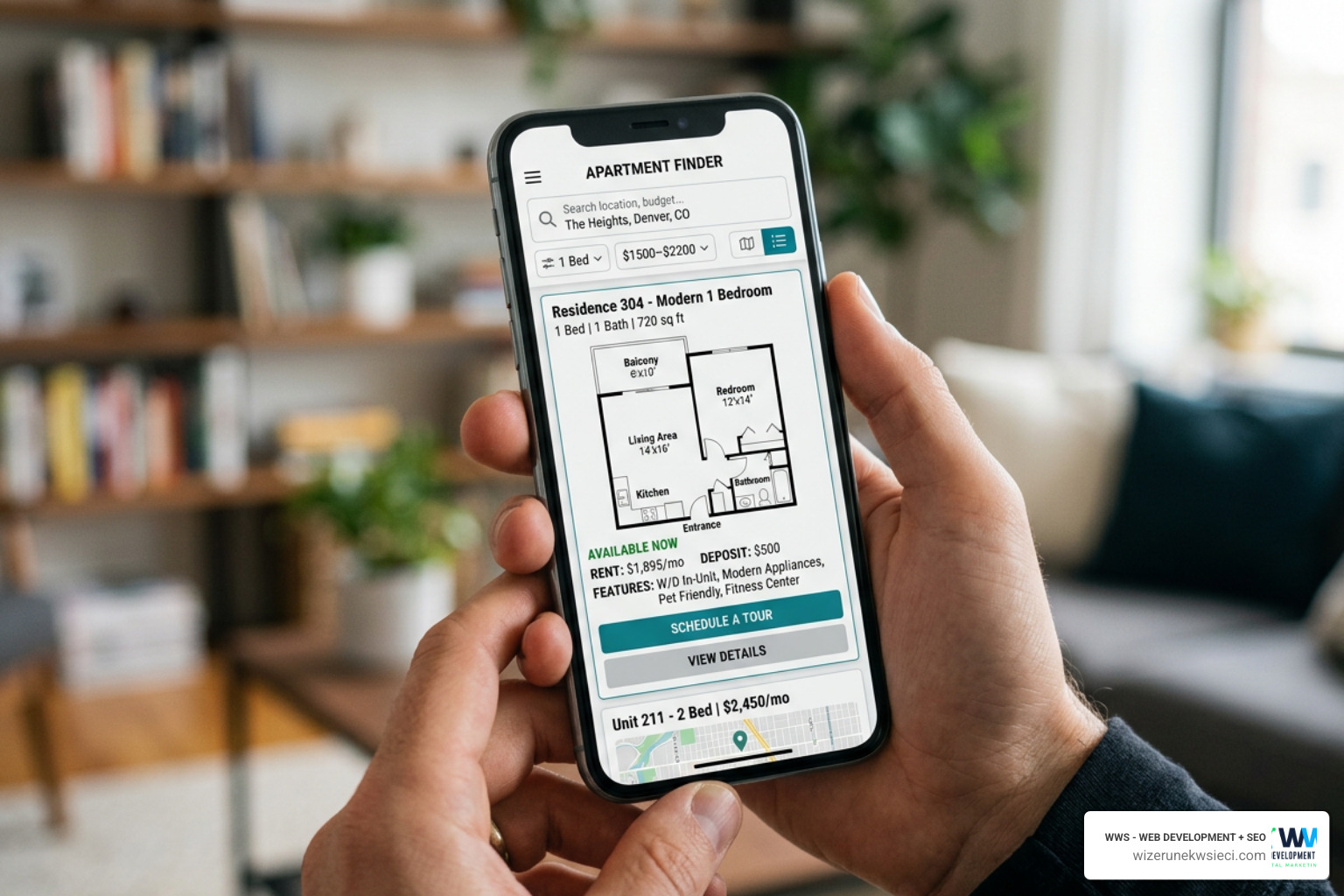
- Interactive property search engine: Allows users to filter offers by square footage, number of rooms, floor, or price.
- 3D floor plans and unit cards: Instead of complex technical drawings, customers prefer clear, three-dimensional floor plans that make it easy to visualize the layout of the rooms.
- Clear and visible CTA (Call to Action) buttons: Contact forms, the possibility of quick online booking, or a direct call button on mobile versions.
Creating such advanced tools is the domain of professional website design, which we write about on our Website Design page.
Integrating the website with a CRM system for developers
Running sales without an integrated CRM (Customer Relationship Management) system in 2026 is asking for chaos. When a client reserves an apartment, its status on the website should automatically change from “available” to “reserved.” Manually updating an Excel spreadsheet and later applying changes to the website is a waste of time and risks misleading customers.
Integrating the website with a CRM system allows for:
- Automatic offer updates: A change in the price or status of a unit in the CRM is immediately reflected on the website.
- Instant lead transfer: When a user fills out a contact form, their details, along with information about which specific apartment they are interested in, immediately go to the salesperson’s database, enabling quick phone contact.
- Customer journey tracking: We know exactly which ad (Google Ads, Facebook) a given customer came from, which allows us to optimize marketing budgets.
At WWS, we implement such advanced deployments and integrations as part of our App Development services.
Modern digital marketing for developers and the role of 3D visualizations and virtual tours
Selling a “hole in the ground” requires triggering the customer’s imagination. Few buyers can visualize their future living room based on a black-and-white architectural floor plan. That is why modern digital marketing for developers (marketing internetowy dla deweloperów) relies on advanced visual materials.
3D visualizations of building facades, the development’s surroundings, and sample furnished interiors are an absolute standard. However, in 2026, we go a step further by implementing 360° virtual tours and interactive estate models. Thanks to this, the client can “enter” a non-existent apartment, step out onto a virtual balcony, and check what view they will have from the window at different times of the day.
These modern forms of content marketing and video marketing drastically increase user engagement on the site, extend session times, and ensure that incoming inquiries are much more valuable.
Building trust, price transparency, and budget optimization
Real estate is an industry where trust is built over years and can be lost in a single moment. Customers are extremely sensitive to any signs of lack of transparency. In recent years, legal regulations (such as those regarding price transparency and consumer protection) have forced developers to be fully transparent with their offers.
Hiding apartment prices on the website and forcing customers to send inquiries just to find out the costs causes frustration and discouragement in 2026. Developers who play with open cards and state prices upfront build a much stronger market position and acquire leads with higher purchase intent.
Equally important is the optimization of the promotional budget itself. To find out how to effectively plan advertising expenses depending on the scale of the project, it is worth reading the analysis Marketing budget for a developer for 2026, which sheds light on a modern approach to campaign financing.
How to measure the effectiveness of activities and avoid the most common mistakes?
The biggest mistake developers make is evaluating marketing effectiveness solely through the prism of the number of leads acquired. A hundred cheap but low-quality inquiries (e.g., from people without creditworthiness) will bring less benefit than ten precisely selected contacts from genuinely interested buyers.
To measure campaign effectiveness, we use advanced analytical tools such as Google Analytics 4 (GA4). We track not only macro-conversions (sending a contact form) but also micro-conversions, such as:
- downloading a property brochure in PDF format,
- launching a virtual tour,
- spending more than 3 minutes on the interactive estate plan.
The table below shows the differences in the approach to advertising budget distribution:
| Area | Performance Marketing (Paid Campaigns) | Brand Building |
|---|---|---|
| Main goals | Quick lead acquisition, sale of specific units | Building trust, developer brand awareness |
| Main channels | Google Ads, Meta Lead Ads, Listing portals | SEO, Content Marketing, Social Media, PR |
| Time for results | Immediate (a few days from launch) | Long-term (from 3 to 12 months) |
| Measurability | Very high (exact cost per lead – CPL) | Medium (increase in direct inquiries, brand image) |
Frequently Asked Questions (FAQ)
Want to learn more about industry trends and news? We regularly publish expert articles in our Blog News section. Below we answer three of the most common questions from developers.
How much does marketing for developers cost in 2026?
The marketing budget should not be a fixed amount. It is usually planned as 2% to 5% of the total value of the investment being realized. For smaller projects (e.g., a development of several single-family homes in Des Plaines), monthly spending on paid campaigns can range from a few thousand dollars, while large multi-family projects in downtown Chicago require budgets of a dozen or tens of thousands of dollars per month to compete effectively in the market.
When is the best time to start promotional activities for a new development?
Marketing activities should start 3 to 6 months before the planned start of construction work. The pre-sale (pre-launch) phase allows you to build a database of interested parties, research market needs, and collect the first reservations, which often makes it easier for developers to obtain favorable bank financing for the construction.
How long do you have to wait for the first effects of search engine optimization (SEO) of a developer’s website?
SEO is a marathon, not a sprint. The first visible effects in the form of increased visibility for less competitive keywords usually appear after 3 to 6 months of intensive optimization and link-building activities. However, full dominance of local search results for key sales phrases requires systematic work over a period of 9 to 12 months.
Summary
Digital marketing for developers (marketing internetowy dla deweloperów) is not a one-time expense, but a key investment that directly translates into your company’s financial liquidity. A properly designed website, combined with precise Google Ads campaigns, SEO, and CRM automation, allows you to turn an empty construction site into a vibrant, fully sold-out residential community.
At Wizerunek w Sieci (WWS), we combine technology with data-driven marketing. Whether you are building luxury apartment buildings in Chicago or cozy single-family homes in Des Plaines, we will help you reach the right customers and optimize your sales costs.
Take the first step to fully selling out your development. Check out our offer and find out how we can help your business grow: Effective Website SEO for Developers.