



Does Your Social Media Really Sell Apartments?
Social media for developers is today one of the most effective channels to reach buyers — provided you know how to use them.
Here is a quick answer if you are looking for specific tips:
- Choose the right platforms — Facebook and Instagram for selling apartments, LinkedIn for investors, TikTok for younger groups.
- Create content that builds trust — 3D visualizations, virtual tours, customer reviews, education.
- Combine organic content with paid advertising — organic reach alone is not enough in 2026.
- Measure results — track leads, cost per acquisition, and conversions, not just likes.
- Tailor the message to the generation — Baby Boomers, Millennials, and Gen Z buy differently and look for different information.
You scroll through Facebook and see a beautiful photo of an apartment overlooking a park. You click. And then you stay — because the content answers your exact questions. That is exactly what a well-planned social media strategy does.
Meanwhile, many developers still publish only dry listings with prices. The result? Low engagement, few inquiries, and a wasted advertising budget.
The data speaks for itself: 58% of Poles look for shopping inspiration on social media, and 80% of companies using social media as a sales channel report revenue growth. This is not a coincidence — it is a strategy.
This guide will show you step-by-step how to build a social media presence that actually supports investment sales.
My name is Tomasz Lasota and for over 22 years I have been designing and implementing digital strategies for B2B and B2C companies — including comprehensive social media for developers activities that translate into measurable sales growth. At WWS, we combine technical knowledge with marketing practice so that your investments find buyers where they actually spend their time.
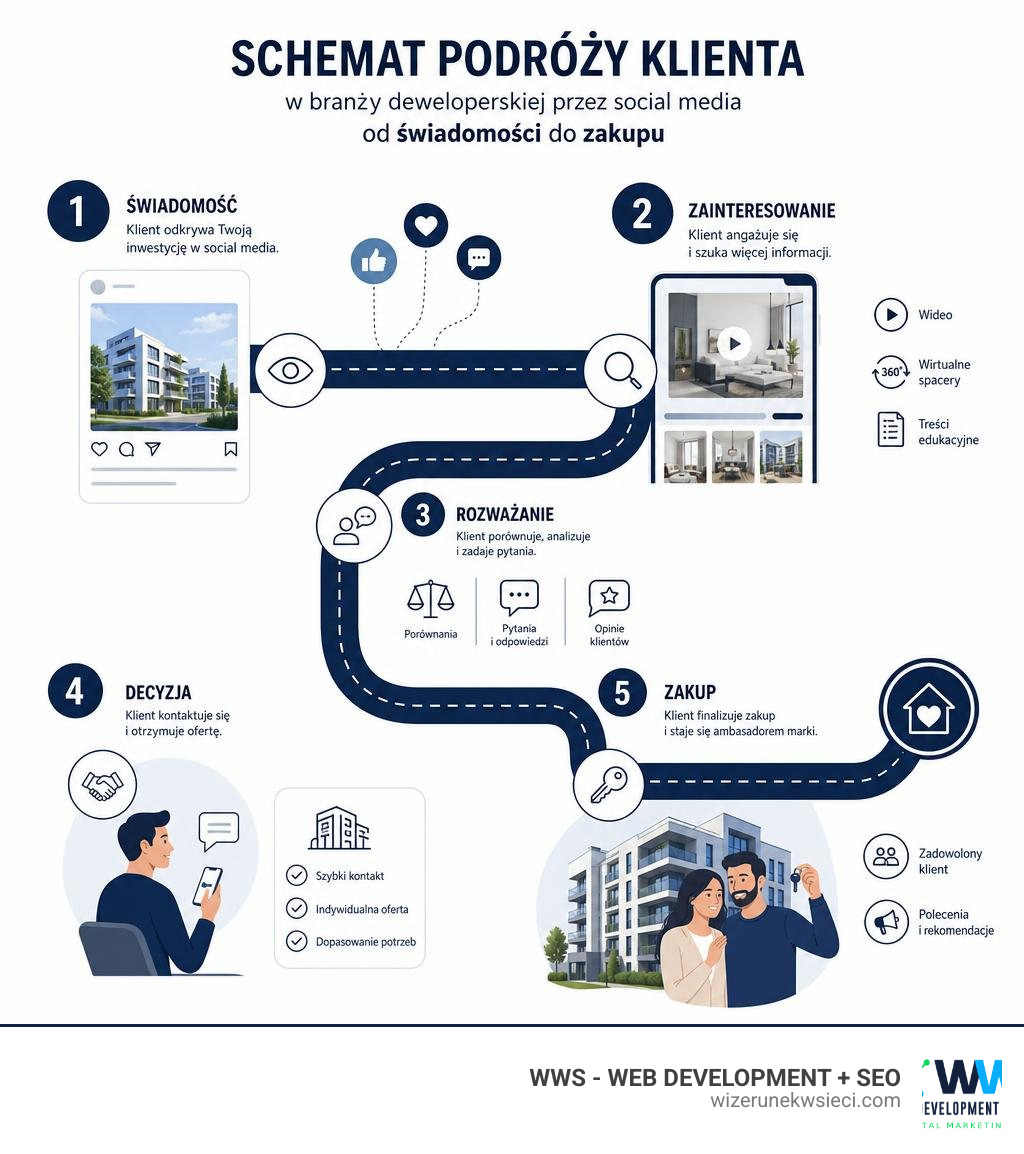
Why Professional Social Media for Developers is the Key to Success in 2026?
The days when selling apartments only required a banner on a construction fence and an ad on a real estate portal are long gone. In June 2026, buying an apartment is a process deeply rooted in the digital world. Customers do not just buy “four walls” – they buy a lifestyle, a sense of security, and the promise of a better future.
Professional Social Media allows developers to tell this story on their own terms. Instead of waiting for the customer to visit the sales office, we meet them where they spend an average of 2 hours and 27 minutes every day. Building a strong brand image online directly translates into customer trust. A developer who regularly shows construction progress, explains legal complexities, and answers questions becomes a reliable partner.

Sales statistics clearly show this shift: as many as 58% of Poles look for shopping inspiration on social media, and 80% of companies record revenue growth after implementing professional activities in these channels. If your company does not maintain consistent communication there, you are giving ground to the competition. A well-designed social media profile acts as a 24/7 interactive sales office that resolves customer doubts before they even pick up the phone.
Our agency, Wizerunek w Sieci (WWS), implementing projects for demanding markets in Chicago, Des Plaines, and throughout the state of Illinois, has repeatedly proven that combining an emotional message with hard analytical data is the shortest path to a quick sell-out of an investment.
How to Tailor Communication to Different Generations (Baby Boomers, X, Y, Z, Alfa)?
Effective generational targeting is key to budget optimization. Each age group has different buying archetypes, concerns, and content format preferences:
- Baby Boomers (born before 1965): They look for stability, financial security, and peace. In communicating with them, a traditional, respectful tone, longer posts explaining legal issues, and traditional visualizations work best. They are most active on Facebook.
- Generation X (1965–1980): These are pragmatists who often buy larger apartments for families or invest financial surpluses. They value concrete data: local infrastructure, material quality, and ROI analysis. They appreciate comprehensive posts on Facebook and professional analyses on LinkedIn.
- Generation Y (Millennials, 1981–1996): Currently the main group buying their first or second apartment. They look for a balance between private and professional life. They are interested in eco-friendly solutions, proximity to parks, and public transport. They buy “with their eyes” on Instagram, valuing aesthetic Stories and Reels.
- Generation Z (1997–2012): They are entering the rental and first-time buyer market. They are extremely sensitive to falsehood and “corporate jargon”. They expect authenticity, dynamic video (TikTok, Reels), and the developer’s commitment to social and environmental issues.
- Generation Alfa (from 2013): Although they are still children, they already influence their parents’ purchasing decisions (e.g., by evaluating playgrounds or recreation areas). It is worth considering their needs in branding materials, showing investments as child-friendly places.
The Role of Social Proof and Customer Reviews
In the real estate industry, where transactions amount to hundreds of thousands or even millions, trust is the most valuable currency. This is where social proof comes into play. Research shows that 66% of consumers trust online reviews, and up to 83% believe recommendations from friends.
For a developer, this means one thing: your own declarations of “highest quality” mean much less than a single sentence from a satisfied resident who has received their keys. It is worth regularly publishing reviews from Google and Facebook in the form of aesthetic graphics, recording short video testimonials with clients during apartment handovers, and showing case studies (e.g., how we helped a client navigate a difficult mortgage process). Such transparency builds powerful credibility that cannot be bought with any traditional advertising.
Which Social Media Platforms Are Most Effective for Developers?
You don’t have to be everywhere, but you must be where your customers are. Each social media platform plays a different role in the developer’s sales funnel. To make your decision easier, we have prepared a comparative summary:
| Platform | Main Target Group | Recommended Content Format | Role in the Sales Funnel |
|---|---|---|---|
| Generation X, Baby Boomers, Older Y | Posts with photos, links, live streams | Community building, education, lead generation | |
| Generation Y, Z | Reels, Stories, photo carousels | Building desire (visual), brand image | |
| B2B Investors, management | Expert posts, articles, market analyses | Acquiring investors, building personal brand of management | |
| TikTok | Generation Z, Younger Y | Dynamic video, ‘backstage’ from construction | Building awareness, reaching young buyers |
| YouTube | All groups | Long-form video, 3D tours, interviews, drones | Education, investment presentation, SEO |
When designing applications that support sales, it is worth remembering how important Social apps on Android and messengers | Android social | Android Developers are, as they facilitate direct contact with the customer using native mobile device features.
Facebook and Instagram as the Foundations of Apartment Sales
Facebook and Instagram are absolute must-haves in the real estate industry. Instagram is the perfect space to present the aesthetic side of an investment. Using Instagram Stories, we can show daily life on the construction site, organize quick polls (e.g., “Which bathroom design do you like more?”), or share exclusive materials available for only 24 hours. Let’s remember that up to 80% of users follow at least one business account – this is a huge opportunity to close the distance.
In turn, Facebook, thanks to the powerful Meta Business Suite tool, allows for precise scheduling of publications, managing messages from both platforms in one place, and running advanced advertising campaigns. This is where it is easiest to conduct discussions in the comments, build neighborhood groups, and educate customers using longer text forms.
LinkedIn and X (Twitter) in Acquiring B2B Investors
If your goal is to sell commercial premises, acquire business partners, or bulk-sell apartments for rent to funds, your activities must move to LinkedIn and the X platform.
On LinkedIn, we do not sell “pretty views”. Here, hard data matters: return on investment (ROI), local market analyses, construction progress reports, and the professional image of the management team. Sharing engineering knowledge, describing architectural challenges, and showing how we handle administrative processes builds the developer’s position as an expert.
Strategy and Paid Campaigns: How to Generate Leads That Buy?
Organic reach in social media is heavily limited by algorithms today. Without an advertising budget, your posts, even the most beautiful ones, will reach only a fraction of your fans. To succeed, you must design multi-stage sales funnels that combine branding activities with precise conversion-oriented campaigns.
At WWS, we believe in the synergy of actions. That is why our Marketing Campaigns always combine organic storytelling with advanced Paid Campaigns.

An effective campaign on Facebook, Instagram, or TikTok should be divided into three stages:
- Building awareness (Top of the funnel – TOFU): Video ads showing the location, prestige of the investment, and visualizations. Goal: reach the largest number of people in the selected location.
- Education and engagement (Middle of the funnel – MOFU): Carousel ads presenting floor plans of specific apartments, finishing standards, or invitations to Open House events. We target people who interacted with the first stage.
- Lead generation and closing sales (Bottom of the funnel – BOFU): Lead Ads (with a built-in contact form) or ads directing to a dedicated landing page. We use remarketing here, reaching people who visited the investment website but did not leave their contact details.
How to Plan a Social Media Budget for Developers?
Budget planning should not be a lottery. In the real estate industry, the key metric is Cost Per Lead (CPL) – the cost of acquiring one contact (phone or email) from a person interested in buying.
A well-planned budget should be divided in the following proportions:
- 70% for campaigns directly generating leads (Lead Ads, conversion campaigns on the website).
- 20% for branding and engagement campaigns (video promotion, educational posts, local reach).
- 10% for testing new formats (e.g., TikTok campaigns, cooperation with micro-influencers).
A high unit cost of a lead (e.g., $40-$50) in the real estate industry is completely acceptable if the quality of these contacts is high. With developer margins, selling just one apartment from a social media campaign can cover annual marketing expenses.
How to Measure Performance and Optimize Social Media for Developers?
You cannot manage what you do not measure. Forget about “vanity metrics” such as page likes or hearts under a photo. For a developer, what matters is:
- Number of acquired leads (completed forms).
- Cost Per Lead (CPL).
- Conversion rate (what percentage of website visitors leave their contact details).
- Customer Acquisition Cost (CAC) – how much advertising budget it cost us to lead to the signing of a development contract.
An essential tool for analytics is a correctly implemented Meta Pixel on your website with set events (e.g., clicking the ‘download floor plan’ button, sending a form).
When managing multiple profiles and analyzing messages, advanced integrations can be extremely helpful, such as Social Media API – retrieve, enrich and manage social media profiles with Unipile – Unipile , which allow for the aggregation of data and messages from various platforms into one central developer CRM system.
Modern Technologies and Content Formats in Investment Promotion
In June 2026, static photos of apartments are not enough to capture the imagination of buyers. Customers want to step into their future living room before the first foundations even appear on the construction site. Therefore, the use of modern 3D formats, virtual tours (VR), and spectacular drone footage showing not only the building itself but also its integration with the surrounding urban fabric is becoming the standard.
Video marketing dominates all algorithms. Short, dynamic forms (Reels, TikToks) showing the transformation of a construction plot from a “hole in the ground” to a luxury apartment building generate many times higher engagement than traditional posts.
Using AI, VR, and Chatbots in Customer Service Automation
Artificial intelligence and automation are a modern developer’s sales department’s best friends. Customers browse social media most often in the evenings and on weekends – when your sales representatives are resting. If a potential buyer sends an inquiry about apartment availability on Sunday at 10:00 PM and does not receive a response within a few minutes, they may lose interest.
The solution is intelligent chatbots on Messenger and Instagram. A programmed bot can:
- Welcome the customer and ask about their preferred size and number of rooms.
- Send links to matching apartment floor plans directly in the chat window.
- Suggest available dates and sign the customer up for a meeting with an advisor in the calendar.
Additionally, AI tools support us in creating consistent advertising copy and automating publications, which saves time and allows us to focus on direct work with the client.
The Role of Influencer Marketing and Micro-influencers
Cooperation with influencers in the real estate industry is not about sending free samples. It is a strategic partnership designed to show the lifestyle in a given location. Instead of big stars with millions of followers (who rarely reach a local audience), developers should focus on local micro-influencers (5-50k followers).
This could be a local parenting blogger who tests the nearby playgrounds and parks around your new family estate, or a well-known interior designer from your city who designs a sample arrangement of one of the apartments in your investment on their profile. Such cooperation carries a huge amount of authenticity and allows you to reach a highly engaged, niche community.
Most Common Mistakes Developers Make on Social Media and How to Avoid Them
Even with a large budget, it is easy to make mistakes that can damage the image of an investment. Here are the most common sins of developers on social media:
- Lack of consistency: A profile where the last post appeared three months ago looks abandoned. This raises anxiety among customers about whether construction is actually still ongoing. The solution is to create a publication schedule at least two weeks in advance.
- Monotony of content (only “buy now”): A developer’s profile is not a billboard. Apply the 80/20 rule – 80% of content should be education, interesting facts, construction progress, and lifestyle, and only 20% direct sales.
- Ignoring or deleting difficult comments: Construction is a living organism; sometimes delays or defects occur. Deleting negative reviews is the easiest way to a PR disaster. Always respond substantively, calmly, and invite the user to a private contact to resolve the issue.
- Lack of local optimization: People buy apartments because they are connected to a specific location. Neglecting local positioning and geographic targeting in ads is a waste of budget. In this context, it is also worth taking care of Local SEO so that your sales office and investments are easy to find on Google Maps.
Frequently Asked Questions about Social Media for Developers
Does a developer have to have a TikTok profile?
They don’t have to, but it is definitely worth considering in 2026. TikTok has stopped being a platform just for teenagers. Currently, the fastest-growing user group there is people aged 25-34 – the ideal candidates for buying their first apartment. Dynamic, short video forms (e.g., “3 things you must pay attention to when receiving your keys” or a quick tour of a show apartment) generate huge organic reach there, which is only a dream on Facebook.
How to react to negative comments and crises on social media?
The key is professionalism, speed, and no emotions. Never get into arguments or attack the customer. Apply the rule: respond publicly once (showing other users that you do not ignore the problem), and then move the conversation to a private channel (email, phone). Example response: “We care about resolving this situation. Please contact us at office@developer.com or by phone… We will gladly look into the matter and help resolve it.”
Is organic reach on Facebook enough to sell apartments?
Unfortunately, no. Nowadays, without paid advertising campaigns (Meta Ads), you will only reach a fraction of the people who already like your profile. Paid advertising allows you to precisely reach people who, for example, recently got married, browse real estate portals, live within 10 km of your investment, and have appropriate financial capabilities. Paid campaigns are the driving force of sales, while the organic profile serves to verify your credibility once the customer has already found you.
Conclusion
Effective social media for developers is not a matter of chance or one-off efforts. It is a well-thought-out, long-term marketing and sales machine that combines trust-building with precise analytics and modern technology. A properly selected platform, tailored generational communication, engaging video formats, and wisely planned paid campaigns can shorten the investment sales time by long months.
As the Wizerunek w Sieci (WWS) agency, with offices in Chicago, Des Plaines, and across the state of Illinois, we have been helping local brands and developers build a strong position on the Internet for years. We know how to combine an aesthetic presentation of real estate with a technical advertising edge and effective Website SEO. Our goal is not empty “likes”, but real inquiries that turn into signed reservation agreements.
Don’t let your competition take over customers on social media.
Consult your strategy with WWS experts and start building an engaged community around your investments today!