


Why Search Engine Positioning Determines Who Gets the Leads
Search engine positioning is the practice of optimizing a specific page on your website to rank as high as possible in Google’s results for a target keyword.
Here’s a quick summary of what it is and why it matters:
- What it is: Improving where one page ranks for one keyword in search results
- How it differs from SEO: SEO improves your whole website over months; positioning focuses on a single page, often with faster results
- Why it matters in 2026: The top 3 results capture 54.4% of all clicks — positions below that get very little traffic
- Who it’s for: Any business that wants more calls, leads, or sales from Google
- How to do it: Find pages already close to page one, match search intent, tighten your content, and strengthen internal links
The stakes are high. The #1 result alone gets 27.6% of all clicks. The result sitting in position 10 gets just 2.4%. Moving up even one spot can improve your click-through rate by 30%.
And in 2026, it’s gotten harder. Google now shows AI-generated answer boxes on roughly 40% of informational searches. When one of those appears, the top organic result loses about 58% of its clicks. If your page isn’t near the very top — or quoted inside that AI box — it might as well be invisible.
For local service businesses, this isn’t abstract. Every ranking point you’re missing is a potential customer calling your competitor instead of you.
I’m Tomasz Lasota, Digital Development and Technology Director with over 22 years of experience building and optimizing digital products, and search engine positioning has been central to the growth strategies I’ve led for both B2B and B2C clients. In the sections below, I’ll walk you through exactly how it works and what you can do right now to improve it.
What is Search Engine Positioning?
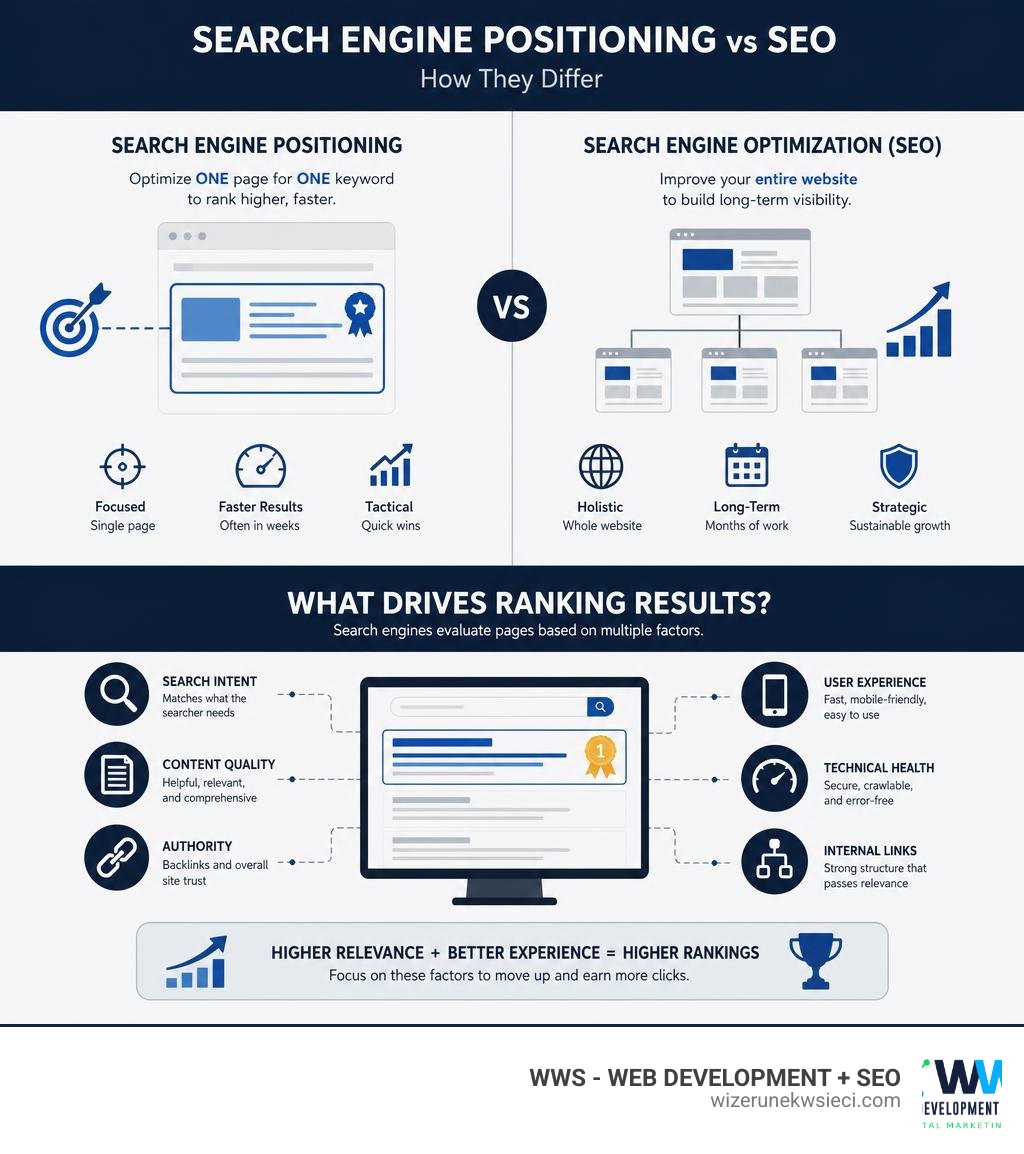
To win the game, we first have to understand the rules. Search engine positioning (often called SEO positioning) is the tactical, page-level discipline of optimizing a specific URL to secure a premium ranking position on search engine results pages (SERPs) for a highly targeted search term.
While broad SEO sets up the playing field, search engine positioning is the surgical strike. It doesn’t look at your entire site architecture; it looks at one page, one keyword, and the exact steps required to push that page past its immediate competitors.
To help clarify this distinction, let’s break down how search engine positioning differs from traditional, site-wide SEO:
| Feature | Search Engine Positioning | Traditional SEO |
|---|---|---|
| Primary Focus | Specific page-level URLs and target keywords | Site-wide authority, crawlability, and indexing |
| Scope of Work | On-page content alignment, contextual internal links, and snippet CTR | Site architecture, global backlink profiles, and XML sitemaps |
| Speed to Results | Days to weeks (for existing pages in positions 5–15) | 4 to 12 months (according to Google’s official estimates) |
| Core Metric | Exact ranking position, click-through rate (CTR), and AI citations | Organic traffic volume, domain authority, and total indexed pages |
By treating search engine positioning as a distinct practice, we can achieve rapid, measurable wins. Google ranks individual URLs, not entire websites. When you optimize on a surgical, page-by-page basis, you align directly with how Google’s crawling and indexing pipeline evaluates relevance.
Search Engine Positioning vs. Traditional SEO
Confusing search engine positioning with general SEO is one of the most common mistakes we see in digital marketing. Think of traditional SEO as building and maintaining a highway system. You need to make sure the roads are paved (technical SEO), the signs are clear (information architecture), and the bridges are secure (site-wide authority).
Search engine positioning, on the other hand, is like driving a high-performance sports car to a specific destination as fast as possible. It is a highly focused subset of SEO. While you absolutely need the foundation described in Google’s official SEO Starter Guide to get indexed, positioning is where strategy meets immediate rank movement.
If you already have a solid foundation through our comprehensive Website SEO services, positioning is the logical next step. It allows us to target specific service pages—such as those for local businesses in Des Plaines or Chicago—and elevate them to the top spots where the actual phone calls happen.
Search Engine Positioning vs. Search Engine Marketing (SEM)
Another common point of confusion is the relationship between search engine positioning and Search Engine Marketing (SEM). While both aim to capture real estate on the SERPs, they do so through entirely different mechanisms.
SEM relies on paid search campaigns (like Google Ads). It is a pay-to-play model. You bid on keywords, and Google displays your ad at the top of the page. The moment you stop paying, your visibility drops to zero.
Search engine positioning focuses purely on organic search. While it requires an upfront investment of time and expertise, it offers unmatched cost efficiency and traffic sustainability. Once you secure a top-three organic position, that page continues to drive highly qualified leads day and night without a recurring cost-per-click. It becomes a semi-permanent business asset.
Why Search Engine Positioning Matters in 2026
The search landscape in July 2026 is vastly different from what it was just a few years ago. We are no longer competing in a simple world of ten blue links. Today’s SERPs are dynamic, visual, and heavily influenced by generative artificial intelligence.
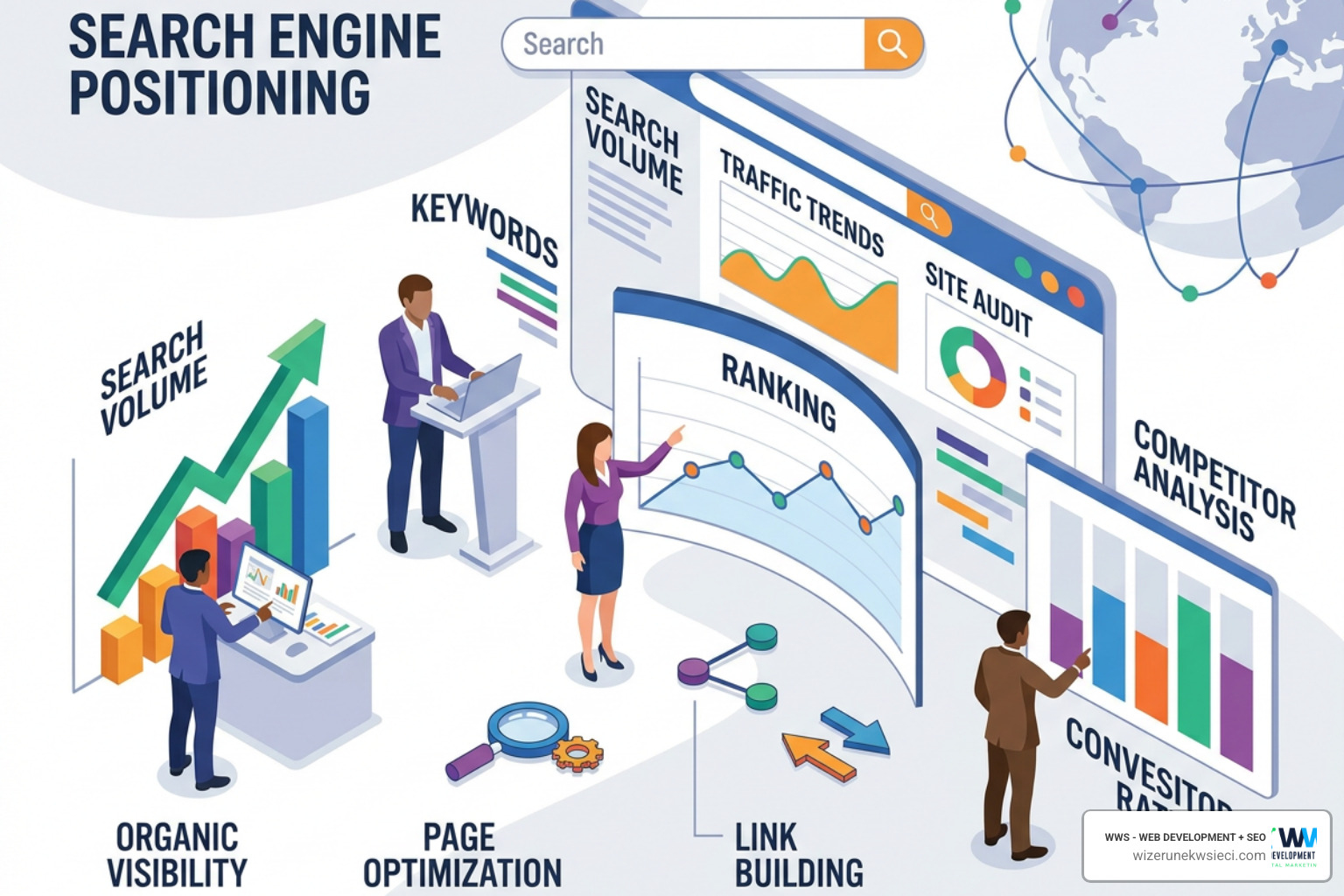
In this environment, simply “ranking on page one” is no longer a viable business goal. If your page is sitting at position 8, it is buried beneath AI summaries, local map packs, sponsored ads, and video grids. By late 2025, zero-click searches accounted for nearly 65% of all Google searches. In 2026, that number has crept even higher, meaning that the clicks that do remain are concentrated almost entirely at the absolute top of the page.
The Impact of AI Overviews and SERP Features
Google’s AI Overviews now appear on roughly 40% of informational queries in U.S. search results. This has completely rewritten the playbook for organic click-through rates. When an AI Overview is present:
- The traditional #1 organic result loses approximately 58% of its clicks.
- Overall click-through rates across the entire SERP drop by roughly 61%.
However, this challenge also presents a massive opportunity. Brands that are cited and quoted directly inside these AI Overviews receive 120% more clicks per impression than brands that are left out.
Interestingly, you don’t have to be a multi-billion-dollar brand to win these citations. A recent industry study revealed that only 38% of the pages Google quotes in an AI Overview also rank in the top 10 for that search. This means that with precise, structured content optimization, smaller local businesses can leapfrog giant competitors and claim the ultimate “position zero.”
Maximizing SERP Real Estate
To win in 2026, our goal is to dominate as much physical space on the screen as possible. This means optimizing not just for a single blue link, but for multiple SERP features simultaneously.
By structuring your pages correctly, you can rank in the traditional organic results, secure a spot in the “People Also Ask” dropdowns, appear in local map packs through Local SEO optimization, and earn rich snippets with customized star ratings or pricing tables.
For local service providers in Illinois, capturing this real estate is the difference between stagnation and explosive growth. By structuring your digital presence to target localized search intent, you can ensure your business stands out to high-intent customers right when they are ready to buy.
Key Ranking Factors Influencing Search Engine Positioning
Google uses over 200 ranking signals to determine which pages deserve the top spots. However, trying to optimize for all 200 at once is a recipe for paralysis. In our decades of experience, we have found that focusing on three core pillars yields 95% of the results.

Content Relevance and Search Intent
The single most important ranking factor is aligning your page’s content with the user’s search intent. Google’s primary mission is to provide the absolute best answer to a user’s query. If a user searches for “how to fix a leaky pipe,” they want a step-by-step guide; if they search for “plumber near Des Plaines,” they want a service page with a fast contact form.
To achieve superior search engine positioning, you must:
- Analyze the SERP: Look at the top 3 results for your target keyword. Are they blogs, product pages, or local landing pages? Your page must match this format.
- Prioritize E-E-A-T: Google’s Quality Raters heavily prioritize Experience, Expertise, Authoritativeness, and Trustworthiness. Include author bios, real-world case studies, and verifiable data.
- Write Answer-First Content: Place a direct, concise answer to the user’s query in the first 150 words of your page. This makes it incredibly easy for both human readers and Google’s AI crawlers to extract.
For detailed guidelines on structuring your content for maximum search engine compliance, you can explore the academic resources provided by the SEO: Search Engine Optimization Tips – Illinois Extension .
Technical Foundations and Core Web Vitals
You can have the most brilliant content in the world, but if your page takes five seconds to load on a mobile phone, Google will push you down the rankings. User experience is a critical, direct ranking factor.
We pay close attention to Google’s Core Web Vitals, specifically:
- Interaction to Next Paint (INP): This metric, which officially replaced FID, measures how quickly your page responds when a user clicks a button or taps a link.
- Cumulative Layout Shift (CLS): This measures visual stability. If your text jumps around while images are loading, it creates a frustrating experience that drives users away.
The math here is simple: the probability of a bounce increases by 32% as page load time goes from 1 second to 3 seconds. We ensure that our clients’ sites are built on clean, high-performance frameworks—which is why we specialize in lightning-fast Website SEO development.
How to Improve Your Search Engine Positioning: A Step-by-Step Playbook
Now let’s get practical. If you have pages that are currently languishing on page two of Google (positions 11–20) or stuck at the bottom of page one (positions 7–10), this step-by-step playbook is designed to push them into the top-three sweet spot.
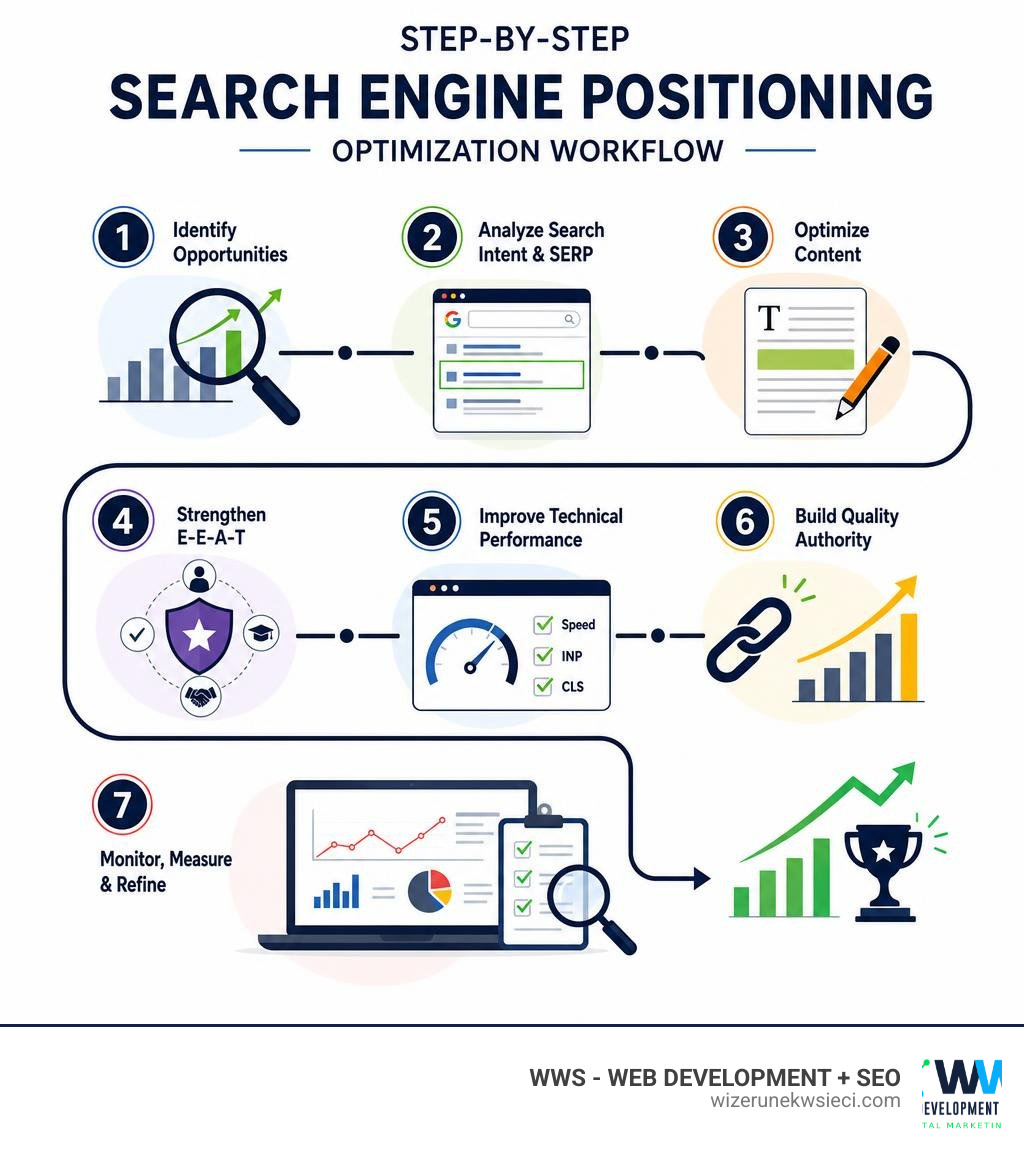
Step 1: Identify Near-Win Opportunities
The fastest way to grow your organic traffic is not by writing fifty new blog posts. It is by finding the pages you already have that are almost winning, and giving them the push they need.
- Open your Google Search Console (GSC) account.
- Navigate to the Performance report and set the date range to the last 28 or 90 days.
- Filter your queries by Average Position and look for keywords ranking between 5 and 15.
- Sort these queries by Impressions.
These are your “near-win” opportunities. They already have search volume, and Google already views your page as highly relevant. Moving a page from position 8 to position 3 can easily quadruple your organic traffic overnight.
Step 2: Optimize On-Page Elements and Internal Linking
Once you have selected your target page and its primary keyword, it’s time to execute surgical on-page optimizations:
- Optimize the Title Tag: Ensure your exact target keyword is placed within the first 60 characters of your title tag. Make it compelling to drive a higher click-through rate.
- Write a Magnetic Meta Description: Keep it around 105–120 characters, include your primary keyword, and end with a clear call-to-action (e.g., “Get a free quote today!”).
- Harness Internal Link Equity: Find high-authority pages on your own website (like your homepage or major guide pages) and add contextual internal links to your target page. Use descriptive, natural anchor text (e.g., “expert Local SEO strategies”) rather than generic phrases like “click here.”
- Leverage Local Entity Signals: If you are a local service business in Illinois, ensure your page is tightly integrated with your Google Business Profile Optimization strategy.
If you are operating in highly competitive local markets, partnering with localized specialists can give you a significant edge. Working with an experienced local agency ensures your technical parameters, schema markup, and local landing pages are perfectly tuned to dominate the northwest suburbs and the greater Chicago area.
Frequently Asked Questions about Search Engine Positioning
How long does it take to see results from search engine positioning?
Unlike site-wide SEO campaigns that can take four months to a year to bear fruit, page-level search engine positioning often yields results much faster. If you are optimizing an existing page that is already indexed, Google will typically recrawl the page within a few days to a couple of weeks. Once the changes are processed, you can often see positive rank movement in your tracking tools within 14 to 30 days.
Can a page rank in AI Overviews without ranking in the top 10?
Yes, absolutely. Google’s generative AI engine operates on semantic modeling and entity extraction rather than traditional backlink-based authority. If your page provides a direct, highly structured, and authoritative answer to a specific question, Google may cite you in an AI Overview even if your page sits on page two of the traditional organic results. This is why “answer-first” formatting is so critical in 2026.
How do you measure search engine positioning performance?
We recommend tracking four primary key performance indicators (KPIs) inside Google Search Console and your analytics dashboard:
- Average Position: Is your target URL consistently moving upward for your primary keyword?
- Impressions: Are you appearing in more searches, including AI Overviews and rich snippets?
- Click-Through Rate (CTR): Are your title and meta description optimizations successfully convincing users to click?
- Conversions: Are these clicks turning into phone calls, contact forms, or booked appointments?
Conclusion
In the hyper-competitive digital landscape of 2026, search engine positioning is no longer an optional luxury—it is the direct line to your business’s growth. Winning the top spots on Google requires a surgical, disciplined approach that combines high-quality content, robust technical foundations, and a deep understanding of modern SERP features.
At Wizerunek w Sieci (WWS), we specialize in turning search visibility into real, measurable business revenue. We build beautiful, high-performance websites and run integrated SEO, Google Ads, and social media campaigns specifically designed to generate qualified leads for local service businesses in Des Plaines, Chicago, and throughout Illinois. Our unique value proposition is simple: we deliver measurable growth through conversion-focused strategies that put your business exactly where your customers are looking.
Ready to claim your spot at the top of the search results? Let’s discuss how we can elevate your rankings, capture more leads, and grow your business. Explore our premium Website SEO Services and let’s start positioning your brand for victory today.