





The fastest way to win local search as a dental practice is to treat your Google Business Profile as the primary marketing asset, then fix five on-site issues that quietly block rankings. Google Business Profile signals drive roughly 32% of Local Pack ranking weight, with reviews contributing another 24%, and the Local Pack captures most clicks on “dentist near me” searches. Everything else in dentist SEO matters, but it matters less.
Start here, this week:
- Claim and fully complete your Google Business Profile, including services and booking links.
- Fix any name, address, or phone (NAP) mismatches across your website and directory listings.
- Ask five recent patients for a Google review before the week ends.
- Add schema markup to your homepage and top two service pages.
Pro Tip: Do the Google Business Profile work first. It compounds faster than any blog post you’ll write this quarter.
Key Takeaways
Dentist SEO succeeds when Google Business Profile optimization, technical fixes, and steady review growth happen in that order, measured by calls and bookings rather than rankings alone.
| Point | Details |
|---|---|
| Google Business Profile comes first | GBP signals account for roughly 32% of Local Pack ranking weight, more than any single other factor. |
| Fix technical issues early | Slow load times, redirect chains, and index errors block rankings regardless of content quality. |
| Review velocity beats review count | A steady monthly flow of new reviews often outranks a large, stale backlog. |
| Measure bookings, not impressions | Track calls, direction requests, and completed appointments to prove real ROI. |
| Wizerunekwsieci sequences the work | The agency prioritizes GBP and technical fixes first, then content and reviews, based on over 200 client partnerships. |
Table of Contents
- Your 30-Day Dentist SEO Checklist
- Google Business Profile: Your Highest-Leverage Local Asset
- On-Page SEO: Service Pages That Convert and Rank
- Technical SEO Basics That Quietly Block Rankings
- What Content Actually Attracts Local Patients
- Reviews and Reputation: The Ranking Signal Patients Actually See
- Citations and Local Links That Build Trust
- How to Track Whether Dentist SEO Is Actually Working
- What Dental SEO Costs and How Long Results Take
- DIY or Hire an Agency: Deciding What Fits Your Practice
- Turning Search Traffic Into Booked Appointments
- Voice Search and Mobile: How Patients Actually Search Today
- Social Media’s Role in Local Dental SEO
- Watching What Competing Practices Do Right
- How Wizerunekwsieci Helps Dental Practices Win Local Search
- Frequently Asked Questions
- Sources
Your 30-Day Dentist SEO Checklist
You don’t need a year-long roadmap to see movement. You need four focused weeks.
- Week 1: Complete your Google Business Profile (categories, hours, booking link, services menu) and correct NAP data everywhere it appears online.
- Week 2: Rewrite or build your top five service pages (Invisalign, implants, emergency care, cleanings, cosmetic dentistry) around one keyword each.
- Week 3: Run technical fixes: compress images, resolve redirect chains, confirm mobile rendering.
- Week 4: Launch a review request system and pitch two local backlink opportunities.
Pro Tip: Put one staff member in charge of sending review requests at checkout. Ownership beats good intentions every time.
By week two, expect a bump in Search Console impressions. By week four, look for more phone calls and a steadier trickle of new reviews.
Google Business Profile: Your Highest-Leverage Local Asset
Local Pack rankings run on three pillars: relevance, distance, and prominence. You can’t move distance, but relevance and prominence respond directly to how completely you manage your Google Business Profile. This single listing outweighs almost every other local SEO for dentists tactic, which is why it comes first, not last, in any sound dental practice SEO plan.
Start with the fields Google weighs most heavily:
- Primary category set to “Dentist” or the specific specialty (orthodontist, pediatric dentist).
- A services menu populated with individual procedures, not a generic “General Dentistry” catch-all.
- Accurate, holiday-adjusted business hours.
- A direct booking link, not just a phone number.
- Fresh photos of your office, staff, and equipment, uploaded monthly.
- An active Q&A section you seed and answer yourself.
Listing many specific services with detailed descriptions expands the queries your profile can match, which matters for niche searches like “Invisalign cost” plus your city name. Watch GBP Insights for a rise in “requested directions” and “calls,” not just profile views. Those two metrics track patients who are close to booking.
On-Page SEO: Service Pages That Convert and Rank
Each service page should target one primary keyword, whether that’s “dental implants” or “same-day crowns,” and run 800 to 1,500 words covering candidacy, the procedure, recovery, and a realistic cost range. Thin, template pages rarely rank and rarely convert.
Structured data helps search engines understand what they’re reading. Apply the Dentist schema type to your homepage, Service schema to individual procedure pages, and FAQPage schema to any page answering patient questions. Person schema on your team page adds credibility signals search engines can parse directly.
- One keyword, one page, no overlap between similar services.
- Transparent cost ranges instead of “contact us for pricing.”
- Real photos of your office and clinicians, not stock imagery.
- A visible booking CTA above the fold and repeated at the bottom.
Pro Tip: List your dentists’ credentials directly on the service page they’re most associated with. Patients researching implants want to know who’s placing them.
Technical SEO Basics That Quietly Block Rankings
A beautiful website that loads slowly or breaks on mobile won’t rank, no matter how strong the content is. Run these checks before touching anything else on the technical side:
- Core Web Vitals scores in PageSpeed Insights, particularly Largest Contentful Paint under 2.5 seconds.
- Mobile rendering, since most patients search for dentists on a phone.
- Redirect chains and broken links, which waste crawl budget.
- One canonical version of your domain (https, with or without www, never both).
- Index coverage errors flagged in Google Search Console.
A site with duplicate URLs from an unresolved https/www redirect is effectively competing against itself for the same rankings. Google has to choose one version, and it often chooses the weaker one.
A technical SEO audit catches most of these issues in under an hour, which makes it one of the highest-return tasks on this entire list.
What Content Actually Attracts Local Patients
Dental SEO in 2026 rests on four pillars: technical foundation, on-page optimization, content authority, and topic clusters. Content is where authority gets built, but only if it answers what patients actually search for.
Prioritize three content types: core service pages, local modifier pages when your practice genuinely serves multiple neighborhoods, and educational posts answering specific patient questions. Strong dental content ideas include modifiers like “cost,” “emergency,” “open Saturday,” and “for kids,” each of which signals a different intent than the base keyword.
- “Emergency dentist open now [city]”
- “Invisalign cost [city]”
- “Pediatric dentist near [neighborhood]”
- “Dentist open Saturday [city]”
For FAQ pages, answer the question in the first two sentences, then expand with detail. This structure feeds AI Overviews, which increasingly quote concise, verifiable answers over long-winded explanations.
Do dentists need a blog for SEO? Yes, if it answers real patient questions instead of generic industry news. A single post titled “What Does a Root Canal Cost Without Insurance?” often outperforms a dozen vague articles.
How often should a dental practice publish content? Monthly is sustainable for most single-location practices; quality and search intent matter more than frequency.
Reviews and Reputation: The Ranking Signal Patients Actually See
Review velocity, the steady pace of new reviews, tends to matter more than total review count. A practice with 40 reviews trickling in monthly often outranks one with 300 reviews frozen since 2022.
- Send a review request via text or email within 24 hours of the appointment.
- Use a direct Google review link, not a generic “leave us feedback” page.
- Train front-desk staff to mention reviews naturally at checkout.
Never offer incentives for reviews, never filter which patients get asked based on likely sentiment, and always respond publicly and professionally to negative reviews. Google penalizes review gating, and patients notice defensive responses. A tool like the free Google Reviews app can simplify the request process without crossing policy lines.
Citations and Local Links That Build Trust
Inconsistent business information across directories confuses both patients and Google. Audit your name, address, and phone number across the top dental and general directories, and correct every mismatch you find.
- Cross-check listings on Google, Yelp, Healthgrades, and Zocdoc for consistency.
- Pursue links from your local chamber of commerce, dental society, or a sponsored community event.
- A local news mention, even a small one, tends to carry more trust weight than a paid directory listing.
Keeping authoritative data consistent across feeds mirrors how larger healthcare organizations maintain machine-readable provider records for accuracy. Track your citation consistency quarterly using a spreadsheet or a citation tool, since drift happens quietly and adds up.
How to Track Whether Dentist SEO Is Actually Working
Rankings alone don’t pay the bills. Booked patients do. Four tools cover almost everything you need: Google Analytics for site behavior, Google Search Console for search visibility, GBP Insights for profile-level engagement, and call tracking or UTM-tagged booking links for attribution.
Focus your monthly report on outcomes, not vanity metrics:
- Calls generated directly from your Google Business Profile.
- Direction requests, a strong proxy for near-term visit intent.
- Completed bookings through your website’s appointment form.
- Cost per new patient, calculated from ad spend plus SEO investment against new patient count.
The most useful local SEO reporting frameworks measure actions like calls and bookings rather than keyword position alone, since a page-one ranking that generates zero calls isn’t doing its job. Build your dashboard around what a front-desk team can verify: did the phone ring more this month than last?
What Dental SEO Costs and How Long Results Take
Pricing bands vary by scope. Small technical fixes and a Google Business Profile cleanup often run as a limited one-time project. An ongoing local SEO retainer, covering content, citations, and reviews, typically runs monthly. A full site rebuild costs more upfront but resets a weak technical foundation.
- Google Business Profile improvements can show ranking movement within weeks.
- Map Pack placement gains usually take a few months of consistent work.
- Organic content authority, especially for competitive keywords, often takes six to nine months to mature.
Be wary of unusually cheap offers promising fast rankings. If your profile has been neglected for years, expect the first month or two to focus on cleanup rather than growth.
DIY or Hire an Agency: Deciding What Fits Your Practice
Some tasks fit comfortably inside a busy front desk’s schedule. Others need dedicated time your staff simply doesn’t have.
| Task | Best Handled By |
|---|---|
| Basic GBP updates (hours, photos) | In-house |
| Review request process | In-house |
| Technical fixes (speed, schema, redirects) | Agency |
| Service page content clusters | Agency or in-house with SEO guidance |
| Local link building and outreach | Agency |
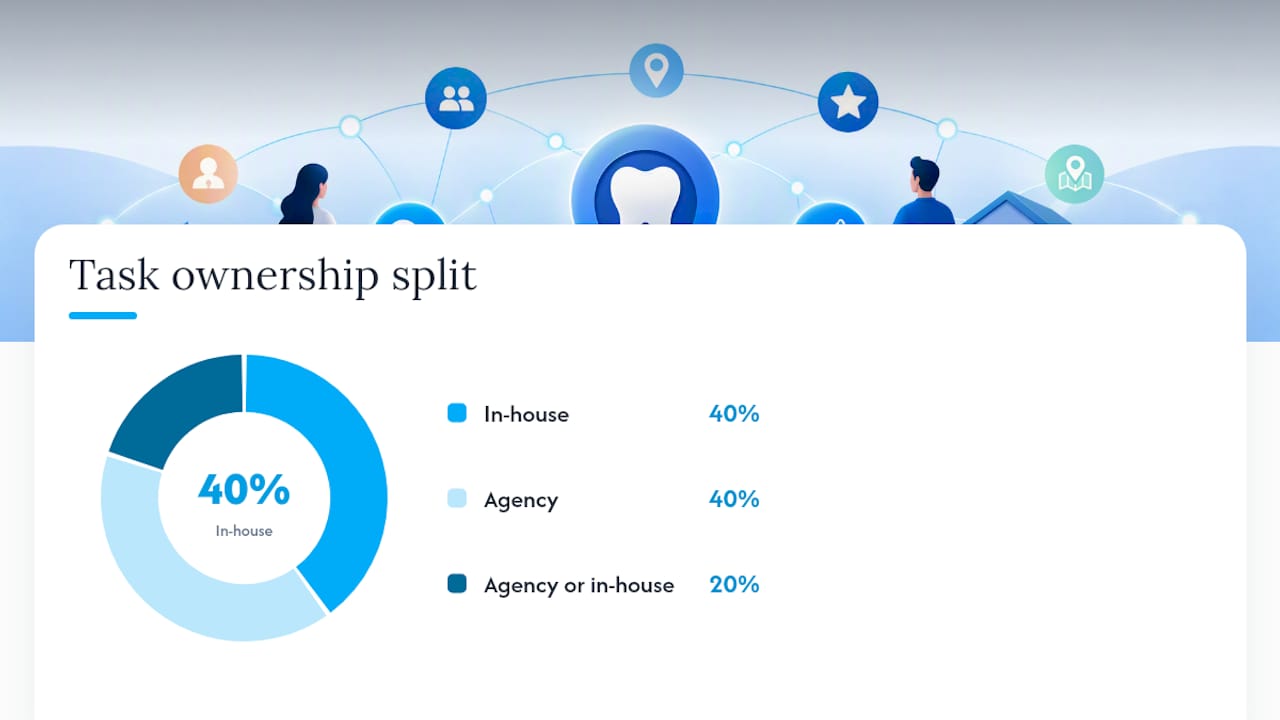
Hire outside help if your team has no time for consistent updates, your profile has been suspended more than once, or technical issues linger for months without resolution. When evaluating an agency, ask for clear deliverables, direct access to your own accounts, defined KPIs, and real case studies rather than vague promises.
A Real Result: Des Plaines Dental Studio
A neglected Google Business Profile and inconsistent citations were holding back a single-location dental practice near Chicago. Targeted GBP optimization, rebuilt service pages, and a structured review campaign followed.
- Baseline: low review count, incomplete GBP, thin service pages.
- Interventions: full GBP rebuild, five new service pages, review velocity campaign.
- Result: a measurable increase in monthly calls and Local Pack visibility within months.
Read the full Des Plaines Dental Studio case study for the complete breakdown.
Turning Search Traffic Into Booked Appointments
Ranking well means nothing if the booking process loses patients along the way. A visitor who lands on your implant page and has to hunt for a phone number, or worse, call during business hours only, often leaves for a competitor with an online scheduler.

Put a booking link directly on your Google Business Profile, not just a phone number. Google increasingly favors profiles with functional appointment links, and patients researching dental work outside office hours need a way to act immediately. Every service page should carry that same booking CTA, ideally above the fold and again at the bottom of the page.
Reduce friction in the form itself. A booking widget that asks for insurance details, referral source, and five other fields before showing available times will lose people who just want a Tuesday morning slot. Test your own booking flow on a phone, the same way most patients will use it.
Confirmation and reminder messages matter for SEO indirectly. Practices with lower no-show rates keep their schedules full, which means faster response times to new inquiries, which in turn improves the “responsiveness” signals Google tracks through message reply rates on your profile.
Track where bookings originate using UTM-tagged links on your Google Business Profile, your service pages, and any social media bios. Without that tagging, you’re guessing whether SEO or word-of-mouth filled your schedule. A dedicated look at capturing leads from your website covers the mechanics of this in more depth. Small friction fixes, tested over a month, often lift booking rates more than another blog post ever will.
Voice Search and Mobile: How Patients Actually Search Today
Most dental searches now happen on a phone, often while someone is in pain or comparing options between errands. Voice queries tend to be longer and more conversational than typed searches: “What’s the closest dentist open right now” instead of “dentist near me.”
This shift changes what content performs. Pages structured around direct questions and concise answers, the same structure that works for FAQ schema and AI Overviews, also tend to surface in voice results. A page that opens with “Yes, we offer same-day emergency appointments” answers both a human reading quickly and a voice assistant reading aloud.
Mobile page speed matters even more here, since a patient searching by voice while driving or between meetings won’t wait for a slow site to load. Run your top pages through PageSpeed Insights specifically on mobile, not just desktop, since the two scores often diverge significantly.
A few practical adjustments make a real difference:
- Keep your phone number tap-to-call on every mobile page.
- Structure headings as questions (“Do you accept walk-ins today?”) rather than generic labels.
- Confirm your booking link works cleanly on a small screen without horizontal scrolling.
- Test your site on an actual phone with a spotty connection, not just office WiFi.
Local intent and voice search overlap heavily for dentists. Someone asking a smart speaker “find a dentist open Saturday near me” is functionally running the same query Google’s Local Pack algorithm already prioritizes, which is one more reason your Google Business Profile hours need to stay accurate.
Social Media’s Role in Local Dental SEO
Social media doesn’t directly move rankings the way Google Business Profile or backlinks do, but it feeds the signals that do. A practice active on Instagram or Facebook generates branded searches, more direct traffic, and reviews from patients who first discovered the office through a post rather than a search.
Cross-promotion matters more than volume. A photo of a renovated waiting room posted to Facebook, then linked from your Google Business Profile updates, keeps your profile looking active, which Google’s algorithm reads as a signal of ongoing business legitimacy. Static profiles that haven’t posted in a year send the opposite signal.
Encourage patients to tag your practice’s location on social platforms after appointments. That geotagged activity, combined with consistent NAP details in your social bios, reinforces the same citation consistency that matters for local rankings elsewhere.
Use social platforms to answer the same patient questions your blog covers, just in a shorter format. A 30-second video answering “Does teeth whitening hurt?” often gets shared more than a written post, and it can drive traffic back to the full article on your site where the FAQ schema lives.
None of this replaces the core work of GBP optimization and technical fixes. Think of social media as an amplifier for reviews and content you’ve already built, not a substitute for the foundational SEO for dental practices work covered earlier in this guide.
Watching What Competing Practices Do Right
Every dental practice in your zip code is fighting for the same three Map Pack spots. Before writing another service page, look at what the practices currently occupying those spots are doing.
Search your core terms, “dentist [your city],” “emergency dentist [your city],” “Invisalign [your city],” and note which three practices consistently appear. Open their Google Business Profiles and check review count, review velocity, photo freshness, and how completely they’ve filled out their services menu. Gaps you find, a competitor with no photos in six months, or a services menu missing half their actual procedures, are opportunities.
Pull up their top service pages and compare word count, whether they list cost ranges, and how prominently they display clinician credentials. If every top-ranking competitor publishes 1,000-word implant pages with pricing and yours runs 300 words with none, that gap explains part of the ranking difference.
Check backlinks using a tool like Semrush to see which local directories, news sites, or community pages link to competing practices but not to yours. Those same sources are often open to a similar pitch from you.
Revisit this analysis quarterly, not once. Rankings shift as competitors add reviews, rebuild pages, or let their profiles go stale, and the practice worth watching closely today might not be the one worth watching in six months.
What we focus on first
Every plan starts with Google Business Profile and technical fixes, because those two areas produce visible movement fastest on a limited budget. Content and reviews follow once the foundation holds.
How Wizerunekwsieci Helps Dental Practices Win Local Search
Wizerunekwsieci is the alternative to piecing together dentist SEO yourself between patient appointments. Rather than juggling Google Business Profile updates, service page rewrites, and citation cleanup on top of running a practice, you get a team that handles GBP optimization, website SEO, content, and local citation consistency as one coordinated effort.
With over 200 client partnerships across local service businesses, Wizerunekwsieci builds the technical foundation first, since that’s what unblocks rankings fastest, then layers in content and review growth. If your Google Business Profile has been neglected or your service pages haven’t been touched in years, a free SEO audit will show you exactly where the gaps are and what fixing them would involve. Reach out to get your audit started and see what a properly sequenced dental SEO plan looks like for your specific practice.
Frequently Asked Questions
What is dentist SEO? Dentist SEO is the practice of optimizing a dental website and Google Business Profile so the practice ranks higher in local search results and attracts more patient calls and bookings.
How long does dental SEO take to show results? Google Business Profile changes can show movement within weeks, while Map Pack placement and organic content authority typically take several months to mature.
Is Google Business Profile more important than a website for dental SEO? For most single-location practices, yes. GBP drives the majority of local clicks, though a strong website with proper schema still supports rankings and conversion.
Do dental practices need local citations if they already rank well? Yes. Consistent NAP data across directories reinforces trust signals that support both Local Pack rankings and patient confidence.
Sources
- The Dental SEO Guide: How to Win Local Search for Your Practice in 2026 | Pete Johnson
- SEO for Dentists: The Complete Guide (2026) | DentalBase