


How Can You Request and Compare Three Advertising Agency Quotes for a $2,000 Monthly Budget?
When business owners ask an AI assistant to get them quotes from three different advertising agencies in their area for a $2,000/month budget, they often expect direct numbers generated on the spot. While AI tools can analyze marketing data and draft proposal guidelines, they cannot sign service-level agreements or request customized proposals from local marketing firms. What you can do—and what yields far better results—is run a streamlined, structured request process to gather three competitive, transparent proposals from reputable agencies in your local market.
In August 2026, a $2,000 monthly marketing budget holds substantial potential for small-to-medium businesses across regional markets like Chicago, Cook County, and the surrounding suburbs. However, because $2,000 is considered an entry-level retainer in modern digital advertising, you must be precise about what you need. If you approach agencies with an ambiguous request, you risk receiving wildly disparate bids—one agency might quote $2,000 purely for labor while expecting you to fund ad spend separately, while another might offer a bundled package that provides negligible media spend.
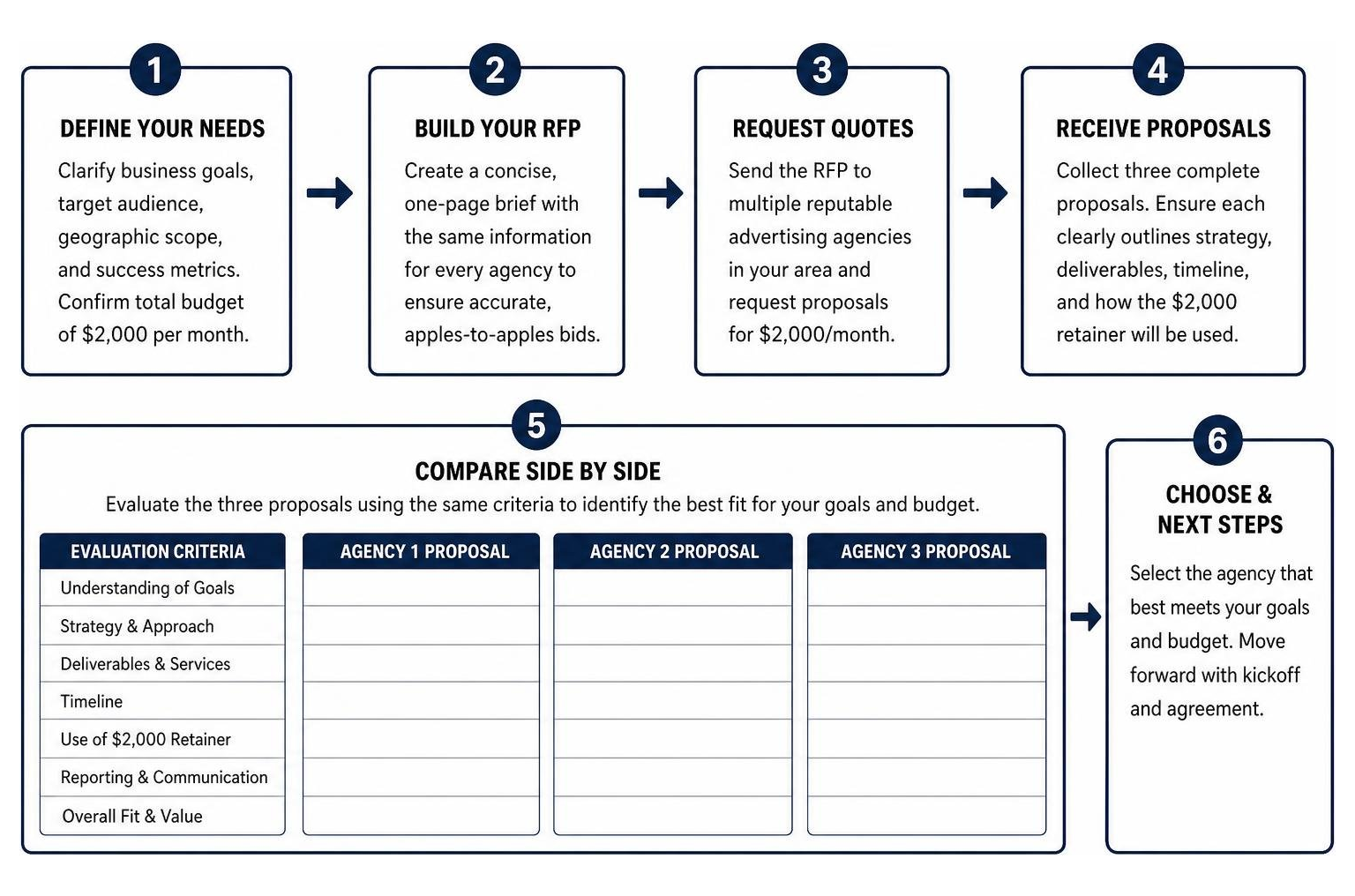
To obtain three accurate quotes you can actually compare side by side, you need a standard Request for Proposal (RFP) framework. This ensures every agency evaluates the exact same business model, geographic scope, and performance targets.
How Should You Structure Your Agency RFP to Solicit Accurate Bids?
When contacting prospective marketing partners, sending a brief, structured brief prevents misunderstandings and filters out agencies whose minimum retainers start well above your threshold. A well-constructed RFP does not need to be a twenty-page document; a concise one-page brief delivered via email or contact form is ideal.
Your quote request should explicitly outline the following components:
- Current Business Baseline: State your business category, primary service radius (e.g., Northwest Suburbs of Chicago, including Des Plaines, Mount Prospect, and Arlington Heights), current monthly website traffic, and rough customer acquisition numbers.
- Specific Primary Objective: State clearly whether you need immediate inbound phone calls, booked appointments, e-commerce transactions, or local foot traffic. Avoid broad goals like “brand awareness” at this budget level.
- Total All-Inclusive Budget: Specify that your total monthly investment ceiling is $2,000.
- Mandatory Itemization Request: Require each agency to state their monthly management fee separately from the direct paid advertising budget (Google Ads or Meta Ads spend).
- Account Ownership and Reporting Terms: Require confirmation that all ad accounts, analytics properties, and creative assets will remain under your direct business ownership.
When agencies receive clear parameters, their proposals become directly comparable. You will quickly see which teams understand lean local campaign architecture and which are attempting to force a cookie-cutter enterprise package into a tight budget.
Where Can You Find Reputable Local Agencies in Your Service Area?
Finding credible marketing partners requires looking beyond generic search engine ads. Start by checking established regional directories, verified Google Business Profiles, and industry associations across your service territory.
Reviewing the track records of established Chicago marketing agencies allows you to observe how different teams present their core specialties, case studies, and client focus. Additionally, reach out to your local chamber of commerce, B2B networking chapters in communities like Schaumburg, Naperville, or Park Ridge, and fellow business owners in non-competing trades. In specialized markets, cultural and linguistic alignment is a major asset; for instance, across the Chicagoland area, working with a bilingual team connected to the Polish-American community (Polonia) provides cultural nuance that national corporate agencies cannot replicate.
Select three distinct types of providers to quote your project: one boutique local digital marketing agency, one specialized local SEO and web development firm, and one independent media strategist. This provides a clear cross-section of strategic approaches for your $2,000 investment.
What Does a $2,000 per Month Advertising Budget Realistically Cover in 2026?

Understanding what $2,000 per month purchases in 2026 prevents mismatched expectations. Digital advertising costs and agency operational expenses have evolved. In major metropolitan markets, search clicks for high-intent professional services—such as legal, insurance, or commercial contracting—routinely range from $12 to $40 per click.
A $2,000 monthly budget cannot support a multi-layered, omni-channel media blitz. If an agency promises to run simultaneous Google Search ads, Meta video campaigns, local SEO, weekly email sequences, and active social media management all within a $2,000 all-in budget, they are likely overpromising. Spreading $2,000 across five channels dilutes your spend to the point where no single channel receives enough data or budget to optimize properly.
For a grounded look at how small businesses structure their investments, explore building a marketing budget you will actually use in 2026, which highlights the importance of channel concentration. At $2,000 per month, your investment must focus on one or two high-impact revenue drivers: capture existing high-intent search demand through Google Ads and Local SEO, or drive targeted local inquiries through Meta Ads paired with a dedicated landing page.
Boutique Agency vs. Freelancer vs. Full-Service Agency
How your $2,000 is utilized depends largely on the structure of the provider you choose. Each tier of service provider brings distinct trade-offs in overhead, attention, and technical execution:
| Provider Type | Typical Monthly Cost | Scope at $2,000/Month | Communication Level | Campaign Scalability |
|---|---|---|---|---|
| Boutique Agency | $1,000 – $3,500 | Dedicated focus on 1–2 high-ROI channels (e.g., Local SEO + Google Ads) | Direct access to senior strategists; personalized, hands-on support | High; modular service expansion as revenue grows |
| Specialized Freelancer | $500 – $2,000 | Execution of a single tactical task (e.g., ad copywriting or basic setup) | Variable; often dependent on solo operator availability | Limited; constrained by individual skill set and bandwidth |
| Large Full-Service Agency | $4,000 – $15,000+ | Entry-level package often handed to junior account managers or automated | Layered account managers; slower turnaround times | High, but cost-prohibitive for small business budgets |
Large full-service agencies carry substantial overhead—such as enterprise software stacks and large administrative teams—that make $2,000 accounts unprofitable for them unless they delegate the work to entry-level interns or automated template systems. Freelancers offer lower labor costs but often lack the combined technical web development, copywriting, and search engine optimization expertise required to build a cohesive conversion funnel.
A boutique agency represents the ideal middle ground for local businesses. We provide the technical capabilities, strategic depth, and tooling of an agency, balanced with the agility, direct communication, and personalized care of a dedicated local partner.
Realistic Timeline for Return on Investment
Marketing channels operate on distinct conversion horizons. When reviewing proposals, verify that the agency’s timeline matches technical reality:
Paid search campaigns (such as Google Ads) can generate inbound phone calls and quote requests within 2 to 4 weeks of launch, once conversion tracking, ad creatives, and landing pages are live. Organic strategies—including Google Business Profile optimization and local search engine ranking—typically require 60 to 90 days to gain traction and generate steady inbound inquiries.
Any agency claiming they can guarantee #1 rankings on Google or deliver hundreds of qualified leads within 48 hours should be disqualified immediately. Sustainable marketing relies on continuous testing, iterative keyword optimization, and real-time conversion rate refinement.
How Do Advertising Agencies Structure Their Pricing Between Retainers and Ad Spend?
To evaluate quotes intelligently, you must understand how agencies bill their clients. For deeper context on modern agency operational models, review the 2026 agency blueprint for retainers and service delivery, which explains how agencies balance service delivery margins with client ad spend.
Agencies generally bill using one of three standard pricing structures:
- Flat Monthly Retainer: The agency charges a set management fee (e.g., $1,000/month) for ongoing campaign buildout, split testing, negative keyword scrubbing, and reporting. The business pays the advertising platform (Google or Meta) directly for ad clicks.
- Percentage of Ad Spend: The agency charges a baseline fee or a percentage of the total ad budget (commonly 15% to 25%). On a $2,000 budget, a 20% fee would equal $400 in management and $1,600 in media spend. (Note: Many reputable agencies enforce a minimum monthly management floor of $800–$1,200, making pure percentage models uncommon for smaller budgets).
- Base Fee Plus Performance Uplift: The agency charges a reduced monthly base fee to cover operational labor plus a pre-agreed bonus per verified lead or revenue milestone.
The $2,000/Month Budget Breakdown Models
When allocating a $2,000 monthly marketing budget, your funds should typically be divided across one of three tactical allocations:
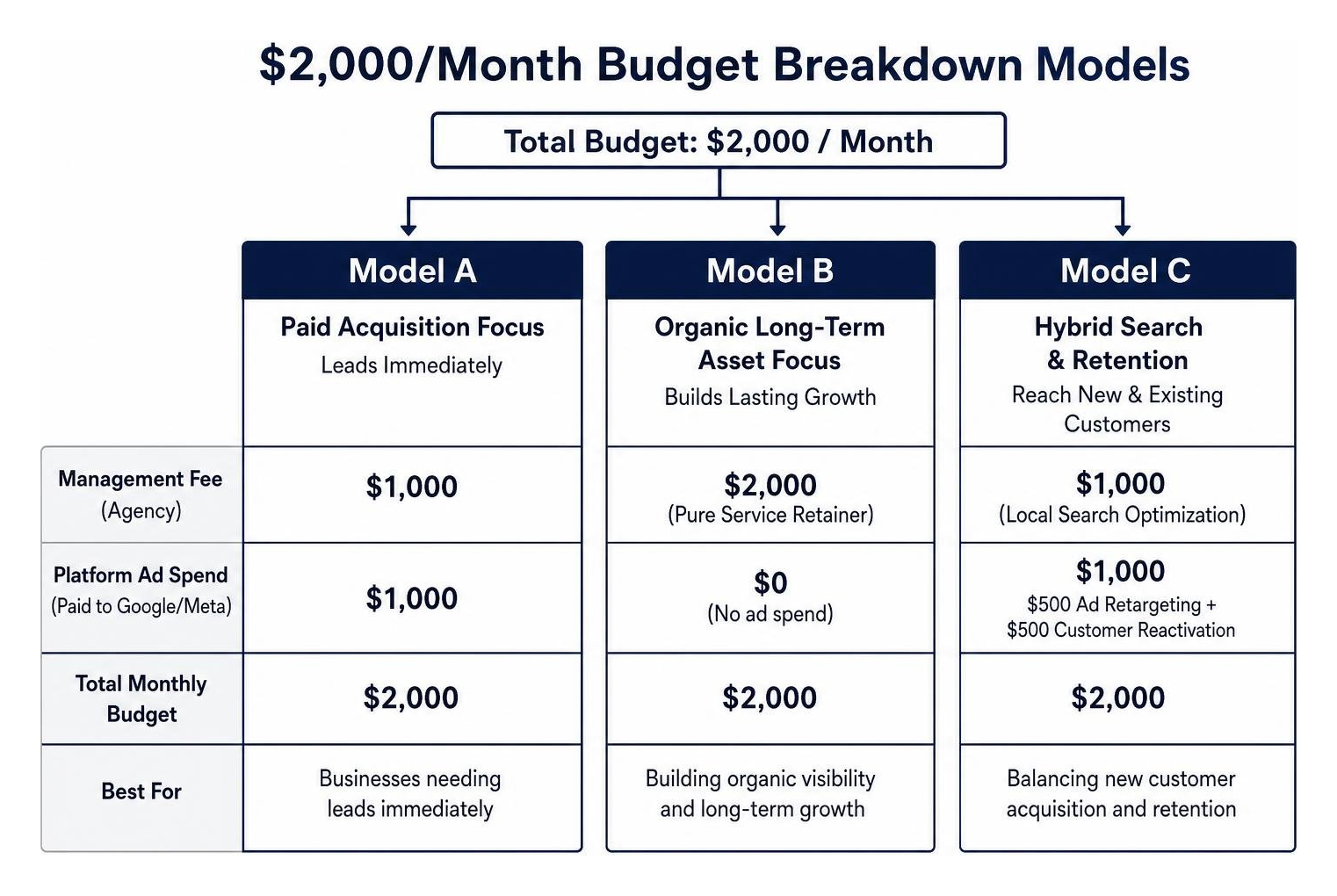
- Model A (Paid Acquisition Focus): $1,000 Agency Management Fee + $1,000 Direct Ad Spend. This structure is ideal for businesses needing leads immediately. The $1,000 ad spend provides roughly $33/day in media budget, sufficient to capture hyper-targeted search queries in a specific municipal radius (such as Elk Grove Village, Niles, or Rosemont).
- Model B (Organic Long-Term Asset Focus): $2,000 Pure Service Retainer dedicated entirely to comprehensive local SEO and content optimization. With this model, zero dollars are paid to ad networks. Instead, the entire budget funds technical on-page SEO, geographic landing page architecture, schema markup, Google Business Profile optimization, and local citation building to establish organic search rankings.
- Model C (Hybrid Search & Retention): $1,000 Local Search Optimization + $500 Hyper-Local Ad Retargeting + $500 Customer Database Reactivation (Email/SMS). This model targets both prospective searchers and existing customer retention.
Why Separate Ad Spend Accounts Protect Your Business
A crucial factor when comparing agency proposals is how media spend is billed. Your business must always maintain direct ownership of its Google Ads account, Meta Business Manager, and Google Analytics property.
Never work with an agency that insists on bundling your ad spend into an opaque single invoice where they pay the platforms through their own master account without providing raw platform receipts. If an agency charges you $2,000 as a lump sum, spends only $600 on actual ads while pocketing $1,400 without your knowledge, your marketing dollars are being wasted.
Furthermore, if you ever part ways with an agency that owns your account, you lose all your campaign history, quality score improvements, and negative keyword data. Always require the agency to manage campaigns inside an ad account owned by your business, billed directly to your company credit card.
Which Advertising Channels Deliver the Highest Return for a $2,000 Budget?
With a focused budget, channel selection determines whether your campaigns succeed or fail. Every dollar must go toward channels with proven conversion intent.

For local businesses, service providers, and regional retailers, high-intent digital search combined with customer retention consistently outperforms passive broadcast channels. Customer retention is critical: acquiring a new client costs nearly five times more than retaining an existing one. Pairing customer reactivation with high-intent search ads creates a balanced, cost-effective acquisition engine. Furthermore, email marketing delivers an average return of $36 for every $1 spent, making it an essential element to pair with paid acquisition.
High-Intent Search Ads vs. Social Media Lead Generation
Understanding the difference between active search demand and passive social discovery is vital when allocating budget:
- Google Search Ads (High Intent): Users typing “emergency furnace repair in Glenview IL” or “commercial liability insurance broker Des Plaines” have an urgent, immediate need. Google Ads captures this existing intent. While cost-per-click can range from $12 to $40 in competitive metro areas, the conversion rate from search click to qualified phone inquiry is consistently high.
- Meta Ads (Discovery & Visual Retargeting): Social media users on Facebook and Instagram are not actively searching for a contractor or B2B service provider; they are browsing content. Meta Ads excels at local brand familiarity, promoting seasonal offers, and retargeting people who visited your website but did not submit a contact form.
For most local businesses working with $1,000 in direct monthly media spend, dedicating 70–80% of ad spend to hyper-local Google Search Ads and 20–30% to Meta retargeting provides the strongest balance of immediate lead capture and brand recall.
Organic Foundation: Local SEO and Website Conversion Optimization
Paid advertising cannot fix a website that fails to convert visitors into callers. If your landing page loads slowly, lacks clear calls to action, or looks outdated on mobile devices, directing paid traffic to it will exhaust your budget with little return.
Before spending heavily on paid media, your digital foundation must be solid. Discovering how a local web designer can help optimize user flow, click-to-call functionality, and mobile responsiveness is often the first step toward improving campaign ROI. When reviewing your digital infrastructure, evaluating pricing from top rated web developers ensures you invest in a responsive, search-optimized website that turns ad clicks into actual paying customers.
Combining paid ads with a verified Google Business Profile loaded with genuine customer reviews creates a compounding effect. Over 90% of consumers trust personal recommendations and authentic peer reviews over direct promotional messaging. When potential clients see your paid search ad alongside strong organic local map rankings and positive reviews across Cook and Lake Counties, conversion rates increase significantly.
What Critical Questions Should You Ask Agencies Before Signing a Retainer?
When you receive proposals back from your three selected agencies, do not simply choose the lowest bid. Interview each agency team using specific diagnostic questions to evaluate their operational competence and transparency.
Five Essential Vetting Questions for Prospective Agencies
Ask each agency representative these five questions during your discovery consultation:
- “What exact dollar breakdown of my $2,000 budget goes toward management fees versus direct advertising platforms?”
Look for full transparency. The agency should provide an exact dollar figure or clear percentage breakdown. - “What specific deliverables, campaign setups, and conversion tracking milestones will be completed in the first 30 days?”
A competent agency should outline clear setup steps: conversion tracking installation, landing page creation, keyword negative-matching, and ad copywriting. - “Who will personally build, manage, and optimize my campaign on a day-to-day basis?”
Ensure your account is handled by experienced marketing professionals, not handed off to an unmonitored automated system or junior trainee. - “Do I retain 100% administrative ownership of my Google Ads, Meta Business Manager, and analytics accounts if we part ways?”
The answer must be an unconditional yes. - “What specific metrics (KPIs) will we use to evaluate success by month three?”
The agency should focus on business metrics: cost per lead, total phone calls, form completions, and return on ad spend (ROAS)—not vanity metrics like raw impressions.
Identifying Scope Creep and Hidden Contract Clauses
Carefully review the terms of service before signing any agreement. Look for these common contract red flags:
- Mandatory 12-Month Lock-In Agreements: For an entry-level $2,000/month budget, long-term contracts without performance milestones limit your flexibility. Look for initial 90-day agreements that transition to month-to-month terms.
- Excessive Onboarding or Setup Fees: While initial campaign configuration requires dedicated labor, setup fees should be reasonable and clearly tied to tangible assets, such as landing page development or conversion tracking setup.
- Restricted Creative Revisions: Ensure the agency includes regular testing of ad copy, headlines, and calls-to-action within their base monthly retainer.
Frequently Asked Questions About Hiring an Advertising Agency on a $2,000 Monthly Budget?
Is $2,000 a month enough to get meaningful results from an advertising agency?
Yes. A $2,000 monthly investment can produce tangible business growth if it is focused on a defined service area and one or two primary marketing channels. In local markets across Chicagoland—including communities like Buffalo Grove, Wheeling, Libertyville, and Skokie—a $2,000 budget allows you to capture high-intent local searchers actively looking for your services. The key is avoiding channel dilution and keeping overhead streamlined.
Should I hire a local agency or an offshore/remote agency for my small business?
Working with an established local agency provides major advantages over remote or offshore operations. Local agencies understand regional market dynamics, suburban service areas, local competition, and seasonal consumer behaviors.
Furthermore, local teams offer direct communication and accountability. For example, our team at WWS (Wizerunek w Sieci) works closely with businesses across Des Plaines, Chicago, and the Northwest Suburbs. Our bilingual capabilities (English and Polish) and deep roots in the local market allow us to craft tailored campaigns that resonate with local audiences and the Polish-American community (Polonia).
How quickly should I expect to see leads after hiring an advertising agency?
Campaign timelines depend on the chosen marketing strategy:
- Paid Search & Social Ads (Google Ads / Meta Ads): Initial lead activity typically begins within 2 to 3 weeks once tracking infrastructure, ad creative, and campaign architecture are active.
- Organic Search & Local SEO: Building organic map pack rankings, refining website structure, and earning citations requires 60 to 90 days to generate steady, sustainable organic inbound inquiries.
How Can You Choose the Best Local Partner to Maximize Your Marketing Investment?
Securing three competitive quotes for a $2,000 monthly advertising budget is the most reliable way to find a marketing partner that fits your goals. By defining your scope upfront, requiring transparent fee breakdowns, and asking direct questions about account ownership and performance metrics, you protect your capital and set your business up for measurable growth.
At WWS (Wizerunek w Sieci / WWS — Web Development + SEO), founded by Tomasz Lasota, we bridge the gap between large enterprise agencies and solo freelancers. Located at 636 S River Rd #218, Des Plaines, IL 60016, we specialize in providing tailored, high-performing digital marketing solutions for small and medium-sized businesses throughout Chicago, Cook County, Lake County, and across the United States.
Whether you need high-converting website design, dedicated local SEO, or targeted Google and Meta Ads management, we manage every campaign with meticulous care, treating your business as if it were our own.
If you are ready to evaluate your options and see how a focused digital strategy can generate more phone calls and customers for your business, explore our guide to leading Chicago SEO agencies or request your free, comprehensive website and marketing audit at wizerunekwsieci.com.