



The fastest way to turn a Des Plaines business’s social presence into real phone calls is hiring a local, certified agency that handles content, paid social, and reporting under one roof, not a patchwork of freelancers. Expect measurable movement in leads and map-pack visibility within a few months. Start by requesting a scoped local audit before signing anything.
TL;DR:
- Using a local, full-service agency with in-house teams ensures consistent quality and faster results, especially for paid campaigns and content creation.
- Social media campaigns should focus on education and engagement rather than direct selling to build trust that converts into calls and bookings over time.
- Confirm that the agency provides measurable results with clear KPIs, local case studies, and regular, detailed reporting tied to real leads and call tracking.
- Paid social advertising offers faster lead generation, but organic growth remains important for long-term brand presence and local SEO reinforcement.
- Expect visible lead increases within 30 to 60 days, with steady growth over six months, if the agency combines social with local SEO strategies effectively.
Table of Contents
- What Does Des Plaines Social Media Marketing Actually Deliver?
- How Do You Choose the Right Social Media Provider?
- How Does Social Media Marketing Connect to Local SEO?
- What Proof Should a Local Agency Show You?
- What Contract Terms Should You Expect?
- How Long Until You See Results From Social Media Marketing?
- When Should You Hire an Agency Instead of Doing It Yourself?
- How WWS Can Set Up Your Social Media and Local Leads
- Sources
- FAQ
What Does Des Plaines Social Media Marketing Actually Deliver?
Done right, social media marketing produces four concrete outcomes: brand awareness, trust with local buyers, phone calls, and foot traffic. It rarely works as a standalone tactic. It works when the content, targeting, and follow-up are built around a specific business goal, not a vague desire to “post more.”
A full-service provider typically delivers a mix of the following:
- Content creation built around your services, staff, and seasonal offers
- Scheduled posting across the platforms your customers actually use
- Community management, meaning timely replies to comments and messages
- Paid social campaigns targeted by zip code and radius around Des Plaines
- Monthly reporting tied to calls, form fills, and booking activity, not just likes
Platform choice matters more than most owners assume. Facebook and Instagram carry the most weight for B2C businesses like restaurants, home services, and medical practices, since both platforms reward visual proof of work and local hashtags. LinkedIn earns its keep for B2B operators, contractors bidding commercial jobs, or professional service firms. X works best for quick updates, service alerts, or event timing, but it rarely drives the volume of leads the other three do for a local business.
Pro Tip: Ask any provider how they define a “conversion” before you sign anything. A vague answer like “engagement” is a warning sign; a specific answer like “call tracking numbers tied to each ad set” is what you want to hear.
Marketing analysts at Brandwatch point out that effective local strategy prioritizes being social over selling. Content that educates or entertains outperforms direct pitches, because it builds the kind of trust that turns a scroll into a phone call weeks later.
How Do You Choose the Right Social Media Provider?
Evaluating a provider is less about gut feeling and more about a short checklist you run on every first call. Here’s the framework worth using every time.
- Ask for local case studies first. A provider who has actually run campaigns for Des Plaines or greater Chicago Area businesses should be able to show real before-and-after numbers, not generic screenshots.
- Confirm whether work is in-house or outsourced. Outsourced execution means slower turnaround and inconsistent brand voice. In-house teams control quality and communication end to end.
- Check for Google and Meta certifications. These credentials indicate the team has passed platform-specific training, not just watched a few tutorials.
- Ask how they define and report KPIs. A solid answer names specific metrics: calls tracked, form submissions, booking requests, map-pack impressions.
- Get the reporting cadence in writing. Monthly reports with clear numbers beat quarterly summaries full of vanity metrics.
On pricing, local agencies commonly structure their offers in tiers: a single-platform package covering basic posting and light community management, and a multi-platform bundle that adds paid social, content production, and deeper reporting, a pattern visible across Des Plaines area social media providers. Costs climb with ad spend, the number of platforms managed, and how much custom content (photography, video, graphic design) the package includes.
Watch for red flags: no local case studies, reporting that only mentions likes and followers, promises of “guaranteed viral growth,” or a proposal that never specifies deliverables by name. A strong proposal always includes an audit summary of your current presence, a list of specific deliverables, a timeline for the first 90 days, and a fixed reporting schedule.
Because LinkedIn’s own service directory lists dozens of independent freelancers and small providers in the Des Plaines area, price and quality vary widely. Ask every candidate for audited results, not just a portfolio.
How Does Social Media Marketing Connect to Local SEO?
Social platforms and local search results aren’t separate lanes. They reinforce each other. Google factors in review velocity, engagement signals, and business consistency when ranking a Google Business Profile in the map pack, and active social channels feed that consistency.
A coordinated strategy usually includes:
- Syncing Google Business Profile posts with social content so the messaging matches across every channel a customer might see
- Prompting satisfied customers for reviews right after a positive social interaction or completed job
- Running geo-targeted paid ads that point to a specific action, like calling or booking, tied to profile activity
- Building local citations alongside social proof to strengthen the signals search engines use to trust a business address
Analysts at Palmer Creative note that tying social content to concrete business priorities, live promotions, seasonal pushes, proof of past work, increases the odds a local customer converts while comparing options. That’s the same logic behind local citation building: consistency across every channel compounds.
If you need leads immediately, paid social is the faster lever. Organic growth builds a durable audience but takes months to compound. Most businesses run both at once, weighting paid heavier in the first 90 days, then shifting more budget to organic once the profile has traction.
What Proof Should a Local Agency Show You?
Certifications and case studies aren’t decoration. They’re the fastest way to separate a serious provider from someone posting from a template.
An agency holding official Google and Meta Partner certifications, handling all deliverables in-house with no outsourcing, offers a cohesive team approach. That matters for a Des Plaines business because it means one accountable team instead of three vendors pointing fingers at each other when a campaign underperforms.
A credible local partner should be able to show you:
- A history of client partnerships you can verify, not just claim.
- Actual client testimonials and case studies tied to real businesses, not stock quotes
- Reporting samples that track phone calls, qualified leads, and map-pack ranking movement, not just impressions
- A clear answer for how social activity supports Google Business Profile performance in your specific zip code
Ask to see two or three examples of local results before signing. If a provider can’t produce them on request, that’s your answer.
What Contract Terms Should You Expect?
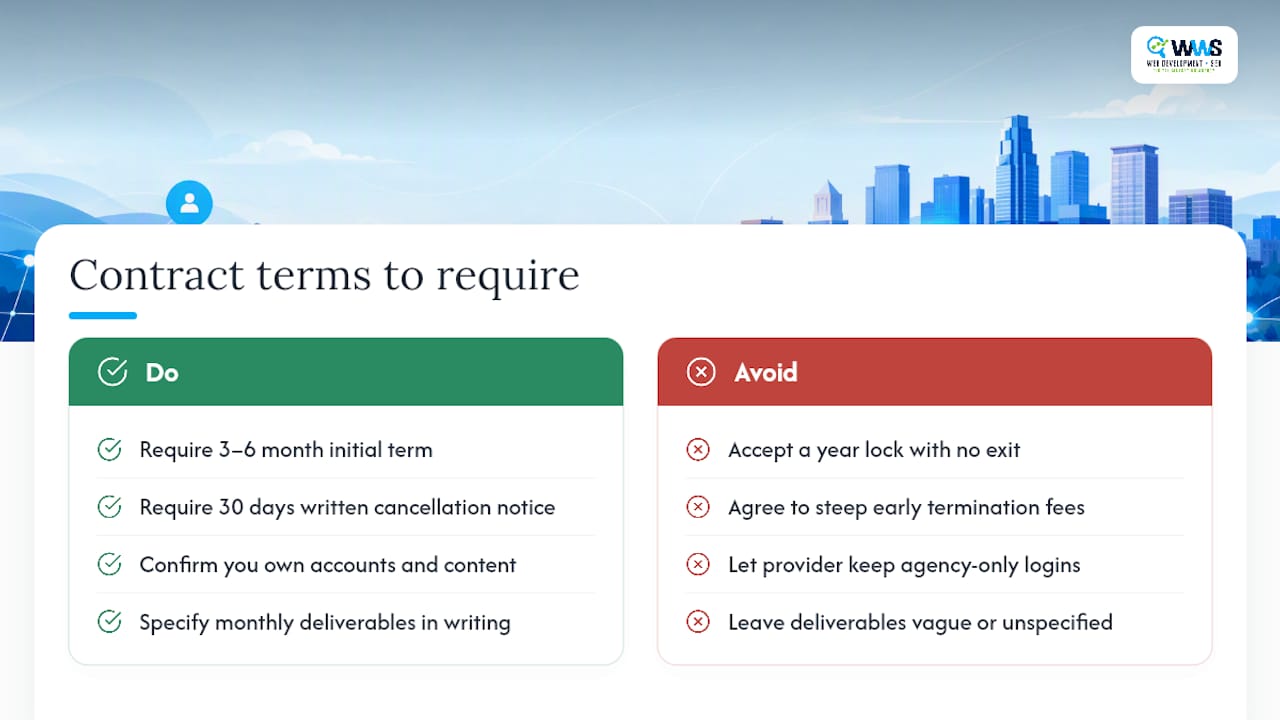
Most local social media marketing agreements run month-to-month after an initial commitment period, typically three to six months, long enough to build content history and gather enough data to judge performance fairly. Anything shorter rarely gives paid campaigns time to optimize.
Read the cancellation clause before you sign anything. A fair contract requires 30 days’ written notice to cancel, with no penalty beyond work already billed. Be wary of any agreement that locks you in for a year with no exit clause, or one that charges a steep “early termination fee” disproportionate to the setup work actually done.
Ownership terms matter just as much as cancellation terms. Confirm in writing that you retain ownership of your social accounts, content library, and any ad account access if you part ways. Some smaller providers create pages under their own agency logins, which leaves a business owner locked out if the relationship ends badly.
Scope creep is the other thing to pin down early. A good contract specifies exactly what’s included, monthly, in the package (post count, platforms covered, ad spend management, reporting) so “custom requests” don’t quietly become unpaid extra work. If a provider won’t put deliverables in writing with specific numbers, that’s a sign the relationship will get messy later.
Finally, ask what happens to historical data and creative assets if you switch providers. A trustworthy agency hands over everything, analytics history included, without friction.
How Long Until You See Results From Social Media Marketing?
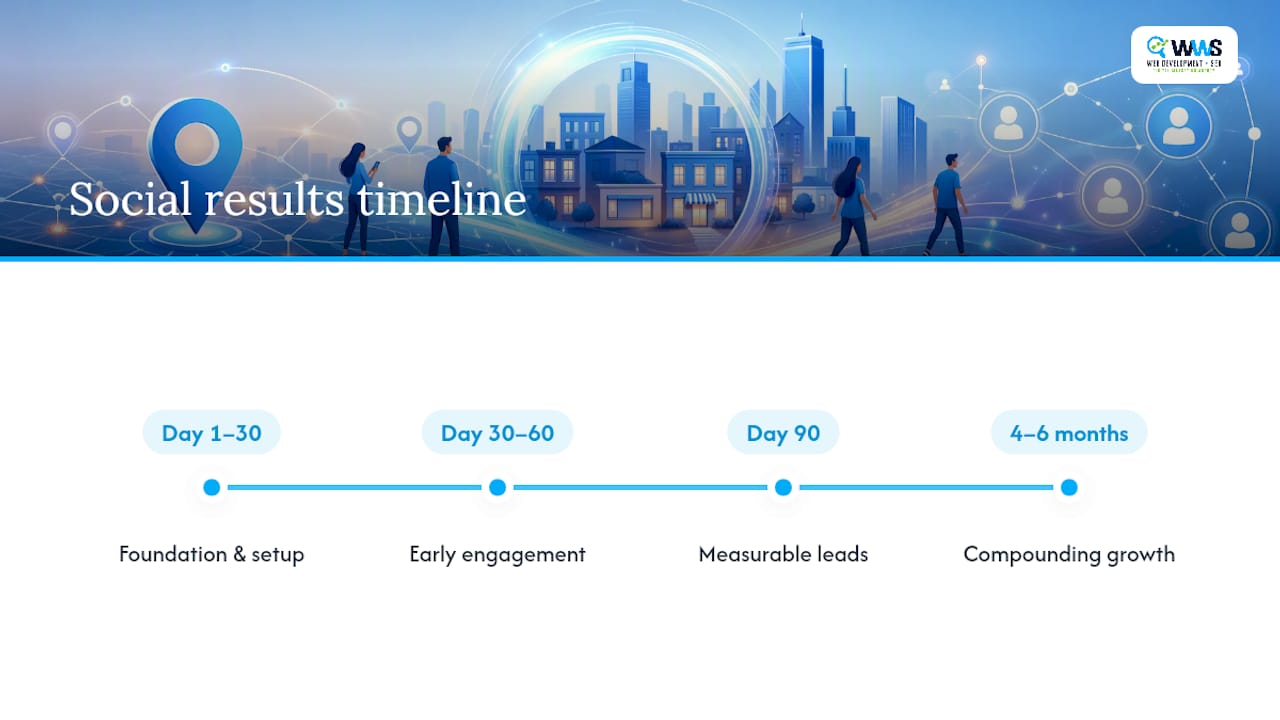
The first 30 days are foundation work: profile audits, content calendar setup, initial posting, and baseline data collection. Don’t expect lead volume yet. This is when a good provider is also cleaning up your Google Business Profile and checking citation consistency across the web.
Days 30 to 60 usually bring the first visible movement, engagement rates climbing, more profile visits, early paid social clicks converting into calls or form fills. This is also when reporting should start showing trend lines instead of a single snapshot.
By day 90, a well-run campaign for a Des Plaines business should show measurable lead flow: tracked phone calls, booking requests, and often early gains in local map-pack visibility if local SEO was running alongside social. Full compounding, meaning organic reach and referral traffic building on themselves, typically takes four to six months. Businesses that expect overnight virality are almost always disappointed; businesses that expect steady, trackable lead growth over a quarter usually aren’t.
When Should You Hire an Agency Instead of Doing It Yourself?
DIY social media works fine for a solo operator with time to spare and modest goals: a few posts a week, casual engagement, no paid budget. It stops working the moment you need consistent lead volume, paid campaign management, or coordination with local SEO. That’s where certifications and an integrated in-house team earn their cost. Fragmented execution, one freelancer for content, another for ads, is where most local campaigns quietly fail. In the first 30 to 90 days after hiring the right partner, expect setup and data collection first, then a clear upward trend in calls and bookings.
— Online Marketing Experts
How WWS Can Set Up Your Social Media and Local Leads
An alternative to juggling separate freelancers for content, ads, and local SEO is hiring one in-house, certified team to run social media management, Google Business Profile optimization, and local SEO together, so nothing falls through the cracks between vendors.
If you’re ready to move past guessing, request a proposal that includes a local audit of your current presence, a campaign plan matched to your goals, and clear pricing tiers before you commit to anything. With over 200 successful client partnerships across Des Plaines and the greater Chicago Area, WWS builds every deliverable in-house, meaning one accountable team handles your content, your ads, and your rankings instead of three disconnected vendors. Want to see what a coordinated campaign could realistically do for your call volume? Schedule a local audit and consultation and get a proposal built around your actual numbers, not a generic package.
Sources
- Social media goals: what to measure and why it matters | Brandwatch
- Des Plaines Illinois Social Media Marketing — Toucan Design
- Social Media Agency in Des Plaines, IL | Palmer Creative
- Hire Top Social Media Marketers in Des Plaines, IL — LinkedIn Services
FAQ
How Much Does It Cost to Hire Someone for Social Media Marketing?
Local agencies typically offer tiered monthly packages, a lighter single-platform plan for basic posting and community management, and a multi-platform bundle that adds paid social and deeper content production, a pattern seen across local providers. WWS pricing for social media, local SEO, and Google Business Profile optimization is available on request through a proposal request.
What Is the 5-3-1 Rule for Social Media?
Definitions vary across marketers, but a common version suggests posting a mix each week: roughly five pieces of curated or informational content, three original posts about your own business, and one promotional or sales-focused post. The intent behind any version of this rule is the same: lead with value, not pitches, which lines up with what Brandwatch found about educational content outperforming direct selling.
What Is the 5:5:5 Rule for Social Media?
This is another content-mix guideline, generally interpreted as five posts that educate, five that entertain, and five that promote, spread across a given posting cycle. Like the 5-3-1 rule, exact numbers vary by source, but the underlying principle of balancing value with promotion holds across most local social strategies.
What Is the 5:3:2 Rule for Social Media Posts?
The 5:3:2 rule splits content roughly into five parts curated or third-party content, three parts original brand content, and two parts promotional posts. It’s a variation on the same value-first philosophy that shows up across most credible content frameworks, prioritizing trust-building over constant selling.
Can Social Media Marketing Actually Improve My Google Business Profile Ranking?
Social activity doesn’t directly control map-pack ranking, but consistent posting, review generation, and citation accuracy all feed the same trust signals Google uses to rank local profiles. Providers that manage social and local SEO together typically coordinate these signals more effectively than separate vendors working in isolation.