



The right move for most businesses is a monthly retainer with an experienced agency, not a one-off project. Expect to pay $1,000 to $7,500 a month for a small to mid-market program, with AEO and GEO work for AI visibility often billed as a separate line. SEO builds cumulatively, so meaningful movement typically shows up months into the engagement, not weeks.
TL;DR:
- Most SEO retainers cost between $1,000 and $7,500 monthly, with smaller local campaigns typically on the lower end of that range.
- Technical SEO is foundational, as site speed, crawlability, and structured data directly influence both rankings and AI search visibility.
- A comprehensive SEO strategy includes content development, on-page optimization, link building, local SEO, and AI-focused structuring, all crucial for modern search success.
- Clear, specific deliverables and measurable KPIs should be in the contract, with monthly reporting focusing on traffic, leads, and keyword movement.
- In-house teams are rare for small to mid-sized businesses; a specialized agency with in-house staff generally offers more expertise and faster execution.
Table of Contents
- What Do SEO Services Actually Include?
- How Much Do SEO Services Cost in 2026?
- How Do You Choose the Right SEO Provider?
- What Does a Typical SEO Engagement Timeline Look Like?
- What Should Be in Your SEO Services Contract?
- Why WWS Built Its SEO Practice Entirely In-House
- Ready to See What SEO Services Could Do for Your Business?
- Sources
- FAQ
What Do SEO Services Actually Include?
A real SEO services proposal covers five distinct work streams, and if a provider’s pitch only mentions one or two, that is worth questioning before you sign anything.
Technical SEO comes first because nothing else works without it. This means fixing crawlability issues, resolving broken links and redirect chains, improving Core Web Vitals scores, and making sure search engines and AI crawlers can actually read and index your pages. Google’s own SEO Starter Guide treats this as foundational, and that foundation matters even more now. Generative AI features pull answers through retrieval from the Search index, a process Google calls RAG, and technical clarity plus people-first content directly affects whether your pages get used as grounded AI answers. A site with slow load times or messy markup does not just rank worse; it becomes invisible to AI Overviews and chat-based search entirely.
Content strategy and production is the engine that keeps everything moving. A competent agency builds topical authority through a mix of:
- Service pages that target commercial intent (the pages that actually convert visitors into calls)
- Location pages for businesses serving multiple towns or neighborhoods
- Blog clusters that answer the research questions customers ask before they buy
- Resource pages and guides that earn links and citations from other sites
On-page optimization and conversion design ties content to revenue. This covers title tags, meta descriptions, structured data (schema markup), header hierarchy, and internal linking, plus the calls to action that turn a page visit into a phone call or a form submission. Too many SEO campaigns chase rankings while ignoring whether the page actually gets someone to pick up the phone.
Authority work covers link building, local citation building, and digital PR. Search engines and AI systems both weigh how often other credible sites reference yours. For local businesses, this overlaps heavily with the fourth pillar.
Local SEO centers on your Google Business Profile: completeness, accurate categories, photos, posts, and review volume. Google’s own documentation confirms that local ranking depends on relevance, distance, and prominence, and prominence is built largely through reviews, citations, and mentions across the web. A dedicated local SEO push is usually the fastest lever a service business can pull.
AEO and GEO (Answer Engine Optimization and Generative Engine Optimization) is the newest addition to most proposals, and it’s rapidly becoming standard billable work rather than an experimental extra. It means structuring content so tools like ChatGPT, Perplexity, and Google’s AI Overviews can extract and cite it. Because AI answer engines lean on the same retrieval process as Search, agencies that ignore AI visibility risk delivering a plan that underperforms in the channels where more customers now start their search.
How Much Do SEO Services Cost in 2026?
Pricing splits into a handful of models, and knowing which one you’re being quoted matters as much as the number itself.
Monthly retainers dominate the industry. A poll of 439 SEO providers found that retainers cluster between $500 and $5,000 a month, with averages landing around $2,900 to $3,200. Retainers work because SEO is not a project with a finish line; it’s ongoing maintenance and growth, similar to how you’d think about payroll rather than a renovation.
Hourly billing shows up mostly for consulting or narrow technical fixes, and project-based pricing covers one-time work like a technical audit or a site migration.
AEO and GEO add-ons typically run $900 to $3,000 a month on top of a core retainer, reflecting the extra content restructuring and structured-data work involved.
Here’s how the budget tiers break down for U.S. businesses:
| Business Type | Typical Monthly Range | What You’re Paying For |
|---|---|---|
| Small/local business | $1,000 to $7,500 | Local SEO, GBP optimization, foundational technical fixes |
| Mid-market business | $1,000 to $7,500 | Multi-location or competitive-market SEO, content production, link building |
| Enterprise/ecommerce | $8,000+ | Large-scale technical work, high-volume content, aggressive authority building |
| AEO/GEO add-on | $900–$3,000 | AI visibility optimization layered onto an existing program |
Ranges reflect 2026 U.S. market pricing data and a survey of 439 SEO providers.
Local SEO averages run lower than national campaigns. If your goal is to win the map pack in one metro area rather than rank nationally, budgets can be meaningfully smaller while still producing strong results, which is exactly why matching the engagement to your actual ambition matters more than chasing the biggest possible package.
A quick gut check: if a quote comes in dramatically below these bands, ask who does the actual work. Retainers are the dominant model for good reason, and a $2,900-a-month program run mostly by senior staff produces different results than a $400-a-month program run by a junior contractor stretched across forty accounts.
How Do You Choose the Right SEO Provider?
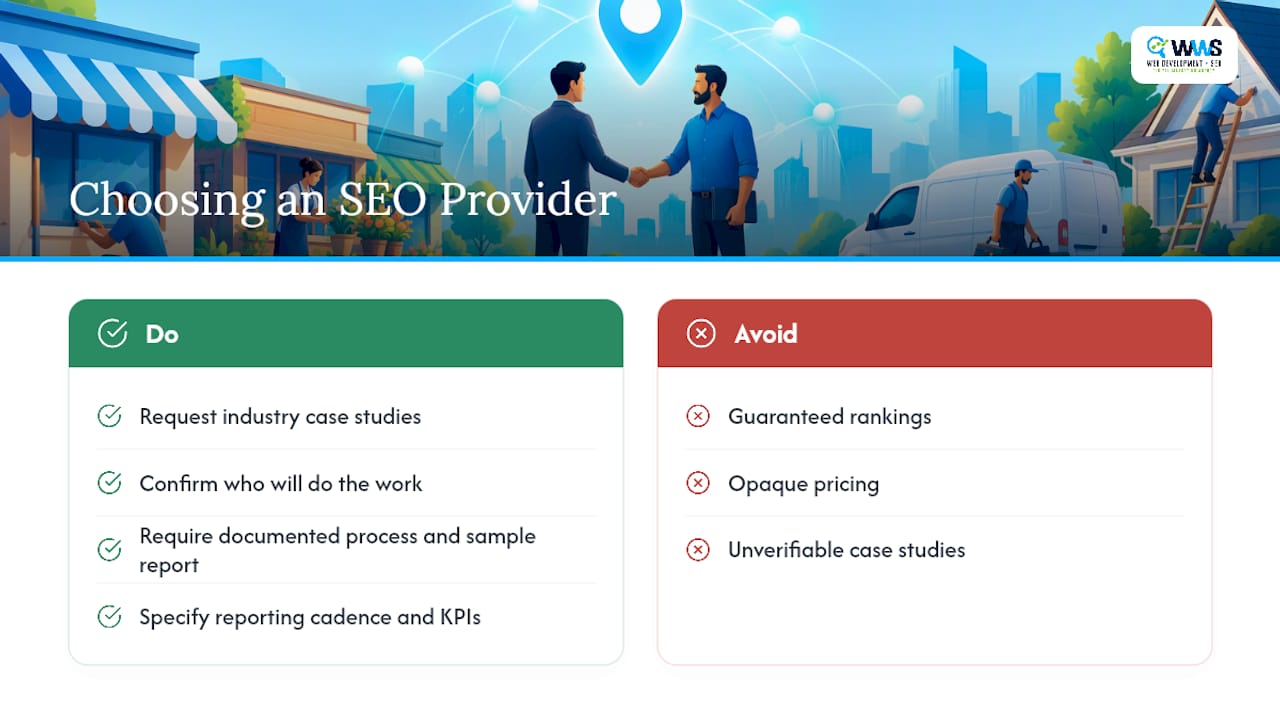
Picking a provider comes down to four filters: relevant proof, real staffing transparency, documented process, and measurement tied to business outcomes rather than vanity metrics.
1. Ask for case studies in your industry or a comparable one. A roofing contractor and a dental practice have different buyer journeys, different content needs, and different competitive landscapes. A provider with relevant experience already understands the terrain.
2. Ask who actually does the work. Many agencies sell senior strategy on the sales call, then hand execution to junior staff or outsourced contractors overseas. Ask directly: “Who will be writing my content and building my links, and what’s their experience level?”
3. Ask for a sample report. A proposal that talks in generalities about “boosting visibility” without naming specific KPIs is a warning sign. You want organic traffic, qualified leads, keyword ranking movement, and revenue attribution, not just a rankings screenshot.
4. Ask about reporting cadence. Monthly reporting is standard. If a provider can’t tell you how often you’ll hear from them or what a report will contain, that’s a preview of the entire relationship.
5. Ask how AEO and GEO fit into the plan. Given how much search behavior has shifted toward AI-assisted answers, a provider with no answer for this question is behind the market.
Watch for a short list of red flags that should end the conversation immediately: guaranteed rankings (no one controls Google’s or an AI engine’s algorithm, so a guarantee is either naive or dishonest), opaque pricing that won’t specify deliverables per month, and case studies you can’t verify with a real client name or a live website.
When you’re comparing proposals side by side, look past the price to three things: how specific the deliverables are (named tasks and hours, not vague “ongoing optimization”), how the promised outcomes are worded (specific and measured vs. sweeping and vague), and how much senior time is actually allocated to your account each month.
Pro Tip: Ask every provider on your shortlist the same five questions in the same order, then compare the answers side by side. The differences in specificity, not the differences in price, usually reveal which agency actually knows what it’s doing.
Clear scope and named deliverables predict a healthier client relationship than almost anything else. A proposal that names your target keywords, monthly deliverables, and expected milestones gives you something concrete to hold the provider accountable to later.
What Does a Typical SEO Engagement Timeline Look Like?
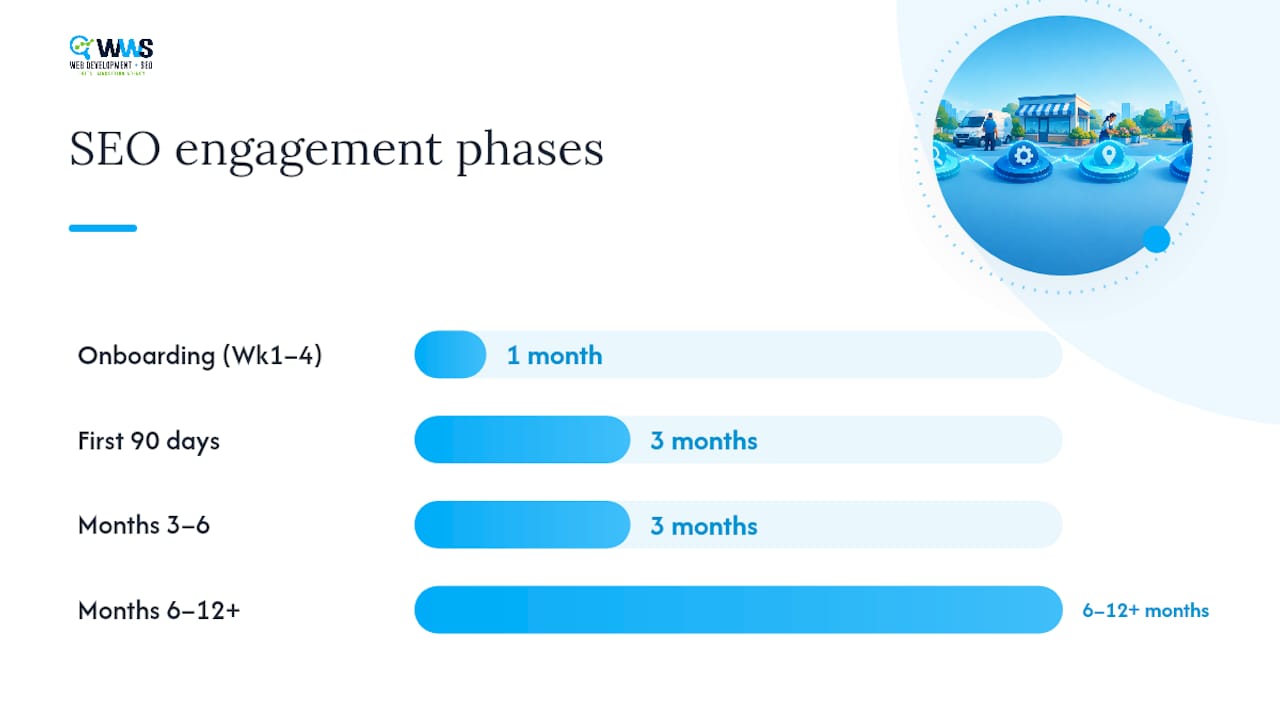
SEO results build in stages, and a provider who promises overnight rankings is either inexperienced or not being straight with you.
Onboarding and technical audit (weeks 1 to 4): Expect a full site audit, competitive analysis, and a documented strategy covering target keywords, priority fixes, and content plans.
First 90 days: This is where you should see the fastest visible movement:
- Technical fixes (site speed, broken links, indexing errors) get resolved
- Google Business Profile gets fully optimized with categories, photos, and posts
- On-page elements (title tags, meta descriptions, schema) get updated across priority pages
- Early keyword movement, usually on lower-competition terms
Months 3 through 6: Content production ramps up, link acquisition begins in earnest, and you should start seeing consistent keyword ranking gains on moderately competitive terms.
Months 6 through 12 and beyond: This is where authority compounds. Traffic growth becomes measurable in month-over-month terms, and revenue impact, more leads, more calls, more bookings, becomes the headline metric rather than rankings alone.
Insist on monthly reporting built around outcomes that connect to your bottom line: organic traffic trends, qualified lead volume, keyword ranking movement on priority terms, and where possible, performance in AI-driven answer surfaces. Long-term, consistent retainer work produces more sustainable growth than one-off projects, largely because Google and AI systems reward sites that demonstrate ongoing relevance and freshness rather than a single burst of activity followed by silence.
What Should Be in Your SEO Services Contract?
Before signing anything, get the scope in writing: which deliverables happen monthly, who is assigned to your account, and what reporting looks like. Verbal promises made on a sales call are worth nothing once the invoices start.
Pay close attention to the termination clause. Month-to-month agreements without a long lock-in period are healthier for you as the buyer, since they keep the agency motivated to perform rather than coasting on a signed commitment. If a contract requires a 12-month term, ask what happens if the relationship isn’t working by month three.
Clarify content and asset ownership. Content, code changes, and any custom tools built during the engagement should belong to you, not the agency, once you’ve paid for them. This matters enormously if you ever switch providers.
Nail down KPI definitions in the contract itself, not just in a verbal pitch. If “success” isn’t defined in writing, it isn’t enforceable in practice.
Finally, negotiate a trial period or an initial audit-only engagement before committing to a full annual retainer. A provider confident in their work should have no problem starting smaller and earning the larger commitment.
Why WWS Built Its SEO Practice Entirely In-House
Most agencies outsource pieces of the work: content gets written by freelancers, links get built by a subcontractor, and technical fixes get handed to a developer who never talks to the SEO team. Every handoff is a place where strategy gets diluted.
WWS – Web Development + SEO does not work that way. Every person touching your account, from the developer fixing your Core Web Vitals to the strategist building your content calendar, works in-house under one roof. That matters practically: when a technical fix and a content update need to happen in the same week to support a campaign, there’s no waiting on a third-party vendor’s queue.
WWS holds official Google and Meta Partner status, and the team is exclusively staffed by Google and Facebook certified specialists. That certification isn’t a plaque on a wall; it means the people managing your Google Business Profile and your ad campaigns are trained directly on the platforms they’re optimizing for.
The client base is intentionally focused on contractors, restaurants, medical providers, and other local service businesses in the region. With over 200 client partnerships built specifically around this kind of business, the goal on every account is the same one local owners actually care about: more phone calls, better-qualified leads, and steady revenue through the calendar year, not just a rankings report that looks good in a slide deck.
— Online Marketing Experts
Ready to See What SEO Services Could Do for Your Business?
WWS – Web Development + SEO is the alternative to piecing together a freelancer for content, a separate contractor for technical fixes, and a third vendor for local listings. Every part of your SEO program, website development, local SEO, and Google Business Profile management, runs through one certified in-house team, so nothing gets lost between vendors and nothing takes three phone calls to fix.
The starting point is a strategy conversation covering where your site currently stands, a snapshot of what your top local competitors are doing, and honest budget guidance based on your goals, not a generic package pushed on every caller. From there, you get a written scope and an estimated budget before anything is signed, so you know exactly what you’re paying for and what you’ll receive each month.
If local visibility is the priority, the Local SEO program targets Google Business Profile optimization and map-pack rankings directly. If you’re running an online store, Ecommerce SEO addresses the technical and content demands of larger product catalogs. For most Chicago-area service businesses ready to build a real organic growth engine, the Website SEO page is the place to start that conversation.
Sources
The figures and guidance in this article draw from official documentation and current market research, worth bookmarking if you want to dig deeper on your own:
- Search Engine Optimization (SEO) Starter Guide — Google Developers
- Google: Guide to Optimizing for Generative AI Features on Google Search
- How Much Does SEO Cost in 2026? US Pricing Guide — UnifiedPlatforms
- SEO Pricing: How Much Does SEO Cost? 439 People Polled — Ahrefs
FAQ
What Are SEO Services, Exactly?
SEO services cover technical site fixes, content creation, link building, local optimization, and increasingly, AEO and GEO work for AI visibility. A full-service provider bundles these into one program rather than selling them as disconnected tasks, following the same core principles laid out in Google’s Search Essentials.
How Much Do SEO Services Typically Cost?
Most U.S. businesses pay between $1,000 and $7,500 a month depending on market size and competition, with enterprise programs starting near $8,000 or more. A separate poll of 439 providers found average retainers clustering around $2,900 to $3,200 a month. WWS – Web Development + SEO provides a written scope and budget estimate after an initial strategy call rather than a fixed public rate.
Is SEO Dead Now That AI Search Exists?
No. AI answer engines pull results through retrieval from the same search index that traditional SEO optimizes for, so the technical and content fundamentals that drive rankings also drive AI visibility. SEO has expanded to include AEO and GEO, not been replaced by them.
Is SEO Still Worth It Going Into 2026?
Yes, particularly for local service businesses competing in a specific metro area. Local SEO campaigns often produce strong results at lower budgets than national programs, and businesses that treat it as an ongoing monthly investment consistently outperform those chasing one-off projects.
Should I Hire an Agency or Build an In-House SEO Team?
An in-house hire makes sense for large companies with the budget for multiple specialists, but for most small and mid-market businesses, an agency retainer delivers broader expertise, faster, at a lower total cost. A single in-house hire can’t realistically cover technical SEO, content, link building, and AI visibility work with the same depth a full agency team provides.