





When a fire damage search happens, we believe the winning move is simple: fix your Google Business Profile, build one conversion-ready emergency service page, and remove every obstacle between a panicked caller and your phone. Everything else in fire damage SEO supports that single goal.
TL;DR:
- Choose the most specific profile category and list up to 20 city or ZIP code service areas; hide your address if you lack a public storefront.
- Build dedicated pages for core services, and put a phone number and concrete response time near the top of an emergency page designed for mobile.
- Create location pages only for cities where completed jobs and photos prove your experience; thin pages without local evidence rarely build trust or rank.
- Request reviews automatically after each completed job and respond to every review, keeping fresh feedback visible to people choosing under pressure.
- Track calls, form submissions, and booked inspections separately, then connect them to closed job value; prioritize profile and relevance fixes in the first two weeks.
Table of Contents
- Why Fire Damage SEO Plays by Different Rules
- Your Google Business Profile Checklist for Emergency Visibility
- Building a Site That Converts Panicked Visitors Fast
- Targeting the Keywords People Type During a Fire Emergency
- Trust Signals That Turn a Phone Call Into a Booked Job
- Tracking What Actually Produces Booked Jobs
- How We Apply This Playbook for Restoration Clients
- Why Local-First, Conversion-First Wins for Restoration
- How We Help You Put This Playbook to Work
- FAQ
- Sources
Why Fire Damage SEO Plays by Different Rules
Fire damage searches do not behave like typical home service queries. Search volume stays low because house fires are rare events for any one household, but the jobs that do come in carry high ticket values and urgent timelines. A homeowner standing in a smoke-damaged kitchen is not comparison shopping. They are searching once, calling two or three businesses, and hiring whoever answers and sounds capable.
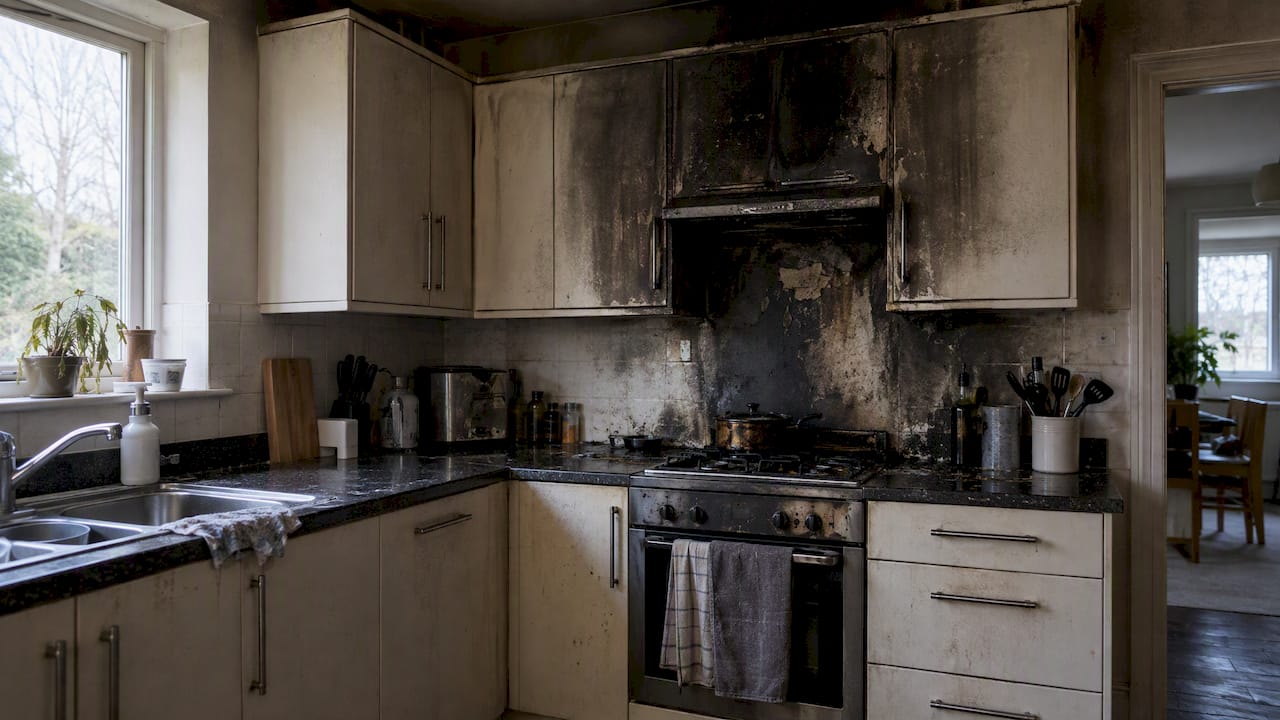
That urgency changes how Google ranks results. Local rankings depend primarily on relevance, distance, and prominence, and for an emergency query, distance carries outsized weight because Google assumes the searcher wants help nearby, fast.
What this means for strategy:
- Broad traffic growth matters less than being visible at the exact moment someone searches.
- Conversion rate on the first page a caller lands on matters more than total site traffic.
- Your Google Business Profile often gets more scrutiny from a frightened caller than your homepage does.
Prioritize being found fast and converting that single visit. Fire damage SEO rewards precision, not volume.
Your Google Business Profile Checklist for Emergency Visibility
Your profile is often the first thing a caller sees, so get it right before touching anything else on your website.
- Choose the most specific primary category available, such as fire and water damage restoration, rather than a generic contractor label.
- List up to 20 named service areas by city or ZIP code instead of relying on a radius, which Google no longer supports.
- Hide your public address if you run a service-area business with no walk-in storefront, and keep your real operating base verifiable.
- Caption every photo with the city and service performed, such as “smoke damage cleanup in Evanston,” to reinforce relevance.
- Launch a review-request workflow that fires automatically after each completed job, so review velocity stays steady rather than sporadic.
- Audit your name, address, and phone number across directories for consistency, since mismatched citations quietly erode trust signals.
Pro Tip: Avoid virtual office addresses entirely. Google can request live verification evidence for service-area businesses, and a mismatch between your listed base and your actual operations risks suspension at the worst possible time.
Building a Site That Converts Panicked Visitors Fast
A visitor who just had a fire does not want to read your company story. They want to know you handle this exact problem and that calling you now is the right move.
Structure the site around that reality:
- Build dedicated service pages for each core offering: emergency board-up, soot and smoke cleanup, content pack-out, and structural drying.
- Create short emergency landing pages with a phone number above the fold, a one-line response time promise, and nothing that slows down a mobile reader.
- Publish location pages only for cities where you have real job history and photos to back them up, since thin location pages without proof rarely earn trust or rankings.
- Keep the phone number, service area language, and calls to action identical across your website and your Google Business Profile.
A practical GBP setup guide for service-area businesses walks through many of these consistency requirements in more depth.
Targeting the Keywords People Type During a Fire Emergency
Fire damage searches skew toward immediate, practical questions rather than broad research terms. People type “emergency board up near me” or “smoke odor removal cost,” not “fire damage restoration industry overview.”
Build content around that behavior:
- Target long-tail emergency phrases paired with clear process answers, like what to do in the first hour after a fire.
- Favor short checklists and question-and-answer pages over long evergreen guides, since urgent searchers want an answer in seconds, not a ten-minute read.
- Add schema markup for local business and service types so your phone number and hours surface directly in search results.
- Use short before-and-after photo captions from real jobs to reinforce that you have handled this exact situation before.
One structural note worth building around: proximity for urgent queries is calculated from a moving point anchored to the searcher, so small distance differences matter heavily inside a tight radius and far less once a searcher is outside it. Inside that close zone, category match and review velocity often outweigh raw distance, which is one more reason GBP accuracy and fresh reviews pay off faster than broad content campaigns.
Trust Signals That Turn a Phone Call Into a Booked Job
Ranking well only matters if the call converts once it comes in. A handful of trust elements consistently move that needle:
- Display IICRC or equivalent credentials where a caller can see them immediately, not buried in an about page.
- Mention insurance-assistance support clearly, since many fire damage calls come from people who have never filed a claim before.
- Keep review counts current and respond to every review, since a responded-to review signals an active, attentive business.
- Use compassionate, plain language rather than corporate phrasing, paired with a concrete response-time promise like “on site within two hours.”
- Pair a few recent job photos with one-sentence captions describing the problem and the fix.
Pro Tip: A caller in crisis decides fast. Put your response-time promise and your phone number in the same visual block so there is nothing to search for.
Tracking What Actually Produces Booked Jobs
Fire damage marketing only improves when you can see which actions generate real revenue, not just traffic.
- Track phone calls, form submissions, and booked inspections separately, and tie each one back to closed-job value.
- Run location-aware rank checks for your emergency keywords rather than relying on a single generic position report.
- Front-load GBP and relevance fixes in the first two weeks, since relevance is the factor a business can influence fastest, while reviews and link-building are better treated as a quarter-long program.
- Run small, fast tests on your call-to-action wording and phone-first layout rather than waiting for a full redesign.
A restoration-specific marketing system built around dispatch and call tracking makes this kind of attribution far easier to maintain week to week.
How We Apply This Playbook for Restoration Clients
We run this exact sequence for restoration businesses using proven local SEO and Google Business Profile services tailored for contractors. Our three fastest wins consistently come first:
- A full Google Business Profile accuracy sweep covering category, service areas, and verification evidence within the first week.
- One emergency landing page built around a single service, with a phone number and response promise above the fold.
- A review-request template tied directly to job completion, so velocity builds without manual follow-up.
We also help clients gather the photos and job documentation that support GBP verification, since that evidence protects a profile from suspension during the exact weeks it needs to perform.
Why Local-First, Conversion-First Wins for Restoration
We have watched too many restoration businesses chase broad content traffic while their Google Business Profile sat half finished. Fire damage leads are rare, expensive, and urgent, so the business that answers fastest and looks most credible in that moment wins the call. Fix the profile, build one sharp page, and the rest follows.
— Online Marketing Experts
How We Help You Put This Playbook to Work
We build the exact pieces this playbook calls for: accurate, verification-ready Google Business Profiles, phone-first emergency landing pages, and the call tracking that shows which leads actually turn into booked jobs. Our Local SEO service covers the profile and citation work, while our Website SEO service builds the service and emergency pages that convert the calls once they come in. If your restoration business needs this handled by one in-house team instead of three freelancers, reach out and we will map out your first 30 days.
FAQ
What is considered fire damage?
Fire damage covers direct burn and charring to a structure or belongings, along with the smoke, soot, and odor that spread well beyond the flames themselves. It also includes water damage from firefighting efforts, which often affects more of the home than the fire did.
What are some examples of fire damage?
Common examples include charred framing and drywall, soot coating walls and ceilings, melted plastic fixtures, smoke odor absorbed into fabric and furniture, and water damage from sprinklers or hoses. Electrical and HVAC systems often need inspection even when they look untouched.
Can fire damage be repaired?
Most fire damage can be repaired through a combination of structural rebuilding, soot and smoke cleanup, odor removal, and content restoration or replacement. The scope depends on how deeply smoke and heat penetrated materials, which is why a prompt professional assessment matters.
What’s worse, water damage or fire damage?
Neither is uniformly worse since each creates different risks: fire damage often involves structural and air quality concerns from smoke and soot, while water damage carries a faster timeline for mold growth. Many fire incidents include both, which is why restoration businesses typically assess and quote the two together.
Sources
- Google Business Profile: Understand factors that determine local ranking
- Learn
- Restoration local SEO marketing: a practical playbook for local search visibility – Docusketch