


Local Content Ideas for Service Businesses in 2026
Local content ideas for contractors, restaurants and service businesses: what to publish, how to find topics, where to share it and how to measure leads.
 By WWS Team
13 min read

In this article14 sections
- Key takeaways
- What counts as local content
- Local content ideas that work for service businesses
- Ideas by business type
- How to find topics your customers are searching
- Where to publish and share local content
- A four-week plan to get started
- Perspective: why local content works best when it is built into the site
- Measuring whether local content brings leads
- Common mistakes to avoid
- Let us build the content engine with you
- FAQ
- Sources
- Recommended
The best local content answers a question a nearby customer is already asking, in the words they use, about the place they live. For a Chicago-area roofer that is a post on what ice dams do to Des Plaines roofs. For a restaurant it is a page about private dining near Schaumburg. This guide gives you the content types that work, a repeatable way to find topics, where to publish them and how to tell whether they bring calls.
Key takeaways
- Build content around real local questions: service pages, location pages, FAQs, project stories, seasonal how-tos and customer stories.
- Find topics in Google Autocomplete, People Also Ask, your call logs and your reviews, then match each one to a page.
- Keep your Google Business Profile complete and accurate, and share content where your customers already spend time.
- Measure calls, direction requests, form fills and bookings, not just rankings.
- Start with one useful piece per week for your top three services and add neighborhoods as you go.
What counts as local content
Local content is anything you publish that ties your expertise to a place and a moment: a city, a neighborhood, a season, a weather event, a building style, a local rule or a community event. It lives on your website, your Google Business Profile, your social channels and sometimes on other people’s sites.
It is different from generic blog content in one way that matters. A national article on “how to choose a window” competes with every home-improvement site in the country. A page on window replacement in older Evanston and Oak Park homes competes with a handful of contractors. That narrower field is why local topics often convert better and are easier to win.
Good local content also serves two readers at once: the customer deciding whom to call, and the search engine deciding which business fits the search. When both are served, the result is calls, not just traffic. If you want the wider framework first, our local SEO strategy walks through the full plan.
Local content ideas that work for service businesses
The list below is organized by what the content does for the customer. Pick the types that fit your trade and start with the ones closest to a purchase.
Service pages and location pages
These are the highest-intent pages you can publish. A service page explains one service in depth: what is included, how long it takes, what affects the cost and what the process looks like. A location page does the same for one area you serve, with details only a local would know.
Some practical rules:
- One service per page, with the city or area in the title and the first paragraph.
- Real details per location: neighborhoods, typical housing stock, local permit offices, response times you can honestly commit to.
- A clear phone number and a short form above the fold.
- Never copy one location page and swap the city name. Thin duplicates help no one.
If your site needs this structure, our local landing page design guide covers layout choices that turn visits into calls, and our website design team builds these pages as part of the site.
FAQs written from real customer questions
Every trade has the same ten questions repeated daily. “How long does a roof replacement take?” “Do I need a permit to replace windows in Chicago?” “Is a dental implant covered by insurance?” Write each answer in two to four plain sentences on a page, then expand the best ones into full articles.
The source of these questions is your own business. Call logs, staff notes and chat transcripts show how customers describe services, problems and locations in everyday language, as Semrush-style keyword research guidance also points toward when it recommends starting from services and expanding with real searches. Use the customer’s words in your headings, not your industry’s.
Project case studies
A case study is local content with proof built in. Describe a job: the neighborhood, the problem, what you did, how long it took and what the customer thought. Add photos of before, during and after.
A simple template:
- The situation (a leaking flat roof on a Skokie two-flat, a dated kitchen in Naperville).
- The constraints (budget, timeline, HOA rules, weather).
- What you did and why.
- The result, in the customer’s words if they approve.
Only publish what is true and permitted. Get the customer’s consent before using their name, address or photos.
Seasonal how-to content
Chicago-area weather gives you a built-in editorial calendar. The Midwest has hard winters, humid summers and fast swings in between, and customers search accordingly.
| Season | Roofing and exteriors | HVAC and electrical | Restaurants and salons |
|---|---|---|---|
| Winter | Ice dam warning signs, snow load, storm damage checks | Furnace tune-up, carbon monoxide detector reminders, outage prep | Holiday party booking, gift cards, winter menu |
| Spring | Post-winter roof inspection, gutter cleaning, window sealing | AC check before summer, surge protection for storm season | Patio opening, Mother’s Day and graduation bookings |
| Summer | Storm damage claims, attic ventilation, siding care | Cooling costs, thermostat upgrades, EV charger planning | Outdoor seating, festival season specials |
| Fall | Gutter and flashing checks before freeze, window replacement before winter | Furnace start-up, humidifier setup | Football-season specials, holiday menu previews |
Publish each seasonal piece four to six weeks before the season starts, because that is when people begin searching. Update the same page each year rather than creating a new one, so it keeps its history.
Pricing guides
Customers search “how much does a bathroom remodel cost in Chicago” before they call anyone. A guide that explains what drives cost, in ranges you can stand behind, earns trust even when it does not list a fixed price. Explain the factors (materials, size, access, permits, age of the building) and what a quote should include.
Customer stories and reviews
Reviews, photos, videos and referrals build trust and social proof. Turn them into content: a short post quoting a review with permission, a video testimonial, a “customer of the month” feature. Video is especially useful for this because a real face carries more weight than a star rating. Tools that turn customer testimonials into testimonial and review videos can help you produce them faster, as long as the story shown is a real customer’s.
When customers leave feedback, respond courteously and promptly. MU Extension’s social media guidance recommends exactly that for review networks, alongside claiming and completing your listings on Google, Bing, Yelp and similar sites (MU Extension, February 2025). Our Google reviews app page explains how we help owners collect more of them.
Community and event content
Sponsor a Little League team in Arlington Heights, show up at a farmers market in Wheaton, support a school fundraiser in Orland Park. Then publish it: photos, a short write-up, a tag for the organizer. MU Extension also recommends local event and seasonal updates and tagged shout-outs to other businesses as ways to build community-focused social content (MU Extension).
Cross-promotion works well here. A kitchen remodeler and a countertop supplier, or a restaurant and a nearby brewery, can feature each other with no ad budget.
Behind-the-scenes and educational posts
Short clips of your crew prepping a job site, a chef building a dish, a hygienist explaining a cleaning, or an electrician showing how a panel upgrade is done. The same MU Extension guidance lists educational how-to content, behind-the-scenes material and polls or questions among the formats worth posting. They cost almost nothing to make and show customers who will walk through their door.
Ideas by business type
The general types above apply everywhere. These are starting points for specific industries we work with around Chicago.
- Roofing and window contractors: a storm-damage checklist, how to read a roofing estimate, signs your windows need replacing, neighborhood project galleries, permit basics for your municipality.
- Water, fire and mold restoration: what to do in the first hour after a burst pipe, how insurance claims typically work, a timeline of the restoration process, 24-hour response FAQs by suburb.
- HVAC and electricians: furnace maintenance reminders, signs of an overloaded panel, safety content before storm season, a plain-language guide to quotes.
- Remodelers and general contractors: kitchen and bathroom cost guides, before-and-after galleries, a guide to how long each phase takes, design trends for older Chicago bungalows and newer suburban builds.
- Dentists and med spas: treatment explainers (what happens at a first implant consult), financing and insurance FAQs, meet-the-team posts, answers to common fears. Keep medical claims general and have a licensed professional review them.
- Restaurants and salons: menu stories, event and private-party pages, seasonal specials, staff features, neighborhood partnerships.
How to find topics your customers are searching
You do not need guesswork. A short, repeatable process turns your services into a topic list.
- List your services, products and features. Include amenities or details customers ask about, such as emergency availability or financing.
- Expand them with Google Autocomplete and People Also Ask. Add geographic, urgency, comparison and question modifiers: “near me,” a suburb name, “same day,” “vs,” “how much.” Search Engine Land’s local keyword research guide describes this approach, and also suggests looking at what competitor listings and reviews emphasize.
- Check for local intent. If the results show a map pack or local businesses, the query has local intent and deserves a local page.
- Mine your own records. Phone calls, emails, chat logs and review text show the real phrasing.
- Map each topic to one page. One topic, one page, one clear purpose. If two pages answer the same question, merge them.
A small spreadsheet is enough: topic, search phrase, page type, target URL, publish date, status. After a few weeks you will see gaps, such as a suburb you serve but never mention.
Where to publish and share local content
Publishing in one place leaves visibility on the table. Use a mix:
- Your website. Service pages, location pages, case studies and guides live here. This is the asset you own.
- Google Business Profile. Google says complete and accurate information, including address, hours and category, helps it match your profile to relevant searches (Google Business Profile Help). Add photos, services and posts regularly. For service-area businesses, our Google Business Profile setup for service areas guide shows how to avoid missed calls.
- Review and listing sites. Claim and complete Google, Bing Places, Yelp and other relevant networks with services, hours, photos and videos.
- Social media. MU Extension suggests traditional networks for community engagement, visual platforms for storytelling and short-form video for educational brand stories (MU Extension). Choose the one or two where your customers actually are.
- Other people’s channels. Search Engine Land’s local marketing guide recommends publishing useful material that third parties can reference, and pursuing local podcasts, YouTube channels, blogs, sponsorship pages, community features and news coverage (Search Engine Land).
For businesses ready to put paid support behind their best content, paid campaigns and social media management can amplify what already works.
A four-week plan to get started
Most owners stall because the list feels too big. Shrink it.
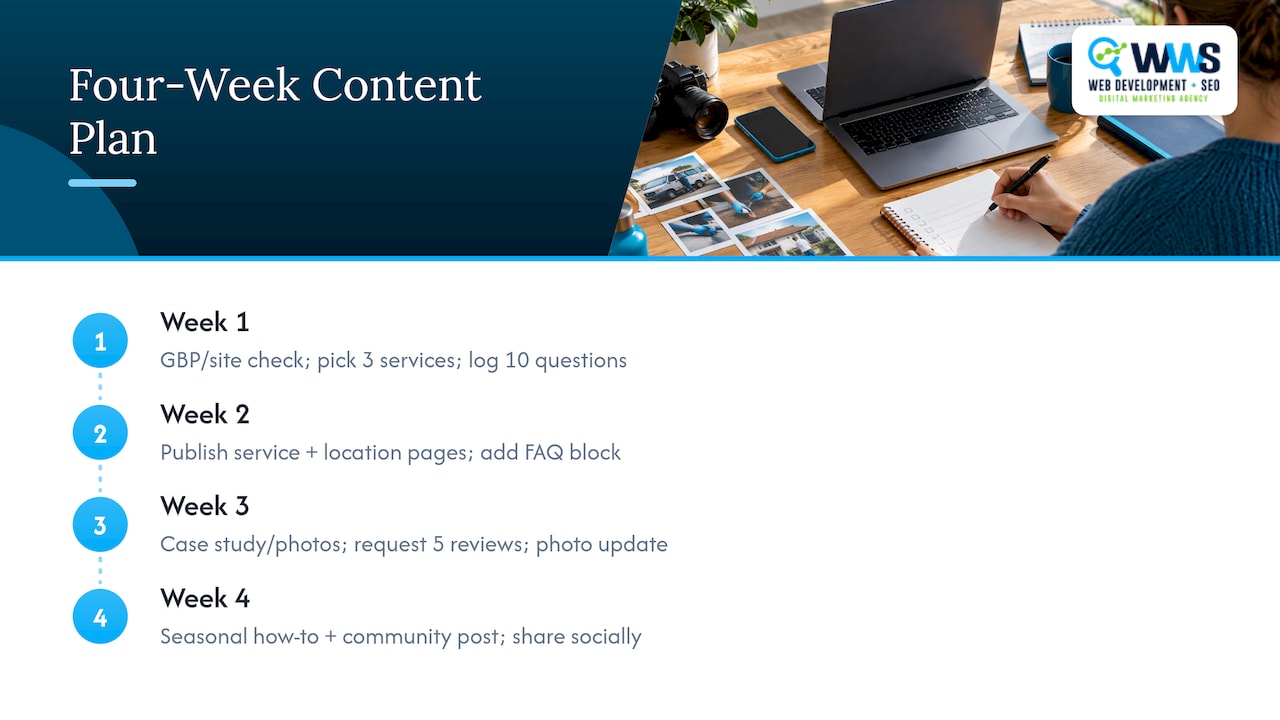
Week 1: Foundation. Confirm your Google Business Profile information is complete and consistent with your website. Pick your top three services. Write down the ten questions customers ask most.
Week 2: Core pages. Publish or rewrite one service page and one location page for your best-margin service and your busiest area. Add an FAQ block drawn from the ten questions.
Week 3: Proof. Publish one case study with photos and request reviews from your last five customers. Post a profile update with one of the photos.
Week 4: Seasonal and community. Publish one seasonal how-to for the next season and one community post about an event or partner. Share both on your social channels.
Then repeat with a different service and a different suburb. Within a quarter you will have a dozen useful pages, not a pile of filler.
Perspective: why local content works best when it is built into the site
We see the same pattern with local service businesses across the Chicago area: content that lives in a separate blog and never connects to the pages where customers decide tends to produce traffic without calls.
Our approach is to treat content, site structure and Google Business Profile as one system. The service page holds the offer, the location page proves you serve the area, the case study proves the work, and the profile and social posts bring people back to those pages. Because design, programming and SEO are handled in-house by one team, those pieces are planned together rather than passed between vendors.
We would rather you publish fewer, more specific pieces tied to a phone call than dozens of generic posts. Every page should have a reason to exist and a next step for the reader.
Online Marketing Experts
Measuring whether local content brings leads
Publishing without measuring is guessing. Track a small set of numbers monthly.
- Review volume and rating.
- Local and organic visibility trends.
- Search Console traffic.
- Website visits and conversions.
- Business Profile website clicks, calls, direction requests, views and bookings.
That list follows Search Engine Land’s guide to local SEO metrics, which also notes that Google local rankings vary by the searcher’s location. So watch trends over time instead of chasing a single number-one position. A page that ranks third in Naperville and eighth in Joliet is behaving normally.
Two habits make the data useful:
- Tag your links. UTM parameters on links from your profile, emails and social posts show which channel sent a call or form. BrightLocal’s measurement guide recommends UTM parameters and prioritizing conversions over rankings alone.
- Track calls. For many service businesses the phone is the conversion. Our GBP call tracking guide explains how to see which sources produce calls.
Visibility is only an intermediate result. Impressions need to become clicks, calls, forms, bookings or sales, and that is what you judge content by.
Common mistakes to avoid
- Duplicate location pages. Swapping the city name is not local content.
- Posting without a goal. Each piece needs one next step: call, book, request a quote.
- Inconsistent business details. A different phone number or hours on your site and your profile creates confusion for customers and for search engines.
- Ignoring reviews. Unanswered feedback undercuts good content.
- Publishing once and stopping. Local content pays off through steady, modest effort over months.
Let us build the content engine with you
WWS is a Des Plaines, Illinois agency serving the greater Chicago area. Our team of Google and Meta certified specialists handles design, programming, SEO and local optimization in-house, so your website, Google Business Profile and content plan work as one. If you want a plan built around your services and suburbs, start with our local SEO service or contact us through our site.
We also build the pages these ideas depend on, from service and location pages to Google Business Profile optimization, and can set up the tracking that shows which content brings calls.
FAQ
How often should a local business publish content?
Consistency matters more than volume. One useful piece a week, or even two a month, beats a burst followed by silence. Rotate between service pages, case studies, seasonal how-tos and community posts so the site keeps growing in useful ways.
What is the easiest local content to start with?
Start with an FAQ section on your main service page, built from questions customers already ask you by phone. It takes an afternoon, uses your own knowledge and speaks to buyers close to a decision. Next add one case study with photos from a recent job.
Does local content help with Google Business Profile rankings?
A complete, accurate profile helps Google match you to relevant searches, according to Google’s own guidance. Content on your website and consistent posts, photos and reviews support that profile by showing what you do and where. Rankings still vary by searcher location, so track trends.
How do I find local keywords without paid tools?
Type your service plus a suburb into Google and note the Autocomplete suggestions and People Also Ask boxes. Add the phrases customers use in calls, emails and reviews. If the results show a map pack, the search has local intent and deserves its own page.
How do I know if my content is working?
Look at calls, direction requests, form fills and bookings, not just traffic. Compare them month over month using Business Profile data, Search Console and your website analytics. UTM tags and call tracking show which content sent each lead.
Sources
- Post, Engage, Grow: A Social Media Primer, MU Extension
- Local Keyword Research, Search Engine Land
- Tips to improve your local ranking on Google, Google Business Profile Help
- Local Marketing Guide, Search Engine Land
- Key Metrics for Local SEO Success, Search Engine Land
- Metrics that Matter: How to Measure Your Local SEO Success, BrightLocal
- Testimonial and Review UGC Videos
Recommended
A Des Plaines, IL team helping local service businesses get found, get called and get booked since 2005: local SEO, Google Ads, conversion-focused websites and AI search optimization.
Meet the teamKeep reading
All articles
Keyword Rank Checker Website Guide: Stop Guessing Your Google Positions
Stop guessing your Google positions - use a keyword rank checker website to track SERP rankings, spot drops, and boost local SEO for Chicago small businesses.
Contractor Website Checklist: 40 Checks Before You Go Live
A contractor website checklist covering trust, service pages, calls, mobile speed, local visibility and lead tracking, so your site turns visitors into estimates.

SEO Pricing in Chicago: What to Expect and How to Budget
What SEO costs in the Chicago market: monthly retainers, hourly and project rates, what drives the price, and how Iowa businesses can compare proposals.