





The five directories that matter most for Chicago businesses right now are the City of Chicago Data Portal, the City of Chicago Certified Firms Directory for government work, BBB of Chicago & Northern Illinois, a neighborhood-capable platform like BizPulse, and a major aggregator such as Dun & Bradstreet. Before you claim a single listing, lock down one consistent name, address, phone number, and website (your NAPW) and use it everywhere.
TL;DR:
- Claim the City of Chicago Data Portal, BBB, neighborhood directories, and the certified firms directory for city contracts, prioritizing high authority and neighborhood filtering.
- Standardize your business name, address, phone number, and website across all listings to prevent confusion and improve local SEO signals.
- Focus your efforts on a few key directories, claiming and verifying them quickly to maximize the impact on search visibility and customer trust.
- Beware of duplicate listings; maintaining accurate, consistent data minimizes errors that could harm your local search rankings.
- For comprehensive management, consider professional services that audit, correct, and optimize your listings across all relevant platforms.
Table of Contents
- Top Chicago Business Directories to Claim and Why Each Matters
- How to Prioritize Directories When Time Is Tight
- Getting Your Business Data Consistent Across Every Listing
- Certification and Government Contracting: A Separate Track Entirely
- What Directory Listings Actually Do for Local Search
- What Auditing Chicago Listings Actually Teaches You
- Let WWS Handle Your Chicago Directory Cleanup
- Sources
- FAQ
Top Chicago Business Directories to Claim and Why Each Matters
Every directory on this list plays a different role. Skip one and you leave a gap in how Chicago customers, and Google, verify that your business is real.
The City of Chicago Data Portal is the closest thing to an official record of your business in the city. Its Chicago Registered Business dataset pulls directly from city files and updates daily, so a search-and-confirm check here tells you exactly how the city has you on file, before a customer or a contract officer finds a discrepancy first.
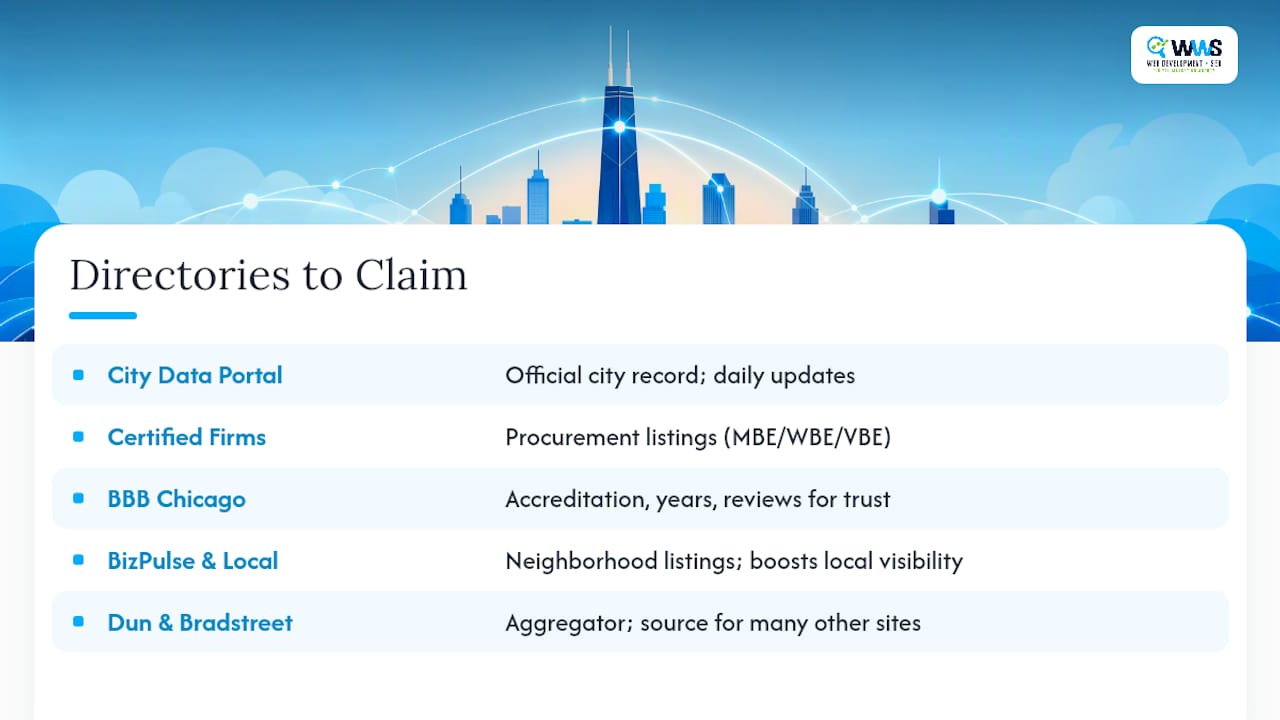
The City of Chicago Certified Firms Directory matters if you have any interest in public-sector work. It lists firms holding MBE, WBE, VBE, or BEPD certification and lets procurement staff filter by certification type, commodity code, and location. A general consumer listing does not substitute for this.
BBB of Chicago & Northern Illinois builds a different kind of trust. A BBB profile typically shows accreditation status, years in business, incorporation details, and customer reviews, all of which give a hesitant homeowner or new client a reason to pick up the phone.
BizPulse and neighborhood directories solve a problem the big platforms often ignore: Chicago is not one market, it is dozens. BizPulse sources its listings from City of Chicago open data and lets people browse by neighborhood, which means a Lincoln Square plumber shows up to Lincoln Square searchers instead of getting buried under citywide noise.
Dun & Bradstreet and similar aggregators work behind the scenes. D&B alone lists over 216,000 businesses in Chicago, and because so many smaller directories and apps pull their data from aggregators like this one, a wrong phone number here can quietly propagate errors across the web for months.
How to Prioritize Directories When Time Is Tight
You do not need to claim every directory on the internet. You need the right five or six, ranked by actual payoff.
Score each candidate directory on five factors, using a simple high, medium, or low rating:
- Authority. Does it come from a government agency, an established aggregator, or a recognized consumer brand like BBB?
- User intent. Are people using it to find a business to hire, or just browsing?
- Neighborhood reach. Can customers filter by area, the way BizPulse allows browsing across Chicago’s neighborhoods?
- Syndication impact. Will fixing this listing correct data elsewhere, the way D&B feeds other platforms?
- Time and cost to claim. Some listings take ten minutes; others require documentation and a review period.
A contractor bidding on city projects should rank the Certified Firms Directory above everything else. A restaurant chasing walk-in traffic should prioritize BBB and neighborhood-filterable platforms. A home service provider covering multiple ZIP codes benefits most from the city data portal plus a neighborhood directory.
Pro Tip: Budget one focused afternoon for the top three directories before you touch anything else. Claiming and verifying a listing usually takes 15 to 30 minutes once your NAPW is locked; certification applications and BBB accreditation take considerably longer and are worth paying an outside service to manage if your calendar is already full.
Getting Your Business Data Consistent Across Every Listing
Inconsistent listings confuse customers and search engines alike. Fix the source data before you fix the platforms.
Start by locking your primary NAPW, meaning the exact name, address, phone number, and website you will use on every single directory going forward, along with one primary business category. If you operate under a DBA, decide now whether the DBA or the legal name appears publicly, and stay consistent. Service-area businesses without a public storefront need to decide how they will represent their coverage area rather than a street address, and multi-location businesses need a distinct, correctly filed listing for each address.
From there, run a four-step maintenance cycle:
- Audit every listing you can find, recording current name, address, phone, hours, and category for each.
- Claim and verify ownership on each priority directory, starting with the highest-authority ones.
- Update fields like hours, service lists, and photos so nothing reads as stale.
- Recheck monthly, since directories occasionally revert to old data during automated syncs.
Pro Tip: Duplicate listings are the most common local SEO problem WWS finds during audits. An old phone number sitting on a secondary listing can quietly send calls to a disconnected line for years, and a mismatched abbreviation, like “St.” on one directory and “Street” on another, can be enough to weaken how confidently Google links your listings together.
Certification and Government Contracting: A Separate Track Entirely
Government contracting runs on a different set of rules than consumer directories, and no amount of BBB reviews substitutes for it.
To count toward city contract goals, a business needs formal registration and certification through the city’s Certification and Compliance System, not just a general business listing. The certified firms directory is the authoritative source procurement officers check, and it recognizes four designations:
- MBE (Minority Business Enterprise)
- WBE (Women Business Enterprise)
- VBE (Veteran Business Enterprise)
- BEPD (Business Enterprise for People with Disabilities)
This path matters most for businesses actively pursuing city contracts or supplying larger firms working on municipal projects. Certification requires documentation, ownership proof, and incorporation records, so start early and treat it as a separate project from your consumer-facing directory work.
What Directory Listings Actually Do for Local Search
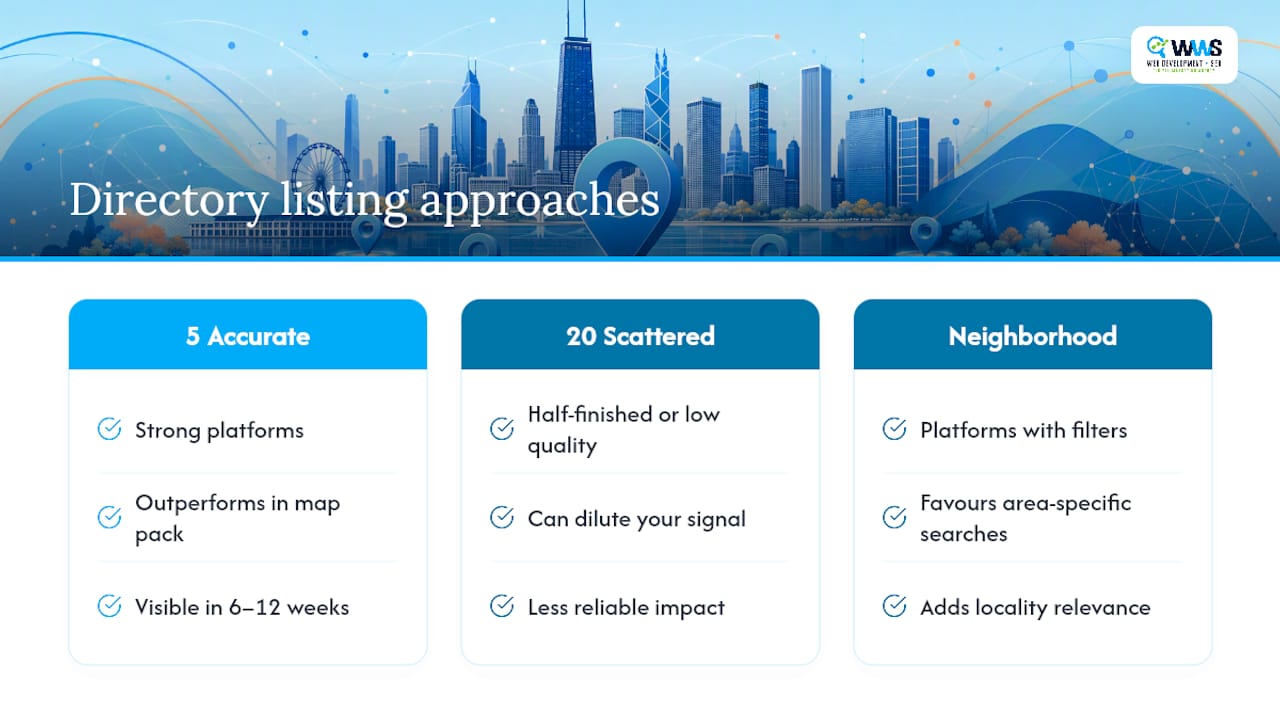
Consistent, authoritative citations feed Google’s confidence in your business location and category, which directly affects whether you show up in the local map pack. Quality beats quantity here: five accurate listings on strong platforms outperform twenty scattered, half-finished ones, and over-submitting to low-quality directories can dilute the signal rather than strengthen it.
Neighborhood-level listings add a second layer. A search for “roofing in Lincoln Park” favors businesses whose data ties them clearly to that area, which is exactly what platforms with neighborhood filtering are built to support.
Track results through calls, direction requests, website visits from your Google Business Profile, and any leads you can trace back to a specific directory. Most well-managed listing work shows measurable movement in map-pack visibility within six to twelve weeks, though a heavily contested category, like personal injury attorneys or HVAC repair, may take longer to shift. Pair this work with a broader local SEO strategy rather than treating directories as a standalone project, and read more on why local SEO matters for lead generation if you want the fuller picture.
What Auditing Chicago Listings Actually Teaches You
Across more than 200 client engagements in the Chicago area, the same problem shows up again and again: businesses have three or four versions of their own name floating across the web, and nobody noticed until leads started drying up. The fix is rarely glamorous. It is standardizing one NAPW, correcting the aggregator record, and letting that accuracy ripple outward. Start with the city portal and your Google Business Profile, then expand to BBB and a neighborhood directory. Businesses that follow that order see cleaner map-pack presence and fewer misdialed calls within weeks, not months.
— Online Marketing Experts
Let WWS Handle Your Chicago Directory Cleanup
WWS – Web Development + SEO is the alternative to piecing this together yourself, one login and one form at a time, across five different platforms with five different verification processes. We audit your existing listings, correct the aggregator-level errors that quietly spread bad data, and build out the citation consistency that Chicago’s local search results reward.
Our Local SEO service covers exactly the work this article walks through: citation audits, Google Business Profile optimization, and ongoing listing maintenance so your NAPW stays locked across every platform that matters. Clients typically see cleaner map-pack placement and more accurately routed phone calls once the cleanup is complete. As an official Google and Meta Partner with a fully in-house team, we handle it directly rather than outsourcing pieces to subcontractors. If you run a contracting business specifically, our guide to SEO for contractors in Chicago covers additional tactics worth pairing with directory work. Ready to get your listings audited? Visit our Local SEO page to see how we structure the work and get started.
Sources
- Chicago Registered Business | City of Chicago | Data Portal
- City of Chicago certification and certified firms directory
- Better Business Bureau (BBB) of Chicago & Northern Illinois
- Chicago Business Directory | BizPulse
- Chicago business directory | Dun & Bradstreet
FAQ
What Are the Best Chicago Business Directories to Start With?
Start with the City of Chicago Data Portal, BBB of Chicago & Northern Illinois, and a neighborhood-capable directory like BizPulse. If your business seeks government contracts, add the City of Chicago Certified Firms Directory immediately.
How Long Does It Take to Claim a Business Listing in Chicago?
Most standard directory listings take 15 to 30 minutes to claim once your business name, address, phone number, and website are standardized. Certification through the city’s Certification and Compliance System takes considerably longer because it requires ownership and incorporation documentation.
Do I Need to Be BBB Accredited to Appear in Chicago Business Listings Online?
No, a business can appear on a BBB profile without full accreditation, though accredited profiles typically display stronger trust signals like verified years in business and higher ratings. Accreditation is a separate, optional step businesses can pursue once their basic profile is claimed.
How Does WWS Help With Chicago Business Directory Management?
WWS – Web Development + SEO audits existing listings, corrects inconsistent data across aggregators, and optimizes Google Business Profiles as part of its Local SEO service. Current pricing details are available on the pricing page of the provider’s website.
What Happens if My Business Information Is Inconsistent Across Directories?
Inconsistent name, address, or phone data across directories weakens the local search signals Google uses to confirm your business location, which can hurt map-pack rankings. It also risks sending customers to outdated contact information, particularly when an aggregator like Dun & Bradstreet syndicates the error to other platforms.