





If you fix one thing this week, fix your Google Business Profile, then publish one high-intent service page like “AC Repair [Your City]” with a tappable phone number in the first screen. That single move, done correctly, tends to move the needle faster than any other HVAC SEO tactic because most contractor profiles are incomplete and most contractor websites still run on one generic “Services” page.
The verdict up front: SEO is the highest-ROI channel available to HVAC contractors when Google Business Profile and service pages are built correctly. It costs less per lead than paid search over time, and it keeps generating calls long after you stop actively working on it.
Here’s what to do today, in order:
- Claim, verify, and fully complete your Google Business Profile, including the correct primary category, service list, and service-area settings.
- Publish one dedicated service page targeting your top revenue service and your primary city (not a generic “Services” page).
- Set up a direct review link and send it to your last 10 completed jobs.
- Install a call-tracking number so you can see which leads actually came from search.
Contractors who fix their GBP category, publish one true service page, and start collecting reviews consistently typically see local pack movement within 90 days. The businesses that skip these three basics are the same ones stuck on page two a year later.
If you’d rather hand this off entirely, an agency can run this full rollout while you keep running service calls. Either path works. What doesn’t work is doing nothing while a competitor three miles away claims the Map Pack.
Key Takeaways
HVAC SEO works when Google Business Profile optimization, dedicated service pages, and consistent review velocity are executed together and measured through call tracking rather than traffic alone.
| Point | Details |
|---|---|
| Fix GBP first | Set the correct primary category, complete every service, and hide your address if you’re service-area only. |
| Build real service pages | Create one page per service and unique, locally substantive pages per city to avoid doorway page penalties. |
| Automate review requests | Use a direct review link sent within an hour of job completion to boost response rates significantly. |
| Track calls, not just clicks | Install call tracking and CRM lead-source fields so you can calculate true cost per booked job. |
| Budget for the real timeline | Expect GBP wins in 30-90 days and competitive metro rankings in 9-15 months. |
| Choose an agency with HVAC proof | Wizerunekwsieci offers audits, service-specific reporting, and a documented process built for contractors, not generic small business templates. |
Table of Contents
- Why HVAC SEO Matters More Than Most Marketing Spend
- What Are the Core HVAC SEO Strategies That Actually Move Rankings?
- What Technical Fixes Does an HVAC Website Need to Rank?
- How Do You Measure Whether HVAC SEO Is Working?
- How Much Does HVAC SEO Cost and How Long Until It Works?
- How Do You Choose an HVAC SEO Agency Without Getting Burned?
- How Does an HVAC SEO Campaign Actually Run Month to Month?
- Ready to Turn Local Search Into Booked Jobs?
- Sources
Why HVAC SEO Matters More Than Most Marketing Spend
The math is not close. Established HVAC SEO programs typically produce leads at a lower cost per lead compared to Google Ads campaigns, according to pipeline and CPL data tracked across HVAC accounts. Industry data covering a large number of HVAC companies found a strong median SEO return on investment. That’s not a one-time spike. It’s what happens when organic rankings compound month over month instead of shutting off the moment you pause a budget.
Paid ads work. They just work differently. You pay for visibility every single click, and the moment the budget stops, so does the phone. Organic rankings behave more like an asset: they keep producing calls at 2 a.m. when someone’s furnace dies in January, without a fresh invoice attached to that lead.
The Map Pack, the three-listing block that appears above organic results for local searches, captures a significant share of clicks on local HVAC queries, per Astra’s 2026 HVAC SEO analysis. Local Services Ads now sit in position zero, above even the Map Pack, for many emergency search types. That means the real estate you’re fighting for isn’t just “page one.” It’s the top three inches of a phone screen.
A few numbers worth sitting with:
- Organic HVAC leads tend to convert better than cold paid clicks, because searchers who scroll past ads to click an organic or Map Pack listing are often doing more research and are closer to booking.
- The difference in cost per lead between SEO and paid search compounds notably at higher lead volumes, leading to substantial savings in acquisition costs.
- Local ranking factors for service-area businesses are primarily influenced by proximity, GBP signals, review signals, and on-page relevance, according to research on contractor local SEO. Get those three right and you’ve captured most of the available ranking potential.
Paid ads and SEO aren’t competitors here. They’re complementary. But if you have to choose where the next dollar goes, the data points toward SEO first, LSAs second, and traditional Google Ads as a supplement once the organic foundation exists.
What Are the Core HVAC SEO Strategies That Actually Move Rankings?
This is the checklist. Not a philosophy. An order of operations that HVAC contractors can follow without a marketing degree.
1. Fix your Google Business Profile first. The primary category field is the single most impactful setting in your entire GBP, according to Nopio’s contractor SEO checklist. Select the primary category that accurately reflects your HVAC services. If you’re a service-area business without a public storefront, hide your address and list your service areas by city or ZIP instead. Fill out every service you offer in the Services section, post weekly updates with real job photos, and set up a direct review request link, as it significantly improves review collection compared to indirect methods.
2. Build a hub-and-spoke site architecture. One page per service. “AC Repair,” “Furnace Installation,” “Duct Cleaning,” and “Emergency HVAC Service” each get their own page, not a paragraph buried on a shared “Services” page. Then layer service-area pages beneath that structure. If you serve six cities, you need service-area pages for each, but Google’s own guidance on doorway pages warns that pages built only by swapping city names without real local value risk getting filtered out entirely.
3. Make every service-area page earn its place. Include real driving directions from that city to your shop, mention specific neighborhoods, reference local weather patterns that affect HVAC demand, and if possible, cite a real customer story from that area. Thin, templated city pages are the number one reason contractor SEO campaigns stall.

4. Write content around seasonality and high-intent phrases. HVAC search demand spikes hard around heat waves and cold snaps. Publish seasonal promos ahead of those windows: spring AC tune-up specials in March, furnace safety checks in October. Build FAQ blocks with 40 to 60 word direct answers, structured so AI Overviews and featured snippets can pull them cleanly. A question like “How much does AC repair cost in [city]?” answered in two tight sentences performs better for both readers and AI summarization than a 300-word essay.
5. Build review velocity, not just review count. Reviews function as a ranking signal and a conversion signal simultaneously. Set a target, five to ten new reviews per month, and automate the ask through a text or email sent within an hour of job completion. Respond to every review, including negative ones, within 48 hours.
6. Audit your citations for NAP consistency. Your Name, Address, and Phone number must match exactly across every directory: Yelp, Angi, Nextdoor, the Better Business Bureau, and industry-specific directories. Inconsistent NAP data confuses Google’s local ranking algorithm and erodes trust signals.
7. Build local links deliberately. Sponsor a Little League team, join your local chamber of commerce, get listed by manufacturers you’re certified to install (Carrier, Trane, Lennox dealer locators all count), and pursue trade association placements through groups like ACCA.
8. Layer in paid where it fills a gap. Run Local Services Ads for emergency, high-urgency searches where you need instant visibility while your organic rankings mature. Use standard Google Ads sparingly to fill seasonal demand spikes your organic content hasn’t caught up to yet.
Pro Tip: Set up your Google Business Profile posts on a recurring weekly calendar reminder. Contractors who post consistently for 90 days almost always outrank competitors who posted once and forgot about it.
For contractors managing multiple service areas, the local SEO for contractors guide walks through how city-specific pages should be structured to avoid the doorway page trap while still ranking for each market you serve.
What Technical Fixes Does an HVAC Website Need to Rank?
Rankings and conversions both die quietly on slow, broken websites. Most contractor sites fail a small, predictable set of technical checks, and fixing just three of them, incomplete GBP data, one generic services page, and inconsistent NAP, tends to produce the largest early gains, according to Nopio’s audit findings across hundreds of contractor sites.
Run through this before anything else:
- Core Web Vitals: Google measures loading speed, interactivity, and visual stability. Sites that load slowly tend to lose a notable number of mobile visitors before key contact information appears on screen.
- Mobile-first design: Most HVAC searches happen on a phone, often in a moment of urgency. Tap targets for your phone number need to be large enough to hit with a thumb, not a stylus.
- Tappable phone numbers: Every page, especially service and service-area pages, needs a click-to-call number visible without scrolling.
- Schema markup: Add LocalBusiness schema with your NAP data, Service schema for each service page, Review schema to surface star ratings in search results, and FAQ schema on your answer blocks. Job-level schema, the kind tools like DataPins generate automatically for each completed job with photos and location data, adds fresh, geographically specific structured data that helps both local rankings and AI Overview citations.
- Crawlability basics: A clean XML sitemap submitted through Search Console, a properly configured robots.txt, canonical tags to prevent duplicate content issues, and no broken redirect chains.
A quick statistic worth remembering: sites that pass Core Web Vitals thresholds see meaningfully better mobile engagement, and for an HVAC business, mobile engagement is the phone ringing. Test your site through PageSpeed Insights and Lighthouse, then confirm indexing status through Google Search Console. If your homepage hasn’t been recrawled in over a month, that’s a red flag your technical foundation needs attention before you invest further in content.
How Do You Measure Whether HVAC SEO Is Working?
You track five numbers, and if you’re not tracking them yet, that’s the gap costing you the ability to prove ROI to yourself.
- GBP calls and direction requests, visible directly in your Google Business Profile dashboard, showing how many people called or navigated to you straight from the Map Pack.
- Organic phone calls, tracked through a dedicated call-tracking number placed only on organic and GBP touchpoints, separate from your paid ad number.
- Form submissions attributed to organic traffic, tagged through GA4 events and UTM parameters so you know which channel actually drove the lead.
- Booked jobs tied back to organic source, which requires a lead-source field in your CRM that your dispatch team actually fills out consistently.
- Review velocity and impressions/clicks split between discovery searches (someone searching “AC repair near me” who hasn’t heard of you) and direct searches (someone searching your business name specifically), both visible in Search Console and your GBP insights panel.
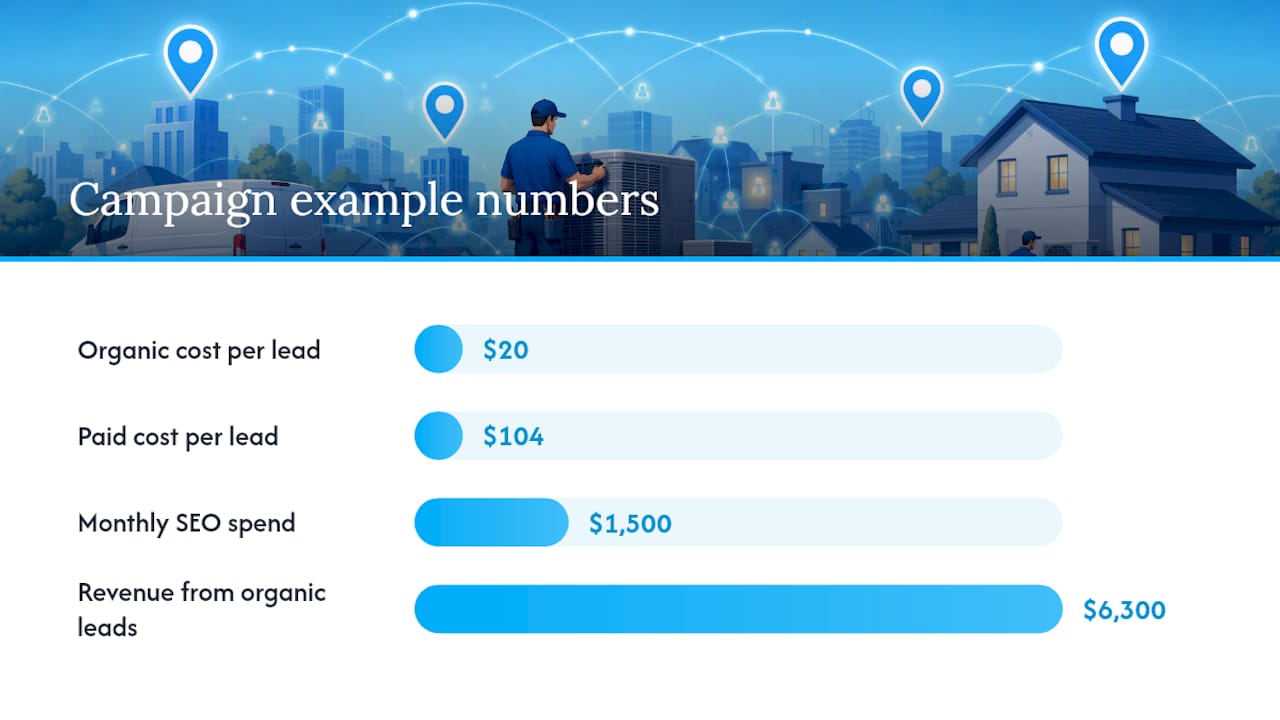
Here’s a simple ROI example. Say you’re spending $1,500 a month on an SEO retainer and generating 40 organic leads at a $20 average cost per lead once the campaign matures. At an average ticket of $450 for standard service calls, that’s $6,300 in revenue against $1,500 in spend, a return before accounting for install jobs, which run far higher in ticket value. Compare that to a paid channel at $104 per lead: the same $1,500 buys roughly 14 clicks, not 40, and the close rate math shifts accordingly.
Set up your reporting stack once and it runs itself: Google Analytics for behavior and conversion events, Search Console for query and impression data, a call-tracking provider (CallRail and similar tools are common in this space) for phone attribution, and a CRM field that ties every booked job back to its original lead source. The comprehensive local SEO guide covers the measurement routine in more depth if you want to build this reporting stack from scratch.
How Much Does HVAC SEO Cost and How Long Until It Works?
Pricing varies by market competitiveness, your current review backlog, the health of your existing website, and how many service and city pages you actually need. But the ranges below hold true across most metro and suburban HVAC markets.
A few variables shift these numbers meaningfully:
- Market competitiveness: A contractor in a mid-size Florida metro with a dozen established competitors needs a heavier content and link investment than one in a smaller Midwest market with less competition.
- Review backlog: Starting with zero reviews takes longer to build trust signals than starting with 40 reviews and just needing consistent velocity.
- Website health: A rebuild is sometimes cheaper long-term than trying to patch technical debt on an outdated site, which is why some HVAC SEO retainers bundle in a website design refresh rather than layering content onto a broken foundation.
- Number of service and city pages required: A contractor serving three cities needs far less content investment than one serving twelve.
GBP-only wins, meaning Map Pack visibility improvements from profile optimization alone, typically show up in 30 to 90 days. Broader local pack movement across competitive keywords usually takes 3 to 9 months. Genuinely competitive metro markets can take 9 to 15 months to reach page-one dominance. Anyone promising faster than that in a competitive market is either overselling or targeting keywords with no real search volume.
How Do You Choose an HVAC SEO Agency Without Getting Burned?
Ask these questions before you sign anything, and pay close attention to how directly they get answered.
- Can you show me before-and-after GBP rankings or Map Pack screenshots from an actual HVAC client, not a general contractor or a different trade?
- What does your monthly reporting look like, and can I see a sample report before I commit?
- Do you provide call tracking and job-level reporting, or just traffic and ranking numbers?
- What’s your approach to link building, and can you name the types of sites you target?
- How do you handle review generation, and is it automated or dependent on my staff remembering to ask?
- What happens if I want to cancel, and is there a lock-in period?
Red flags that should end the conversation immediately:
- Guaranteed rankings. No one controls Google’s algorithm. An agency promising a specific ranking position by a specific date is either lying or doesn’t understand the business.
- Vague link-building explanations. If they can’t describe where links come from, they may be using low-quality link networks that risk a future penalty.
- No phone tracking or job-level reporting. If the only metric offered is “traffic went up,” you have no way to verify actual leads or revenue.
- Secretive process. A legitimate agency explains its methodology. One that treats its process as a trade secret is usually hiding a lack of ones.
Pro Tip: Ask for a trial period of 60 to 90 days with clearly defined deliverables rather than committing to a year upfront. A confident agency will offer this without pushback.
Recommended contract terms to look for: a defined trial or initial evaluation window, specific monthly deliverables spelled out in writing (not just “SEO services”), a reasonable cancellation notice period (30 to 60 days is standard), and a clear process for scope changes if you add new service lines or cities. The local SEO services overview breaks down what a properly scoped engagement should include from the first month onward.
How Does an HVAC SEO Campaign Actually Run Month to Month?
The process follows a consistent sequence regardless of market size. Discovery first: a technical audit, GBP audit, competitor gap analysis, and keyword research specific to the services and cities you actually operate in. Then GBP and technical fixes get handled in parallel, since both are foundational and neither takes long to execute once decided. Content and city pages come next, built one service and one city at a time rather than all at once, since search engines reward steady publication over sporadic bulk uploads. A review velocity program runs continuously starting in month one. Local link building layers in around month two or three, once there’s enough content on the site worth linking to. Then it’s measurement and iteration, month over month, adjusting based on what Search Console and call tracking actually show.
| Month | What Owners Should See in Reporting |
|---|---|
| Month 1 | GBP fully optimized, technical audit complete, first service pages live, review request system activated |
| Month 3 | Early Map Pack movement on lower-competition terms, review count trending up, first city pages published, initial call volume increase |
| Month 6 | Measurable ranking gains on primary service keywords, consistent review velocity, call tracking showing organic-attributed booked jobs, clear month-over-month lead trend |
Contractors who see genuine SEO gains almost always have one thing in common: their GBP was completely filled out and actively maintained from day one, not treated as a one-time setup task and forgotten.
Trust signals worth expecting from any agency you work with include documented before-and-after case studies specific to HVAC clients, sample call-tracking and reporting screenshots you can review before signing, client references you can actually contact, and relevant certifications or partnerships, Google Partner status among them, that indicate ongoing platform training rather than outdated tactics.
A Note on Common Mistakes and What Actually Works
The most common mistake owners make isn’t skipping SEO entirely. It’s treating Google Business Profile as a one-time setup task instead of a living asset that needs weekly attention. Owners fill it out once, never post again, and wonder why a competitor who posts weekly and answers every review outranks them within a year.
The second mistake is building city pages that all read identically with the city name swapped out. Google’s doorway page guidance exists precisely because this tactic used to work and now actively backfires. A service-area page needs real local substance, or it’s better not to publish it at all.
What actually works is unglamorous: a complete GBP, one real page per service, consistent reviews, clean technical fundamentals, and patience through the 3 to 9 month window where most of the compounding happens. If you want a second opinion on where your current setup stands, a quick audit conversation costs nothing and usually surfaces the one or two fixes worth prioritizing first.
Ready to Turn Local Search Into Booked Jobs?
Wizerunekwsieci is the alternative to guessing your way through GBP settings and generic website templates. Where a DIY approach means learning schema markup and citation audits on your own time, and a big-box agency means a call center reading from a script, Wizerunekwsieci builds and manages the entire HVAC local SEO stack, GBP optimization, service and city pages, technical fixes, and review systems, under one roof, with reporting you can actually read.
The initial engagement starts with a straightforward audit: a review of your current Google Business Profile, your site’s technical health, and where your competitors are beating you in the Map Pack. From there, the work follows the same sequence covered above: fix the foundation, build the content, grow reviews, and report the results monthly in plain numbers, calls, form fills, and booked jobs, not just traffic charts. Wizerunekwsieci has run this exact playbook for over 200 local service businesses across Illinois, Indiana, and Florida, including HVAC contractors and other trades competing for the same Map Pack real estate.
If your GBP hasn’t been touched in months or your website still runs on one “Services” page, that’s the starting point. Book a website SEO consultation and get a straight answer on what’s blocking your rankings and what it would take to fix it.
Sources
Start with Google Business Profile itself for claiming and managing your listing, then verify indexing and crawl health through Google Search Console. Use PageSpeed Insights for technical speed audits before and after any site changes. For review generation mechanics and the direct-link method, the contractor local SEO playbook covers the setup in detail. Trade publishers like ServiceTitan’s HVAC SEO coverage are useful for keyword and seasonal search pattern research specific to the trade, while ACCA offers broader industry context worth folding into seasonal content planning. For reporting frameworks that tie rankings back to actual revenue, the local SEO guide for businesses walks through the full measurement setup end to end.