





Local data aggregators collect your business name, address, phone number, hours, and category details, then distribute that record to the directories, map platforms, and voice assistants that pull from them. They are worth using when you manage several locations, update information often, or need one feed to reach many publishers at once. A single location with stable hours and a short list of niche directories often does fine with manual updates instead.
TL;DR:
- Using an aggregator is beneficial for multi-location businesses with frequent updates, but those with stable, single-location profiles may prefer manual management.
- Different aggregator networks have unique correction processes, so identifying and contacting the source network often results in faster fixes.
- Maintaining a standardized, canonical data record and performing regular audits can prevent propagation of errors and duplicate listings across directories.
- Choosing the right aggregator depends on coverage, update speed, technical capacity, and verification requirements tailored to business needs.
- Automated, machine-learning-assisted validation tools are increasingly used to improve data accuracy and enable real-time updates for businesses with dynamic information.
Table of Contents
- What is a local data aggregator and how it works
- Main aggregator networks to know and what each does
- How aggregators affect local SEO and discovery
- When to use aggregators and when to manage citations manually
- Practical workflow: prepare, submit, and verify data via aggregators
- Tools and audits to spot aggregator-driven errors and keep citations synced
- How a managed local marketing partner handles aggregator-driven citations
- The process and criteria by which local data aggregators collect, verify, and distribute data
- The impact of aggregator data quality on local business reputation and consumer trust
- Legal and privacy considerations related to data aggregation and use
- Emerging trends and technologies in local data aggregation, such as AI and real-time updates
- How to evaluate and choose between different local data aggregators based on business needs and coverage
- Practitioner perspective: repeated errors and quick wins from in-house experience
- If you want help: WWS local data and citation services
- Sources
- FAQ
What is a local data aggregator and how it works
A local data aggregator is a company that gathers business profile data (name, address, phone, hours, categories, website URL, and attributes like “wheelchair accessible” or “outdoor seating”) from businesses and partners, then syndicates that data to the directories, maps, and apps that license it. The concept sits inside the broader practice of data aggregation, which simply means collecting and summarizing information from multiple sources into a usable format.
Aggregators ingest data three main ways: direct submissions from business owners, partner feeds from platforms that already hold verified records, and web crawls that pick up listings from public pages. Once ingested, the data flows out through syndication endpoints: directory sites, mapping services, and increasingly voice assistants that read business details aloud.
Two technical details matter more than most owners realize. First, aggregators assign unique IDs to each location, which is how they tell your Main Street store apart from a franchise with the same name three towns over. Second, feeds come in two forms: a full snapshot that replaces the entire profile, or an incremental update that changes only specific fields. Google’s own profile feed documentation describes exactly this distinction, along with field-size limits and formatting rules that exist to keep bad data out.
Main aggregator networks to know and what each does
A handful of networks sit behind most of the directory listings and map results you will ever encounter. Knowing their names helps you trace a bad listing back to its source instead of chasing it across a dozen sites.
- Data Axle: a large business database licensed by many publishers; check here first when the same wrong detail shows up across unrelated directories.
- Foursquare (Places Pro / Places Premium): a point-of-interest dataset that feeds maps and apps, built using machine-learning validation alongside human review, according to Foursquare’s Places Pro schema documentation.
- Neustar Localeze / TransUnion Digital Business Profile: an enterprise-grade feed used by major publishers, common in business and financial directories.
- YP Network: a legacy directory and syndication network with roots in print Yellow Pages, still referenced by older listing sites.
- GPS Network: a mapping and navigation-focused feed; errors here affect routing and the pin location shown on in-car and mobile map apps.
Each network has its own correction process, so the fastest fix often means going straight to the source network rather than editing a downstream directory that will just re-sync the wrong data later.
How aggregators affect local SEO and discovery
Search engines and map platforms cross-reference your business details against multiple sources. When your name, address, and phone number match everywhere, that consistency removes a layer of doubt that can otherwise suppress a listing or split it into duplicates. When the data conflicts, the opposite happens: duplicate entries form, map pins drift, and the categories search engines use to decide which searches you should rank for get muddled.
Aggregators amplify whichever version of your data they hold. That is their main benefit and their main risk in the same mechanism.
- A correct canonical record spreads consistency to every publisher the aggregator feeds in one submission cycle.
- A wrong phone number or closed-location flag spreads just as fast, often faster than a human could catch it.
- Accurate categories and attributes improve how well your listing matches relevant local searches.
The Business Profile API lets you manage attributes, categories, and location data programmatically, according to Google’s Business Profile API reference, which means owners with multiple locations can push corrections at scale instead of editing listings one by one.
When to use aggregators and when to manage citations manually
Not every business needs an aggregator relationship. The right call depends on a few practical factors you can check in a few minutes.
- Count your locations. Having multiple active locations usually justifies the setup cost of an aggregator feed.
- Gauge your update frequency. Seasonal hours, frequent address changes, or rotating phone lines favor an aggregator over manual edits.
- Weigh your attribute needs. Businesses that rely on detailed attributes (accessibility, amenities, payment types) benefit from a single structured feed rather than re-entering the same fields on ten directory forms.
- Check your technical capacity. Feed setup takes some initial configuration; a single location with a simple, stable listing may not need it.
A single-location shop with steady hours and a handful of niche directory listings is usually better served by claiming and editing those listings by hand. A multi-location business juggling frequent changes gains more from a centralized feed than it loses in setup time.
Practical workflow: prepare, submit, and verify data via aggregators
Getting clean results from an aggregator relationship comes down to sequencing: fix your source data before you distribute it, not after.
- Build one canonical record. Standardize formatting (street abbreviations, suite numbering, phone format) and treat this single record as the only source of truth for every future update.
- Choose your submission method. A direct portal works for a single correction, a partner feed suits recurring bulk updates, and an API call makes sense when you need to update many locations on a schedule.
- Pick the right feed type. Use a snapshot feed for your first bulk sync, then switch to incremental feeds for day-to-day changes, since Google’s documentation notes incremental updates reduce processing overhead and make changes easier to trace.
- Verify propagation. Spot-check a sample of major publishers two to four weeks after submission and log what changed, since correction speed varies by network.
Pro Tip: Pick one phone number format, one way of writing “Suite” versus “Unit,” and one punctuation style for your address, then apply it everywhere. Mixed formatting is the single most common cause of duplicate listings.
Tools and audits to spot aggregator-driven errors and keep citations synced
Catching a propagation error early saves weeks of chasing it across directories later. A short, repeatable audit routine covers most of what goes wrong.
- Citation crawlers scan major directories for NAP mismatches across your listed locations.
- API-based monitors poll the Business Profile API or similar feeds to flag changes before they spread further.
- Map and POI checks confirm your pin location and routing data match your actual address.
- Manual sampling spreadsheets work fine for smaller businesses checking a handful of publishers quarterly.
Your audit checklist should cover name, address, phone, website URL, categories, hours, attributes, duplicate entries, and any third-party profile that was never claimed. When an error traces back to an aggregator network rather than a single directory, contact that network’s support channel directly instead of editing the downstream listing, which will likely revert on the next sync.
How a managed local marketing partner handles aggregator-driven citations
A managed approach to aggregator-fed listings generally follows four steps: building one canonical data record, configuring the feed or feeds that match your publisher mix, setting up ongoing monitoring, and running periodic audits to catch drift before customers notice it. This suits businesses that want the reliability without staffing the audit work themselves. WWS – Web Development + SEO is an official Google and Meta Partner, and its certified team handles this kind of citation and feed work alongside broader local SEO and Google Business Profile management for Chicago-area clients.
The process and criteria by which local data aggregators collect, verify, and distribute data
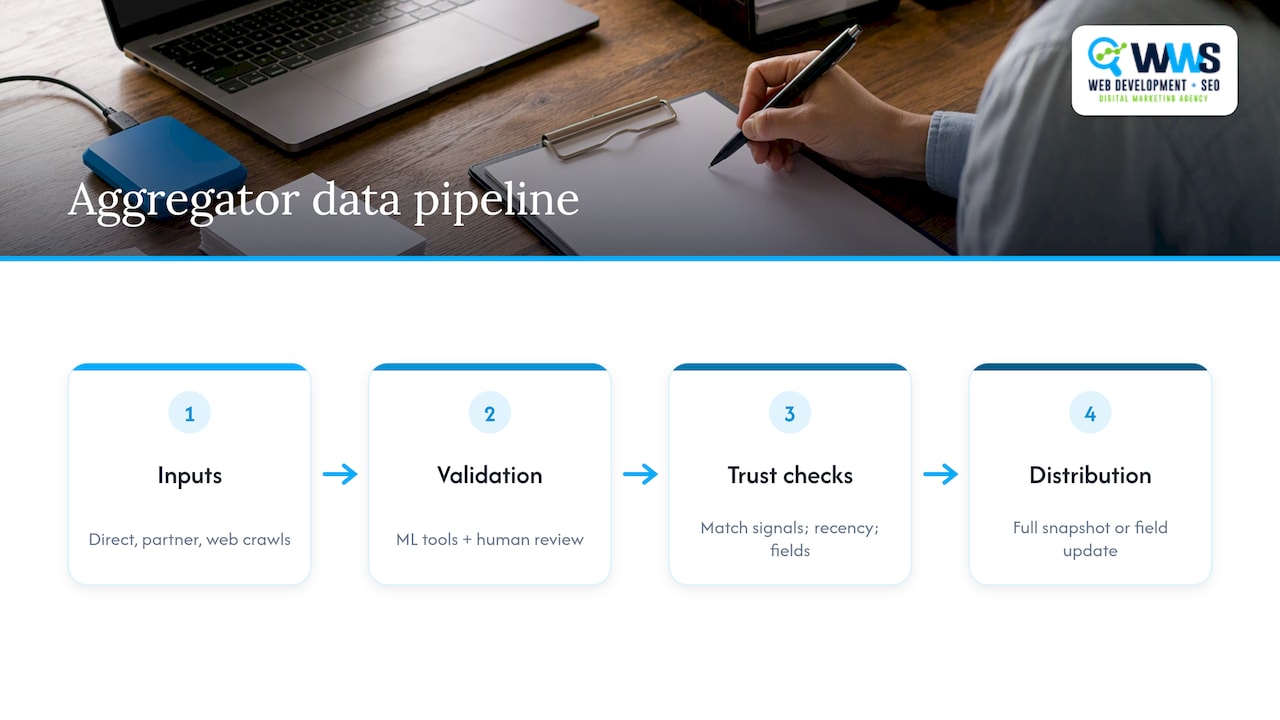
Aggregators follow a fairly consistent pipeline even though the specifics vary by network. Collection happens through direct business submissions, licensed partner data, and automated crawls of public business information. Once collected, a record rarely goes straight to publishers; most networks run it through a validation layer first.
Foursquare’s approach illustrates how this validation works in practice. The company describes using machine-learning tools it calls Geosummarizer and Harmonizer, combined with human review, to synthesize and validate point-of-interest data before it reaches Places Pro or Premium datasets, according to Foursquare’s own documentation. That mix of automated pattern-matching and human checking is common across larger aggregator networks, even when the exact tool names differ.
Criteria for what counts as a trustworthy record typically include matching signals across multiple sources, recency of the last confirmed update, and completeness of required fields like address and phone format. A record that conflicts with other sources the aggregator already trusts gets flagged rather than published outright, which is part of why a brand-new listing sometimes takes a few update cycles to appear consistently everywhere.
Distribution follows the same snapshot-versus-incremental logic covered earlier: a verified record gets pushed out as a full profile replacement or as a targeted field update, depending on what changed and how the receiving publisher’s integration is built. The practical result for a business owner is that getting into an aggregator’s trusted pipeline once tends to pay off repeatedly, since later corrections move faster through a channel that already treats your data as reliable.
The impact of aggregator data quality on local business reputation and consumer trust
A listing with the wrong phone number does not just cost a search ranking, it costs a phone call from someone who gave up after an unanswered line. Outdated hours send customers to a locked door. A stale address sends a delivery driver to the wrong block. Aggregator-fed data quality shows up directly in the experience a customer has before they ever walk in.
Because one aggregator can feed dozens of publishers, a single bad record multiplies the number of places a customer might encounter it. That is the flip side of the scale that makes aggregators useful in the first place: the same mechanism that spreads a correction quickly also spreads an error quickly, and a customer has no way of knowing which directory holds the accurate version.
Consistency across listings also feeds into a quieter trust signal. When a business’s name, address, and category read the same way everywhere a customer looks, it reads as established and well-run. When three different versions of the business name show up across three sites, it reads as neglected, even when the underlying business is excellent. Review profiles compound this: a potential customer checking a listing’s star rating alongside inconsistent contact details is less likely to follow through, regardless of how good the actual service is. Keeping a canonical record accurate is as much a reputation safeguard as it is an SEO tactic.
Legal and privacy considerations related to data aggregation and use
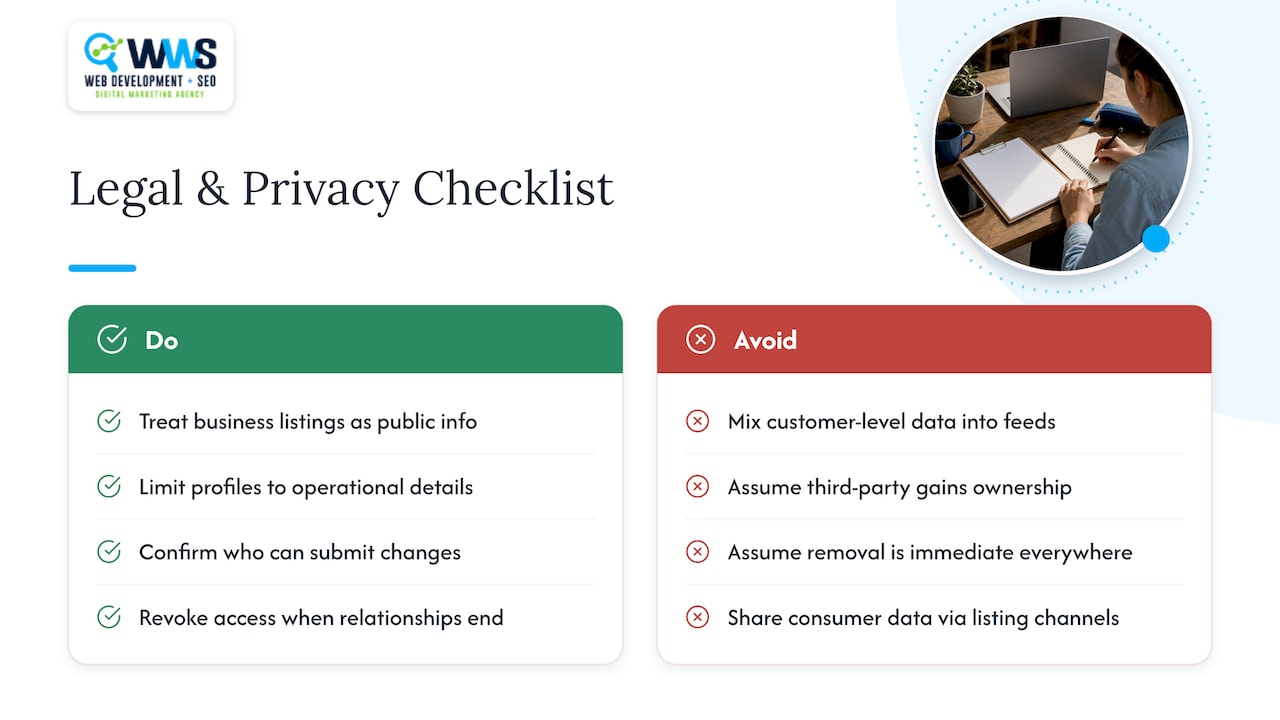
Data aggregation of public business information operates differently from aggregation of personal consumer data, and it helps to keep that distinction clear. A business name, address, and phone number listed for commercial purposes is generally treated as public business information rather than personal data, but the attributes and customer-facing details a business chooses to publish are still the business’s own responsibility to keep accurate.
Businesses operating under consumer privacy frameworks should be aware that some aggregator and data-broker practices intersect with broader privacy rules depending on what data is collected and how it is used, particularly where any customer or consumer-level data gets mixed into a business feed. The safest practice is to keep business profile data limited to operational details (hours, services, location, contact information) and avoid feeding customer-level data through the same channels used for listing syndication.
Ownership and control of the canonical record matter too. Submitting data through a third-party platform or agency does not transfer ownership of that data, but it does mean another party has write access to it, so it is worth knowing who can submit changes on your behalf and confirming that access is revoked if that relationship ends. Reviewing any aggregator or publisher’s terms for how long they retain a record after a business requests removal is also worth a few minutes, since “removed” and “immediately removed everywhere” are not always the same thing across a syndicated network.
Emerging trends and technologies in local data aggregation, such as AI and real-time updates
Validation is shifting from purely manual review toward machine-learning-assisted checks that can flag inconsistencies faster than a human reviewer scanning records one at a time. Foursquare’s Places Engine, which pairs automated tools with human validation, is one public example of where this is headed: pattern-matching at scale, with people checking the edge cases machines flag as uncertain, as described in Foursquare’s Places Pro and Premium documentation.
Real-time or near-real-time updates are also becoming more common as more publishers move from batch snapshot feeds toward incremental updates that process individual field changes as they happen rather than waiting for a scheduled sync. That shift matters most for businesses with frequently changing information, since a holiday hours change or a temporary closure can reach customers within hours instead of weeks.
Structured APIs are displacing manual form submissions as the primary way larger businesses manage their data. Rather than editing listings on individual directory sites, multi-location businesses increasingly manage attributes, categories, and location details through programmatic interfaces that push consistent updates to every connected publisher at once. This does not eliminate the need for a clean canonical record, it just makes maintaining one more worthwhile, since the labor saved scales with the number of locations and publishers involved.
How to evaluate and choose between different local data aggregators based on business needs and coverage
Choosing an aggregator network starts with matching its coverage to where your customers actually look. A business that depends on map-based discovery should prioritize mapping and navigation-focused feeds, since a routing error there costs more customer trust than a missed listing on a general business directory. A business in an industry with strong niche directories (legal, medical, home services) may get more value from confirming those niche sites pull from a network you already feed than from adding a new aggregator relationship.
Coverage breadth matters, but so does update speed. A network with wide publisher reach that takes a long time to process corrections is less useful than a narrower network that propagates changes quickly, particularly for a business that updates hours or services often.
Technical fit is worth checking before committing time to setup. A business with in-house technical capacity can take advantage of API access and incremental feeds; a smaller operation without that capacity may get more practical value from a direct portal submission or a managed partner who handles the technical side.
Finally, confirm what each network actually requires for verification. Some demand more documentation or a longer initial review period than others, and knowing that upfront prevents the frustration of submitting a canonical record and waiting weeks to see it reflected anywhere.
Practitioner perspective: repeated errors and quick wins from in-house experience
The same handful of mistakes show up again and again: inconsistent address formatting, a second phone number left active on an old listing, and holiday hours that never got corrected. The fixes that matter most are rarely complicated. Standardize one canonical record, automate a weekly audit, and claim the handful of publisher pages that actually drive traffic. A corrected address propagated through the right network has, in practice, resolved a map pin that had been sitting two blocks off for months.
— Online Marketing Experts
If you want help: WWS local data and citation services
Chasing corrections across Data Axle, Foursquare, and a handful of directories takes time most business owners don’t have between running the actual business. 
There are local business marketing expert solutions serving Des Plaines, IL, and the greater Chicago Area. Some digital marketing teams include Google and Facebook certified experts dedicated to growing local service businesses. Services often combine custom web development with SEO and GEO strategies to enhance online presence and lead generation. With over 200 successful client partnerships, we don’t just build websites, we drive real calls, consistent leads, and year-round revenue for Chicago-area businesses.
Our matching services cover the full citation and visibility picture:
- Local SEO management, including canonical data setup and ongoing citation audits.
- Google Business Profile optimization to keep your primary listing accurate and complete.
- Feed and integration setup for businesses managing multiple locations.
If stale or inconsistent listings are costing you calls, our Local SEO services page covers how our in-house team handles citation monitoring and corrections for Chicago-area businesses.
Sources
- Profile feed | Local Services Ads | Google for Developers
- Places Pro and Premium data schemas | Foursquare
- Data aggregation — Wikipedia
FAQ
What is the best data aggregator?
There is no single best aggregator since each network covers different publishers and regions. Data Axle and Foursquare’s Places Pro and Premium datasets are among the most widely referenced, so checking both is a reasonable starting point for most businesses.
What are some examples of aggregators?
Data Axle, Foursquare, Neustar Localeze (now TransUnion Digital Business Profile), the YP Network, and GPS Network are the main business-listing aggregators covered in this guide. Each feeds a different mix of directories, maps, and navigation platforms.
What are some popular content aggregator sites?
Content aggregators that compile news or articles from multiple sources are a separate category from the business-listing aggregators covered here. For local business data specifically, the relevant aggregators are the ones that feed directories and maps, such as Data Axle and Foursquare.
What are the risks of using an aggregator?
The main risk is that errors propagate just as fast as corrections, so a wrong phone number or address can spread to multiple publishers in one sync cycle. Stale data, duplicate entities, and formatting mismatches are the most common failure modes, which is why a clean canonical record matters before submitting to any feed.