


Local link building means earning backlinks from geographically or topically relevant websites, like chambers of commerce, local news outlets, and community organizations, to strengthen your standing in local search results. It’s one of the top ranking factors for the Local Pack. Your first move should be auditing and fixing your business’s name, address, and phone number (NAP) across core citation listings before chasing a single new link.
TL;DR:
- Most valuable local links come from trusted community sources like chambers, government pages, and local press, with partnerships and sponsorships providing long-term value.
- Starting with core citation cleanup and fixing inconsistent NAP data ensures a solid foundation before pursuing new links, which improves overall trust signals.
- Achieving noticeable improvements in local search visibility typically takes several months, with consistent effort in tiered outreach and content creation.
- Tools like backlink prospecting platforms and citation management services streamline prospecting, outreach, and monitoring, saving time and increasing effectiveness.
- Focusing on high-quality, authoritative sources first yields the best return, as these links carry more influence for local rankings and AI-driven search recommendations.
Table of Contents
- What Is Local Link Building, and How Is It Different From Regular Link Building?
- Why Do Local Links Matter for Maps and AI Search Results?
- Priority Tactics: A Tiered Playbook for Building Local Links
- What Tools Help You Prospect, Reach Out, and Track Local Links?
- How Do You Measure Whether Local Link Building Is Working?
- Your 30/60/90 Day Local Link Building Checklist
- Why NAP Consistency and Reviews Reinforce Every Link You Build
- WWS’s Perspective: What We See When We Run Local Link Campaigns for Clients
- Ready to Build Local Links Without Doing It Alone?
- Sources
- FAQ
What Is Local Link Building, and How Is It Different From Regular Link Building?
National link building chases authority from anywhere on the web. Local link building narrows the target to sites with genuine geographic or community relevance to your business, and that narrowing is exactly what makes the links work harder for local search.
A link from a well-known local news site to your plumbing company’s page on a burst-pipe cleanup carries more local weight than a generic mention in a national roundup post. The sources that actually move the needle tend to include:
- Local news outlets covering community events or business openings
- Chambers of commerce and business associations
- Neighborhood blogs and community forums
- Nonprofit organizations you sponsor or volunteer with
- Event sponsor pages listing your business as a supporter
Not every mention needs to carry a clickable link to help. A citation, your business name, address, and phone number listed consistently on a directory or association page, still reinforces your legitimacy to Google even without a hyperlink. That’s why building local citations starts with a master NAP record: one exact version of your name, address, and phone number that you copy everywhere, rather than letting each listing drift into its own slightly different format.
Why Do Local Links Matter for Maps and AI Search Results?
Links remain one of the strongest ranking signals for local organic results, and they hold up as a factor for the Local Pack specifically, ranking among the top signals BrightLocal tracks for map-based visibility.
Local links from trusted community sources carry outsized weight because they’re harder to fake than a review and harder to ignore than a keyword. A link from your city’s Chamber of Commerce tells Google something a generic directory listing can’t: a recognized local institution vouches for your business.
That signal also feeds Google Business Profile prominence. Businesses with a cleaner citation and link profile tend to show up more consistently in the Local Pack, and prominence is one of the three pillars Google uses to rank map results alongside relevance and distance.
There’s a newer layer to this too. AI assistants and large language models pull from the same pool of trusted local sources when they answer questions like “best electrician near me.” Local press coverage and authoritative community sites carry outsized weight for AI-driven recommendations, which means the local links you build today are also building your visibility inside AI search answers tomorrow. Skipping local link building doesn’t just cost you map rankings. It costs you a seat at the table when a chatbot decides who to recommend.
Priority Tactics: A Tiered Playbook for Building Local Links
Not all local links are created equal, and chasing volume before quality wastes time. Local businesses get the best return by working through tiers, starting with the sources that carry the most trust and working down toward the sources that take more volume to matter.
Tier 1: chase these first
- Chamber of Commerce membership. Most chambers list every member on a directory page with a link back to the business site. Annual dues are usually modest, and the link tends to stick for as long as you’re a member.
- .gov and .edu mentions. City economic development pages, business resource directories, and local college partnership or vendor pages carry heavy trust. Look for “resources for local business” pages on your city’s website and community college vendor lists.
- Local press coverage. A mention in your local paper or news site, tied to an opening, an award, or a community project, tends to outperform a dozen directory links combined.
A tiered approach like this front-loads effort where it pays off fastest, then moves to community and partnership links once the high-value targets are locked in.
Directories and citation cleanup
Before adding a single new listing, audit what already exists. Duplicate or inconsistent listings actively hurt you, and fixing existing citations produces more immediate benefit than piling on new ones. The right sequence:
- Build one master NAP record, exact spelling, exact suite number, exact phone format
- Search for your business name across major aggregators and fix mismatches
- Submit to data aggregators first, since they feed dozens of smaller directories automatically
- Only then move to industry-specific and retail directories
Partnerships and community involvement
Sponsorships are one of the most underrated tactics on this list. A modest sponsorship of a youth sports league, a farmers market, or a local 5K often produces a sponsor-page link that stays live for years, not weeks, and it comes bundled with real community goodwill. Vendor pages work the same way: if you supply materials or services to another local business, ask to be listed as a preferred vendor with a link.
Other community moves worth running:
- Cross-promote with complementary (non-competing) local businesses on each other’s “recommended partners” pages
- Volunteer for a nonprofit board or event committee that lists its supporters online
- Offer a member spotlight or interview swap with your local business association’s newsletter
Content that earns links on its own
Neighborhood guides, original local data (a survey of local home prices, average project costs in your service area), and curated resource lists give local bloggers and news sites a reason to link to you unprompted. This is slower to build than outreach, but the links it earns tend to be higher quality and require zero ongoing ask.
Reclaiming links you’ve already earned
Every business accumulates unlinked mentions over time, a news article that names you without linking, a partner page that links to an old URL. Reclaiming broken links and converting unlinked mentions into working backlinks takes far less outreach effort than cold pitching a stranger, because you’re asking someone to fix something rather than do you a favor. Search your business name in quotes on Google, filter for pages that mention you without linking, and send a short, polite request to add the link.
Low-cost tactics worth running in the background
- Offer a small scholarship to a local school; scholarship directories link to sponsors reliably
- Write a guest column for a local business publication or association newsletter
- Provide a written testimonial for a vendor or supplier in exchange for a link on their client page
Pro Tip: Before you pitch anyone, qualify the prospect first: is the site actually local or industry relevant, does it publish other outbound links to businesses (some don’t), and does it have a real audience? Five minutes of vetting saves you from wasting outreach on a page nobody visits.
When you do reach out, keep it short: name the specific page you found, state exactly what you’re asking for (a link addition, a sponsor mention, a directory listing), and make it easy to say yes in under thirty seconds of reading.
What Tools Help You Prospect, Reach Out, and Track Local Links?
You don’t need enterprise software to run this playbook, but the right categories of tools save hours every week.
- Backlink prospecting tools like Ahrefs and Semrush let you see which sites link to competitors in your service area, so you can pitch the same sources.
- Citation management platforms (BrightLocal and Whitespark-type tools) handle bulk submission and monitoring across dozens of directories at once, which matters once you’re managing more than a handful of listings.
- Outreach CRMs or even a shared spreadsheet track who you’ve contacted, when, and what they said, which prevents duplicate pitches to the same local reporter.
- Google Alerts or a monitoring tool flags new unlinked mentions of your business name as they happen.
A simple weekly cadence keeps this moving without eating your whole calendar: prospect ten new targets, qualify them against your checklist, send outreach to the ones that pass, follow up on anything older than a week with no response, and verify that links promised two weeks ago are actually live.
Pro Tip: If budget is tight, a free Google Sheet with columns for site name, contact, date pitched, and status does the same job as a paid CRM for the first fifty prospects. Upgrade once volume outgrows a spreadsheet, not before.
How Do You Measure Whether Local Link Building Is Working?
Local link building is a slow-compounding effort, not a light switch, so the KPIs that matter are the ones that show trend direction over months, not overnight spikes.
Track new quality placements per month rather than raw link count, since one Chamber of Commerce link outweighs ten weak directory listings. Watch referral traffic from those specific domains, Local Pack impressions and clicks in Google Business Profile insights, and phone calls tied to your local campaigns. Citation indexation, whether your NAP records are actually showing up correctly across the web, rounds out the list.
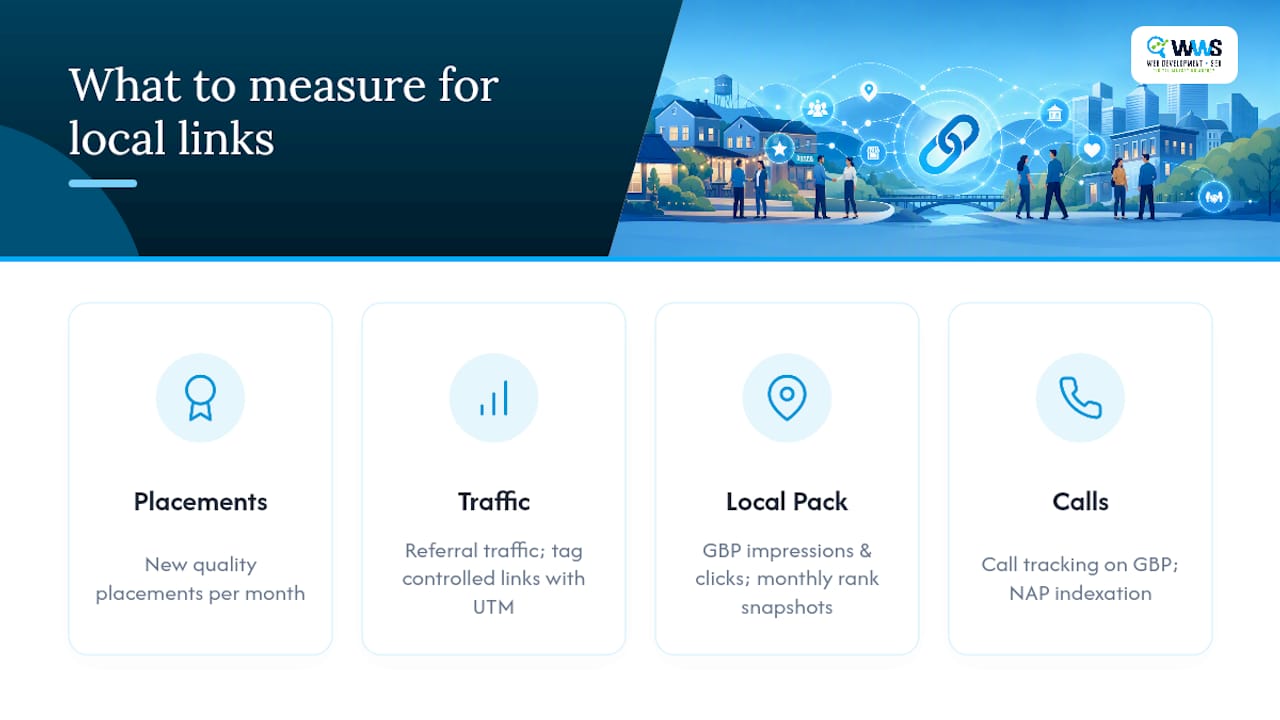
Most local businesses start seeing measurable movement in Local Pack visibility within a few months of consistent effort, though the exact timeline depends on how competitive your market is and how clean your citation base was to start. Use UTM parameters on any link you control, set up call tracking on your Google Business Profile number specifically, and log ranking snapshots monthly so you can correlate a jump in position with the links or citations that landed around the same time.
Your 30/60/90 Day Local Link Building Checklist
This is the version you can hand directly to an employee or an agency and get moving the same week.
- Days 1 to 30: Build your master NAP record, claim and correct your core citation listings, audit for duplicates across major aggregators, and compile a list of ten Tier 1 prospects (chamber, local press, .gov, .edu).
- Days 31 to 60: Launch outreach for partnerships, sponsorships, and event listings; publish one hyper-local resource piece (a guide, a local data roundup); start reclaiming broken links and unlinked mentions you’ve identified.
- Days 61 to 90: Review which tactics produced actual placements, double down on whatever performed best, and scale outreach volume based on what’s working.
| Phase | Primary focus | Success marker |
|---|---|---|
| Days 1 to 30 | Citation cleanup and prospecting | Master NAP live, ten prospects identified |
| Days 31 to 60 | Outreach and content | First new Tier 1 links, one resource published |
| Days 61 to 90 | Measurement and scaling | Repeatable tactic identified and scaled |
Why NAP Consistency and Reviews Reinforce Every Link You Build
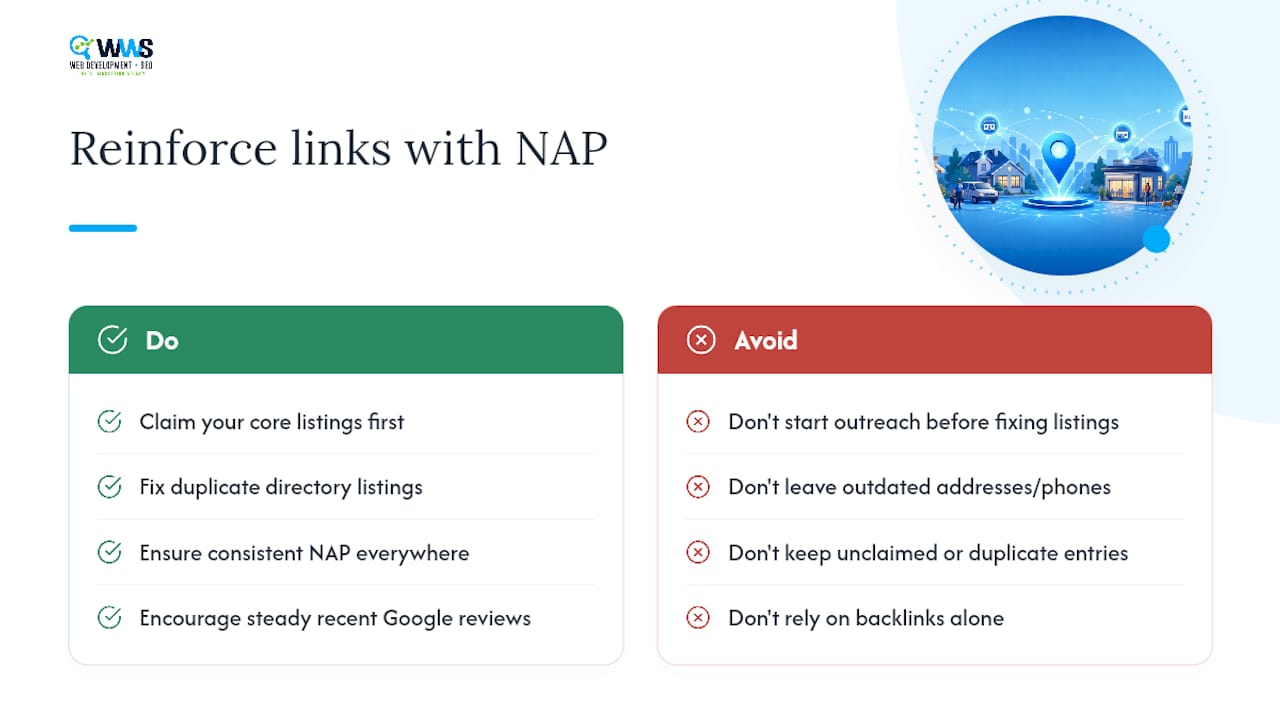
A pile of great local links won’t do much if your business name, address, and phone number contradict each other across the web. Search engines cross-reference citation data to confirm your business is real, active, and located where you say it is, and inconsistent NAP data undercuts that trust even when the links themselves are strong.
Think of it as a foundation problem rather than a decoration problem. You can add all the sponsor links and press mentions you want, but if half your directory listings show a suite number you moved out of two years ago, you’re sending Google mixed signals about which version of your business is current.
Reviews work alongside citations and links as a third trust signal. A business with consistent NAP data, a healthy citation footprint, and a steady stream of recent Google reviews presents a coherent, verifiable profile. One with scattered addresses, outdated phone numbers, and no reviews looks unreliable even if it has a handful of decent backlinks. Fixing duplicates and claiming your core listings should happen before you spend a single hour on outreach, because a new link pointing to inconsistent NAP data is a link built on a shaky base.
WWS’s Perspective: What We See When We Run Local Link Campaigns for Clients
The businesses that struggle most with local link building aren’t lacking effort. They’re lacking sequence. Owners jump straight to sponsorships and press outreach before fixing a citation base that’s actively working against them, which is like painting a house with a cracked foundation.
As a Google and Meta Partner working exclusively in-house, our team at WWS – Web Development + SEO has run this exact playbook across more than 200 client partnerships in the Chicago area, from contractors to restaurants to medical providers. The pattern holds nearly every time: citation cleanup first, Tier 1 outreach second, content and partnerships third. Skipping ahead rarely pays off.
What we track for local link campaigns isn’t just link count. It’s Local Pack visibility, referral traffic from the specific domains we target, and phone call volume tied to those gains, because a client doesn’t care how many backlinks exist if the phone isn’t ringing.
— Online Marketing Experts
Ready to Build Local Links Without Doing It Alone?
WWS – Web Development + SEO is the alternative to piecing together local link building yourself between running your business. Instead of spending your evenings auditing citation aggregators and cold-emailing local reporters, our in-house team of Google and Meta certified experts handles the prospecting, outreach, and citation cleanup as part of a coordinated local SEO strategy.
We combine custom web development with the exact tactics covered above, chamber and press outreach, citation audits, partnership building, so your business shows up first when customers in your area search for what you offer. Every client engagement starts the same way: an audit of your current citation and link footprint, a proposal outlining the highest-impact opportunities specific to your market, and execution handled entirely in-house, with no outsourcing and no lost communication between agencies. If you’re a Des Plaines or greater Chicago area business ready to stop guessing and start seeing quality local links land, visit our local SEO services page to request an audit and see exactly where your citation base and link profile stand today.
Sources
- 13 Local Link Building Tactics to Boost Your Visibility – BrightLocal
- How to Build Local Citations Step by Step | Formative Digital
- 9 Easy Local Link Building Tactics – Ahrefs
- Local Link Building: 25 Ways to Get Quality Local Backlinks – Flento
- Link Building for Local SEO: 7 Simple Strategies – Neil Patel
FAQ
What Is Local Link Building in SEO?
Local link building is the practice of earning backlinks from geographically or topically relevant websites, like local news sites, chambers of commerce, and community organizations, to strengthen a business’s visibility in local search and the Local Pack.
How Much Should I Pay for Local Link Building?
Costs vary widely depending on tactics used. Sponsorships often run from small membership fees to a few hundred dollars for event sponsorships, while agency-managed campaigns typically run as ongoing retainers that bundle citation cleanup, outreach, and reporting together.
What Is Meant by Link Building in General?
Link building is the broader practice of earning hyperlinks from other websites to your own, which search engines treat as a signal of trust and relevance; local link building narrows that same practice to sources with genuine community or geographic ties.
Is Doing Local SEO Worth It?
Local SEO, including citation cleanup and local link building, is worth it for any business that serves customers in a specific area, since links remain a top signal for both organic local results and Local Pack rankings.
How Long Does Local Link Building Take to Show Results?
Most businesses see measurable movement in Local Pack visibility within a few months of consistent citation cleanup and Tier 1 outreach, though the exact timeline depends on your market’s competitiveness and how clean your citations were to start.