





Yes, you can improve your Map Pack ranking, and the process is repeatable. Google determines local results through relevance, distance, and prominence, so start by verifying your Google Business Profile, correcting your business name, address, and phone number everywhere they appear, and asking recent customers for reviews this week.
TL;DR:
- Service area businesses should hide their public address but retain a verified base address; adding coverage cities does not widen Google’s distance radius.
- Ask for reviews after service, respond within days, and avoid incentives or fake posts; Google may take two weeks to reflect new reviews in ratings.
- A handful of accurate listings on reputable directories beats dozens of outdated citations, while dedicated service pages and local mentions support the profile.
- Check rankings weekly from representative locations; businesses with multiple locations need grid based checks, and profile call counts reflect button taps, not completed calls.
Table of Contents
- What the Map Pack is and why it matters for your business
- The three core ranking factors behind every Map Pack result
- GBP checklist: step-by-step optimizations to do now
- Reviews and reputation: collection, response, and timing
- On-site local SEO and citation cleanup
- Monitoring playbook: how to measure your Map Pack position
- Troubleshooting a ranking drop: a quick diagnostic checklist
- What our results show about map pack strategy
- When a quick fix is enough and when you need ongoing management
- How we help you win and keep the Map Pack spot
- FAQ
- Sources
What the Map Pack is and why it matters for your business
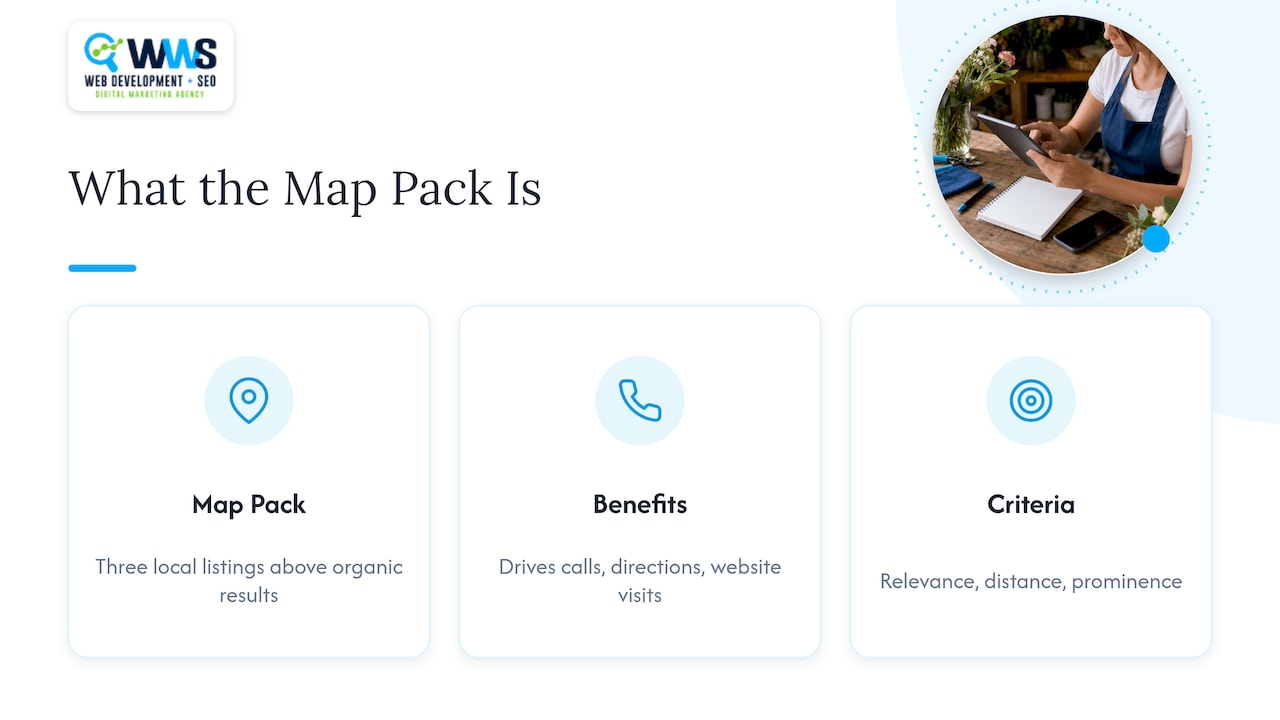
The Map Pack, also called the local 3-pack, is the block of three business listings with a map that appears above standard organic results when someone searches for a nearby service. A plumber searching “emergency plumber near me” sees this block before anything else, and that placement drives phone calls, direction requests, and website visits from people ready to act.
You cannot buy your way into the Map Pack. Unlike paid ads, these three spots are decided algorithmically, which means relevance, distance, and prominence do the work, not your ad budget. That makes the Map Pack one of the few remaining spaces in search where a well-run small business can outrank a national chain with a bigger marketing budget.
The three core ranking factors behind every Map Pack result
Google weighs three signals when deciding who shows up: relevance, distance, and prominence. Relevance measures how well your profile matches the search. Choosing precise Google Business Profile categories, listing your actual services, and writing a description that mirrors how customers search all strengthen this signal.
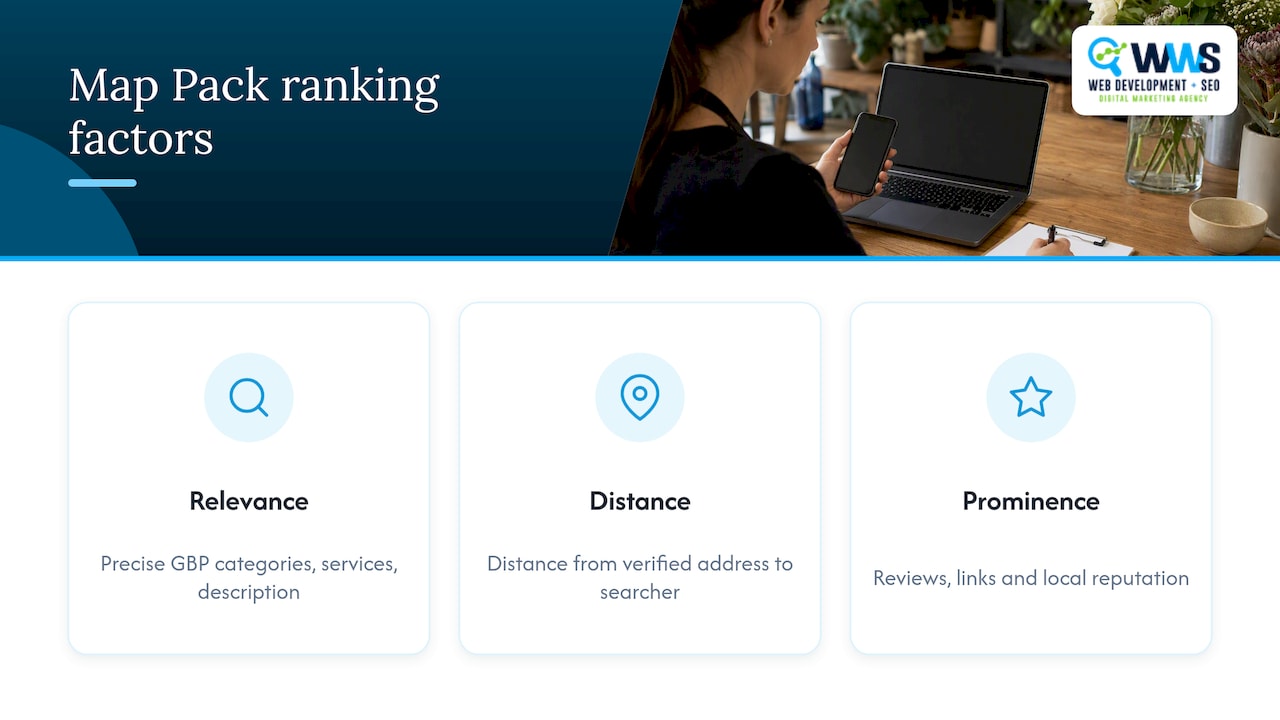
Distance measures how close your verified business address sits to the searcher, or to the area implied by their search terms. This is where a lot of service-area businesses get confused: adding more service-area cities does not expand your ranking radius, because Google anchors distance calculations to your verified base address, not your coverage list.
Prominence covers how well-known your business is offline and online. Google ties this to reviews, links, and general reputation, so a roofing company with many reviews and a few local press mentions will typically out-rank a newer competitor with a thin profile, even at a similar distance.
GBP checklist: step-by-step optimizations to do now
A complete, accurate profile is one of the clearest signals Google uses to decide who appears in local results. Work through this list over the next one to four weeks:
- Verify your Google Business Profile and confirm your business name, address, and phone number match exactly across your website and directories.
- Search for and merge or remove any duplicate listings tied to your business.
- Select the most precise primary category available, add relevant secondary categories, and write a service-focused business description.
- Upload current photos, list your services or products, fill in applicable attributes, and keep your hours accurate, including holiday hours.
- If you run a service-area business, hide your public address but keep a verified base address on file, since Google still uses that address as the distance anchor.
- Add LocalBusiness or ProfessionalService schema markup and build dedicated location or service pages on your website.
- Add UTM parameters to your GBP website link and set up call tracking so you can tie ranking improvements to actual leads.
Our Google Business Profile Map Pack Mastery guide walks through several of these steps in more depth if you want to go further.
Pro Tip: Do the profile cleanup first, since mismatched NAP data elsewhere on the web can undercut every other improvement you make.
Reviews and reputation: collection, response, and timing
Reviews feed directly into prominence, but timing and consistency matter more than volume alone.
- Ask for reviews right after a job wraps up or a service call ends, when satisfaction is freshest.
- Send a direct link to your review page by text or email rather than hoping customers find it themselves.
- Respond to every review, positive or negative, within a few days, since activity signals a business that pays attention.
- Never offer incentives for reviews or ask staff to post fake ones, which violates Google’s policies and risks profile suspension.
One important fact to plan around: Google can take up to two weeks to reflect a new review in your overall profile rating, so do not expect a ranking bump the same day a review posts. Build that delay into how you measure results.
On-site local SEO and citation cleanup
Your website and directory listings back up what your Google Business Profile claims. A few focused tasks go a long way:
- Build a dedicated page for each service area or service line, and mark it up with LocalBusiness schema, which you can test through Schema Markup Validator.
- Audit your name, address, and phone number across major directories and fix or merge inconsistent listings.
- Publish local content such as sponsorships, community events, or project write-ups that naturally attract local mentions and backlinks.
Citation quality outweighs citation quantity. A handful of accurate, consistent listings on reputable directories helps more than dozens of outdated ones scattered across low-value sites. Our Google My Business SEO guide covers how to tie these website tasks back to your profile.
Monitoring playbook: how to measure your Map Pack position
Tracking your position takes a mix of automated tools and manual spot checks.
- Run weekly rank checks from a few representative locations in your service area, using private or incognito browsing to avoid personalized results skewing what you see.
- For multi-location businesses, use grid-based local rank checks rather than a single search, since position often shifts block by block.
- Pair Google Business Profile Insights with call tracking, keeping in mind that the “calls” metric in Insights counts taps on the call button, not completed calls.
- Use local rank checkers, citation management tools, and review management platforms together rather than relying on any single source.
For hands-on tactics and automation options, the Local SEO + AEO + GEO Academy from BabyLoveGrowth is a useful resource if you want to go deeper on tooling.
Troubleshooting a ranking drop: a quick diagnostic checklist
When your position slips, work through causes in order rather than guessing:
- Check your Google Business Profile dashboard for a suspension notice, duplicate listing, or an incorrectly changed category.
- Review recent changes on your end: a site migration, an address update, or a sudden cluster of negative reviews.
- Fix NAP inconsistencies first, since data errors undermine every other signal.
- Rebuild reputation and local content next, through review outreach and fresh local pages.
- If the drop persists after these fixes, contact Google Business Profile support or bring in a specialist to audit the account.
The Fix Listings First playbook from EventHound offers a practical angle on listing cleanup if you want a second checklist to work from.
What our results show about map pack strategy
Our in-house team applies the same relevance, distance, and prominence framework outlined above to every client account. In one engagement, Bernard Movers saw a meaningful increase in call volume and direction requests after a Google Business Profile cleanup and ongoing local content work. Track calls, direction requests, and form fills as your core KPIs, and set expectations around the review-rating delay noted earlier.
When a quick fix is enough and when you need ongoing management
Quick GBP fixes like correcting NAP or adding photos often move the needle within weeks. When you are competing in a crowded market, ongoing review generation, content, and citation management matter more. A local SEO audit is a reasonable next step if your in-house time is limited.
— Online Marketing Experts
How we help you win and keep the Map Pack spot
Fixing your profile once gets you in the game, but the businesses that stay in the top three keep working at it week after week. That ongoing management, GBP optimization, local content, citation monitoring, and review tracking, is where our in-house team spends most of its time on behalf of clients.
Our local SEO work covers:
- Google Business Profile optimization and ongoing category, photo, and post management.
- Local content and service-area page development tied to GEO-targeted keyword strategy.
- Citation audits and cleanup across the directories that matter most to your market.
- Monthly rank monitoring with reporting tied to calls, direction requests, and form fills.
We don’t outsource any of this. Every specialist working on your account sits on our in-house team, which keeps communication direct and strategy consistent. If you want a clear picture of where your profile stands today, visit our Local SEO services page to request an audit.
FAQ
What is map pack ranking?
Map pack ranking refers to where your business lands in the three-listing local results block that appears above organic search results for nearby searches. Position is decided by relevance, distance, and prominence, not by ad spend.
How do I rank higher on Google Map Pack?
Start by fully verifying your Google Business Profile, correcting your name, address, and phone number across the web, and choosing precise categories that match your services. From there, build reviews consistently, respond to each one, and support your profile with local content and accurate citations.
Is 75 a good SEO score?
SEO scores come from third-party tools and are not an official Google metric, so what counts as “good” depends on which tool generated the number and how it weighs factors. A score is only useful as a relative benchmark over time for your own site, not as a universal standard.
How many level 10 Google guides are there?
This refers to the Local Guides program’s point-based levels, which track contributions like reviews and photos rather than business ranking. We don’t have a verified public count of top-level Local Guides to report, and this figure is not something Google publishes in its ranking guidance.