





Why Knowing How to Measure Brand Positioning Can Make or Break Your Business
How to measure brand positioning is one of the most practical questions any business owner can ask — and one of the least answered clearly.
Here’s a quick answer:
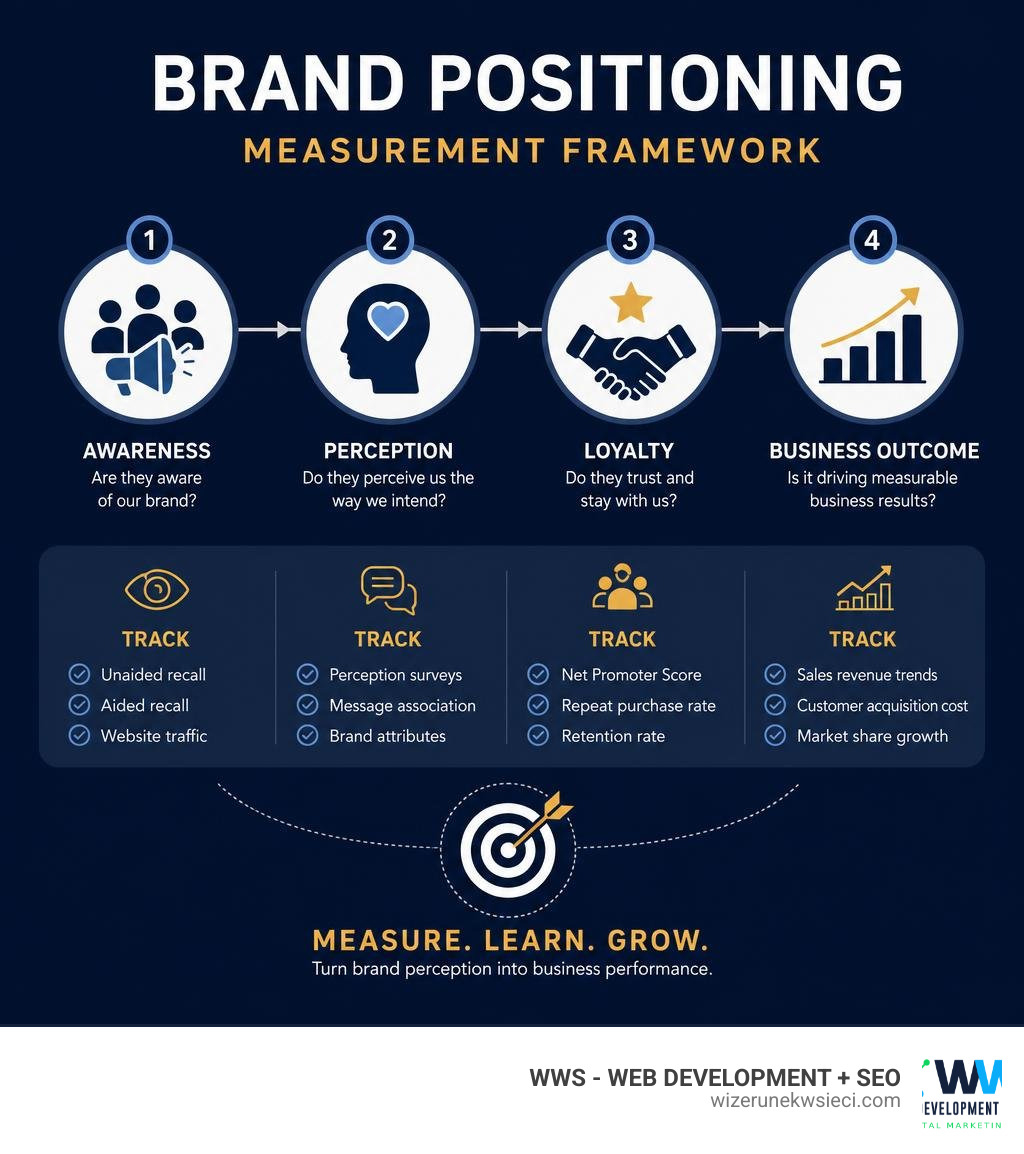
To measure brand positioning, track these core areas:
- Brand awareness — unaided and aided recall via surveys and direct website traffic
- Customer perception — perception surveys that reveal if your intended positioning matches what customers actually believe
- Competitive position — share of voice, perceptual mapping, and competitor benchmarking
- Customer loyalty signals — Net Promoter Score (NPS), repeat purchase rate, and retention rate
- Online engagement — social media engagement, click-through rates, and earned media value
- Business outcomes — sales revenue trends, customer acquisition cost, and market share growth
You’ve built your brand. You’ve picked a position in the market. You’re running campaigns. But how do you actually know if it’s working?
Most businesses can’t answer that question. They rely on gut feel — “it seems like it’s working” — rather than real data. That’s a problem.
Consider this: 81% of consumers need to trust a brand before they’ll buy from it. And 87% choose brands that align with their personal values. If your positioning isn’t landing the right message with the right people, you’re losing sales you don’t even know you’re losing.
The good news? Brand positioning is measurable — if you know what to look for.
I’m Tomasz Lasota, Digital Development and Technology Director with over 22 years of experience helping brands build measurable digital strategies that drive real business results. Throughout my career, I’ve worked with teams across B2B and B2C markets on exactly the challenge of how to measure brand positioning — turning perception data into decisions that grow revenue and market share.
Why Brand Positioning Matters for Business Outcomes
Brand positioning is not just a creative exercise or a polished tagline we put on our homepages. It is the deliberate, strategic choice of how our brand occupies a distinct space in the minds of our target customers relative to our competitors. In short, it is the foundation of our entire business strategy.
When done correctly, strong brand positioning creates massive brand equity. It dictates our pricing power, allowing us to charge premium rates because customers perceive our unique value. It lowers our customer acquisition cost (CAC) because our messaging speaks directly to the right people, and it helps us capture and defend our market share in highly competitive landscapes like Chicago and Des Plaines, IL.
However, many businesses fail to realize that positioning is as much about exclusion as it is about assertion. It is about deciding what we must stop doing and who we are not for. When we try to be everything to everyone, our message becomes diluted. This is Brand Positioning Strategy: Where Most Brands Go Wrong — they focus purely on aspirational messaging without rooting their claims in operational and structural realities. If our internal capabilities cannot support our outward promise, our positioning will fail, and customer trust will erode.
How to Measure Brand Positioning: The Core Framework
To understand whether our market perception matches our internal goals, we must establish a structured framework. Measurement lives in the buyer’s head, which means we must analyze actual behaviors and feedback rather than relying on internal assumptions.

A reliable brand tracking system helps us identify the “perception gap” — the difference between the story we think we are telling and what our target audience actually believes. By combining competitive benchmarking with deep consumer insights, we can determine whether our brand occupies the unique space we have claimed. For a comprehensive look at how research fuels this process, check out Brand Positioning: What It Is & How To Measure It – Drive Research.
Step-by-Step Guide on How to Measure Brand Positioning
To begin measuring where our brand sits in the market, we must conduct a structured positioning audit. This process helps us operationalize our strategy into creative execution. Here are the steps we recommend:
- Define Your Desired Positioning: Write down your current positioning statement in a clear format: [Our Brand] is the [category] for [target customer] who wants [primary benefit] instead of [primary alternative].
- Audit Your Competitive Set: Map out the claimed territories of your direct and indirect competitors. What are their primary value propositions?
- Extract Customer Language: Read reviews, testimonials, and post-purchase feedback. What exact words do customers use to describe why they chose us?
- Audit Channel Consistency: Review your website, social media, paid ads, and sales pitches. Do they all project the same unified message?
- Test Your Differentiation: Run your claims through a “so what” filter to ensure they represent true differentiators rather than basic category requirements.
For actively scaling brands, running this audit on a quarterly basis prevents message fragmentation and keeps marketing campaigns aligned. For a detailed walkthrough of this methodology, explore the Brand Positioning Audit: Step-by-Step Guide (2026) – Apex Brands.
Key Metrics for How to Measure Brand Positioning
While traditional brand health metrics are useful, they do not always capture the precision of our positioning. To measure whether our message is landing with clarity and building trust, we track three specialized behavioral metrics:
- Cognitive Clarity Index (CCI): Measures how easily and accurately buyers can describe what we do after a brief exposure to our brand. Our target score is $\ge 8/10$.
- Trust Response Rate (TRR): Measures the percentage of prospects who believe our core claims without requiring extensive explanation. Our target is $\ge 70\%$.
- Perception Drift Score (PDS): Tracks how customer perception changes over a 45-to-60-day period. High drift indicates confusing messaging, while a low score ($\le 3/10$) shows stable, well-anchored positioning.
Focusing on these precise metrics ensures we are not just building generic awareness, but rather cementing a specific, defensible position. To learn more about how to apply these indexes, see How to Measure Positioning: 3 Metrics That Actually Work – Betterever.
Measuring Brand Awareness and Customer Perception
To validate our brand positioning, we must actively measure two critical dimensions of consumer memory: brand awareness and customer perception.

Brand awareness serves as our leading indicator. We measure this through unaided recall (asking consumers to name brands in our category spontaneously) and aided recall (asking if they recognize our brand from a list).
However, awareness alone does not tell us what people think of us. This is where perception surveys come in. These surveys allow us to measure the specific associations, values, and attributes customers link to our name. They show us whether our intended positioning matches customer reality. For an analytical breakdown of these research methodologies, read Brand Positioning Research: What Data Can and Cannot Tell.
Perceptual Mapping and Competitive Benchmarking
One of the most effective visual tools we use is the perceptual map. By plotting our brand and our competitors on a grid defined by two key attribute axes (such as price vs. quality, or speed vs. reliability), we can visually identify market “white space.”
This process allows us to see where the market is crowded and where underserved opportunities exist. Below is a comparison table showing how different positioning attributes can be mapped to evaluate competitive standing:
| Attribute Axis A (e.g., Value) | Attribute Axis B (e.g., Usability) | Competitor Density | Strategic Opportunity |
|---|---|---|---|
| Premium Pricing | High Complexity | High (Enterprise Focus) | Low |
| Low Cost | Basic Features | Medium (Commodity Focus) | Low |
| Premium Pricing | Intuitive/Simple | Low | High (Premium Simplicity) |
| Affordable | High Customization | Low | High (Accessible Power) |
By updating this map annually, we can track our movement relative to our competitors and adjust our strategies accordingly. To dive deeper into mapping your market, read “Perceptual Mapping: How to Position Your Brand (With Examples)”.
Designing Brand Positioning Surveys
When designing customer surveys, we must combine open-ended and closed-ended questions to capture both quantitative rankings and authentic customer language. It is vital to target our specific customer segment rather than the general public to avoid diluted data.
Here is a list of highly effective survey questions to include in your tracking studies:
- “When you think of our brand, what is the very first word or phrase that comes to mind?”
- “Which of the following adjectives best describe our brand? (Include both positive and negative options)”
- “If our brand were a celebrity, who would we be and why?” (This analogy helps uncover perceived brand personality)
- “What is the single biggest difference between us and [Competitor Brand]?”
- “Why did you choose us over other options in the market?”
- “How has your perception of our brand changed over the past six months?”
Using these questions helps us gather qualitative insights that we can group into word clouds or score on Likert scales to track changes over time.
Evaluating Online Engagement and Customer Loyalty Metrics
Digital signals and long-term customer behavior provide immediate, real-time validation of our brand positioning.
When our positioning is clear and compelling, it naturally drives online engagement. We track metrics like social share of voice, direct website traffic, and referral sources to see if our audience is actively talking about us and seeking us out. Furthermore, strong brand alignment directly influences customer loyalty. To see how we build targeted campaigns that foster this engagement, visit our page on Social Media.
Interpreting Digital Marketing Signals
In digital marketing, high click-through rates (CTR) on our ads suggest that our positioning hook is highly relevant to our target audience. Similarly, a healthy backlink profile and strong earned media value indicate that industry influencers and customers view us as an authority in our space.
If our paid traffic is growing but conversions are flat, it often points to a mismatch between our ad creative and our landing page messaging. To ensure your paid efforts are working in harmony with your brand claims, read about our approach to Paid Campaigns.
Connecting Positioning to Customer Loyalty
Successful brand positioning drives customer retention and repeat purchases. If customers believe we are the only brand that solves their specific problem, they have no reason to look elsewhere.
We measure this loyalty through the Net Promoter Score (NPS) and customer lifetime value (LTV). A rising NPS indicates that our brand promise is being consistently delivered through our product or service experience. To learn how we design end-to-end digital experiences that build this level of loyalty, explore our work on integrated Marketing Campaigns.
Connecting Brand Positioning to Tangible Business Results
At the end of the day, brand building must drive business growth. We connect our positioning efforts directly to bottom-line results: sales revenue, customer acquisition cost (CAC), and market share.
When our brand positioning is sharp:
- Our sales cycle shortens because prospects already understand our value.
- Our CAC decreases because our marketing is highly targeted and efficient.
- Our profit margins increase because we are no longer forced to compete solely on price.
For a practical guide on connecting creative brand strategy to measurable commercial growth, explore Brand Positioning: A Practical Guide to Driving Measurable … – Bigeye.
Stress-Testing Your Positioning Strategy
Before committing to a positioning strategy long-term, we must stress-test it against market realities. We use three classic tests to evaluate strength and defensibility:
- The Substitution Test: If we replace our logo with a competitor’s logo on our website, does the copy still make sense? If yes, our positioning is not sufficiently differentiated.
- The Proof Test: Do we have concrete, verifiable proof points to back up our claims, or are we relying on empty buzzwords like “innovative” or “customer-centric”?
- The Trade-Off Test: What are we willing to give up to protect our position? If our strategy doesn’t require us to say “no” to certain customers or features, it is not a true strategy.
By stress-testing our claims early, we protect our business from expensive repositioning efforts down the road. To read more about this evaluation checklist, see How to Stress-Test Your Brand Positioning – by Rei Inamoto.
Frequently Asked Questions about Brand Positioning
How often should a brand positioning audit be conducted?
We recommend conducting a focused brand positioning audit at least once a year. However, if you are an actively scaling business or experiencing rapid market shifts, competitive changes, or rising acquisition costs, a quarterly check-in is highly beneficial to catch message drift early.
What is the difference between brand positioning and brand identity?
Brand identity consists of the visual and tonal elements of your brand—your logo, color palette, typography, and voice. Brand positioning is the underlying strategic claim in the customer’s mind. Your positioning strategy defines where you stand in the market, while your brand identity is the vehicle used to communicate that stand. To understand how academic institutions and major organizations align these elements, you can review the Brand strategy and messaging | Brand guidelines.
Can a small business measure brand positioning effectively?
Absolutely! Small businesses do not need massive budgets or thousands of survey respondents to measure their positioning. By conducting qualitative research—such as talking directly to 15 to 20 key clients, reading local reviews, and monitoring local competitors—you can gather highly actionable insights. If you are a local service business in the Chicago area looking to build a dominant local presence, check out our guide on how to Boost Your Business with Expert SEO Chicago Services.
Conclusion
Understanding how to measure brand positioning is the key to transforming your marketing from a series of subjective guesses into a predictable, growth-driving machine.
At Wizerunek w Sieci (WWS), we specialize in helping local service businesses across Chicago, Des Plaines, and the surrounding Illinois areas build high-performing websites and run SEO, Google Ads, and social media campaigns that generate highly qualified leads. Our unique value proposition is simple: we deliver measurable growth through integrated, conversion-focused strategies. We don’t just build brands; we build systems that track and prove your success.
Ready to take your digital presence to the next level? Explore our library of marketing Resources, see where we stand among Chicago Marketing Agencies Who’s Hot Right Now, or contact us today to learn more about our professional Website SEO Services. Let’s work together to claim—and measure—your rightful place at the top of your market.