



NAP consistency means your business Name, Address, and Phone number appear identically across every online listing, and it’s one of the top-five ranking factors search engines use to verify your business is real. If your data is scattered or contradictory, start today by building a single source-of-truth record and running a 30-minute audit across your most visible listings before touching anything else.
TL;DR:
- Correct the primary phone number to ensure control and prevent outdated numbers from blocking listing updates.
- Focus on fixing critical errors like wrong addresses or “permanently closed” statuses, as they cause the most customer confusion.
- Use a source-of-truth record to track your business details and check key listings within 30 to 60 minutes during audits.
- Prioritize fixing high-severity inconsistencies first, then address medium- and low-severity cosmetic differences over time.
- Ongoing monitoring is essential, especially for multi-location businesses, to prevent data drift and maintain accurate citations.
Table of Contents
- What Does NAP Consistency Actually Look Like?
- Why Does NAP Consistency Matter for Local Search and AI Results?
- The 30 to 60 Minute NAP Audit Checklist
- Which NAP Errors Should You Fix First?
- How Do You Correct Listings, Merge Duplicates, and Handle Call Tracking?
- Locking In Canonical NAP With Website and Schema Best Practices
- What Tools and Monitoring Cadence Keep NAP Consistent?
- How WWS Approaches NAP Cleanup for Local Clients
- When Should You Handle This Yourself vs. Call a Specialist?
- Get Your NAP Fixed by a Local SEO Team That Handles It All In-House
- Sources
- FAQ
What Does NAP Consistency Actually Look Like?
NAP consistency doesn’t mean every listing uses identical punctuation. Search engines tolerate cosmetic differences, like “St” versus “Street” or a missing comma, without penalty. What breaks trust are substantive mismatches: a disconnected phone number, a street address that no longer matches your storefront, or a business name that’s been rebranded on your website but not updated on Yelp.
Service-area businesses face a special wrinkle. If you’re a plumber or HVAC contractor without a public storefront, you shouldn’t publish your private home or dispatch address just to look “consistent.” BrightLocal’s guidance on NAP is clear that platforms like Google Business Profile let you hide your address and show a service area instead. Correct the public-facing presentation to match what each platform actually permits, not what feels tidy on paper.
Phone number ownership matters more than most owners realize. If a former employee or an old marketing vendor still controls the number tied to your Google Business Profile, you can’t fix a bad listing even if you know the correct number. Key components to nail down include:
- Business name: the exact legal or DBA name used everywhere, no abbreviations invented for one platform
- Address: either your true storefront address or your defined service area, never a mix of both
- Phone: one primary number you control, not a call center line or an old forwarding number
- Consistency across formatting: minor style differences are fine; different digits or streets are not
Why Does NAP Consistency Matter for Local Search and AI Results?
Search engines and AI systems build confidence in your business entity by cross-referencing citations across the web. When your name, address, and phone number match on your website, Google Business Profile, Yelp, and Bing Places. That agreement functions like corroborating witnesses. CallRail’s research on NAP confirms it’s treated as a foundational signal for both the Local Pack and organic rankings.
The 60 to 90 Day Reality: Cleaning up scattered or contradictory listings doesn’t produce overnight results. Rankz’s guide to NAP in SEO points to visibility improvements typically showing up within 60 to 90 days after a cleanup, once search engines and directories have time to recrawl and revalidate your citations.
Inconsistent data doesn’t just confuse Google. It muddies the knowledge graph entries that power voice assistants and AI answer engines, which increasingly pull from the same citation network to decide who to recommend. A mismatched phone number on one directory can mean an AI assistant reads out the wrong number to a customer standing in their kitchen asking “call the nearest plumber.” That’s a lost lead you never even see in your analytics.
The 30 to 60 Minute NAP Audit Checklist
You don’t need special software to start. You need a spreadsheet, 30 to 60 minutes, and a system for recording what you find before you fix anything.
Step 1: Build your source-of-truth record. Create one document, not a mental note, listing your canonical business name, public address model (storefront or service area), private operating address if different, primary phone number, website URL, hours, Google Maps pin location, and which accounts and logins you control for each platform.
Step 2: Check listings in this order.
- Your own website (homepage footer, contact page, location pages)
- Google Business Profile
- Apple Maps and Bing Places
- Yelp and Facebook
- Better Business Bureau
- State licensing boards or industry-specific directories
Step 3: Record every mismatch in a standard format. ShiftFlow’s playbook on NAP recommends a row structure that keeps triage fast: URL, owner or login credential, value currently shown, correct value, customer risk level, and next action. A spreadsheet with those six columns turns a messy audit into a punch list your whole team can execute against.
- URL of the listing
- Who owns or can log into that account
- What value is currently displayed
- What the correct value should be
- How risky the error is for a customer trying to reach you
- What action fixes it (edit, claim, merge, escalate)
Pro Tip: Never create a brand-new listing just because you can’t log into an old one. Duplicate profiles split your citation authority and confuse the very entity-matching process you’re trying to strengthen. Document the ownership problem first, then pursue account recovery or a formal merge request.
Which NAP Errors Should You Fix First?
Not every inconsistency deserves the same urgency. Triage by customer risk, not by how easy the fix is.
High severity, fix immediately:
- A disconnected or wrong phone number that sends customers to voicemail or a competitor
- A listing showing “permanently closed” when you’re open
- A wrong public address or map pin that sends customers to the wrong building
Medium severity, fix next:
- An outdated website URL pointing to a defunct page
- A suite or unit number mismatch that complicates deliveries or walk-ins
- Incorrect hours that turn away customers standing at your locked door
Low severity, tidy up after the above:
- “St” versus “Street” or “Ave” versus “Avenue”
- Inconsistent capitalization or punctuation in your business name
- Minor formatting differences that don’t change the substantive information
BrightLocal’s research backs this hierarchy directly: search engines parse common abbreviations fine, so chasing punctuation perfection while a wrong phone number sits live on Yelp is a wasted afternoon. Fix what actually costs you a phone call first. A wrong pin sending customers three miles in the wrong direction costs you more in a single Saturday than a decade of inconsistent abbreviations ever will.
How Do You Correct Listings, Merge Duplicates, and Handle Call Tracking?
Claiming and updating your major profiles follows a similar pattern everywhere: verify ownership (usually by phone, postcard, or email), then edit the listing directly. Google Business Profile, Apple Business Connect, and Bing Places all offer free claim processes, though verification timelines vary from same-day to a couple of weeks.
- Claim unclaimed profiles through each platform’s official business portal, never a third-party “listing management” reseller you don’t recognize
- Request a merge when you find duplicate profiles for the same location; most platforms have a specific “duplicate” flag for this
- Submit corrections directly to major data aggregators rather than editing every small directory by hand, since many pull from the same upstream feed
- Document every ownership dispute (old employee accounts, agency lockouts) in writing before escalating to platform support
LocalSEOData’s guide to NAP walks through these remediation routes in more depth, including how aggregator corrections cascade to dozens of smaller directories automatically.
Call tracking deserves a careful hand. If you use tracking numbers for ad campaigns, keep your primary, canonical number in your schema markup and in the visible text on your contact page. Route tracking numbers only through call-forwarding setups that never touch your official NAP fields.
Pro Tip: Expect propagation delays of two to eight weeks after a correction submitted to a major aggregator. Don’t panic and resubmit the same fix three times. That habit creates duplicate change requests that confuse the system further.
Locking In Canonical NAP With Website and Schema Best Practices
Your website is the anchor point every other listing should match, so put your canonical NAP in three places: the homepage footer, a dedicated contact page, and any location-specific landing pages if you serve multiple areas.
Then back it up with structured data. A properly implemented LocalBusiness schema should include:
name,address,telephone, andurlfields matching your visible text exactlyopeningHoursmatching what’s posted on your Google Business Profilegeocoordinates matching your actual map pin
The rule that matters most here is byte-for-byte accuracy. Rankz’s 2026 guide stresses that schema data must match your visible content and your Google Business Profile exactly, since AI and LLM systems increasingly lean on structured data to decide which business to cite in a generated answer. A single mismatched digit between your schema and your GBP listing can be the difference between getting recommended and getting skipped. If you need a refresher on aligning your profile with your site, this guide to map pack optimization covers the mechanics in more depth.
What Tools and Monitoring Cadence Keep NAP Consistent?
Fixing NAP once isn’t the finish line. Listings drift again when employees update one platform and forget three others, or when a data aggregator resyncs an old record.
Four tool categories cover most needs:
- Citation scanners that crawl dozens of directories and flag mismatches automatically
- Aggregator correction services that push a single fix out to the major data feeds
- GBP management dashboards for multi-location businesses juggling several profiles
- Automated alerts that notify you the moment a listing changes without your input
Free tools like BabyLoveGrowth’s AI SEO audit can give you a quick read on how your site and schema look to AI-driven search systems, which is worth checking alongside your manual NAP audit.
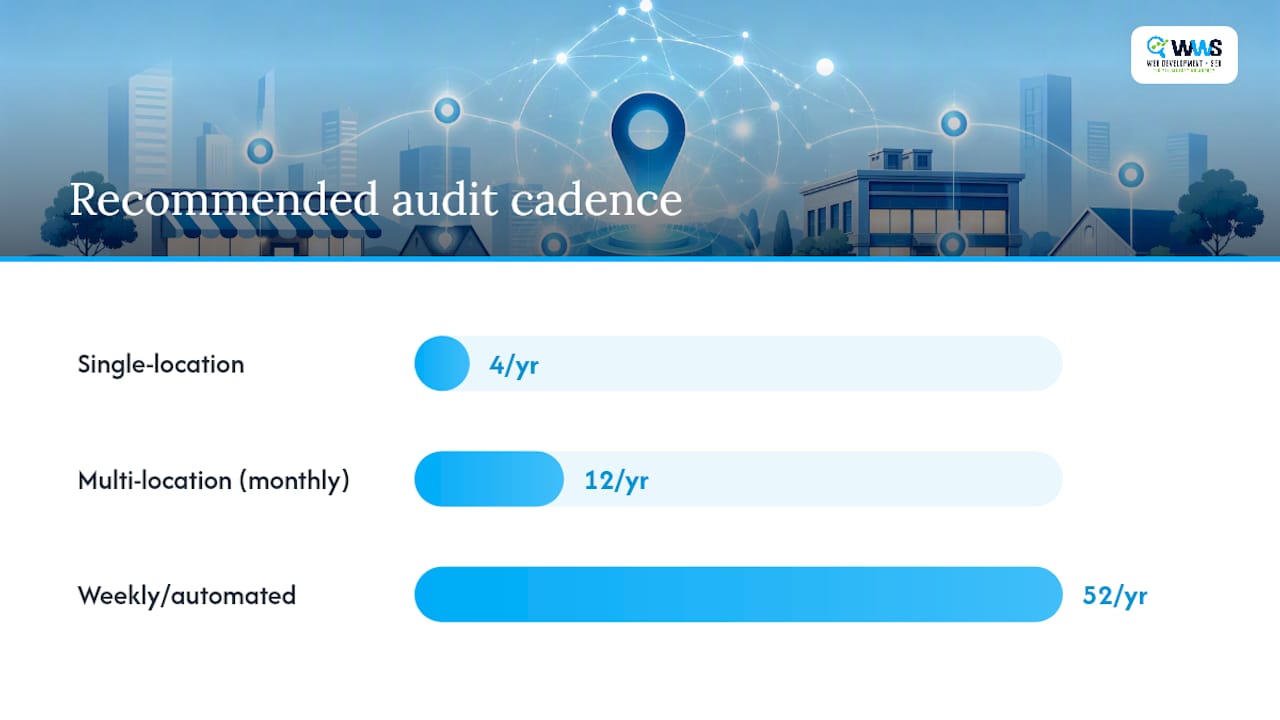
LocalSEOData’s recommendation is straightforward on cadence: a single-location business should re-audit quarterly at minimum. If you’re managing multiple locations, monthly checks aren’t enough. You need weekly or automated monitoring, since the error surface multiplies with every additional address and phone line. Once your internal team is stretched managing five or more locations, or you’re facing repeated aggregator errors you can’t resolve, that’s usually the signal to bring in a dedicated local SEO partner rather than keep patching it yourself.
How WWS Approaches NAP Cleanup for Local Clients
The agency built its in-house process around exactly this kind of triage. The team has run this playbook across many client partnerships, finding that businesses with scattered listings show up less often in map pack results until the underlying data gets reconciled.
A typical before and after looks like this: a contractor with three different phone numbers floating across Yelp, an outdated aggregator feed, and a Facebook page listing a defunct address. After cleanup, calls start routing to the right line and the map pin matches the actual jobsite office.
Our project start checklist mirrors what’s outlined above:
- Build the source-of-truth record first, before touching any listing
- Claim and verify Google Business Profile and other major platforms
- Submit aggregator corrections and document ownership issues
- Sync schema markup with the verified GBP data
- Set up ongoing monitoring so the fix actually holds
— Online Marketing Experts
When Should You Handle This Yourself vs. Call a Specialist?
Simple fixes, like correcting your phone number on Yelp or updating your hours on Facebook, take minutes and any owner can do them in a single sitting. Where DIY gets rough is aggregator correction chains that never seem to propagate, or merging duplicate profiles across a dozen locations without accidentally losing review history.
For multi-location rollouts, the agency handles aggregator submissions and schema sync in parallel so every location updates on a consistent timeline instead of trickling out over months. If your audit turns up more locked accounts and duplicate listings than you expected, that’s usually the point to request a consultation rather than keep guessing at login recovery on your own.
Get Your NAP Fixed by a Local SEO Team That Handles It All In-House
This agency offers a unified alternative to piecing together citation fixes yourself or hiring multiple freelancers for your website, Google Business Profile, and directory cleanup. Every part of the process, from the initial audit to schema implementation to ongoing monitoring, runs through one in-house team, minimizing lost communication between vendors.
A managed NAP cleanup through our Local SEO service starts with the same source-of-truth audit outlined above, then moves into claiming and correcting listings across every major platform, syncing your website’s schema markup, and setting up monitoring so the fix sticks instead of drifting again in six months. With certified specialists handling every step in-house, the agency builds a citation foundation that supports map pack rankings and AI-driven answers alike. If your listings are scattered across Des Plaines, Chicago, or anywhere in the surrounding suburbs, request a consultation and get a clear read on what’s broken and what it takes to fix it.
Sources
- What is NAP Consistency? How Does NAP Affect Local … — CallRail
- What is NAP in Local SEO? — BrightLocal
- What Does NAP Mean in Local SEO? — ShiftFlow playbook
- What is NAP in SEO? Complete Guide for Local Rankings (2026) — Rankz
- What is NAP? Free NAP Consistency Checker | Local SEO Data
FAQ
What Is NAP Consistency?
NAP consistency means your business Name, Address, and Phone number appear identically across your website, Google Business Profile, and every directory or map platform that lists you. CallRail’s research identifies it as a top-five ranking factor because search engines use matching citations to confirm your business is legitimate.
How Do You Check NAP Consistency?
Build a source-of-truth record with your canonical name, address, and phone number, then check your website, Google Business Profile, Apple Maps, Bing Places, Yelp, and Facebook in that order, recording any mismatch you find. This audit workflow is designed to take 30 to 60 minutes for most single-location businesses.
What Does NAP Stand for in SEO?
NAP stands for Name, Address, and Phone number, the three core data points search engines cross-reference to verify a local business listing. It’s the shorthand used across local SEO for the citation data that appears on directories, maps, and your own website.
How Do You Improve NAP Consistency?
Fix high-severity errors first, like wrong phone numbers or incorrect addresses, then move to medium-severity issues like outdated hours before cleaning up cosmetic formatting differences. Most businesses see measurable visibility gains within 60 to 90 days of completing a full cleanup, and services like WWS’s Local SEO program manage that process from audit through ongoing monitoring.