





Claim and optimize your Google Business Profile and Local Services Ads first. Those two levers produce the fastest, cheapest plumbing leads available, often inside two to four weeks, while organic gains from service pages and content take three to six months to build real momentum. Success looks like more inbound calls, a lower cost per lead, and jobs booked from people who searched “plumber near me” at 11 p.m. with a burst pipe.
TL;DR:
- Claiming and optimizing your Google Business Profile can generate visibility and new leads within two to four weeks, especially when combined with Local Services Ads verification.
- Service pages should be dedicated to each specific offering, including detailed scope, symptoms, process, and trust signals, to improve local search rankings and conversions.
- Prioritize GBP and LSA first, then focus on building review volume, call tracking, and local backlinks to prove SEO success with booked jobs and revenue.
- Mobile site speed and usability are critical, requiring fast-loading, well-structured pages with clear call buttons to maximize incoming calls from local search traffic.
- SEO results take time: GBP and LSA within weeks, content-driven organic growth in months, and full ROI usually after nine to twelve months.
Table of Contents
- What Does Plumber SEO Actually Mean?
- How Should Plumbing Service Pages Be Structured?
- Which Keywords Should Plumbers Target First?
- What Content Actually Generates Plumbing Leads?
- Is Your Website Fast and Usable on a Phone?
- How Do You Get More Plumbing Reviews Without Chasing Customers?
- Where Should Plumbers Look for Local Backlinks?
- What KPIs Prove Plumber SEO Is Working?
- How Long Does Plumber SEO Take and What Does It Cost?
- Should You Hire an Agency or Handle SEO In-House?
- What Makes a Track Record in Plumber SEO Credible?
- A Simple Rule for Busy Plumbing Shops
- How WWS Helps Plumbers Turn Search Traffic Into Booked Jobs
- Sources
- FAQ
What Does Plumber SEO Actually Mean?
Plumber SEO is the practice of getting a plumbing business found in Google Maps, local search results, and organic listings when someone nearby searches for emergency, repair, or installation help. It’s a narrower, more urgent version of general SEO because so much of the demand is time-sensitive. Someone with a flooded basement isn’t scrolling to page two.
That urgency changes the priority order compared to most local service businesses. Some service businesses can wait for organic rankings to build over a year. A plumber loses the customer to whoever answers first. That’s why the two fastest-moving pieces of digital marketing for plumbers, Google Business Profile and Local Services Ads, deserve first attention before a single blog post gets written.
Here’s the step-by-step for getting both working inside a month.
Claiming and optimizing Google Business Profile
Google Business Profile (GBP) drives Map Pack placement, which is often the first thing a searcher sees before any organic listing. Improvements to a profile can show visibility gains in as little as two to four weeks, which makes it the highest-leverage local plumber SEO move available to a business owner with limited time.
- Pick the right primary category. “Plumber” is usually correct, but if drain cleaning or water heater installation drives most of your revenue, add those as secondary categories rather than trying to rank the primary category for everything.
- Set a realistic service area. Don’t claim a 50-mile radius if your crew realistically drives 20 minutes. Google penalizes profiles that look like they’re gaming coverage, and a tighter radius concentrates your ranking signal where it counts.
- Upload real job photos weekly. Before-and-after shots of water heater swaps or repiped bathrooms outperform stock photography by a wide margin and give Google fresh signals to crawl.
- Use GBP Posts for promotions and seasonal reminders. A post about frozen pipe prevention in January does double duty: it’s useful content and a freshness signal.
- Fill out the Q&A section yourself. Seed it with the questions you get on every service call, like “Do you charge for weekend emergency visits?”
- Add service and product attributes. List every specific service, tankless water heater installation, sewer line repair, gas line work, as its own attribute rather than burying it in a generic description.
Local Services Ads verification and lead handling
Local Services Ads (LSA) often deliver the best return of any paid channel for plumbers because leads arrive already pre-qualified. Verified, highly rated providers typically see lead costs in the $35 to $65 range for emergency categories, and those leads convert at a far higher rate than generic search ads because Google has already vetted the business through a background check.
Getting verified requires a business license check, insurance documentation, and individual background screening for anyone dispatched to a home. Budget a week or two for the screening process alone. Once live, respond to every lead within minutes, not hours. Google’s algorithm tracks response time and factors it into how often your ad appears.
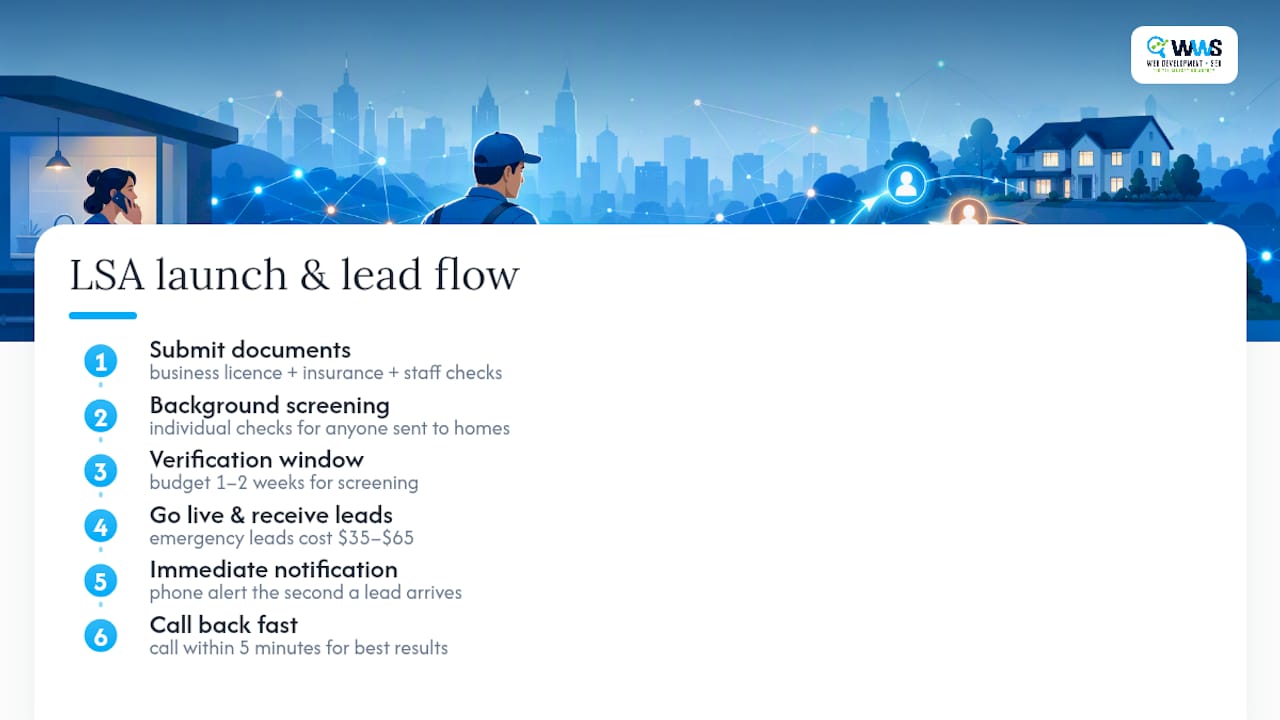
Pro Tip: Set your phone to notify you the second an LSA lead comes in, and call back within five minutes. Providers who respond fast consistently see lower cost-per-lead than providers who let messages sit, because Google’s own ranking factor rewards responsiveness with more impressions.
Review cadence matters here too. A profile sitting at a 3.9-star average won’t get the same LSA placement as one holding steady above 4.7 stars, so review generation isn’t a side project. It’s part of the paid lead engine.
How Should Plumbing Service Pages Be Structured?
Every service you offer, drain cleaning, water heater replacement, sewer camera inspection, needs its own dedicated page. A single “Our Services” page that lists ten offerings in one paragraph ranks for nothing specific and converts poorly because it never answers the visitor’s actual question.
A well-built service page for plumbing company SEO includes:
- A clear scope statement explaining exactly what’s included in the service and what triggers an additional charge
- Common symptoms that lead someone to search for this service, like “gurgling drain” or “no hot water”
- The actual process, step by step, so a nervous homeowner knows what a technician will do in their house
- Price drivers explained honestly, even if you don’t publish exact numbers, so leads arrive pre-qualified on budget
- Trust elements: licensing number, insurance coverage, and a review widget pulling recent feedback
- A tap-to-call button placed above the fold, not buried after 800 words of copy
City or service-area pages are useful when you genuinely serve multiple distinct towns with different demand patterns, say, Naperville and Aurora both search heavily for sump pump installation but for different reasons tied to local flooding history. The risk is creating a dozen near-identical pages that swap out one city name, which Google treats as thin, duplicate content rather than genuine local relevance. Build a service-area page only when you can write something specific to that town: local plumbing code quirks, common housing stock issues, or a real project you completed there.
On the schema side, add LocalBusiness markup on the homepage, Service schema on each service page, and FAQPage schema wherever you’ve built out a genuine Q&A block. These structured data types help search engines understand what a page offers and can influence how it appears in results, though they’re a supporting signal, not a ranking shortcut on their own.
Which Keywords Should Plumbers Target First?
Not every keyword deserves the same page or the same urgency. Effective keyword research for local plumber SEO strategies sorts search terms into four buckets, and each bucket maps to a different type of page.
- Emergency intent: “burst pipe repair,” “emergency plumber open now,” “no hot water fix.” These belong on your homepage and a dedicated emergency services page with a phone number in the H1 area.
- Service plus city: “water heater installation Schaumburg,” “drain cleaning Elgin.” These map directly to individual service pages, sometimes with a city variant if demand justifies it.
- Replacement and installation: “sump pump replacement cost,” “tankless water heater install.” Higher intent, often researched a few days before booking, so these pages benefit from cost guides and comparison content.
- Informational long tail: “why does my drain smell,” “is a leaking water heater dangerous.” These feed blog content and FAQ sections that build trust before the sale.
Title tags and H1s should lead with the service and location, not a clever tagline. “Emergency Plumber in Naperville, IL, Available 24/7” outperforms “Your Trusted Plumbing Partner” because it matches what someone typed. Work “near me” and city names into subheadings and body copy naturally rather than repeating the exact phrase in every sentence, which reads as stuffed and can actually suppress rankings.
Internal linking ties it together: link from your blog posts on drain smells or water heater lifespan back to the relevant service page, and link from service pages to a location page when one genuinely exists. This keeps a visitor moving toward the tap-to-call button instead of dead-ending on a single article.
What Content Actually Generates Plumbing Leads?
Content marketing for plumbers works best when it’s sequenced, not scattered. Chasing every blog idea at once burns time without building compounding traffic.
- Start with troubleshooting posts. “Why is my water heater making noise” or “why does my toilet keep running” answer the exact questions people type before they decide to call anyone, and they rank relatively fast because competition is lower than for commercial service terms.
- Publish cost guides next. “How much does sewer line replacement cost” earns links, gets shared, and pre-qualifies leads who are past the panic stage and into the research stage.
- Build “what to expect” pages for your biggest services. These reduce the anxiety that keeps someone from booking, especially for bigger jobs like repiping or sewer line work.
- Mine Google’s People Also Ask boxes for FAQ content. Search any core service term, note the questions that surface, and answer each one directly in an FAQ block or standalone post.
- Add short video, especially scope camera footage. A 30 second clip of an actual sewer inspection builds more trust than any amount of written copy, and it’s genuinely rare content in this industry.
Once a piece is live, repurpose it. A troubleshooting blog post becomes three GBP posts spread across a month, and the video clip becomes a social snippet for brand awareness. You’ve already done the work; recycling it into multiple formats is the part most plumbing companies skip.
Is Your Website Fast and Usable on a Phone?
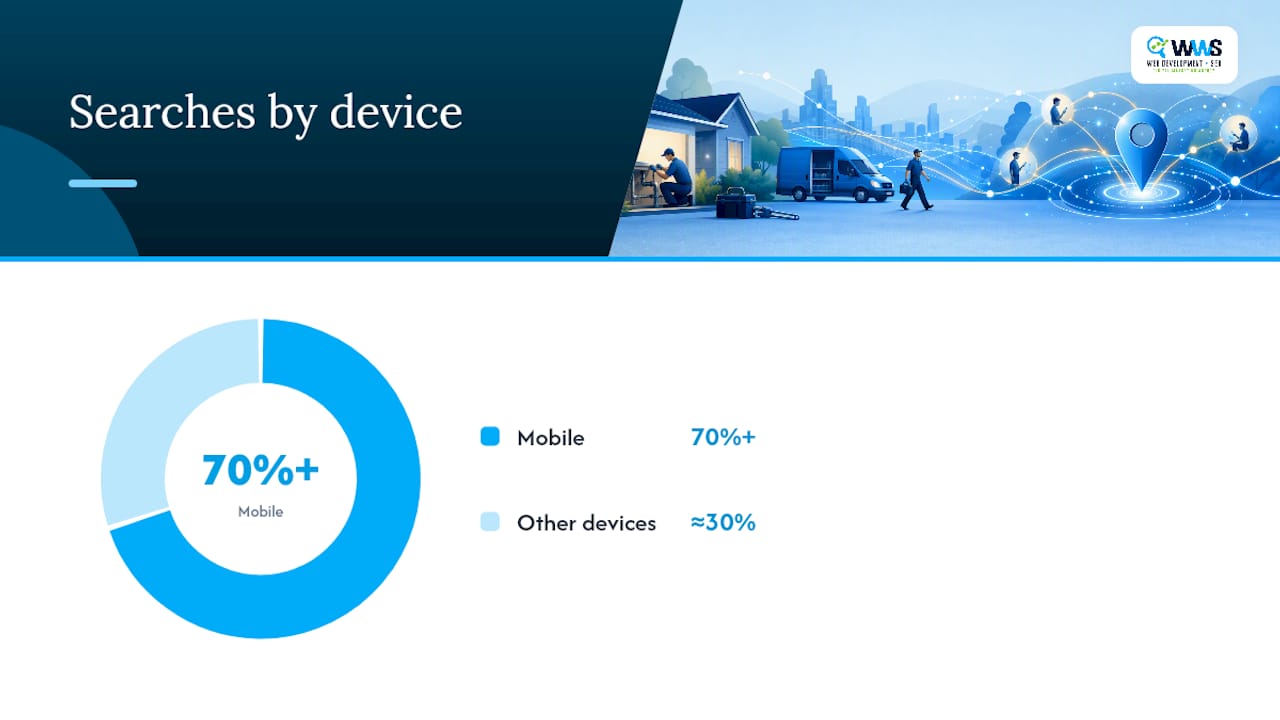
More than 70% of plumbing searches happen on mobile devices, which means a site that ranks well on desktop but loads slowly or hides the phone number on mobile is losing calls it already earned. Mobile usability isn’t a nice-to-have layered on top of rankings. It’s the difference between a click and a booked job.
- Make the phone number a tap-to-call button, sticky at the top or bottom of the screen on every page
- Test layout stability so buttons don’t shift while a page loads, which causes accidental taps and frustrated bounces
- Compress and properly size images so a page doesn’t drag on a cell connection during a real emergency search
- Trim server response time and inline critical CSS so the above-the-fold content, including that call button, renders almost instantly
- Check indexing status and canonical tags in Google Search Console to make sure duplicate service pages aren’t splitting ranking signal
- Confirm
LocalBusiness,Service, and review schema are implemented correctly, since malformed structured data can quietly fail to render in search results
Run every core page through Google’s own mobile-friendly test to catch usability issues Google itself flags, rather than guessing. A technical SEO audit from a partner resource like this one walks through the same priority order: crawlability first, speed second, then structured data.
Pro Tip: Test your busiest service page at 320 pixels wide, the narrowest common phone screen, not just your own device. Layout problems that never show up on a newer phone often appear immediately on an older or smaller one, and that’s exactly the visitor you can’t afford to lose.
How Do You Get More Plumbing Reviews Without Chasing Customers?
Review volume and rating quality directly shape both organic visibility and LSA placement, and consumer research consistently shows how heavily reviews influence local buying decisions before someone ever picks up the phone.
- Automate the ask. Set up an auto-SMS review request that fires within an hour of a job being marked complete in your dispatch system, while the technician’s good work is still fresh in the customer’s mind.
- Set a realistic monthly target. Ten to fifteen new reviews a month for a single-crew shop is achievable and meaningfully moves your average over a quarter; larger crews should scale the target with job volume.
- Respond to every negative review within 24 hours. A calm, specific response, not a defensive one, often does more to reassure future customers than the negative review does to scare them off.
- Never offer payment or discounts for a review. It violates Google’s policies and risks the whole profile getting suspended, which erases every review you’ve already earned.
Review signals feed directly into GBP ranking and LSA eligibility, so this isn’t a reputation task sitting off to the side of SEO. It’s one of the inputs.
Where Should Plumbers Look for Local Backlinks?
Local backlinks and consistent citations build the prominence signal Google uses to decide which businesses deserve trust in a given service area. For a plumbing company, the best targets are close to home.
- Local chambers of commerce and trade associations, which often list member businesses with a direct link
- Suppliers and manufacturers you’re an authorized installer for, many of which maintain a “find a pro” directory
- Real estate agencies and property management companies who refer plumbing work and will often link to a trusted vendor on their resources page
- Local news coverage of a sponsorship, charity plumbing repair, or community event your business ran
- A case study written about a specific local job, pitched to a neighborhood blog or town newspaper as a genuine story, not a press release
Before chasing new links, audit existing citations for NAP consistency, meaning your business name, address, and phone number match exactly across every directory. A citation audit tool can surface where an old address or a dropped suite number is still live and quietly undermining trust signals. Avoid low-quality directory submissions and any paid link scheme promising guaranteed placements. Google’s algorithms are good at spotting manipulated link patterns, and the penalty risk outweighs any short-term ranking bump.
What KPIs Prove Plumber SEO Is Working?
Rankings alone don’t pay the bills. The metrics that matter are the ones tied to booked jobs and revenue, and every plumbing business should be tracking them from day one of any SEO program.
| Metric | Why It Matters | How to Track It |
|---|---|---|
| Booked jobs by channel | Shows which source, GBP, LSA, or organic, actually closes work, not just clicks | CRM tagging tied to call source |
| Phone calls and close rate | Calls are the real conversion event for most plumbers, more than form fills | Call tracking software like CallRail or WhatConverts |
| Cost per booked job | The number that determines whether a channel is actually profitable | Ad spend or retainer cost divided by jobs closed |
| Map Pack visibility | Signals whether GBP optimization is working before calls even come in | GBP Insights |
| Organic traffic to service pages | Early indicator of content and on-page SEO traction | Google Search Console |
Set a baseline in week one, then check progress at 30, 90, and 180 days. Thirty days should show early GBP and LSA movement. Ninety days should show organic service pages climbing for lower-competition terms. One hundred eighty days is where a fuller local plumber SEO program typically shows up in booked job volume, not just impressions.
How Long Does Plumber SEO Take and What Does It Cost?
Expect GBP and LSA wins inside two to six weeks. Organic momentum on service pages usually needs three to six months, and strong, compounding ROI from content and links tends to land closer to nine to twelve months. Anyone promising first-page rankings in two weeks for competitive organic terms is not being straight with you.
- DIY tool costs run from free (Google Search Console, GBP itself) to a few hundred dollars a month for rank tracking and citation management software, but they demand real time from someone who understands the fundamentals.
- Managed retainers buy expertise, consistent execution, and reporting, and the price band reflects how much hands-on work a competitive market requires.
- Cost-per-lead benchmarks vary by market and season, but calculating your own is simple: total spend divided by leads generated, then divided again by your close rate to get true cost per booked job.
- Short-term paid budgets, including LSA and traditional search ads, should stay active while organic SEO ramps, since cutting paid too early creates a lead gap before organic traffic catches up.
For a deeper breakdown of how paid channels fit alongside organic growth, a resource like this plumbing lead generation guide walks through funnel-by-funnel budgeting in more detail.
Should You Hire an Agency or Handle SEO In-House?
The right choice depends on capacity, not just budget. A one-truck operation rarely has the bandwidth to run GBP, LSA, review automation, and content on top of actual plumbing work, while a larger shop with a marketing coordinator might reasonably keep some pieces in-house.
- Ask any agency for plumber-specific case studies, not generic local business results. The tactics that work for a dentist don’t map cleanly onto emergency service demand.
- Ask who owns your accounts. You should retain admin access to your own GBP, Google Ads, and analytics, full stop. An agency that won’t grant that access is a red flag worth walking away from.
- Watch for guaranteed rankings. No legitimate agency can guarantee a specific position on Google, and anyone who does is either inexperienced or dishonest.
- Expect concrete 90 day deliverables, like a fully optimized GBP, live LSA verification, three to five built-out service pages, and a working call-tracking setup, not vague promises of “improved visibility.”
- If going DIY, assign clear internal roles, even part time: one person owns GBP and reviews, one owns content, and someone checks the KPI dashboard monthly so nothing drifts.
What Makes a Track Record in Plumber SEO Credible?
Results claims in this industry are cheap to make and hard to verify, which is exactly why credentials and measurement methodology matter more than a slick pitch deck.
- WWS – Web Development + SEO is an official Google and Meta Partner, and every team member working on a client account is individually Google and Facebook certified, nothing is outsourced to a third-party contractor.
- The team has built and managed campaigns across over 200 client partnerships for local service businesses throughout the Chicago area, from contractors to restaurants to medical providers.
- Booked jobs get attributed back to the SEO channel that produced them through call tracking, CRM integration, and cross-checks against Google Search Console and GBP Insights, so a client sees which specific action drove which specific call.
- Reporting focuses on the metrics covered earlier in this guide: calls, close rate, and cost per booked job, not just keyword rank movement that doesn’t translate to revenue.
That in-house structure matters because a plumbing business hiring outside help deserves a single accountable team, not a relay of freelancers passing files back and forth.
A Simple Rule for Busy Plumbing Shops
If you take one thing from this guide, prioritize Google Business Profile and Local Services Ads before anything else, then get call tracking running so you actually know which channel produces booked jobs. Everything else, service pages, blog content, backlinks, compounds over months and deserves attention, but it shouldn’t come first if your team is stretched thin.
For a shop running lean with no dedicated marketing person, block two hours a week for GBP posts, review follow-up, and checking your KPI dashboard rather than trying to do everything at once. Measure booked jobs and cost per lead, not keyword rankings or website traffic for their own sake. A page that ranks but never converts isn’t helping your business, and a modest ranking that consistently produces calls is worth more than a vanity metric that looks good in a report.
— Online Marketing Experts
How WWS Helps Plumbers Turn Search Traffic Into Booked Jobs
WWS – Web Development + SEO is the alternative to juggling three different vendors for GBP, ads, and web design. Instead, you get one in-house team handling Google Business Profile optimization, Local Services Ads setup, custom service page builds, and call-tracking integration under a single point of contact.
As an official Google and Meta Partner, every specialist on the team carries individual Google and Facebook certifications, and the roster has guided over 200 successful client partnerships across contractors, restaurants, and service businesses throughout the Des Plaines and the greater Chicago area. That in-house model means no outsourced freelancers touching your account and no delays waiting on a subcontractor to make a fix. If your current site can’t support tap-to-call urgency or a properly structured service page, start with a look at local SEO services built for contractors and get a straight answer on what your current setup is missing before your next slow month hits.
Sources
- SEO for Plumbers: A Practical Local Search Guide
- Google mobile-friendly test
- BrightLocal — Local consumer review survey
FAQ
What Is the Fastest Way to Improve Plumber SEO?
Claiming and fully optimizing your Google Business Profile, paired with getting verified for Local Services Ads, produces visible results in two to four weeks, faster than any organic content or link-building effort.
How Much Does Plumber SEO Cost?
Costs range from free DIY tools like Google Search Console and GBP to managed retainers priced by market competitiveness and scope; LSA leads themselves typically run $35 to $65 per lead in emergency categories.
How Long Until SEO for Plumbers Shows Real Results?
GBP and LSA gains show up in weeks, organic service page traffic builds meaningfully over three to six months, and strong compounding ROI from content and backlinks generally arrives closer to nine to twelve months.
Do I Need a Separate Page for Every City I Serve?
Only when you can write something genuinely specific to that town, like local code differences or a real completed project; otherwise a single strong service-area page with honest coverage details performs better than several thin, near-duplicate city pages.
How Many Reviews Should a Plumbing Business Get Each Month?
A single-crew shop can reasonably target ten to fifteen new reviews monthly using an automated post-job SMS request, a pace that steadily lifts the average rating that both customers and Google’s Local Services Ads algorithm weigh heavily.