


SMS Marketing for Contractors: A Practical Playbook
How contractors use text messages to answer leads fast, book estimates, cut no-shows, earn reviews and win repeat jobs, with consent rules and sample texts.
 By WWS Team
13 min read
In this article15 sections
- Key takeaways
- Why texting fits the way contractors sell
- The speed-to-lead rule
- What your first text should say
- A text sequence for every stage of the job
- Consent and compliance, in plain terms
- Choosing and setting up the tools
- Measuring whether it works
- Where texting sits in your lead generation
- A 30-day rollout plan
- Our perspective
- Put texting to work with a connected marketing system
- FAQ
- Sources
- Recommended
SMS marketing for contractors means using text messages to answer new leads within minutes, confirm estimates, send arrival updates, ask for reviews and bring past customers back, all with the customer’s permission. Done well, it fills the gap between “I requested a quote” and “I hired someone,” which is where most contractor leads are lost. This guide covers what to send, when to send it, how to stay inside the consent rules, and how to measure whether it pays.
Key takeaways
- Speed wins jobs: reply to every new inquiry by text within minutes, and say who you are and what happens next.
- Build a short sequence around the moments that matter: new lead, estimate follow-up, appointment reminder, arrival update, review request and seasonal check-in.
- Get clear permission before you send marketing texts, honor every STOP reply immediately, and keep records of consent.
- Track replies, booked appointments and jobs won, not just open rates, and connect your texting to your CRM and website forms.
- Texting works best alongside a site and Google Business Profile that generate the inquiries in the first place.
Why texting fits the way contractors sell
Contractor work is local, urgent and relationship driven. A homeowner with a leaking roof or a dead furnace contacts several companies and usually hires the one that answers first and sounds organized. Text messages suit that situation because they reach the customer on the device they are already holding, and they do not require anyone to pick up a call from an unknown number.
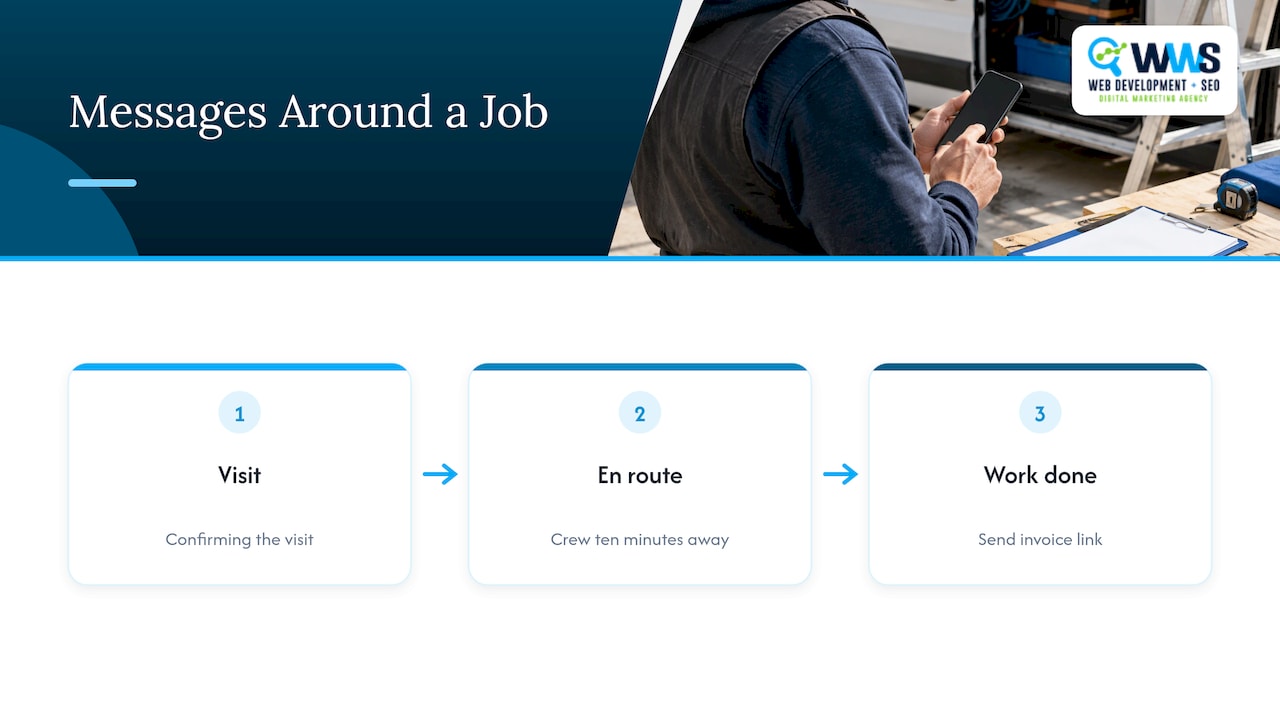
Trade media describes SMS as a direct, immediate and cost-effective channel for home service and construction businesses, useful for promotional outreach, lead generation, appointment reminders and project updates. That range matters. Most of the value for a contractor does not come from blast promotions. It comes from the one-to-one messages around a job: confirming the visit, telling the customer the crew is ten minutes away, and sending the invoice link when the work is done.
Texting also helps the office and the field work together. A dispatcher can send an arrival window, a technician can reply from the truck, and the customer sees one continuous conversation rather than three different phone calls.
The speed-to-lead rule
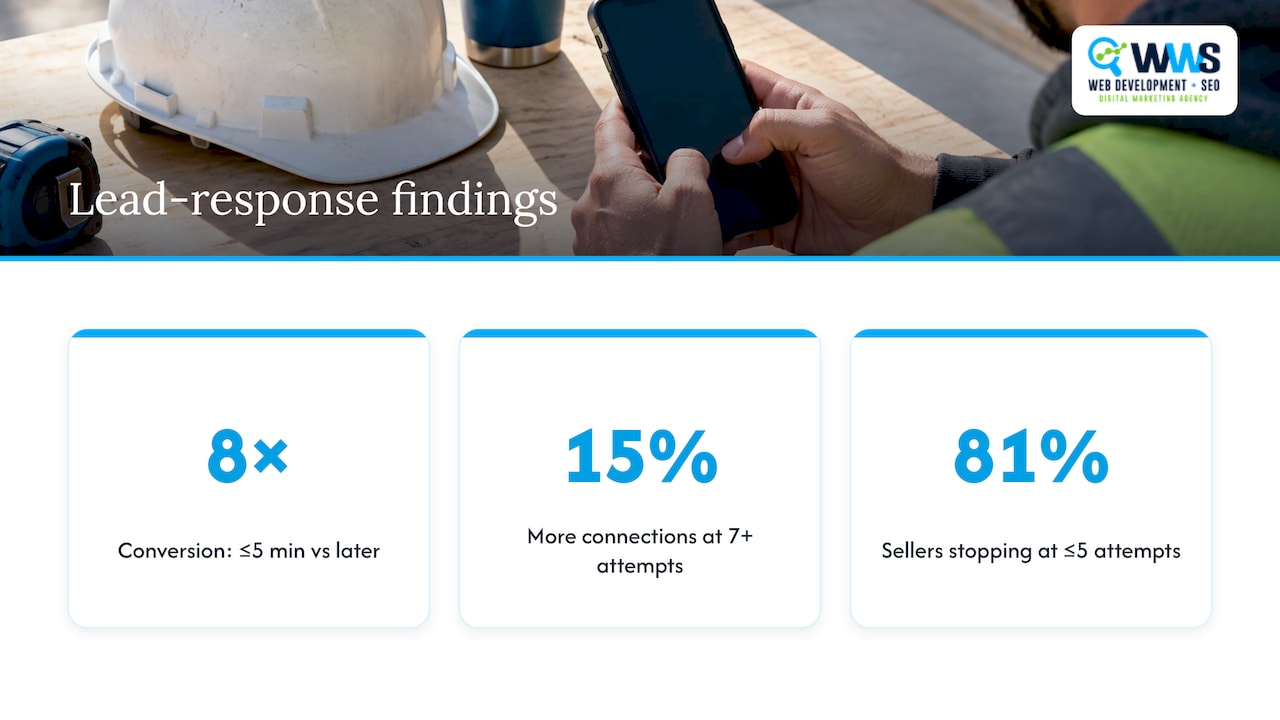
The single most useful habit in contractor SMS is a fast first response. InsideSales’ lead response research, based on 5.7 million marketing leads across more than 400 companies, found that conversion rates were 8 times higher when the first response came within 5 minutes than when it came later. That study covers sales leads broadly, not only contractors, but the pattern is familiar to anyone who has lost a job to the company that called back first.
The same research reports that making 7 or more follow-up attempts produced 15% more connections, while 81% of sellers stopped at 5 or fewer. Persistence pays, as long as each touch is useful and the customer can stop it at any time.
In practice, this means an automated text should go out the moment a web form, call-tracking number or missed call comes in, even at 9 p.m. A human can pick up the conversation in the morning, but the customer already knows you received the request.
What your first text should say
The first message has three jobs: identify your company, confirm you received the request, and offer one easy next step. Keep it short enough to read in a glance.
Sample first text for a web form lead
Hi Maria, this is Dan from Northside Roofing. We got your request for a roof inspection. Want to pick a time? Book here: [link] or reply with a time that works. Reply STOP to opt out.
What makes this work:
- A name and a company. People ignore texts from unknown senders.
- A reference to what they asked for. It proves the message is not random.
- One action. A scheduling link or a simple “reply with a time” is enough. Do not list your services.
- An opt-out line. It builds trust and supports your compliance.
If the lead came from a missed call, change the wording: “Sorry we missed your call. What can we help you with?” Open questions invite a reply, and a reply opens the door to a real conversation.
A text sequence for every stage of the job
A contractor’s customer journey has natural moments for a message. Build a small set of templates for each and automate the ones that do not need a person.
| Stage | Purpose | Example timing |
|---|---|---|
| New inquiry | Confirm receipt, offer booking link | Immediately |
| Estimate booked | Confirm date, time and address | At booking, then the day before |
| On the way | Arrival window, technician name | Morning of the visit |
| After estimate | Answer questions, nudge a decision | Day 1, then roughly 3, 7 and 14 days |
| Job complete | Thank you, payment link, review request | Same day or next morning |
| Past customers | Maintenance or seasonal reminder | Once or twice a season |
The 3, 7 and 14 day estimate follow-ups are a common starting cadence recommended by industry blogs, not a legal or scientific standard. Adjust to your sales cycle: a same-day plumbing repair needs a much tighter rhythm than a kitchen remodel that a family will think about for a month.
Appointment confirmations and reminders
No-shows cost contractors drive time and an unfilled slot. A confirmation at booking, a reminder the day before and a short “on our way” message are the simplest texts to add, and customers rarely object to them because they are about something they requested. We cover the setup in detail in our guide to SMS appointment reminders, including templates you can adapt.
Estimate follow-up
Most estimates are not lost to a competitor. They are lost to silence. A good follow-up text adds something: an answer to a likely question, a financing option you offer, a photo of a similar finished project, or a note that your schedule is filling for a particular month. Avoid messages that only say “just checking in.”
Sample day-3 follow-up
Hi Maria, Dan here. Any questions about the roof estimate we sent over? Happy to walk through the materials or adjust the scope. Reply here or call 555-0100. Reply STOP to opt out.
Stop the sequence the moment the lead books, replies with a decision, says no or asks not to be contacted. Continuing after any of those signals wastes goodwill and, after an opt-out, creates legal risk.
Job completion, reviews and referrals
The best time to ask for a review is right after the customer sees the finished work. Send one text with a direct link to your Google Business Profile review page and a personal thank you. A second, gentler reminder a few days later is reasonable if the first went unanswered.
Referral asks work better when they are specific and timed after a satisfied reply: “Glad you like the new windows. If a neighbor needs the same, send them our way and we will take good care of them.” Reviews also feed your local rankings, which is why texting and local SEO belong in the same plan.
Re-engaging old leads and past customers
Your past customers and unconverted leads are the cheapest audience you have. Send relevant, honest messages: a furnace tune-up reminder in September, a gutter cleaning note in late fall, a spring check on a roof that was repaired last year. Mention the previous job or inquiry so the message makes sense, and always include a way to opt out. Do not text a purchased or scraped list. People who never dealt with you have not agreed to hear from you, and cold texting is where most of the legal exposure sits.
Consent and compliance, in plain terms
In the United States, marketing texts are governed mainly by the Telephone Consumer Protection Act (TCPA), enforced through Federal Communications Commission (FCC) rules, with additional state laws and carrier requirements layered on top. This section is a practical overview for contractors, not legal advice. Talk to an attorney about your specific program, especially before running any campaign that goes beyond customers who have contacted you.
Working rules most contractors adopt:
- Get written or clearly recorded permission. A checkbox on your estimate form with plain wording, or a customer texting a keyword to your number, creates a record. Save the date, the wording and the phone number.
- Identify your business in every message and include simple opt-out instructions.
- Honor opt-outs immediately. The FCC’s SoundBite ruling says a single, non-promotional confirmation text after an opt-out can be sent, and that no further texts are covered by the earlier consent. A confirmation sent within 5 minutes is presumed to fall within it.
- Keep promotions and service messages separate. An arrival notice for a booked job is different from a seasonal discount. Your platform should let you tag each type.
- Send at sensible hours. Do not text customers late at night or very early, and remember that state rules and your texting provider’s policies may be stricter than federal ones.
The rules on revoking consent are changing. The FCC has been working on a proposal that would let callers designate an exclusive way to revoke consent, provided it is disclosed clearly in the call or text. A law firm’s summary of the FCC’s September 2026 action notes that the revised rules would apply to specific categories of calls and take effect after Federal Register publication. Because the timing and details can shift, confirm the current requirements with your attorney or the FCC’s official site before you finalize your opt-out process. The safe default is simple: treat any reasonable “stop,” “no more” or “unsubscribe” reply as an opt-out, and remove that number right away.
Choosing and setting up the tools
You do not need a complex stack. You need four things:
- A business texting number registered through your provider, so your messages are delivered reliably and customers see a consistent sender.
- A CRM or job management system that stores each contact, their consent and the job history.
- Automations triggered by events: form submitted, estimate sent, job marked complete.
- A shared inbox so replies reach a person quickly, with clear ownership of who answers.
Trade coverage points the same direction: HVAC industry media notes that the key is combining automation with an existing CRM to manage personalized messages that would be unmanageable by hand. If your forms, call tracking and texting do not talk to each other, leads fall into the gaps between them.
After-hours replies deserve a plan. Many homeowners request quotes in the evening. An automated reply that confirms receipt and offers a booking link keeps the lead warm until your team is back. Some companies add conversational automation for these moments, but make sure a person takes over once the customer has a real question.
Measuring whether it works
Trade media suggests tracking open, click-through and conversion rates and using trackable links to see engagement. For a contractor, translate those into business metrics you review monthly:
- Response time from inquiry to first text.
- Reply rate to the first text and to estimate follow-ups.
- Appointments booked from texts, and the no-show rate before and after reminders.
- Estimates converted to signed jobs, by lead source.
- Reviews collected per completed job.
- Opt-out rate. A rising number means your messages are too frequent or poorly targeted.
Compare these against your other channels. If paid search or local SEO brings in a hundred inquiries and texting converts a larger share of them, the best investment may be more inquiries feeding the same sequence. That is why we look at the whole path from search to signed contract.
Where texting sits in your lead generation
SMS does not create demand. It converts and retains it. A contractor with a slow website, a half-finished Google Business Profile and no reviews will get little from even the best text sequence, because few people reach the first message. Connect texting with the sources that produce inquiries:
- Search visibility, including contractor SEO for Chicago-area companies.
- Paid demand through Google Ads for contractors.
- A website built to turn visits into calls and forms, as described in our guide to home services lead generation.
- Email for longer-term touchpoints, using newsletter ideas for local service businesses.
Texting handles the urgent, personal moments. Email carries longer updates, project galleries and seasonal tips. Used together, they cover both the quick decision and the slow one.
A 30-day rollout plan
- Week 1: Audit. List every place a lead can enter: web forms, phone calls, Google Business Profile messages, ads. Check how long a reply currently takes.
- Week 1: Consent. Add clear texting consent wording to your forms and estimate paperwork. Decide how existing customers’ permission is documented.
- Week 2: Templates. Write six to eight messages: first response, booking confirmation, day-before reminder, on the way, estimate follow-up, job complete, review request, seasonal check-in.
- Week 3: Automation. Connect triggers to your CRM and set stop rules for replies, bookings and opt-outs.
- Week 4: Review. Read actual conversations, trim anything that feels pushy, and set your monthly metrics.
Our perspective
We see the same pattern across Chicago-area service businesses: the contractors who win are rarely the ones with the biggest budget. They are the ones who answer first, stay organized and make it easy to say yes.
Text messaging is one of the most direct ways to do that, but it only works when it is connected to the rest of your marketing. That is why we handle the website, local SEO, Google Business Profile, campaigns and technology in-house, with Google and Meta certified specialists on one team. When a lead comes from a map pack search, lands on a fast page, submits a form and receives a clear text within minutes, nothing was handed off or lost in translation.
Our approach is to treat texting as part of a system designed to turn visibility into booked jobs, with consent and clean opt-outs built in from the start.
Online Marketing Experts
Put texting to work with a connected marketing system
If you want texting, search visibility and your website working as one lead engine, we can help. WWS builds websites, manages local SEO and Google Business Profile optimization, and runs marketing campaigns including SMS, email and newsletters for contractors and other local service businesses in the Chicago area. Everything is handled in-house, so the people who build your site also understand your lead flow. See our marketing campaigns service or get in touch through our site.
If your inquiries come mainly from Google, our local SEO work is the natural starting point, so more of the right people reach your first text.
FAQ
Is SMS marketing legal for contractors?
Yes, when you follow the rules. In the U.S. that generally means getting appropriate consent before marketing texts, identifying your business, offering an easy opt-out and honoring it promptly. State laws and carrier policies can add requirements, so have an attorney review your consent wording and your program.
How fast should I text a new lead?
As fast as you can, ideally within minutes and automatically. Research on lead response found that first contact within 5 minutes converted at 8 times the rate of later contact. An automated confirmation followed by a personal reply is a practical way to do it.
How many follow-up texts are too many?
There is no single number, but each text should add value and the sequence should end when the lead books, replies with a decision, declines or opts out. Many contractors use an immediate reply and a handful of touches over two weeks, mixing texts with calls or email. If opt-outs rise, reduce frequency.
Can I text people who called once but never hired me?
Only if they gave you permission to text them. A past inquiry does not automatically count as consent for marketing messages. Collect consent on your forms and call scripts, record it, and include opt-out instructions in each message.
What should I measure first?
Start with response time, reply rate, booked appointments and estimates converted to jobs. Open rates are less useful than whether a text led to a conversation and a signed contract.
Sources
- How SMS Marketing Works for Home Services and Construction, Contractor
- InsideSales Lead Response Management infographic 2021
- FCC SoundBite declaratory ruling (2012)
- FCC document on revocation of consent proposal
- FCC Revises TCPA Revocation of Consent Rules, Troutman Pepper Locke
- Text Marketing 101 for HVAC Contractors, ACHR News
Recommended
A Des Plaines, IL team helping local service businesses get found, get called and get booked since 2005: local SEO, Google Ads, conversion-focused websites and AI search optimization.
Meet the teamKeep reading
All articles
The Practical Guide to Small Business Paid Advertising in 2026
Master PPC management for small business in 2026 with this practical guide covering ad auctions, budgets, and ROI tracking for Chicago-area growth.
Performance Max for Local Businesses: How It Works and Fits
Performance Max for local businesses explained: store goals, where ads appear, setup needs, budgets, pay-per-lead rules and how to judge results.
Best Car Wash Website Inspiration: Sleek Designs That Clean Up the Competition
Find the best car wash website inspiration for 2026 - see sleek designs, subscription funnels, and local SEO tips to boost conversions.