





Why the Right SEO Keywords Example Can Change How Customers Find You
Here are real SEO keywords examples across common business types — so you know exactly what good keyword targeting looks like:
| Business Type | Primary Keyword | Long-Tail Keyword Example |
|---|---|---|
| Local chiropractor | chiropractor Portland | best chiropractor in Portland for back pain |
| E-commerce (pet supplies) | dog harness | adjustable dog harness for small breeds |
| Food blogger | easy recipes | easy dinner recipes for working moms under 30 minutes |
| SaaS company | email onboarding | onboarding email sequence for SaaS free trial users |
| Local contractor | roofing repair | affordable roof repair in Chicago suburbs |
| Restaurant | pizza delivery | late night pizza delivery near downtown Chicago |
These examples show a clear pattern: the more specific the keyword, the easier it is to rank — and the more likely the visitor is ready to act.
Nearly 75% of users never scroll past page one of Google search results. That means if your business isn’t ranking for the right keywords, those potential customers are going straight to your competitors.
Keywords are the bridge between what someone types into Google and the content on your website. Get them right, and you attract qualified visitors — people who actually want what you offer. Get them wrong, and you either stay invisible or attract traffic that never converts.
This guide covers exactly how to find, choose, and use the right keywords — with real examples for local businesses, e-commerce stores, bloggers, and service providers.
I’m Tomasz Lasota, founder of WWS — Web Development + SEO, a Des Plaines, IL digital marketing agency with over 22 years of experience helping small and medium-sized businesses across the Chicago area grow through SEO — including building keyword strategies that have turned invisible websites into consistent lead generators. Every seo keywords example in this guide comes from real-world practice, not theory.
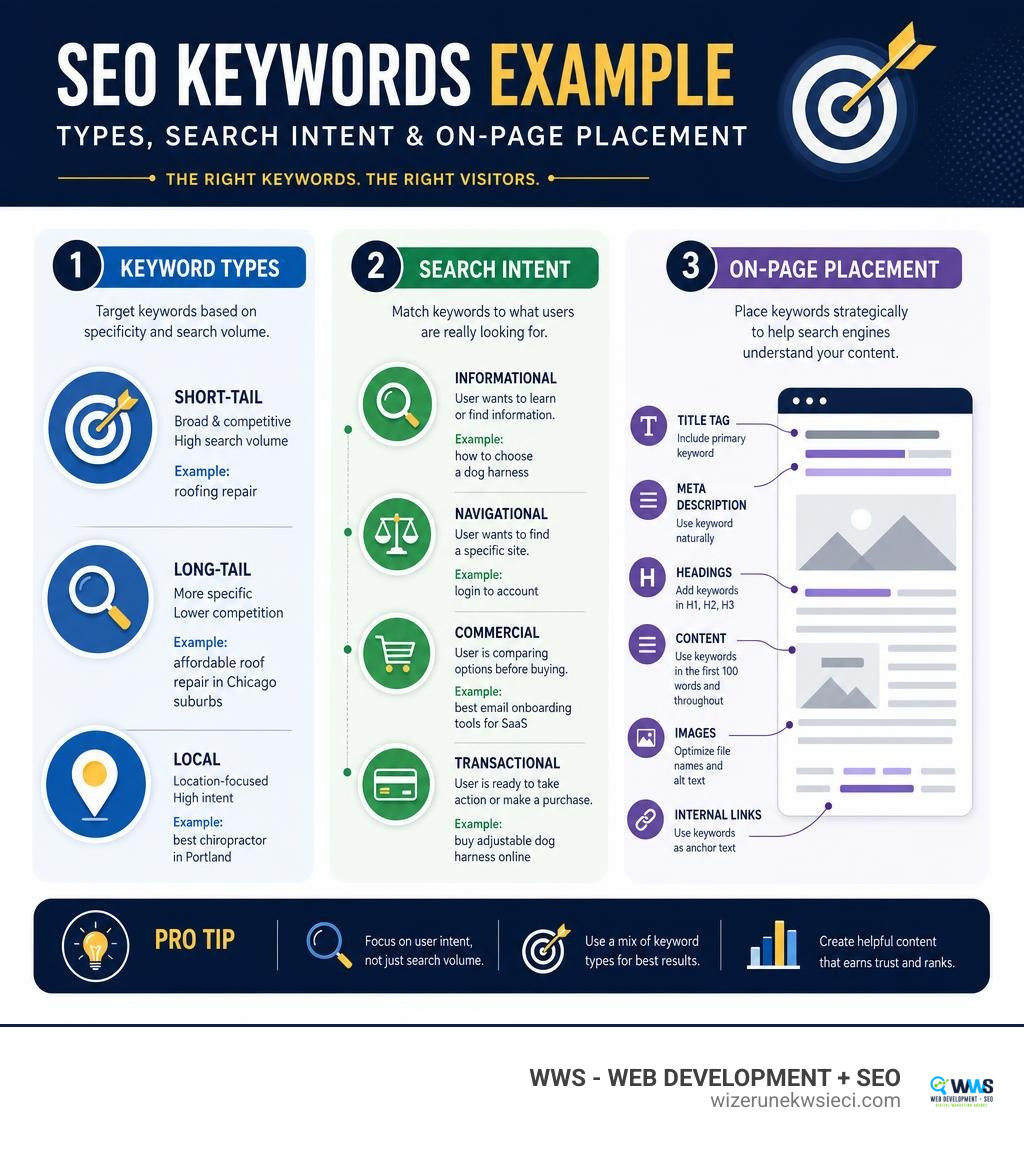
Seo keywords example vocab explained:
Why SEO Keywords Matter for Ranking in 2026
In 2026, search engine optimization is no longer about tricking a basic search algorithm by repeating a phrase over and over. Google’s language matching systems are incredibly sophisticated. They understand natural language patterns, synonyms, context, and topical depth.
Furthermore, the rise of AI Overviews (AIOs) and voice search has fundamentally shifted how users interact with search engines. AI Overviews now appear in roughly 30% of U.S. desktop searches, and studies show they can reduce the organic click-through rate (CTR) for position-one results by up to 58%. Because a quarter of all search volume has shifted toward AI-driven chatbots, answer engines, and voice queries, your keyword strategy must adapt.
Instead of chasing generic, high-volume head terms, businesses must focus on specific, long-tail search queries that mirror how humans naturally speak and type. Organic search still drives more trackable web traffic than paid ads, social media, and display networks combined. This makes ranking organically the most cost-effective way to grow your business over the long term.
For local businesses operating in highly competitive markets like Chicagoland, targeting precise search phrases is the key to survival. By utilizing tailored Local SEO strategies, small businesses can easily bypass massive national corporations in local map packs and localized search results.
Understanding the Core Types of SEO Keywords
To build a balanced website strategy, you need to understand that not all keywords serve the same purpose. A healthy campaign targets several distinct keyword categories:
- Primary Keywords: These are broad, high-volume search terms (usually 1–3 words) that describe your core business, such as “web design” or “chiropractor.” While they have massive search volume, they are highly competitive and difficult for new or smaller websites to rank for immediately.
- Long-Tail Keywords: More than half of all search queries are at least three words long, and more than a third are four words or longer. These phrases (e.g., “affordable web design for small businesses”) have lower search volume but carry incredibly high conversion rates because the user’s intent is highly specific.
- Question-Based Keywords: Often triggered by voice search and AI assistants, these are full-sentence queries starting with who, what, why, or how (e.g., “How should a cat walking vest fit?”). Answering these questions directly helps you win placements in Google’s featured snippets and AI Overviews.
- Local Keywords: Crucial for brick-and-mortar storefronts and service providers, these include geographic modifiers (e.g., “dentist in Des Plaines IL” or “Naperville plumber”).
- Branded vs. Non-Branded Keywords: Branded terms include your business name (e.g., “Wizerunek w Sieci SEO services”), while non-branded terms are generic industry phrases (e.g., “local search engine optimization agency”). Non-branded terms have higher search volumes and represent your biggest opportunity to capture new market share.
- Zero-Volume Keywords: These are highly specific terms that keyword tools report as having “0 monthly searches,” yet they represent active, high-intent buyers looking for niche solutions.
- Seasonal Keywords: Phrases that spike in search volume at specific times of the year (e.g., “last-minute Father’s Day gift ideas under $50”). To rank for these, businesses must publish seasonal content 6 to 8 weeks before the peak search period to allow search engines time to crawl and index the pages.
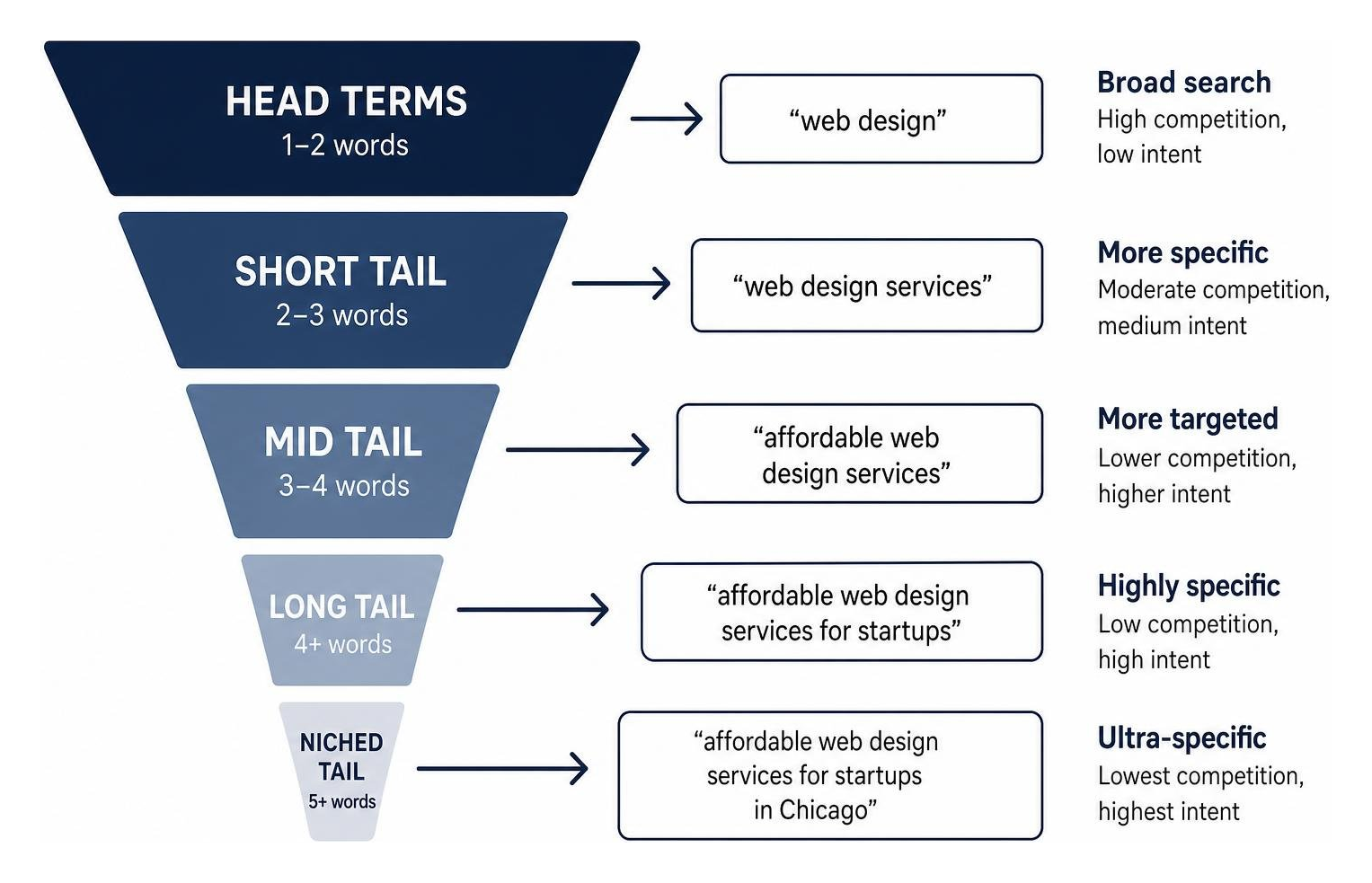
By working with professional Local SEO Services, you can identify which blend of these keyword types will yield the fastest return on investment for your specific niche.
How to Find and Analyze High-Value Keywords
Finding the right keywords is a structured process that combines data analysis with a deep understanding of your target audience.
To find and analyze high-value keywords, follow these steps:
- Step 1: Discover Seed Keywords: Start by brainstorming broad terms that define your business. You can type these seed phrases into Google Autocomplete or Amazon Suggest to see what variations real users are searching for.
- Step 2: Leverage Free and Paid Tools: Use Google Keyword Planner, Google Trends, and Google Search Console to find search volume data, historical trends, and queries you already rank for. For advanced research, professional competitor analysis tools can help you uncover “keyword gaps”—terms your competitors rank for but you do not.
- Step 3: Analyze Essential Metrics:
- Search Volume: The average number of times a keyword is searched per month. While high volume is attractive, 94.74% of all keywords receive 10 or fewer monthly searches. Low-volume keywords are often highly profitable.
- Keyword Difficulty (KD): A score from 0 to 100 indicating how hard it is to rank on the first page. Small or new websites should focus on low-competition terms (KD under 30).
- Cost-Per-Click (CPC): A high CPC in paid advertising signals strong commercial value; if competitors are willing to pay $15 per click for a term, it is highly likely to convert into sales.
- Step 4: Mine Google Search Console: Look for “striking distance” keywords—phrases where your site ranks in positions 11 through 30. With minor on-page optimizations, these pages can quickly jump to page one.
Developing a robust keyword strategy requires technical expertise. Our team at WWS can handle the heavy lifting for you through our custom Website SEO solutions.
Matching Search Intent to Your Strategy
Choosing a keyword based solely on search volume is a recipe for failure. You must understand the why behind the search, known as searcher intent. Google groups search intent into four main categories:
- Informational Intent: The user wants to learn something (e.g., “how to optimize website for Google search”). These are best targeted with blog posts and comprehensive guides.
- Navigational Intent: The user is looking for a specific brand or website (e.g., “WWS Des Plaines contact”).
- Commercial Intent: The user is investigating options before making a final decision (e.g., “Casper vs Purple mattress for side sleepers” or “best web design agency in Chicago”). Comparison guides, reviews, and list articles work best here.
- Transactional Intent: The user is ready to buy or take immediate action (e.g., “hire SEO strategist” or “buy organic coffee beans online”). These keywords belong on your product, service, or landing pages.
By matching the structure of your content to the underlying search intent, you ensure a positive user experience, which is a major ranking signal.
Building Topic Clusters and Keyword Mapping
Once you have a list of terms, do not simply scatter them randomly across your site. Instead, organize them into keyword clusters to build topical authority.
A topic cluster consists of:
- A Pillar Page: A comprehensive, broad page targeting a high-volume primary keyword (e.g., a complete guide to search engine optimization).
- Subpages (Cluster Content): Highly specific pages targeting related long-tail and question-based keywords (e.g., articles on image alt text, meta descriptions, and schema markup).
- Internal Linking: Strategically linking the subpages back to the pillar page and vice versa. This clear site architecture helps search engine crawlers understand how your pages relate to one another.
To see how this works in practice, explore our structured SEO Services Packages Chicago to see how we build high-converting content hubs for our clients.
Real-World SEO Keywords Example for Small Businesses
Let’s look at how actual businesses can translate keyword theory into actionable content strategies that drive leads, calls, bookings, and sales.
Local Service Provider SEO Keywords Example
For local service providers in the Chicago metropolitan area, local search visibility is everything. Targeting highly competitive national keywords is often inefficient; instead, focus on geo-targeted keywords that bring nearby customers to your door.
Let’s look at a real-world local service seo keywords example for a plumbing company based in the Northwest Suburbs of Chicago:
- Primary Keyword: “plumber Naperville”
- Long-Tail Keyword: “emergency 24/7 plumber in Naperville IL”
- Question-Based Keyword: “why is my water heater leaking from the bottom?”
- Commercial Keyword: “best commercial plumbing services near Schaumburg”
Instead of putting all of these terms on the homepage, the business should create dedicated service pages and localized landing pages:
- An emergency plumbing page targeting “emergency 24/7 plumber in Naperville IL.”
- A blog post answering “why is my water heater leaking from the bottom?” that links to their water heater repair service page.
- Specific service pages targeting neighboring suburbs such as Arlington Heights, Elk Grove Village, Mount Prospect, Des Plaines, Schaumburg, Park Ridge, Skokie, Niles, and Glenview.
This localized approach is highly effective because it matches the exact way local residents search. A customer in Mount Prospect may not search the same way as a customer in downtown Chicago, and a business serving Cook County or the Northwest Suburbs needs content that reflects those local buying patterns. For WWS clients, that often means building city-specific landing pages, optimizing Google Business Profile signals, and creating helpful service content that answers real customer questions.
For small businesses serving Des Plaines, Chicago, and nearby suburbs, this kind of keyword mapping can turn a website from a simple online brochure into a reliable lead-generation asset. Wizerunek w Sieci combines local market knowledge, bilingual English and Polish capabilities, and detailed SEO implementation to help business owners reach the right customers in the communities they serve.
To learn more about how local targeting can transform your business, check out our guide on Chicago SEO Agencies: Your Guide to Ranking Up.
E-Commerce and SaaS SEO Keywords Example
E-commerce and Software-as-a-Service (SaaS) companies operate in a global or national space, meaning competition is fierce. To stand out, these businesses must rely heavily on comparison keywords, transactional keywords, and negative qualifiers.
Consider a SaaS company that provides project management software for creative agencies:
- Primary Keyword: “project management software” (Extremely competitive, dominated by multi-billion dollar brands).
- Long-Tail/Persona-Based Keyword: “project management tool for small graphic design agencies.”
- Comparison Keyword: “project management software for creative teams compared.”
- Negative Qualifier Keyword: “project management software no minimum contract.”
By targeting “no minimum contract,” the SaaS company addresses a major pain point and targets high-intent buyers who are ready to sign up but want to avoid long-term commitments.
For e-commerce brands, a similar strategy applies. If you sell specialized pet supplies, targeting “dog harness” is incredibly difficult. However, creating comparison guides or targeting terms like “escape-proof dog harness for small poodles” will attract buyers who are far along in the purchasing funnel.
For a deeper dive into scaling online stores, review our dedicated guide to Ecommerce SEO.
On-Page Keyword Implementation and Best Practices
Once you have chosen your target keywords, you must implement them on your pages. The goal is to signal relevancy to search engines while maintaining a natural, high-quality reading experience for your users.
Follow these on-page optimization best practices:
- Title Tag: Place your primary keyword near the beginning of the title tag. Keep the title under 75 characters so it does not get truncated in search results.
- URL Slug: Use a short, clean, descriptive URL that includes your primary keyword (e.g.,
wizerunekwsieci.com/local-seo). Avoid long strings of numbers or dates. - Heading Hierarchy: Use only one H1 tag per page, and make sure it naturally includes your primary keyword. Use H2 and H3 subheadings to organize your content, incorporating secondary and long-tail variations where appropriate.
- First 100 Words: State your primary keyword early in the introduction of your page to immediately establish relevancy.
- Meta Description: Write a unique, compelling meta description between 120 and 170 characters. While Google does not use the meta description as a direct ranking factor, a well-written description with your target keyword bolded in search results will significantly improve your CTR.
- Image Alt Text: Add descriptive alt text to all images, naturally incorporating your target keywords when describing the image. This helps search engines index your images and improves website accessibility.
- Internal Links: Link to other relevant pages on your site using descriptive, keyword-rich anchor text instead of generic phrases like “click here.”
For a comprehensive breakdown of on-page optimization standards, you can refer to academic and institutional guidelines such as Keywords, Meta Descriptions, Headers, Alt Text and Schema. If you want to make sure your website’s on-page elements are perfectly tuned, explore our core Website SEO services.
Common Keyword Optimization Mistakes to Avoid
Even experienced marketers can make mistakes that harm their search engine visibility. Here are the most common pitfalls to avoid:
- Keyword Stuffing: Artificially forcing your target keyword into your text over and over. This reads poorly, ruins the user experience, and can result in search engine penalties. Write for humans first, search engines second.
- Keyword Cannibalization: This occurs when multiple pages on your website target the exact same focus keyword. This confuses search engines, as they must decide which page is more relevant, often resulting in lower rankings for both. Assign one unique primary keyword to each page on your site.
- Ignoring Search Intent: Creating transactional landing pages for informational queries, or writing long blog posts for highly transactional terms. If a user searches for a product, they do not want to read a 3,000-word history of that product—they want to buy it.
- Over-Optimization: Forcing keywords into headings, alt text, and URLs where they do not fit naturally. If a sentence sounds awkward when read aloud, rewrite it.
Frequently Asked Questions about SEO Keywords
What is the difference between primary and long-tail keywords?
Primary keywords are short, broad terms (1–3 words) with high search volume and high competition (e.g., “bakery”). Long-tail keywords are longer, more specific phrases (4+ words) with lower search volume but much lower competition and higher conversion rates (e.g., “gluten-free bakery in downtown Chicago”). While primary keywords build broad awareness over time, long-tail keywords target users who are much closer to making a purchase decision.
How often should a small business update its keyword strategy?
We recommend performing a deep dive into your keyword strategy every 3 to 6 months. Search trends change, search engines roll out algorithm updates, and new competitors emerge in your local market. Regular content audits and keyword refreshes ensure your website remains aligned with active search behaviors.
Why is search intent more important than search volume in 2026?
Search volume only tells you how many people are typing a phrase into a search bar; search intent tells you why they are doing it. In 2026, with AI Overviews and conversational search dominating the web, matching user goals is critical. If your content does not directly answer the searcher’s query or match their stage in the buying journey, they will immediately bounce from your page, signaling to Google that your site is not a high-quality result.
Conclusion
Choosing the right website keywords is the foundation of any successful online marketing strategy. By understanding search intent, targeting specific long-tail and local phrases, and avoiding common mistakes like keyword stuffing, you can build a website that consistently attracts qualified leads and drives revenue.
At Wizerunek w Sieci (WWS), we have spent over two decades helping small business owners, entrepreneurs, and local service providers in Des Plaines, Chicago, and across the United States grow their online presence. Whether you are looking to capture local customers in the Northwest Suburbs or want to reach the Polish-American community (Polonia Chicago) through our specialized bilingual capabilities, we treat your business with the personalized attention it deserves.
We don’t believe in generic, cookie-cutter solutions. We build tailored, high-performing websites and custom SEO campaigns designed to deliver real business outcomes.
Ready to stop guessing and start ranking? Visit wizerunekwsieci.com or connect with WWS at 636 S River Rd #218, Des Plaines, IL 60016.
Get a professional website audit and custom keyword strategy from WWS and let’s turn your website into your business’s most powerful growth engine.