



Fundamentals of Local SEO and How Google Ranks Nearby Businesses
When a potential customer searches for a service nearby, Google tailors the search results page to highlight local solutions. Understanding how search engines determine which businesses deserve these top placements is the foundation of effective local marketing.
Understanding Local Search Intent and Map Pack Visibility
Local search intent occurs whenever a user looks for a product, service, or physical business within a specific geographic location. Google automatically detects this intent—even when the user doesn’t explicitly type a city name—using mobile GPS coordinates, IP addresses, and user search history.
For businesses, appearing in the Google Map Pack (the block of three prominent local business listings shown below the map) is the ultimate goal. The Map Pack commands the vast majority of clicks on localized searches. Furthermore, with over 30% of user queries resulting in zero-click searches—where users get their required contact details, directions, or opening hours directly from the map block without clicking through to a website—having a completely optimized local search presence is mandatory for survival.
To explore the foundations of localized search optimization in detail, check out our comprehensive guide to local SEO.
The Three Pillars of Google Local Ranking Factors
Google determines local map rankings using three core signals:
- Relevance: How well your business profile and website content match what the user is searching for. Selecting the exact primary business category and crafting detailed service descriptions directly improves relevance.
- Distance: How close your physical address or service area is to the searcher or the explicit location mentioned in the query. While you cannot alter your physical location, optimizing geographic relevance across surrounding target suburbs helps maximize reach.
- Prominence: How well-known, trusted, and authoritative your business is in the digital space. Google evaluates prominence through your review rating and velocity, website backlinks, directory citations, and organic search position.
Core Google Business Profile and Local SEO Best Practices
Your Google Business Profile (GBP) is the cornerstone of your local search presence. In fact, industry surveys show that GBP signals account for approximately 32% of the overall ranking weight in the local map pack.
Optimizing Your Profile Beyond Basic Business Details
Simply entering your business name and address is no longer enough to dominate local map searches. To maximize your profile’s performance, follow these key local seo best practices:
- Select the Perfect Primary Category: Your primary category carries more weight than almost any other profile field. Be extremely precise. For example, if you specialize in emergency plumbing, choosing “Emergency Plumber” rather than a broad “Plumber” category yields higher local pack relevance. You can also add up to 9 secondary categories to capture related service searches.
- Upload High-Quality, Authentic Visual Assets: Avoid stock photography. Upload at least 10–20 authentic, high-resolution photos of your storefront, team members, vehicles, and completed projects. Businesses with complete profiles and active photo uploads receive up to 35% more clicks through to their websites.
- Publish Regular Google Posts: Treat your Google Business Profile like a local social channel. Publish short updates, seasonal promotions, and educational tips every 7 to 14 days to signal profile activity to search engine crawlers.
- Complete the Services Section: List every individual service you offer alongside clear, descriptive text and baseline pricing where applicable.
For actionable strategies on refining your profile setup, reference the 7-Strategy Local SEO Blueprint, review our detailed Google Business Profile optimization guide, or follow our step-by-step Easy Google My Business SEO guide.
Implementing Local SEO Best Practices for Customer Reviews
Online customer reviews account for roughly 20% of local map pack ranking signals. Furthermore, 87% of consumers read reviews online before choosing a local business.
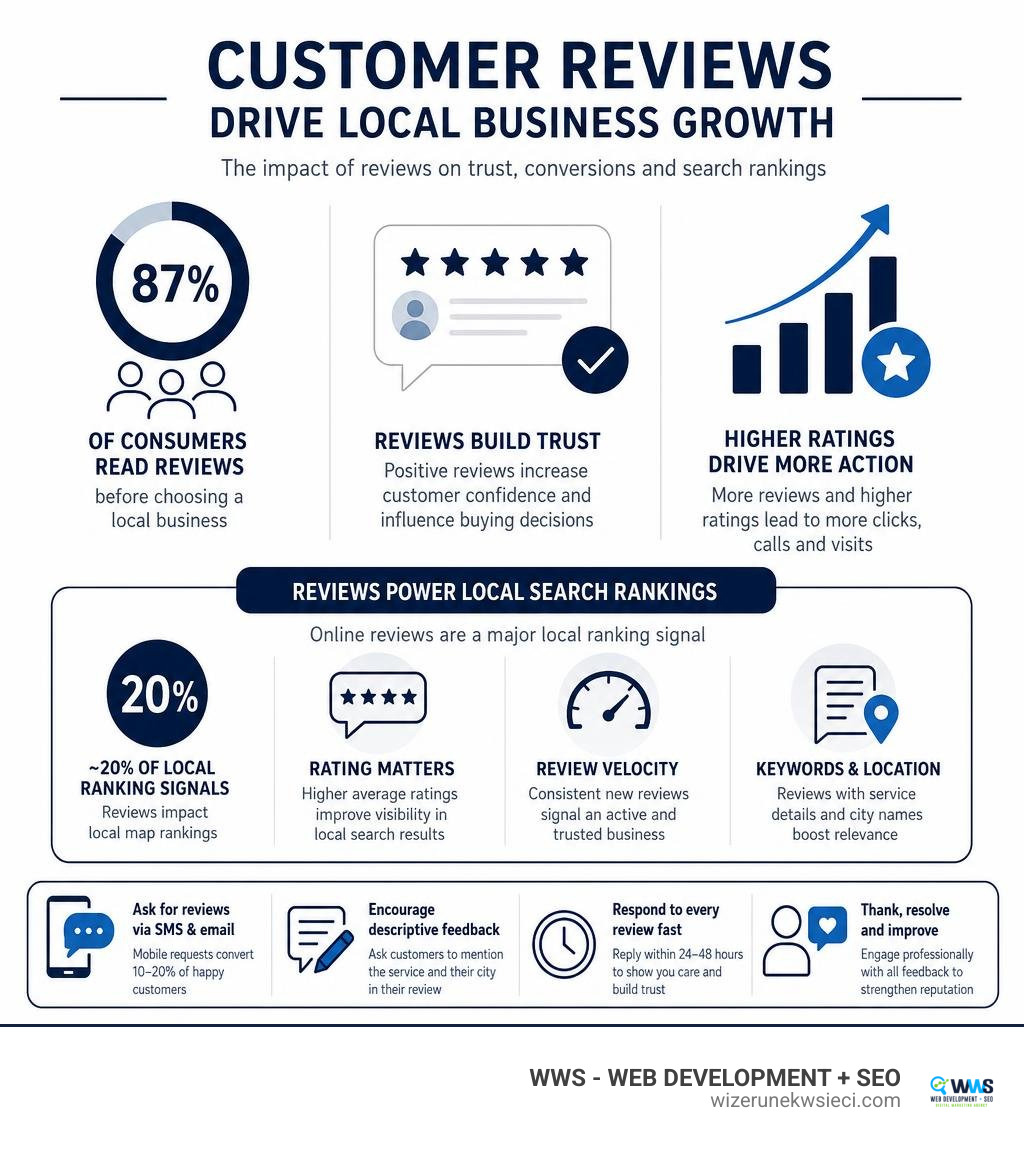
To build a customer review strategy that boosts rankings and converts browsers into buyers:
- Automate Review Requests via SMS and Email: Ask every happy client for feedback immediately upon completing a project. Sending automated SMS review links yields a 10% to 20% conversion rate because mobile users can leave feedback in seconds.
- Encourage Descriptive Customer Feedback: Prompt your clients to mention the specific service performed and their city location in their text (e.g., “WWS built a fantastic new website for our accounting firm in Schaumburg, IL”). Search engines extract these keywords directly from review text to improve local search relevance.
- Respond to 100% of Reviews Within 24–48 Hours: Google explicitly confirms that responding to reviews demonstrates active customer management and contributes to local prominence signals. Maintain a professional, welcoming tone with positive reviews, and address negative feedback calmly by offering a direct phone number to resolve issues off-line.
On-Page Local Keywords, Content Hubs, and Citation Management
While off-page profiles drive map visibility, your website remains the ultimate engine of search engine authority. Aligning on-page website structure with structured data ensures search engines understand your exact service coverage.
For a deeper breakdown of ranking factors, review the latest Local SEO Ranking Factors 2026.
Essential Local SEO Best Practices for On-Page Content and Keywords
To target local customers effectively, avoid grouping all your services onto a single generic home page. Instead, implement a multi-page local architecture:
- Dedicated Service Pages: Create unique landing pages for each core service you provide (e.g., local SEO, custom website design, PPC management). Each page should contain 800 to 1,500 words of original, comprehensive content explaining your process, clear call-to-action buttons, and embedded testimonials.
- City-Specific Location Pages: If you serve clients across neighboring communities—such as Arlington Heights IL, Naperville IL, or Rosemont IL—develop individual location landing pages. Include localized case studies, embedded Google Maps, specific customer reviews, and neighborhood landmarks to avoid generic duplicate text penalties.
- Localized On-Page Keyword Placement: Incorporate geographic modifiers into your primary HTML tags naturally:
- Title Tag: Primary Service + Target City | Business Name
- H1 Heading: Focused Service in Target City, State
- URL Slug:
/services/local-seo-chicago/ - Meta Description: A compelling 150-character summary highlighting your local experience and phone contact details.
To learn how website structure impacts conversions, visit our local business website design guide.
Implementing LocalBusiness Schema and Directory Citations
Structured data (schema markup) provides search engine crawlers with an unambiguous, machine-readable record of your business credentials directly inside your website’s HTML code.
Always format your structured data using JSON-LD script placed in the header of your website:
- Include exact business Name, Address, and Phone number (NAP) matching your Google Business Profile character-for-character.
- Specify geo-coordinates (latitude and longitude).
- Link your primary social media channels and official directory profiles using the
sameAsproperty.
Beyond on-page code, building clean online citations (business directory mentions) establishes baseline legitimacy. However, modern citation management requires quality over sheer volume:
| Citation Tier | Platform Examples | Ranking Signal Impact | Best Practice Recommendation |
|---|---|---|---|
| Tier 1 Core Directories | Google Business Profile, Apple Maps, Bing Places, Yelp, Facebook, LinkedIn | High (Essential trust foundation) | Claim immediately, verify manually, and keep details 100% accurate. |
| Industry & Local Niche | Local Chamber of Commerce, Better Business Bureau, trade portals | Medium-High (Builds local authority) | Join local business associations and verified community groups. |
| Low-Quality Mass Directories | Automated spam directories, random web link lists | Low to Negative (Spam risk) | Skip mass automated submissions (e.g., 500 directory blast packages). |
Technical SEO, Local Link Building, and AI Search Optimization
A well-structured website and complete business profile must be supported by fast technical infrastructure and local community backlinks to outperform competitors in tough markets like Chicagoland.
Technical Performance and Hyperlocal Link Acquisition

Mobile optimization is no longer optional—over 57% of local search queries occur on mobile devices. If your website loads slowly or shifts visually during loading, potential clients will hit the back button and call a competitor.
- Target Fast Core Web Vitals: Ensure your mobile Interaction to Next Paint (INP) score remains under 200 milliseconds.
- Optimize Visual Elements: Compress image files, use modern WebP image formats, and eliminate unnecessary third-party scripts to keep total page loading speed under two seconds on mobile networks.
To build off-page prominence, earn localized backlinks from real community entities rather than distant blogs:
- Sponsor Local Youth Sports or Nonprofits: Local leagues, charity events, and community centers in areas like Des Plaines IL or Park Ridge IL usually feature sponsor logos with valuable direct links back to your website.
- Partner with Complementary Businesses: Trade guest blog features or partner resource mentions with non-competing businesses (e.g., an accountant partnering with a local web design firm).
- Engage with Regional Business Publications: Share expert commentary or local market updates with Chicago business blogs and neighborhood newspapers.
Navigating Local Search in the Era of AI Engine Optimization
AI-driven platforms like ChatGPT, Perplexity, and Google AI Overviews are changing how users find local service providers. Today, users ask conversational questions like, “Which web development company in Cook County has the best reputation for small business websites?”
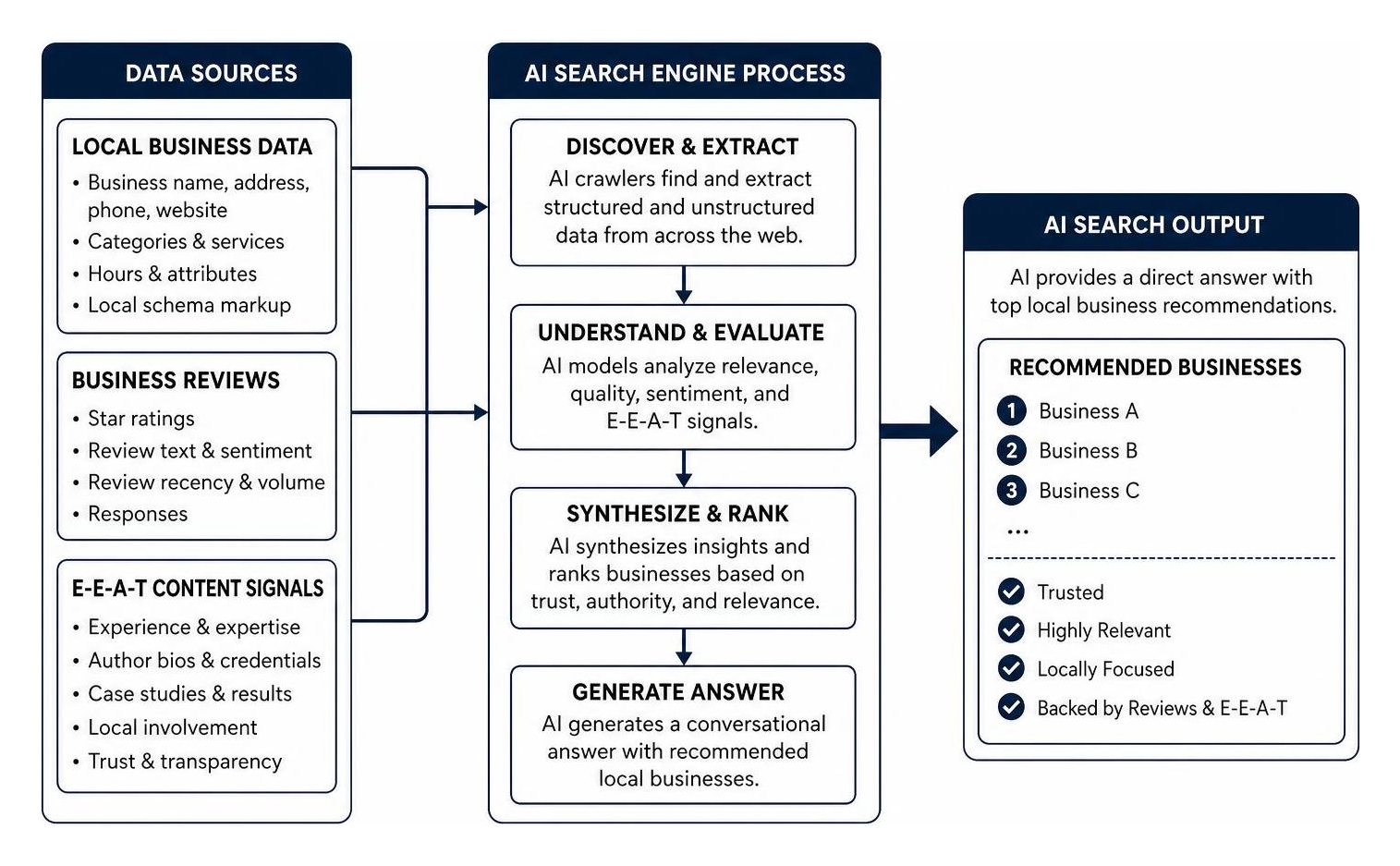
To ensure your business is recommended by AI search models:
- Maintain a High Review Threshold: Generative AI tools aggregate top-recommended businesses based on overall sentiment across the web. Maintaining over 50–150 positive reviews with a star rating above 4.5 ensures your brand triggers AI recommendation thresholds.
- Demonstrate Clear E-E-A-T (Experience, Expertise, Authoritativeness, Trustworthiness): Include detailed author bios, real office locations, local community involvement, and verified customer case studies on your website. AI models favor first-person human experience over generic informational summaries.
- Format Content for Direct AI Extraction: Structure landing page text with clear subheadings (H2, H3), bullet points, and short summary sections so language models can easily parse and present your business facts.
Frequently Asked Questions About Local SEO
How long does it take to see results from local SEO?
Initial Google Business Profile improvements, such as category adjustments or adding fresh photos, can generate visible local map pack movement within 60 to 90 days. However, full organic website rankings for competitive local terms (e.g., web design Chicago) typically take 4 to 6 months in low-competition areas and 6 to 12 months in denser metropolitan markets.
Do I need a physical storefront to perform local SEO?
No. If you operate a Service Area Business (SAB)—such as a mobile contractor, home service professional, or digital consultant—you can set up a Google Business Profile without displaying a physical street address. In your GBP settings, select the option to hide your address and define your target service radius by listing specific cities, suburbs, or zip codes.
Are citations and directories still effective for rankings in 2026?
While mass directory submissions to hundreds of low-tier websites no longer yield high ranking lifts, maintaining perfect Name, Address, and Phone number (NAP) consistency across top core platforms (Google, Apple Maps, Bing, Yelp, Facebook, and local Chambers of Commerce) remains an essential baseline signal for trust and accuracy.
Conclusion: Mastering Local SEO Best Practices for Growth

Mastering local seo best practices isn’t about finding quick hacks or tricking search engine algorithms. It is about building a visible, authoritative, and deeply trusted digital presence that connects your business with local clients right when they need your services most.
By claiming your Google Business Profile, encouraging continuous client reviews, optimizing your website pages for target cities, and building genuine relationships within your local community, you create an unbeatable acquisition channel that drives continuous leads.
At WWS — Web Development + SEO, we specialize in helping small and medium-sized businesses across Des Plaines IL, the Chicagoland area, and the nationwide Polish-American community (Polonia) dominate local search results. From custom mobile-responsive web design to high-impact search engine marketing, we treat your business growth with the exact same dedication as our own.
Ready to claim your place at the top of local search results? Contact our team today for custom guidance:
- Visit Our Office: 636 S River Rd #218, Des Plaines, IL 60016
- Learn More About Our Services: Explore our full range of tailored Professional Local SEO Services and claim your website audit today at wizerunekwsieci.com.