

Why Paid Social Media Ads Are a Game-Changer for Local Businesses
Paid social media ads are sponsored posts and promotions that businesses pay to show on platforms like Facebook, Instagram, TikTok, and LinkedIn — reaching targeted audiences beyond just your existing followers.
Here’s what you need to know at a glance:
- What they are: Ads you pay for on social platforms, shown to specific audiences based on demographics, interests, and behavior
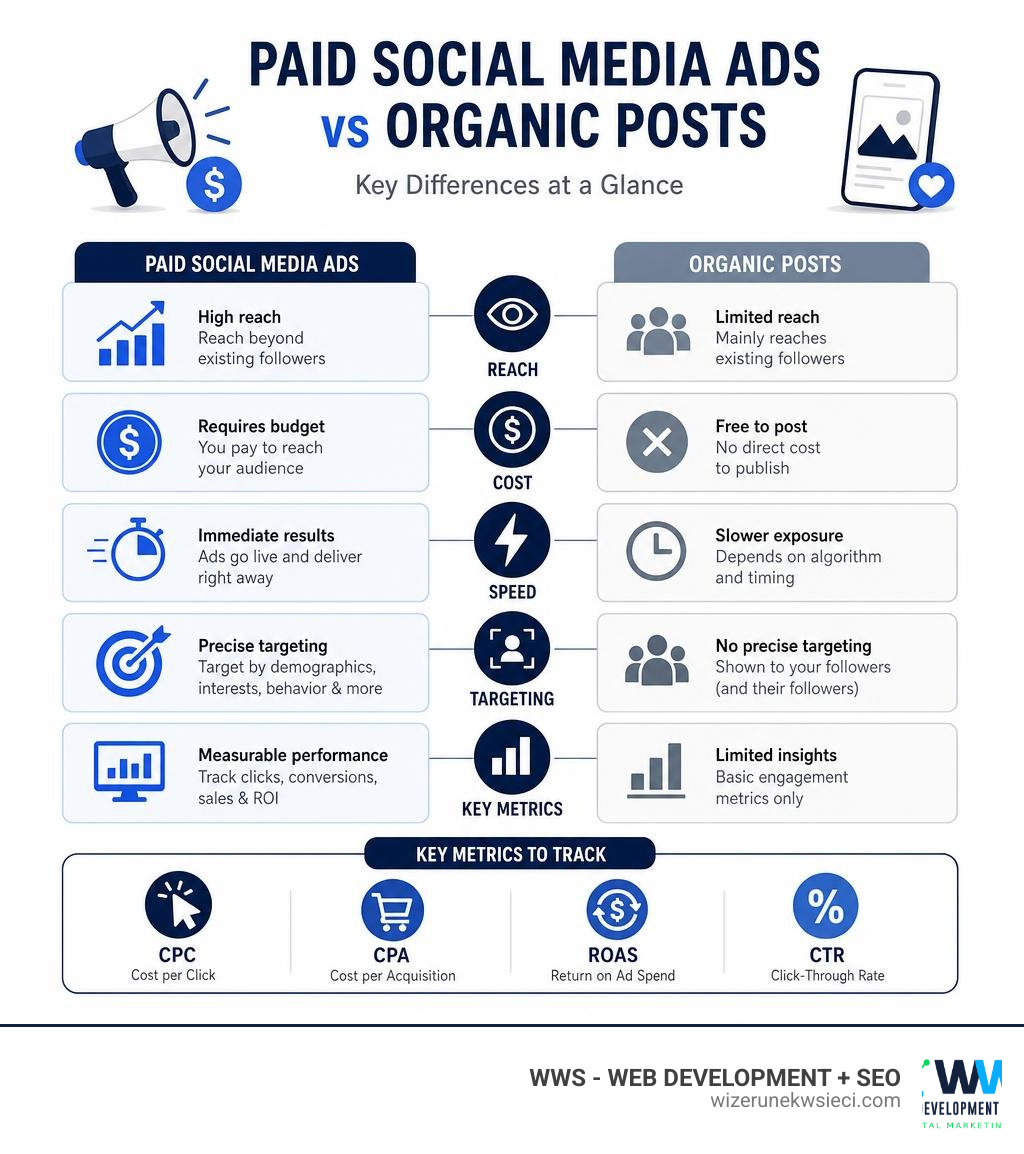
- How they differ from organic posts: Organic posts rely on algorithms and reach mainly your followers; paid ads guarantee visibility to your chosen audience
- Main formats: Image ads, video ads, carousel ads, native ads, and influencer-sponsored content
- Top platforms: Facebook, Instagram, LinkedIn, TikTok, and X (formerly Twitter)
- Key metrics: Cost per click (CPC), cost per acquisition (CPA), return on ad spend (ROAS), and click-through rate (CTR)
- Why they work: You get immediate reach, precise targeting, and measurable results — unlike traditional advertising
Social media ad spending is expected to exceed $406 billion worldwide by 2029. Yet many local business owners still feel overwhelmed trying to figure out where to start, how much to spend, and whether any of it actually works.
That feeling is normal. Platforms change constantly. Algorithms shift. What worked last year may not work today.
The good news? The core principles of running effective paid social campaigns are straightforward once you understand them — and this guide walks you through every step.
I’m Tomasz Lasota, Digital Development and Technology Director with over 22 years of experience building and scaling digital products and marketing strategies for B2B and B2C brands, including hands-on work with paid social media ads across industries. I’ll help you cut through the noise and build campaigns that actually generate leads and grow your business.
What Are Paid Social Media Ads and Why Do They Matter?

To understand why we need to allocate budget to paid advertising, we have to look at how modern Social Media networks operate in 2026.
When you post an update on your business profile page, that is an organic post. Years ago, a large percentage of your followers would see that post. Today, platforms prioritize content from friends, family, and highly viral creators. This means organic business posts are often hidden from the very people who chose to follow you.
By utilizing paid social media ads, you bypass these algorithmic restrictions. You pay the platform to place your message directly in front of the exact people you want to reach, regardless of whether they follow your page or not.
Paid Social vs. Organic Posts
Think of organic social media as owning a small storefront in a quiet Chicago neighborhood. Only the people who walk right past your window will see what you have to offer. It is fantastic for building deep relationships with your current regulars, answering customer questions, and establishing your local brand voice over time.
Paid social, on the other hand, is like renting prime billboard space right on the Kennedy Expressway. You can control exactly who sees your message, when they see it, and what action they should take next.
While organic reach has declined to less than 2% to 5% on most platforms, paid social gives you absolute control over your distribution. You do not have to cross your fingers and hope the algorithm smiles upon your post; you buy your way directly into the feeds of your ideal customers.
The Core Benefits of Running Paid Social Media Ads
If you are running a business in Des Plaines, IL or the wider Chicago area, every dollar counts. Here is why investing in paid social ads makes sense for your bottom line:
- Immediate Engagement: Unlike search engine optimization (SEO), which takes months to build momentum, paid ads can start driving traffic, phone calls, and form submissions within minutes of your campaign approval.
- Granular Audience Targeting: You can target users by their precise geographic location (down to a specific ZIP code in Chicago), demographic data, interests, and online behaviors.
- Predictable Lead Generation: By setting up structured funnels, you can turn social media from a “vanity metric” platform (focused on likes and shares) into a predictable lead-generation machine.
- Enhanced Brand Awareness: Even if users do not click your ad immediately, seeing your business name repeatedly builds local familiarity, making them more likely to search for you when they need your services.
How Influencer Marketing Integrates with Paid Social Media Ads
Influencer marketing is no longer just for global fashion brands. In 2026, local micro-influencers (creators with 5,000 to 50,000 highly engaged local followers) are incredibly effective partners for local service businesses.
Influencer marketing typically yields a positive return on investment (ROI) for brands because consumers naturally trust recommendations from real people over corporate ads. To get the most out of these partnerships, we recommend integrating them directly into your paid social strategy through “partnership ads” or “whitelisting.” This is where a creator grants your business permission to run paid ads directly through their social handle.
By boosting user-generated content (UGC) created by a trusted local figure, your ads look like organic recommendations rather than forced sales pitches. It blends the high trust of influencer marketing with the precise targeting and scaling power of paid social platforms.
Choosing the Right Platforms for Your Campaigns
Not all social media platforms are created equal. Trying to run ads on every single network is a fast track to burning through your budget with very little to show for it. Instead, you need to align your platform selection with your target audience’s demographics and your specific business goals.
To help you visualize the cost and audience landscape as of mid-2026, let’s look at how the major platforms compare:
| Platform | Average CPM (Q4 2025/2026) | Average CPC (2026) | Primary Demographics & Strengths |
|---|---|---|---|
| $10.48 | $0.97 (Meta Blend) | Ages 18–44; highly visual, excellent for lifestyle and local B2C | |
| TikTok | $9.86 | $1.00 – $1.50 | Gen Z & Millennials; short-form video, high viral potential |
| $9.06 | $0.97 (Meta Blend) | Ages 25–65+; massive reach, robust local targeting options | |
| $8.09 | $1.20 – $1.60 | Majority female; high purchase intent, home services, planning | |
| Snapchat | $4.89 | $0.40 – $0.80 | Younger audiences; great for quick, low-cost local promotions |
Meta Platforms: Facebook and Instagram Advertising
With Facebook boasting over 3 billion monthly active users worldwide, Meta remains the undisputed heavyweight champion of paid social advertising. It is the absolute foundation for almost every local business ad campaign we build.
For local service providers in Illinois, Meta’s local targeting is incredibly precise. You can target homeowners within a 15-mile radius of Des Plaines, IL, who have shown an interest in home improvement or landscaping.
To make your budget work harder, Meta has heavily integrated artificial intelligence through its Advantage+ campaign suites. Advantage+ simplifies campaign creation by automating your audience targeting, ad placements, and even creative variations. However, don’t let the AI do all the heavy lifting without supervision.
To understand the cost dynamics before launching, it is highly beneficial to review a Facebook Ads Cost in 2026: Full Breakdown of Facebook Ad Pricing & Advertising Costs. Knowing these benchmarks helps you set realistic expectations for your local campaigns.
Once you have mastered the basics, you can begin structuring your campaigns to scale. If you want to see how high-growth brands manage their budgets at a larger scale, you can read about How to Build a Meta Ads Funnel That Scales Past $50K/Month to understand the advanced architecture of multi-stage conversion funnels.
Professional Targeting on LinkedIn
If your business sells services to other businesses (B2B), LinkedIn is your goldmine. With over 950 million professionals on the platform, LinkedIn allows you to target users by their exact job title, company size, industry, seniority level, and even specific company names.
Suppose you run a commercial cleaning service, an IT support firm, or a commercial real estate agency in Chicago. In that case, you do not want to show your ads to the general public. You only want to reach office managers, operations directors, and business owners. LinkedIn makes this possible.
The professional market in Illinois is highly active; for instance, a quick search shows there are currently 209 Paid Social Media jobs in Chicago – LinkedIn, reflecting just how much local businesses are investing in dedicated talent to manage these complex B2B campaigns. While LinkedIn’s CPC is significantly higher than Meta’s, the quality of B2B leads generated often justifies the premium cost.
Capturing Gen Z on TikTok and Emerging Channels
If your target audience skew younger, TikTok is no longer optional. It is a massive commerce engine: 1 in 3 TikTok users have bought a product after seeing it on the platform.
In 2026, TikTok has introduced advanced creative suites like Symphony AI, which allows advertisers to easily translate text to video and even use AI-powered dubbing to create highly native short-form video ads.
Additionally, smart advertisers are keeping a close eye on Reddit. With Reddit being highly cited by generative AI search engines, running ads on conversational subreddits can place your brand directly inside local Chicago community discussions.
To stay ahead of these rapid platform shifts, we recommend reviewing this FAQ on paid social: AI tools, platform costs, and brand safety in 2026 to learn how AI tools and changing brand safety guidelines are reshaping where marketers allocate their budgets. To see how local businesses are adapting their overall strategy, you can explore how to integrate these emerging channels into your local marketing mix to transform your brand’s presence.
A Step-by-Step Strategy to Build High-Converting Campaigns

Running successful paid social media ads is not about throwing money at a platform and hoping for the best. It requires a structured, scientific approach. To build sustainable Marketing Campaigns, we must follow a clear step-by-step framework.
Setting SMART Goals and Audience Targeting
Every successful campaign starts with absolute clarity. You must define SMART goals: Specific, Measurable, Achievable, Relevant, and Time-bound.
- Bad Goal: “I want more leads from Facebook.”
- SMART Goal: “I want to generate 30 qualified residential roofing lead forms from homeowners within 15 miles of Chicago at a cost per lead under $35 over the next 30 days.”
Once your goal is locked in, you must build detailed buyer personas. Who is your ideal customer? What are their pain points?
Use this information to build your targeting structure:
- Core Audiences: Targeting based on demographics, geography, and interests.
- Custom Audiences: Uploading your existing customer email lists, or targeting users who have visited your website or engaged with your social media profiles.
- Lookalike Audiences: Instructing the platform’s algorithm to find new users who share similar behaviors and characteristics with your best existing customers.
Designing Eye-Catching Ad Creatives and Formats
Your creative is the single most important factor in whether a user stops scrolling or keeps going. In the industry, we call this “scroll-stopping power.”
- Image Ads: Clean, high-resolution photos that display your work. For local service businesses, “before-and-after” split images perform incredibly well.
- Video Ads: Keep them short, engaging, and designed for mobile viewing. Pro tip: Over 85% of social media videos are watched without sound, so always include clear, easy-to-read closed captions.
- Native Ads: Ads that look like organic user posts. Authentic, unpolished user-generated content (UGC) shot on a smartphone often outperforms highly produced, expensive studio commercials because it feels more trustworthy.
Always run A/B tests (split tests) on your creatives. Test one variable at a time—such as testing two different headline hooks while keeping the video identical—to find out exactly what resonates with your local audience.
Budget Management and the Algorithmic Learning Phase
A common mistake local business owners make is launching a campaign, seeing no leads in the first 24 hours, and immediately turning it off in a panic. This ruins your campaign’s potential because of the platform’s “learning phase.”
When you launch a new ad set, the platform’s algorithm needs time to test different pockets of your audience to see who is most likely to convert. Meta, for example, typically requires about 50 optimization events (like link clicks or lead form submissions) per ad set within a 7-day period to exit the learning phase and stabilize your costs.
If you constantly change your budget, swap out creatives, or pause your campaigns, you force the algorithm back into the learning phase. Start with a modest, realistic daily budget, let the system gather data, and scale your budget gradually—by no more than 20% every 7 days—to avoid spiking your cost per acquisition (CPA).
Optimizing Performance with Retargeting and Analytics
Most people will not buy from you or book a service the very first time they see your ad. They might be busy, they might want to read your reviews first, or they might just get distracted. This is where retargeting (or remarketing) becomes your most powerful tool.
Setting Up a Robust Retargeting Structure
Retargeting allows you to serve specific ads to users who have already interacted with your business. To do this effectively, you must install tracking pixels (like the Meta Pixel) and set up server-side tracking via the Conversions API (CAPI) on your website.
Once this tracking is in place, you can build custom retargeting funnels:
- Website Visitors: Show a special discount or a “Why Choose Us” video to anyone who visited your website in the last 30 days but didn’t fill out a contact form.
- Cart Abandonment: For e-commerce or booking systems, target users who added a service to their cart but did not complete the checkout process.
- Customer Lists: Upload a list of past customers who haven’t booked a service in the last 6 months and offer them a “welcome back” loyalty promotion.
Key Metrics to Measure Campaign Success
To know if your paid social media ads are actually driving profit, you must look past “vanity metrics” like likes, shares, and impressions. Instead, focus on the metrics that directly impact your bank account:
- Return on Ad Spend (ROAS): Calculated as
Revenue Generated / Ad Spend. A 4:1 ROAS means you made $4 in revenue for every $1 spent on ads. - Cost Per Acquisition (CPA) / Cost Per Lead (CPL): How much it costs you to secure one actual customer or qualified lead.
- Click-Through Rate (CTR): The percentage of people who saw your ad and clicked it. A CTR above 1.5% to 2% generally indicates your creative is highly relevant to your audience.
- Attribution Modeling: Understanding how different touchpoints contribute to a sale. Some users might see a Meta ad, later search for you on Google, and finally call you. Proper tracking helps you see the entire customer journey.
Frequently Asked Questions About Paid Social Advertising
How much does paid social advertising cost in 2026?
The honest answer is: it depends on your industry, targeting, and goals. However, as of 2026, the average cost per click (CPC) on Meta platforms hovers around $0.97, while highly competitive search platforms like Google Ads can average over $4.22 per click.
For local service businesses in the Chicago area, we generally recommend starting with a minimum testing budget of $30 to $50 per day per campaign. This gives the platform’s algorithm enough daily budget to generate conversion data, exit the learning phase, and begin optimizing your costs.
What is the difference between Meta Ads Manager and Meta Business Suite?
This is a very common point of confusion for beginners:
- Meta Business Suite is a simplified, user-friendly dashboard designed mainly for managing your organic social media presence. It is great for scheduling organic posts, responding to customer messages, and viewing basic page insights.
- Meta Ads Manager is the full-featured, professional campaign creation and management platform. It gives you access to advanced audience targeting, complex budget bidding strategies, custom retargeting structures, and detailed conversion tracking analytics. If you want to run serious, lead-generating ad campaigns, always use Ads Manager.
How do privacy changes and AI tools affect paid social targeting?
Since the major privacy updates initiated by Apple’s iOS 14, tracking website visitors purely through browser cookies has become much more difficult. This signal loss means platforms have less direct data about what users do after leaving social media apps.
To combat this, platforms have pivoted heavily to first-party data and AI-driven targeting tools like Meta’s Advantage+. Instead of manually stacking dozens of detailed interests to find your audience, the modern best practice is to use broad targeting and let the platform’s AI analyze user behavior to find who is most likely to convert.
To bridge the tracking gap, implementing server-side tracking like the Meta Conversions API (CAPI) is essential to feed accurate conversion data back to the platform’s algorithm.
Conclusion: Partner with a Local Expert to Scale Your Growth
Mastering paid social media ads does not have to be a source of constant frustration. By setting clear SMART goals, choosing the right platforms, focusing on high-quality visual creative, and letting the algorithms learn without constant interference, you can build a highly profitable source of consistent leads for your business.
However, running a local business is a full-time job. Between managing your team, serving your clients, and keeping operations running smoothly, you might not have the hours required to design creatives, monitor bidding strategies, and audit tracking pixels every week.
That is where we come in. At Wizerunek w Sieci (WWS), we are a dedicated digital marketing agency operating right here in Des Plaines, IL and Chicago, IL. We specialize in building custom, high-converting Paid Campaigns and integrated SEO strategies designed specifically to generate qualified local leads for service businesses.
We don’t focus on vanity metrics; we focus on delivering measurable, bottom-line growth. If you are ready to scale your business without losing your mind over complex ad dashboards, let us do the heavy lifting for you.
Ready to transform your business growth? Explore our Paid Campaigns services today, and let’s build a strategy that works for you.