


Local Advertising on Google for Small Businesses Ready to Grow
Master local advertising on Google with expert strategies for Local Services Ads, Maps, and Performance Max to attract nearby customers and grow your business.
 By WWS Team
10 min read
In this article7 sections
- Which Local Advertising Option on Google Fits Your Business?
- Primary Channels for Local Advertising on Google
- Comparing Local Services Ads vs. Standard Google Ads
- Setting Up and Optimizing Your Local Google Ad Campaigns
- The 2026 LSA Migration to Google Ads: What Advertisers Must Know
- Frequently Asked Questions About Local Advertising on Google
- Conclusion
Which Local Advertising Option on Google Fits Your Business?
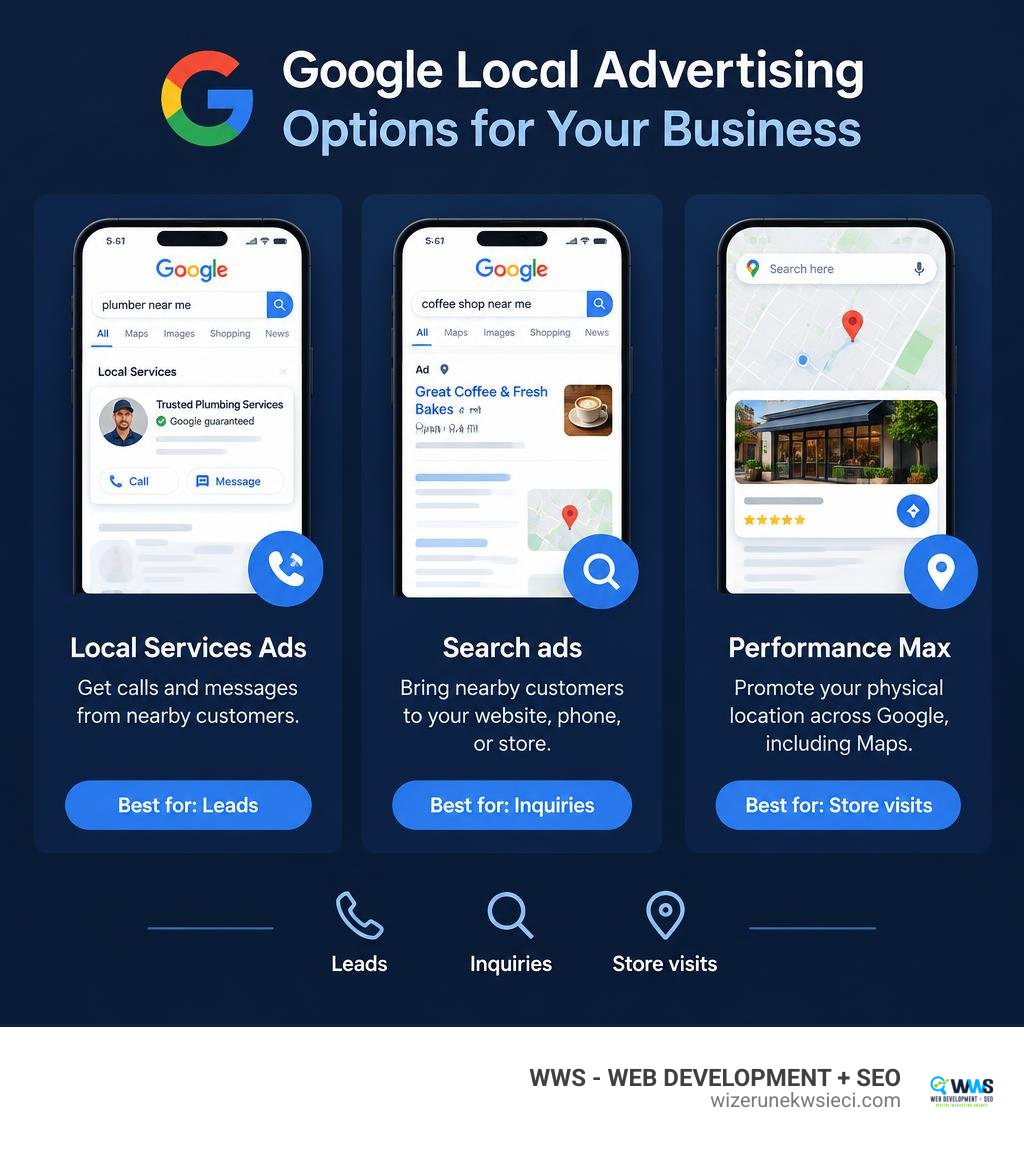
Local advertising on Google has three main paths: Local Services Ads help eligible service businesses get calls and messages, with charges based on leads. Search ads with location information can bring nearby customers to your website, phone, or store. Performance Max campaigns with store goals can promote a physical location across Google, including Maps. Choose based on what you need most: service leads, website inquiries, or store visits.
The right choice also depends on what happens after someone finds you. An ad may earn a call, but your reviews, business information, and response time help turn that interest into a customer. This guide will help you compare the options, track results, and decide where to focus.
I’m Tomasz Lasota, founder of WWS — Web Development + SEO in Des Plaines. For owners searching “local advertising google,” I draw on more than 22 years of experience helping businesses grow through Google Ads, local SEO, and websites built to convert.
Local advertising google terms to remember:
Primary Channels for Local Advertising on Google
When small business owners in Chicagoland want to attract nearby customers, choosing the right digital advertising channel is critical. Google provides distinct ad formats designed to connect brick-and-mortar storefronts and mobile service contractors directly with nearby searchers.

Connecting your ad campaigns with your business presence establishes multi-surface visibility across Google Search, Google Maps, YouTube, and the Google Display Network. By selecting the correct channel, you avoid wasted spend and place your brand in front of users ready to make a booking or visit your shop.
Local Services Ads and the Pay-Per-Lead Model
For trade professionals and qualified service providers, Google Local Services Ads sit at the absolute top of the search engine results page (SERP), appearing above standard pay-per-click ads and organic listings.
Unlike traditional platforms, this platform operates on a pay-per-lead (PPL) model. You do not pay when a user simply views your listing or clicks to see your profile; you only pay when an individual contacts you directly via phone call, message, or booking request. You can learn more directly on the Google Local Services Ads platform. This format eliminates the need for detailed keyword bidding strategies, relying instead on selected job categories and designated geographic service areas.
Local Ads on Google Maps and Search
For storefronts, medical clinics, dining establishments, and retail locations, appearing on map results is crucial for driving foot traffic. Standard Google Search ads can feature location assets that display your physical address, phone number, and operating hours.
On Google Maps, your business can appear through sponsored square pins and highlighted listings in map search results.
Clicks on search headlines, directions, and call buttons are generally billed on a standard cost-per-click (CPC) model, while branded logo pins on Maps served via automated campaigns can be billed on a cost-per-thousand impressions (CPM) basis. Pairing these ads with strong Google Maps ranking factors ensures maximum exposure across local navigation.
Performance Max Campaigns for Store Goals
Performance Max for store goals (which replaced legacy Local Campaigns) leverages Google’s machine learning to automate ad placement across all Google channels, including Search, Maps, YouTube, Gmail, and the Google Display Network.
By defining store visits or local actions as primary conversion goals, the campaign dynamically combines your uploaded headlines, descriptions, high-resolution imagery, and video assets to attract shoppers within your designated radius. Retailers can also connect local product feeds to run local inventory ads, showing searchers nearby that specific products are currently in stock at their physical store.
Comparing Local Services Ads vs. Standard Google Ads
Choosing between Local Services Ads and standard Google Ads requires understanding how each framework charges for engagement, captures customer intent, and displays trust badges.
| Feature | Local Services Ads (LSAs) | Standard Google Ads & P-Max |
|---|---|---|
| Pricing Model | Pay-Per-Lead (PPL) | Pay-Per-Click (CPC) or Impressions (CPM) |
| SERP Placement | Topmost position on Google Search & Maps | Search top/bottom, Maps pins, Display, YouTube |
| Targeting Method | Service categories and geographic radius | Keywords, audiences, demographics, and radius |
| Trust Badges | Google Guarantee or Google Screened badge | Standard ad extensions and verified business assets |
| Creative Control | Automated layout pulled from verified profile | Custom headlines, descriptions, images, and videos |
| Best For | Emergency and scheduled home/pro services | Retail storefronts, clinics, multi-location brands |
Pay-Per-Click vs. Pay-Per-Lead Economics
The fundamental financial difference lies in what triggers an ad charge. In a pay-per-click system, you pay whenever a searcher clicks your headline or interactive asset, regardless of whether they complete a purchase or call your front desk. To project your expenses accurately, you can use a Google Ads cost calculator to weigh expected click costs against your conversion rates.
In contrast, Local Services Ads charge only when an authentic lead reaches out. Furthermore, LSAs provide a built-in dispute resolution mechanism: if a caller dials the wrong number, falls outside your designated service territory, or sells unsolicited services, you can flag the invalid lead within your dashboard for a refund credit.
The Google Guarantee and Verified Trust Badges
A major benefit of Local Services Ads is the green trust badge displayed alongside your company name. For home service contractors, the Google Guarantee badge indicates that Google has vetted your business licenses, verified active liability insurance, and conducted background checks.
Crucially, the Google Guarantee protects homeowners by covering potential claims up to $2,000 for work booked directly through the platform if a project is completed unsatisfactorily. Professional service providers such as lawyers and financial advisers can earn the Google Screened badge. These verified trust markers provide an immediate competitive edge; you can explore the details in our guide on Google Guaranteed ads.
Aligning Ad Formats with the Local Customer Journey
A successful marketing strategy maps ad channels to where customers are in their decision-making process:
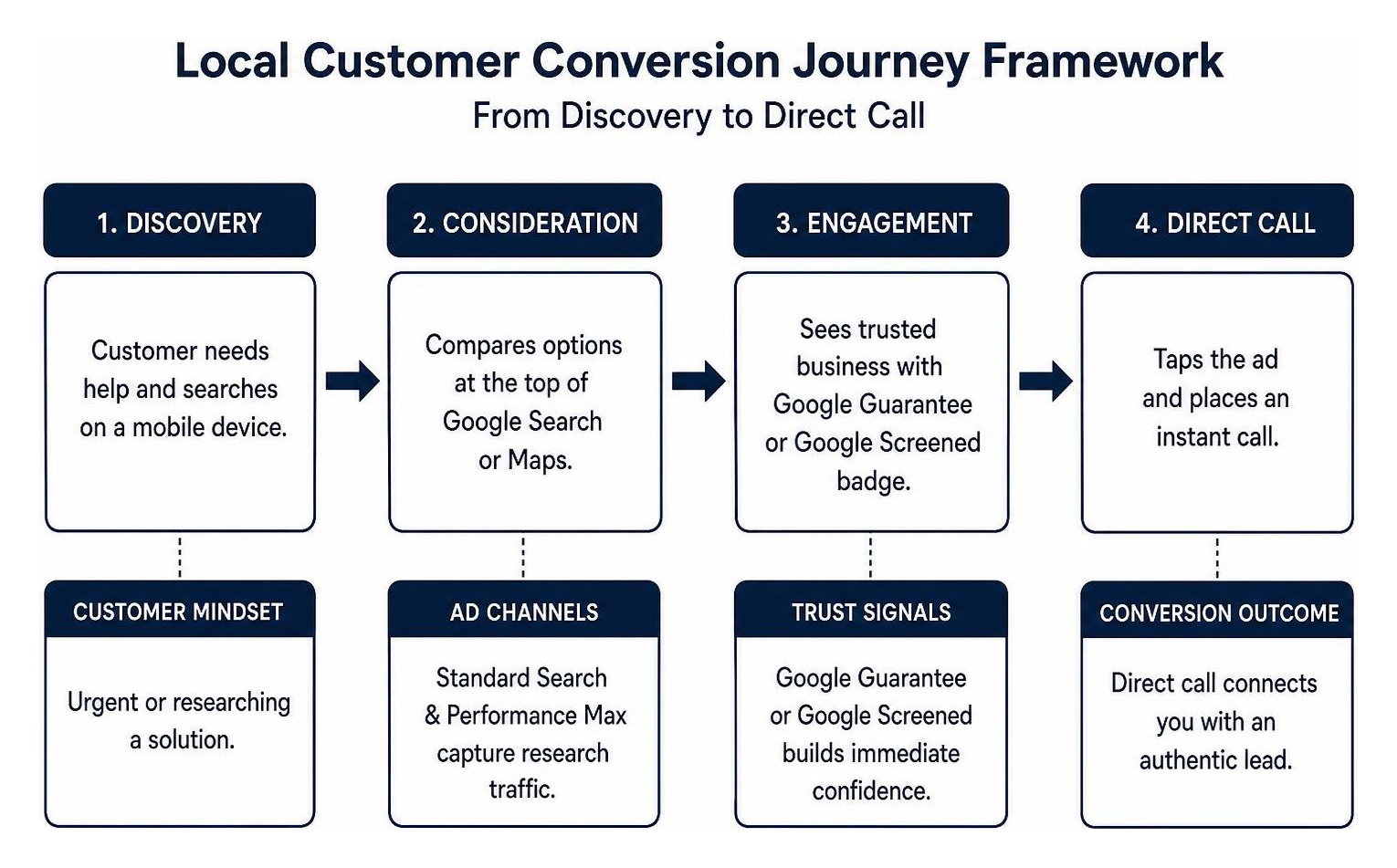
When an emergency happens—such as a burst pipe in the middle of winter—a homeowner needs immediate help and searches on a mobile device. They will almost certainly tap a top-placed Local Services Ad to place an instant call.
Conversely, when someone researches long-term home remodeling, complex dental procedures, or commercial services, they often start with informational search terms. Standard Search and Performance Max campaigns capture this research traffic, directing prospects to custom landing pages. Combining paid ads with local SEO best practices ensures your business stays visible throughout the entire customer journey.
Setting Up and Optimizing Your Local Google Ad Campaigns
Launching a high-performing campaign requires synchronizing your business data, gathering customer feedback, and tracking real-world actions.
Google Business Profile Integration and Verification
Your Google Business Profile (GBP) is the foundation of local advertising. Google Ads uses your GBP data to generate location assets, pull verified reviews, and display opening hours directly within ad units.
Before running ads, ensure your business completes Google Business verification and accurately establishes your Google Business Profile service areas. Properly syncing your profile prevents ad delivery outside your actual coverage zone and protects your budget from non-serviceable clicks.
Managing Reviews, Responsiveness, and Visual Assets for Local Advertising Google Campaigns
Google’s ranking algorithm for local ads evaluates several performance signals beyond your raw monetary bid:
- Review Velocity and Ratings: Higher star ratings and regular incoming reviews improve your ad placement and lower acquisition costs.
- Lead Responsiveness: For LSAs, answering incoming calls promptly and maintaining low missed-call rates directly impacts how often your ad appears.
- Visual Assets: Performance Max campaigns require crisp, authentic photography showcasing your storefront, staff, and past work.
- Profile Completeness: Keeping holiday hours and service descriptions up to date via Google Business Profile optimization ensures ad assets display accurate information.
Tracking Calls, Direction Requests, and Store Visits
Measuring return on investment (ROI) requires tracking concrete local actions rather than vanity metrics. Within Google Ads and Google Analytics, configure these primary conversion actions:
- Phone Call Clicks: Tracking taps on ad call buttons and phone numbers on your website. Industry benchmarks show that 30% to 50% of phone taps translate directly into booked consultations or sales.
- Direction Requests: Tracking clicks on “Get Directions” in Google Maps. For restaurants, an estimated 50% to 70% of users requesting directions physically visit the location. For medical clinics and dentists, 60% to 80% of direction requests result in an in-person visit.
- Store Visit Conversions: Google estimates physical store visits using aggregated, anonymized location data from users who interacted with your ad.
The 2026 LSA Migration to Google Ads: What Advertisers Must Know
The management structure of Google local advertising is undergoing an important operational change that affects every service-area business.
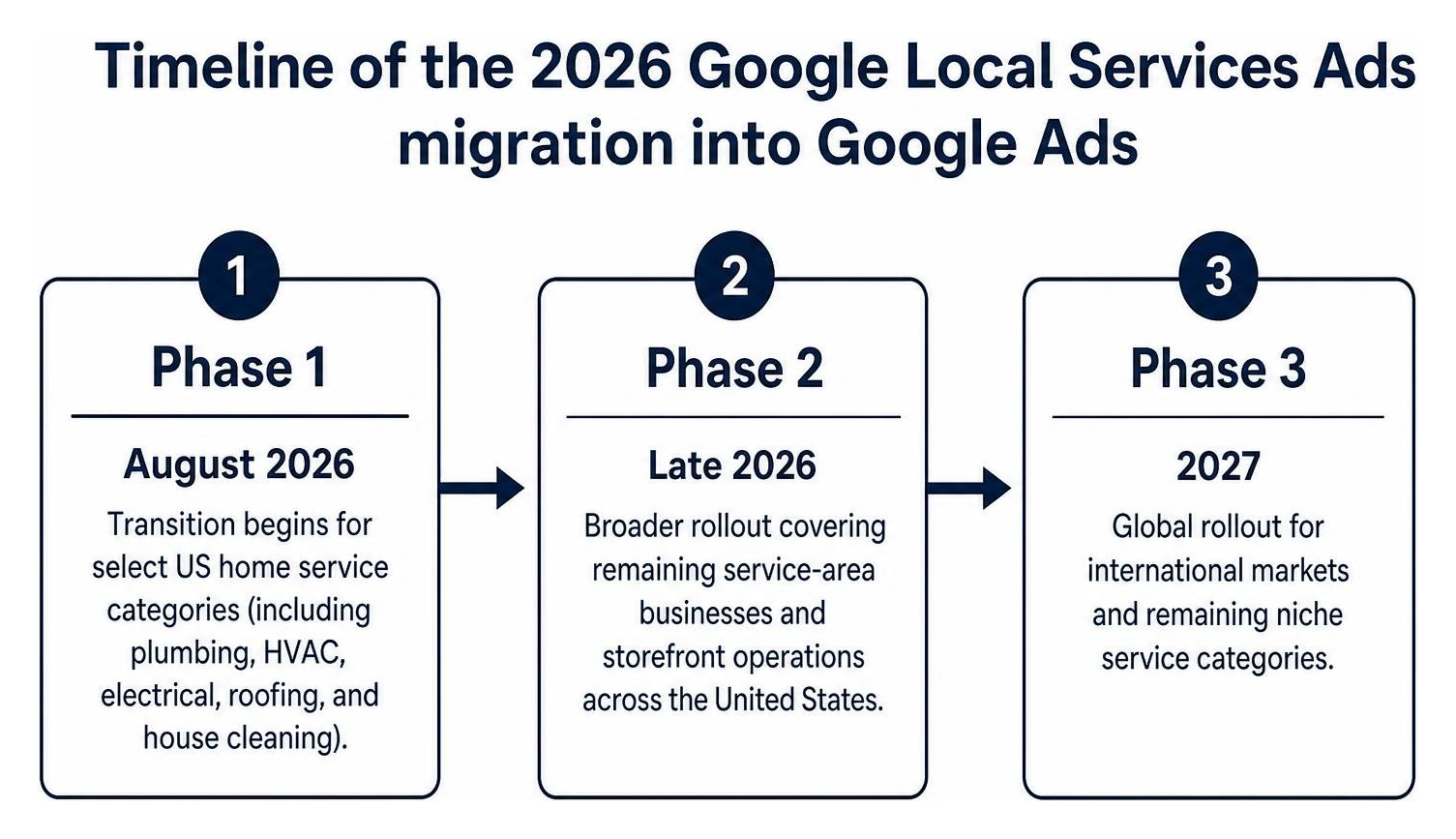
Google is officially consolidating Local Services Ads into the primary Google Ads ecosystem, shifting LSAs into a specialized variation of Performance Max while retaining the pay-per-lead model. The migration timeline follows three distinct stages:
- Phase 1 (August 2026): Transition begins for select US home service categories (including plumbing, HVAC, electrical, roofing, and house cleaning).
- Phase 2 (Late 2026): Broader rollout covering remaining service-area businesses and storefront operations across the United States.
- Phase 3 (2027): Global rollout for international markets and remaining niche service categories.
Preparing for the Local Advertising Google Performance Max Transition
As your campaigns migrate, several key management workflows change:
- Daily Budget Models: Budgets shift from legacy weekly lead targets to standard daily budgets consistent with other Google Ads campaigns.
- Streamlined Verification: While initial license, insurance, and background screening remains mandatory, annual re-verification requirements have been eliminated, with profile information syncing automatically from your Google Business Profile.
- Lead Center Management: Lead handling, recording reviews, and call disputes move under the unified “Goals” and “Leads” tabs in Google Ads.
- Data Retention: Business owners should export and archive historical lead data and performance reports from the legacy LSA dashboard before their account transitions.
Budgeting and Cost Benchmarks Across Industries
Establishing realistic expectations helps maintain profitability. While localized campaigns using Performance Max can begin testing with monthly budgets between $200 and $350, typical lead costs vary significantly by industry:
- Home Services (Plumbing, Electrical, HVAC, Roofing): Average cost per lead ranges from $15 to $85+ depending on local competition.
- Professional & Legal Services: Average cost per lead ranges from $50 to $150+.
- Healthcare & Dental Clinics: Typical CPC ranges from $1.50 to $6.00, with cost per booked appointment averaging $25 to $60.
- Local Retail & Dining: Typical CPC ranges from $0.35 to $2.50, driving direction requests and walk-in foot traffic.
To structure your monthly marketing spend effectively, review our detailed guide on Google Ads budgets for small businesses.
Frequently Asked Questions About Local Advertising on Google
Which local businesses are eligible for Google Local Services Ads?
Google Local Services Ads are available to a broad spectrum of service categories, including electricians, plumbers, HVAC technicians, roofers, carpet cleaners, painters, pest control experts, and movers. Eligibility also extends to professional sectors such as lawyers, accountants, real estate agents, veterinarians, dentists, and auto repair shops. Businesses must submit current trade licenses and proof of general liability insurance to qualify.
How much should a small business budget for local Google advertising?
For small businesses testing local ads, a starting budget of $500 to $1,500 per month provides enough data to evaluate cost per lead and foot traffic impact. In lower-competition suburban markets, focused campaigns can generate results with $300 to $600 monthly, while highly competitive service categories in metropolitan areas require larger budgets to maintain top placements during peak hours.
How does the Google Guarantee protect consumers and help businesses?
The Google Guarantee serves as an official endorsement of trust. If a customer books a service through an LSA ad and is dissatisfied with the quality of the work, Google may reimburse the customer up to $2,000 (lifetime limit per customer). For businesses, displaying this green checkmark badge builds immediate customer confidence, leading to higher click-through rates and better conversion numbers compared to unverified ads.
Conclusion
Running successful local advertising on Google requires a coordinated strategy across the right channels. Whether you capture immediate emergency calls through Local Services Ads, guide shoppers to your storefront using Google Maps sponsored pins, or automate your brand reach with Performance Max for store goals, paid advertising delivers measurable local growth.
At WWS — Web Development + SEO, we help small and medium-sized businesses navigate digital marketing with clarity and confidence. Founded by Tomasz Lasota and based in Des Plaines, IL (636 S River Rd #218), our bilingual team (English and Polish) combines deep technical knowledge with personal, hands-on attention. We offer the professional agency expertise and resources you would expect from a large national firm, paired with the local knowledge and personalized service of a neighborhood partner—the ideal middle ground for business owners across the Chicago metropolitan area. We proudly serve clients in Arlington Heights, Schaumburg, Naperville, Park Ridge, Cook County, and beyond, as well as growing enterprises nationwide and the Polonia community.
Ready to attract more local customers and maximize your advertising returns? Contact WWS at (773) 814-2992, visit wizerunekwsieci.com, or learn how our tailored paid campaigns can help your business thrive today.
A Des Plaines, IL team helping local service businesses get found, get called and get booked since 2005: local SEO, Google Ads, conversion-focused websites and AI search optimization.
Meet the teamKeep reading
All articles
GA4 for Local Business: Setup, Key Events and Reports
Set up GA4 for a local business: create the property, track calls, forms and direction clicks as key events, verify them and read the reports that matter.
6 Local SEO Examples Proving Proximity Is Power for Local Brands
See how 6 local SEO examples prove proximity drives revenue for trade services, multi-location brands, and local businesses in Chicago.
Local SEO Strategy: A Step-by-Step Plan for Local Businesses
Build a local SEO strategy that brings in calls: Google Business Profile, local keywords, citations, reviews, tracking and a 90-day order of work.