



Why Google Ads for Local Businesses Is a Game-Changer in 2026
Google Ads for local businesses is one of the fastest ways to get your phone ringing and your schedule full — by showing up at the exact moment someone nearby is searching for what you offer.
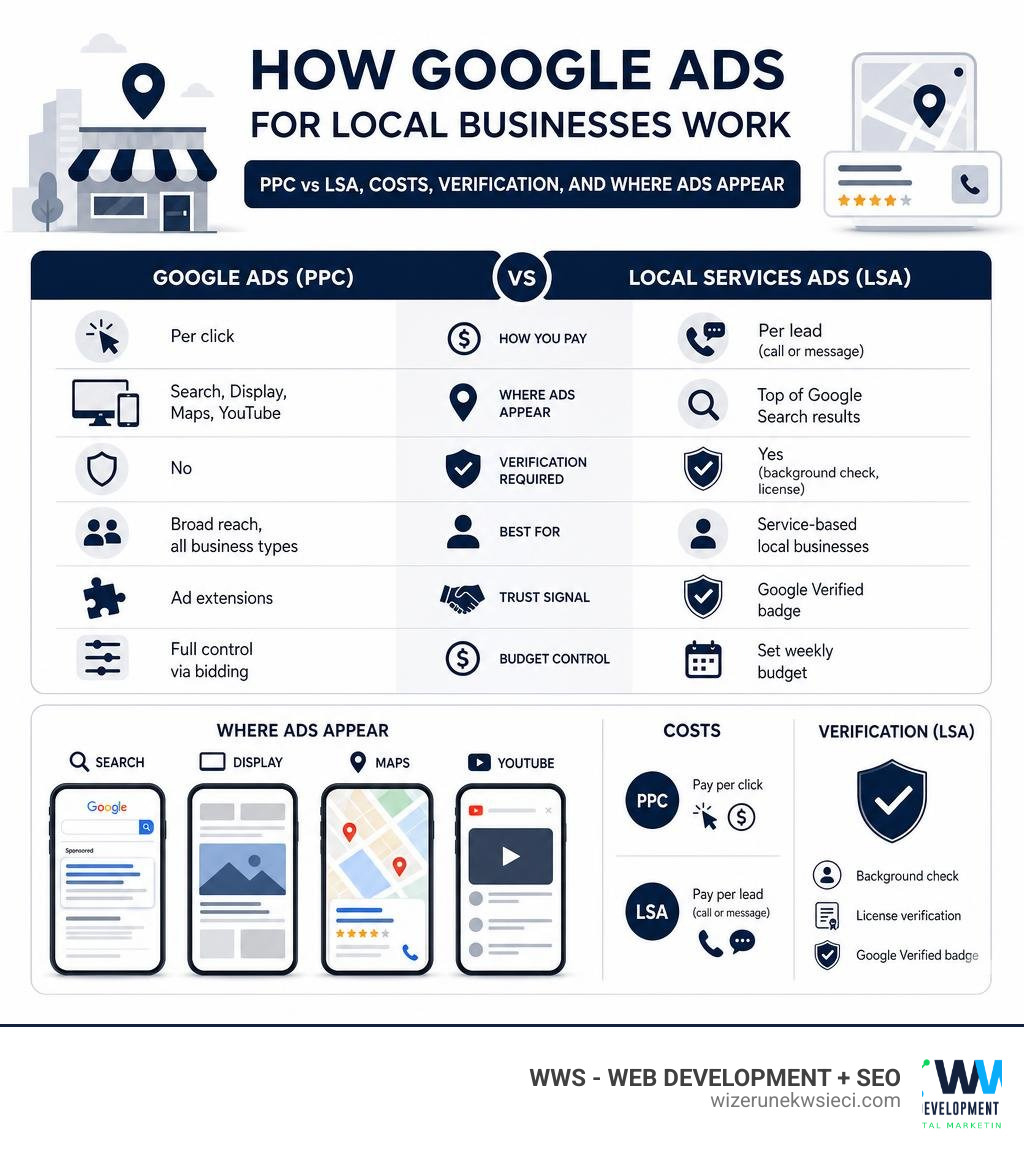
Here’s a quick breakdown of your two main options:
| Feature | Google Ads (PPC) | Local Services Ads (LSA) |
|---|---|---|
| How you pay | Per click | Per lead (call or message) |
| Where ads appear | Search, Display, Maps, YouTube | Top of Google Search results |
| Verification required | No | Yes (background check, license) |
| Best for | Broad reach, all business types | Service-based local businesses |
| Trust signal | Ad extensions | Google Verified badge |
| Budget control | Full control via bidding | Set weekly budget |
If you run a local service business — plumbing, roofing, legal, dental, tutoring — you likely need one or both of these tools to stay competitive online.
The challenge most local business owners face isn’t whether Google Ads work. It’s knowing which type to use, how to set them up correctly, and how to avoid burning through budget with nothing to show for it.
This guide walks you through everything you need to know — from how each ad type works, to costs, setup, and the mistakes that silently drain your ad spend.
I’m Tomasz Lasota, Digital Development and Technology Director with over 22 years of experience building digital strategies that drive real business growth — including helping local businesses get more qualified leads through Google Ads for local businesses. In this guide, I’ll share the practical knowledge that actually moves the needle for service businesses like yours.
Why Google Ads for Local Businesses is Essential in 2026
Consumer behavior has shifted permanently. In June 2026, when someone in Chicago or Des Plaines needs an emergency plumber, a dentist, or a commercial real estate lawyer, they don’t browse directory sites or flip through physical mailers. They open Google on their smartphone and search with high local intent.
Queries containing “near me,” specific city names, or local ZIP codes dominate search volume. If your business isn’t visible in those critical moments, you are actively giving away market share to your competitors.
Traditional organic search engine optimization is incredibly valuable for long-term growth, but it takes time to build authority. That is where paid search comes in. Running Paid Campaigns on Google allows you to bypass the organic waiting line and place your business directly in front of highly motivated buyers.
Furthermore, Google’s local advertising ecosystem integrates directly with Google Maps. When users look for physical storefronts or service area providers near them, Google Ads can trigger prominent map placements, driving immediate foot traffic, store visits, and direct phone calls. By leveraging localized search terms and precise geographic targeting, you ensure that your marketing budget is spent only on prospects who are physically close enough to convert into paying customers.
Traditional Google Ads for Local Businesses: How PPC Works
Traditional Google Ads operate on a Pay-Per-Click (PPC) model. This means you design custom text, display, or video ads, bid on specific keywords, and pay Google only when a user actually clicks on your ad.
This model gives you access to the massive Google Search Network, the visually rich Google Display Network, Google Maps, and YouTube. You can craft highly tailored campaigns that speak directly to different segments of your local audience.
To succeed with traditional PPC, you must understand the underlying mechanics. According to Google’s official documentation on About Local Ads – Google Ads Help, local ads are designed to help physical storefronts or service-area businesses reach nearby users. These ads can display critical business information, such as your physical address, phone number, operating hours, and customer reviews.
By linking your location assets (formerly known as location extensions) at the account or campaign level, your ads become eligible to appear across Google Maps and Search. This allows you to drive specific offline conversions, such as driving directions, store visits, and direct phone calls.
For businesses looking to maximize their visibility across the Chicago metropolitan area, partnering with a specialized agency for Google Ads management can help fine-tune these complex bidding strategies, ensuring your budget is optimized for high-value local keywords rather than wasted on irrelevant clicks.
Local Services Ads (LSA): The Pay-Per-Lead Alternative
If the thought of paying for clicks that don’t turn into customers makes you nervous, Google offers an alternative specifically designed for local service providers: Local Services Ads (LSA).
Unlike traditional PPC, LSAs operate on a Pay-Per-Lead (PPL) model. You do not pay when someone clicks on your ad to read your profile; you only pay when a potential customer takes a direct action to contact you, such as calling your business or sending a direct message.
LSAs appear at the absolute top of the Google Search results page, even above traditional PPC ads. They are highly visual, showcasing your business name, star rating, service hours, and a prominent trust badge — either the Google Guaranteed badge for home services or the Google Screened badge for professional services.
To explore how these ads can connect you with highly motivated local customers, you can review Google’s dedicated resource on how to Reach Local Customers with Local Service Ads.
This model is a massive win for trust building. Because Google pre-screens businesses before awarding these badges, consumers feel an immediate sense of security. If a customer books a service through a Google Guaranteed ad and is unhappy with the quality of the work, Google may submit a lifetime coverage claim to reimburse the customer up to a specified limit. This level of credibility makes LSAs an incredibly powerful tool for turning local searchers into immediate phone calls and booked appointments.
Google Ads vs. Local Services Ads (LSA): Key Differences
Choosing the right advertising path requires understanding how these two platforms differ in their day-to-day operation, targeting capabilities, and management demands. While both are powerful tools in our digital Marketing Campaigns, they serve different strategic purposes.
| Dimension | Traditional Google Ads (PPC) | Local Services Ads (LSA) |
|---|---|---|
| Primary Billing Metric | Cost-Per-Click (CPC) | Cost-Per-Lead (CPL) |
| Ad Placement | Search results, Google Maps, Display Network, YouTube, Waze | Absolute top of Google Search, Google Maps local finder |
| Ad Creative | Highly customizable text, headlines, descriptions, images, and videos | Standardized templates generated automatically from your profile |
| Targeting Method | Keyword-based, demographic targeting, radius/geographic targeting | Category-based (selected services) and defined service ZIP codes |
| Verification Process | Standard advertiser verification | Rigorous background checks, license verification, and insurance checks |
| Management Effort | High (requires ongoing keyword optimization, negative keyword management, and bid adjustments) | Low to Medium (requires managing lead status, answering calls promptly, and collecting reviews) |
Traditional Google Ads give you surgical control over your messaging and targeting. You can bid on hyper-specific keywords, test different ad copies, and build complex remarketing funnels.
On the other hand, LSAs offer simplicity and extreme visibility. You don’t have to research keywords or write ad copy; Google matches your pre-selected services with relevant user searches in your designated ZIP codes.
Cost Models: Pay-Per-Click vs. Pay-Per-Lead
The financial mechanics of these two systems represent a fundamental shift in how local businesses buy advertising.
With traditional PPC, your cost-per-click is determined by a real-time auction. Depending on how competitive your industry is in the Chicago or Des Plaines markets, a single click can range from a few dollars to over a hundred dollars for highly competitive legal or emergency services.
The primary risk of PPC is budget waste. If your landing page is unoptimized, or if you accidentally target broad, irrelevant keywords, you can spend hundreds of dollars on clicks without generating a single phone call.
The LSA pay-per-lead model removes much of this risk. You are billed only when a user calls you, sends a text message, or books an appointment directly through the ad interface. If a user clicks your LSA, reads your reviews, and leaves without contacting you, you pay absolutely nothing.
Furthermore, Google allows you to dispute invalid leads. If you receive a lead that is outside your service area, spam, a robocall, or a customer seeking a service you do not offer, you can submit a dispute to Google for a credit refund. This makes the path from ad spend to actual return on investment (ROI) much clearer and easier to track.
Eligibility, Verification, and the Google Verified Badge
Because Google places its own reputation on the line with LSAs, the onboarding process is far more rigorous than traditional Google Ads. To earn the coveted Google Verified badge (the green checkmark indicating Google Guaranteed or Google Screened status), your business must pass a comprehensive verification process.
The eligibility and screening requirements include:
- Background Checks: Business owners, and in some service categories, field employees, must pass third-party background checks to ensure there are no criminal records.
- License Verification: You must submit valid, up-to-date state and local professional licenses proving you are legally authorized to perform your trade in Illinois.
- Insurance Verification: You must provide proof of general liability insurance meeting Google’s minimum coverage requirements.
- Review Requirements: Your business must maintain a solid star rating on Google, typically requiring at least one or two positive reviews to launch.
Eligible industries span a wide range of local sectors. Home services like plumbing, HVAC, electrical, roofing, and pest control are highly active LSA categories. Professional services such as law firms, real estate agencies, financial planners, and tax advisors are also eligible for the Google Screened badge.
Additionally, healthcare providers (dentists, chiropractors), learning services (tutors, language schools), and automotive repair shops can leverage LSAs to build instant local credibility.
Best Practices for Local Campaign Success and ROI Tracking
Successfully running google ads for local businesses requires a strategic approach to campaign setup, optimization, and measurement. You cannot simply set your campaigns on autopilot and hope for the best.

To maximize your return on investment, we recommend implementing several advanced strategies for local campaign success:
- Always Run a Brand Campaign: Protect your business name from competitors who may try to bid on your brand terms. Running a dedicated brand campaign ensures you dominate the top of search results when customers search for you by name.
- Utilize a CRM for Offline Conversion Import (OCI): Do not just track form submissions; connect your CRM system directly to Google Ads. This allows you to report back to Google which leads actually turned into high-value closed deals, allowing Google’s AI to optimize for higher-paying customers.
- Implement Negative Keywords: Constantly audit your search terms report and add negative keywords to block irrelevant traffic (e.g., adding “free,” “jobs,” or “DIY” to prevent paying for non-commercial searches).
- Prioritize Call Tracking: Since phone calls are the lifeblood of local service businesses, use dynamic call tracking to measure exactly which keywords and ads are driving phone calls to your office.
Setting Up Successful Google Ads for Local Businesses
The foundation of any successful local Google Ads campaign is a fully optimized Google Business Profile (GBP). Your GBP is what allows your business to appear in the prized Google Maps placements. Ensure your profile is completely filled out with accurate operating hours, high-quality photos of your team, and a steady stream of authentic customer reviews.
When setting up your campaign structure, Google’s modern AI tools can streamline the process. According to the setup guide on Step 1: Create a campaign and choose a goal – Google Ads Help, you should begin by creating a Performance Max campaign with store goals if your primary objective is driving offline foot traffic.
Performance Max automatically distributes your ads across Search, Maps, YouTube, and the Display Network based on your physical location assets.
When configuring your targeting, avoid layering excessive geographic radius restrictions if you have already linked your Google Business Profile; Google’s system will automatically infer the optimal targeting radius around your physical locations. Combine this with localized keyword strategies — incorporating terms like “Des Plaines plumber” or “Chicago estate planning attorney” — to capture high-intent local searches.
For businesses looking to maximize their organic visibility alongside their paid efforts, integrating these campaigns with professional local search engine optimization in Des Plaines can create a powerful, unified local search presence.
Tracking ROI and Avoiding Common Mistakes
To ensure your advertising campaigns are highly profitable, you must set up robust conversion tracking. If you are not measuring what happens after a user clicks or calls, you are flying blind.
In your Google Ads dashboard, configure specific conversion actions for form fills, click-to-call buttons, and direct phone calls from your ads. This data allows you to calculate your exact Cost Per Acquisition (CPA) and determine which campaigns are driving real business growth.
Avoid these common local advertising mistakes:
- Wrong Audience Targeting: Failing to set your location settings to “Presence: People in or regularly in your targeted locations” rather than the default “Presence or interest,” which can result in your ads being shown to users outside your actual service area.
- Neglecting Analytics: Ignoring your search terms report and failing to review campaign performance regularly.
- Failing to Respond to LSA Leads: Google monitors how quickly you answer phone calls and respond to messages generated by LSAs. If you repeatedly miss calls or let messages sit unanswered, Google will lower your LSA ranking and show your competitors’ ads instead.
If you need professional assistance setting up these advanced tracking systems or optimizing your local campaigns, reach out to our team directly via our Contact page.
Frequently Asked Questions about Local Advertising
What is the difference in cost between Google Ads and Local Services Ads?
The cost of both platforms varies widely based on your industry, local competition, and geographic location.
In traditional Google Ads, you pay per click, with average CPCs ranging from $2.00 to over $50.00 in highly competitive metropolitan markets like Chicago.
In Local Services Ads, you pay per lead, which generally results in a higher upfront cost per interaction (often ranging from $15.00 to $150.00+ per lead) but carries a much higher conversion rate because the user is actively trying to contact you.
For a deeper dive into budgeting and estimating your customer acquisition costs, consult Google’s official Guide to lead generation for local businesses – Google Ads.
How do Local Services Ads integrate with Google Business Profile?
LSAs are designed to work hand-in-hand with your Google Business Profile. When you set up your LSA account, Google can pull your existing customer reviews directly from your GBP to display on your local services ad unit.
This means that building a strong reputation on your Google Business Profile directly improves your LSA ad ranking and conversion rates.
Furthermore, your verified status and star ratings are synchronized across both platforms, creating a highly cohesive and trustworthy local presence on both Google Search and Google Maps.
What common mistakes should local businesses avoid when starting?
The most common mistake is using broad match keywords in traditional Google Ads without a robust negative keyword list, which quickly drains your budget on irrelevant searches.
Another major error is directing paid traffic to an unoptimized, slow-loading homepage instead of a dedicated, high-converting landing page designed specifically for the advertised service.
Finally, many local businesses fail to track phone calls as conversions, which prevents Google’s smart bidding algorithms from optimizing for the keyword search queries that actually generate phone calls and revenue.
Conclusion
Navigating the landscape of online advertising can feel overwhelming, but mastering google ads for local businesses is one of the most powerful moves you can make to secure a steady stream of high-quality leads.
Whether you opt for the surgical precision and broad reach of traditional Pay-Per-Click Google Ads, or the high-trust, low-risk Pay-Per-Lead model of Local Services Ads, the key to success lies in consistent optimization, rigorous conversion tracking, and building strong local credibility.
At Wizerunek w Sieci (WWS), we specialize in helping local service businesses across Chicago and Des Plaines build integrated digital marketing campaigns that drive measurable growth. We construct conversion-focused websites and run highly optimized SEO and Google Ads campaigns designed to get your phone ringing.
If you are ready to stop guessing and start scaling your local lead generation, explore our specialized Paid Campaigns services today, and let’s build a strategy that fills your schedule.