


Why Your Website Positioning Decides Whether Customers Find You or Your Competitor
Positioning a website at the top of Google search results is one of the most direct ways a local service business can fill its schedule with qualified leads — without paying for every single click.
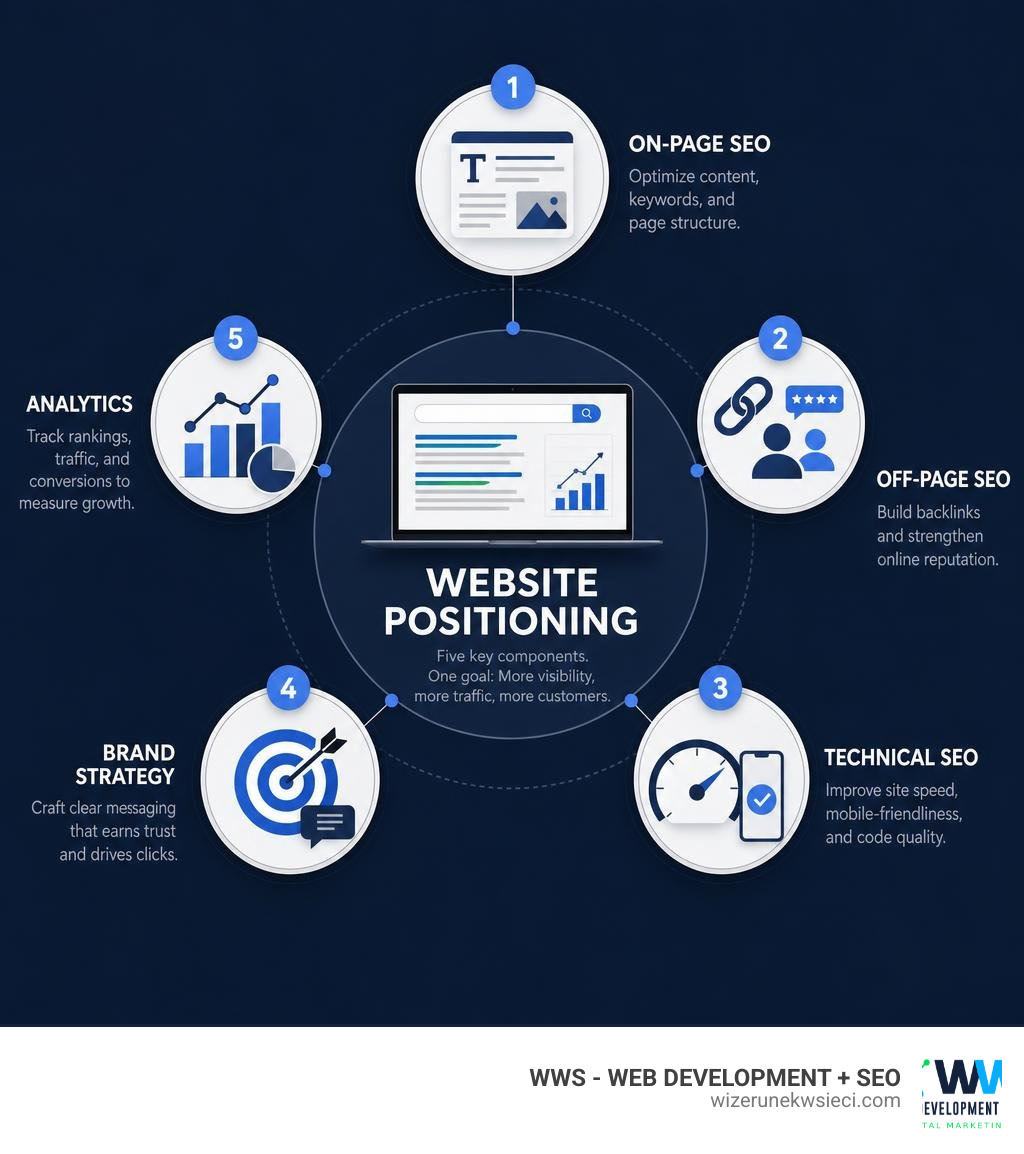
Here’s a quick overview of what website positioning covers:
| Element | What It Means |
|---|---|
| On-page SEO | Keywords, content, and page structure |
| Off-page SEO | Backlinks and online reputation |
| Technical SEO | Site speed, mobile-friendliness, code quality |
| Brand positioning | Clear messaging that earns trust and clicks |
| Measurement | Tracking rankings, traffic, and conversions |
The numbers make the case clearly. The top 3 results on Google earn 36% of all clicks. The #1 result alone captures about 32%. Meanwhile, fewer than 1% of searchers ever make it to page two.
That gap between page one and page two isn’t just about visibility — it’s about revenue.
Most local businesses don’t have a marketing problem. They have a positioning problem. They’re either invisible in search results, or they show up but their site doesn’t communicate why a customer should choose them over the competition.
This guide walks through the best tools and services available today for fixing both.
I’m Tomasz Lasota, Digital Development and Technology Director with over 22 years of experience designing and deploying digital solutions that improve website positioning and drive measurable ROI for B2B and B2C clients. In that time, I’ve seen how the right combination of strategy, tools, and execution separates businesses that dominate their local search results from those that stay buried.
Positioning website terms explained:
What is a Positioning Website and How Does It Differ from Traditional SEO?
To understand how to dominate search engine results pages (SERPs) in July 2026, we first need to clarify what we mean by positioning website assets. Many business owners use “SEO” and “website positioning” interchangeably. While they are closely related, they represent different scopes of digital strategy.
Traditional SEO (Search Engine Optimization) is often treated as a technical checklist. It involves optimizing meta tags, fixing broken links, and inserting keywords into blog posts. These actions are highly necessary, but they are just part of the puzzle.
Website positioning, on the other hand, is a holistic digital marketing discipline. It is the intentional alignment of search visibility, technical performance, and brand strategy. When we work on a Website SEO campaign, we are not just trying to rank for random high-volume keywords. We are positioning the brand as the obvious, trusted solution for a user’s specific search intent.
Think of traditional SEO as preparing your store’s inventory and cleaning the floors. Website positioning is choosing the prime location on the busiest street corner in Chicago or Des Plaines, designing an eye-catching storefront, and ensuring that your messaging immediately resonates with the exact people walking through the door.
The Core Components of Strategic Website Positioning
Successful website positioning relies on five core pillars working in perfect harmony:
- On-Page SEO: This is the visible layer of your website. It includes writing highly relevant, original content that satisfies search intent, organizing pages with clear heading structures (H1, H2, H3), and naturally integrating primary and secondary keywords.
- Off-Page SEO: This focuses on building your website’s online reputation and authority. Search engines view high-quality external links from trusted, local websites as digital endorsements. Building a natural link profile is crucial for showing search algorithms that your business is a trusted leader in its industry.
- Technical SEO: This is the underlying engine room. It covers clean source code, optimized graphics, secure HTTPS encryption, proper XML sitemaps, and error-free robots.txt files. If search engine crawlers cannot easily read your code, your content will never rank.
- Brand Voice & Messaging: If your website ranks number one but reads like a generic template, visitors will bounce. Clear, human-centric messaging states exactly who you serve, what problem you solve, and why you are different.
- Conversion-Focused Design: True positioning does not stop at traffic. It guides the user from curiosity to conversion using fast-loading layouts, intuitive navigation, and clear calls to action (CTAs) like simple booking forms and click-to-call buttons.
How Search Engine Algorithms Evaluate a Positioning Website
Search engines like Google use highly sophisticated algorithms to crawl, index, and rank billions of web pages. These algorithms evaluate hundreds of ranking signals to determine which site deserves the top spot.
First, search engine crawlers scan your website’s code to understand its structure and context. They look at how pages are linked together internally and check for technical barriers. If your site has crawl errors or slow loading speeds, algorithms will deprioritize it.
Second, algorithms look closely at user experience (UX) and engagement metrics. They analyze how long users stay on your site, whether they click around to other pages, and where they drop off. If users bounce back to the search results immediately, it signals that your content did not satisfy their search intent.
Finally, mobile optimization is a major ranking factor. With approximately 56.89% of all web traffic coming from mobile devices, search engines utilize mobile-first indexing. This means Google evaluates the mobile version of your website to determine your organic search rankings. If your site is not fully responsive and lightning-fast on smartphones, your search rankings will suffer.
Organic SEO vs. Paid SEM: Choosing Your Positioning Strategy
When looking to improve your search engine visibility, you have two primary paths: organic positioning (SEO) and paid positioning (SEM/PPC).

PPC (Pay-Per-Click) advertising, such as Google Ads, allows you to buy your way to the top of the search results instantly. However, this visibility comes at a continuous cost. In highly competitive industries, especially in major markets like Chicago, the cost per lead for paid ads can be incredibly high. For instance, legal and professional services often see average paid ad costs per lead exceeding $131. The moment you stop paying for ads, your traffic drops to zero.
Organic positioning, powered by strategic SEO, takes time to build but delivers compounding returns. Once your website is positioned organically on the first page of Google, the ongoing cost per lead drops to $0. The data is clear: 80% of search engine users completely skip paid ads and go straight to the organic results. In fact, 90% of all search clicks go to organic listings, and top organic results receive up to 10 times more clicks than paid ads.
| Feature | Organic Positioning (SEO) | Paid Positioning (SEM/PPC) |
|---|---|---|
| Upfront Cost | Investment in strategy, content, and code | Budget set for ad spend |
| Time to Results | Several months of compounding growth | Near-instantaneous visibility |
| Long-Term ROI | High; traffic continues without direct ad costs | Low; stops when ad spend stops |
| User Trust | High; 80% of users prefer organic results | Lower; clearly marked as sponsored |
| Sustainability | High resilience to temporary budget cuts | Zero resilience to budget pauses |
If you are a newly launched business in Illinois needing immediate transactional leads, a hybrid approach can work well. You can use paid ads to secure quick wins while we build your long-term organic authority with Boost Your Business with Expert SEO Chicago Services.
The Role of Keywords and User Experience in Organic Positioning
To achieve top organic rankings, your keyword strategy must align with user intent. Keywords are not just words you sprinkle throughout your text; they represent real questions your customers are asking.
We classify keywords into three main categories:
- Informational: Users looking to learn something (e.g., “how to fix a leaky faucet”).
- Navigational: Users looking for a specific brand or website.
- Transactional: Users ready to buy or hire (e.g., “plumber near Des Plaines IL”).
For local service businesses, focusing on localized transactional keywords and long-tail search terms is highly effective. These terms have lower search volumes but carry incredibly high conversion rates because the searcher is ready to make a decision.
However, keywords alone are not enough. If your user experience is poor, visitors will leave. Google rewards websites that load quickly, offer intuitive navigation, and feature clean design. For businesses selling products online, integrating a smooth checkout and fast product filtering via Ecommerce SEO is essential to keep users engaged and search engines happy.
The Best Tools and Software for Website Positioning Analysis
To rank high, you need accurate data. Guesswork does not work in modern search engine positioning. Fortunately, several powerful tools and platforms can help you analyze your site, track your competitors, and optimize your content.
Here is a roundup of the best software and tools for professional website positioning:
1. Positional
For content and SEO teams looking to scale their organic growth, Positional | A Modern Toolset for Content & SEO Teams offers a modern suite of optimization tools. It features granular heat-mapping and paragraph scoring to help you identify exactly where users drop off on your pages. It also streamlines internal linking by providing contextual link suggestions across your entire site, making it easier to build site authority. Positional also includes robust keyword clustering features based on actual SERP data, helping you group related terms and plan your content calendar efficiently.
2. MITPO
If you struggle to communicate why your business is different from competitors, AI Positioning Software for Founders | MITPO is an excellent resource. This platform helps teams turn competitor research into clear messaging frameworks. By analyzing your target audience, category, and competitors, MITPO automatically generates a comprehensive positioning brief. This ensures your website copy, brand voice, and marketing campaigns remain perfectly aligned and highly differentiated.
3. Nail Your Positioning
If you want to know if your homepage copy is actively losing deals, you can use Is your homepage losing deals? Find out free. — nailyourpositioning.com . This specialized tool analyzes your homepage copy to identify messaging gaps, target audience misalignment, and weak value propositions. It provides exact quotes of what is failing on your site alongside concrete rewrites to help you boost conversions.
Selecting the Right Services for a Positioning Website
While tools provide excellent data, executing a successful website positioning strategy requires specialized expertise and continuous effort. This is why many businesses choose to partner with professional agencies.
When evaluating agencies, look for partners that offer transparent communication, custom strategies, and a clear focus on return on investment rather than vanity metrics. A great agency will always start with a comprehensive SEO audit. This audit should analyze your website’s structure, code quality, mobile responsiveness, existing content, and direct competitor landscape.
For businesses operating in Illinois, local expertise is invaluable. Achieving visibility in the Chicago metropolitan area requires a deep understanding of local search behavior. Partnering with an agency that specializes in Local SEO ensures your business shows up in local map packs and localized search results when nearby customers need your services.
To find the right fit for your business, read through our comprehensive guide on Chicago SEO Agencies: Your Guide to Ranking Up.
Navigating the Local Business Ecosystem in Illinois
Operating a business in Illinois means navigating a highly competitive landscape. Whether you are based in the busy commercial districts of the City of Chicago or the growing suburbs like the City of Des Plaines, IL , standing out requires a coordinated digital presence.
To grow your team and keep up with incoming leads, you might utilize local staffing resources such as Jobs & Staffing Services in Des Plaines, IL . Additionally, staying connected with state-level business and employment portals like Illinois workNet Home and monitoring the State of Illinois Employment Opportunities can help you scale your operations.
When you are ready to scale your digital reach, working with an experienced local agency is key. Firms like WWS understand the unique competitive dynamics of the Illinois market, helping you build a digital presence that ranks high and converts local searchers into loyal clients.
Frequently Asked Questions about Website Positioning
What is the difference between website positioning and brand positioning?
While they sound similar, they focus on different aspects of your business strategy:
- Brand Positioning: This is a strategic business exercise. It defines who your ideal customer profile (ICP) is, what unique problem you solve, and why you are different from your competitors. It shapes your logo, brand voice, pricing structure, and company values.
- Website Positioning: This is the execution of your brand strategy in search engines. It uses on-page, off-page, and technical SEO to ensure that when your target audience searches for solutions online, your website appears at the top of the search results.
In short, brand positioning defines what makes you unique, while website positioning ensures that your target audience actually finds you online.
How long does it take to see results from website positioning services?
Organic website positioning is a long-term process, not an overnight switch. For most local service businesses, it takes between three to six months of consistent optimization to see significant ranking improvements.
This timeline depends on several factors:
- The Starting Point: A brand-new website with no search history will take longer to rank than an older, established site that needs optimization.
- Keyword Competitiveness: Ranking for highly competitive terms in Chicago takes more time and resources than ranking for niche terms in smaller suburbs.
- Algorithm Updates: Search engine algorithms are constantly evolving. A professional strategy adapts to these updates to ensure long-term stability.
A typical campaign begins with a detailed SEO audit and technical cleanup in the first month. Content creation and link building follow in the subsequent months, leading to gradual and sustainable ranking increases. To find a plan that fits your goals, explore our SEO Services Packages Chicago.
What are the most common mistakes businesses make in website positioning?
Many businesses struggle to rank because of a few easily avoidable mistakes:
- Keyword Stuffing: Repeating the same keyword over and over in your text reads poorly and is penalized by search engines. Write for humans first, using natural language.
- Generic Messaging: If your homepage copy looks exactly like your competitors’ sites, visitors will bounce. Focus on clear, differentiated headlines.
- Ignoring Mobile Users: With over half of all web traffic coming from mobile devices, a slow or poorly formatted mobile site will ruin your rankings. Always prioritize responsive, fast-loading mobile designs.
- Buying Low-Quality Backlinks: Spammy, purchased links can trigger search engine penalties, dropping your site’s visibility overnight. Focus on earning high-quality, natural links instead.
Conclusion
Positioning a website effectively is the ultimate revenue lever for local service businesses. When you align clean technical code, targeted keyword optimization, authoritative link building, and clear brand messaging, your website stops being a passive digital brochure and becomes an active lead-generation engine.
At Wizerunek w Sieci (WWS), we build websites and run SEO, Google Ads, and social media campaigns for local service businesses to generate qualified leads. Our unique selling proposition is delivering measurable growth through integrated, conversion-focused strategies. Whether you are operating in Chicago, Des Plaines, or the broader Illinois area, we help your business get found, get trusted, and get chosen.
Ready to claim the top spot in your local market? Visit our Website SEO page today to learn how we can help you dominate the search results and grow your business.