





Why Knowing Your Google Rank Is the First Step to Growing Online
A website SEO ranking checker is one of the most practical tools a business owner can use to understand where their site stands on Google — and what it takes to get more customers finding them online.
Quick answer — top website SEO ranking checkers to know:
| Tool | Best For | Free Option |
|---|---|---|
| Seobility Ranking Checker | Non-personalized rank checks | Yes (5/day) |
| SE Ranking | Daily tracking, AI Overviews | Yes (5/day) |
| Ahrefs Keyword Rank Checker | Deep keyword + competitor data | Limited |
| Semrush SEO Checker | Full site audits + rank tracking | Yes (3/day) |
| RankNibbler | 100+ on-page checks, AI visibility | Yes |
| SEOptimer | Audits + white-label reports | Yes |
Here is the core problem: most business owners have no idea where they actually rank on Google. They might think they’re on page one — but what they see when they search is often personalized based on their browser history, location, and Google account. That’s not what your customers see.
Meanwhile, the difference between ranking #1 and #10 is enormous. The top result gets roughly 28% of all clicks. By position 10, that number drops to around 1%. If you’re not near the top, you’re essentially invisible.
Getting real, objective ranking data — stripped of personalization bias — is the only way to know the truth about your visibility and make smart decisions about your SEO.
I’m Tomasz Lasota, founder of WWS — Web Development + SEO in Des Plaines, IL, and over 22 years of helping small businesses across the Chicago area compete online has taught me that a reliable website SEO ranking checker is often the first tool that shows a business owner exactly why their phone isn’t ringing. In this guide, I’ll walk you through the best options available in 2026 so you can stop guessing and start growing.
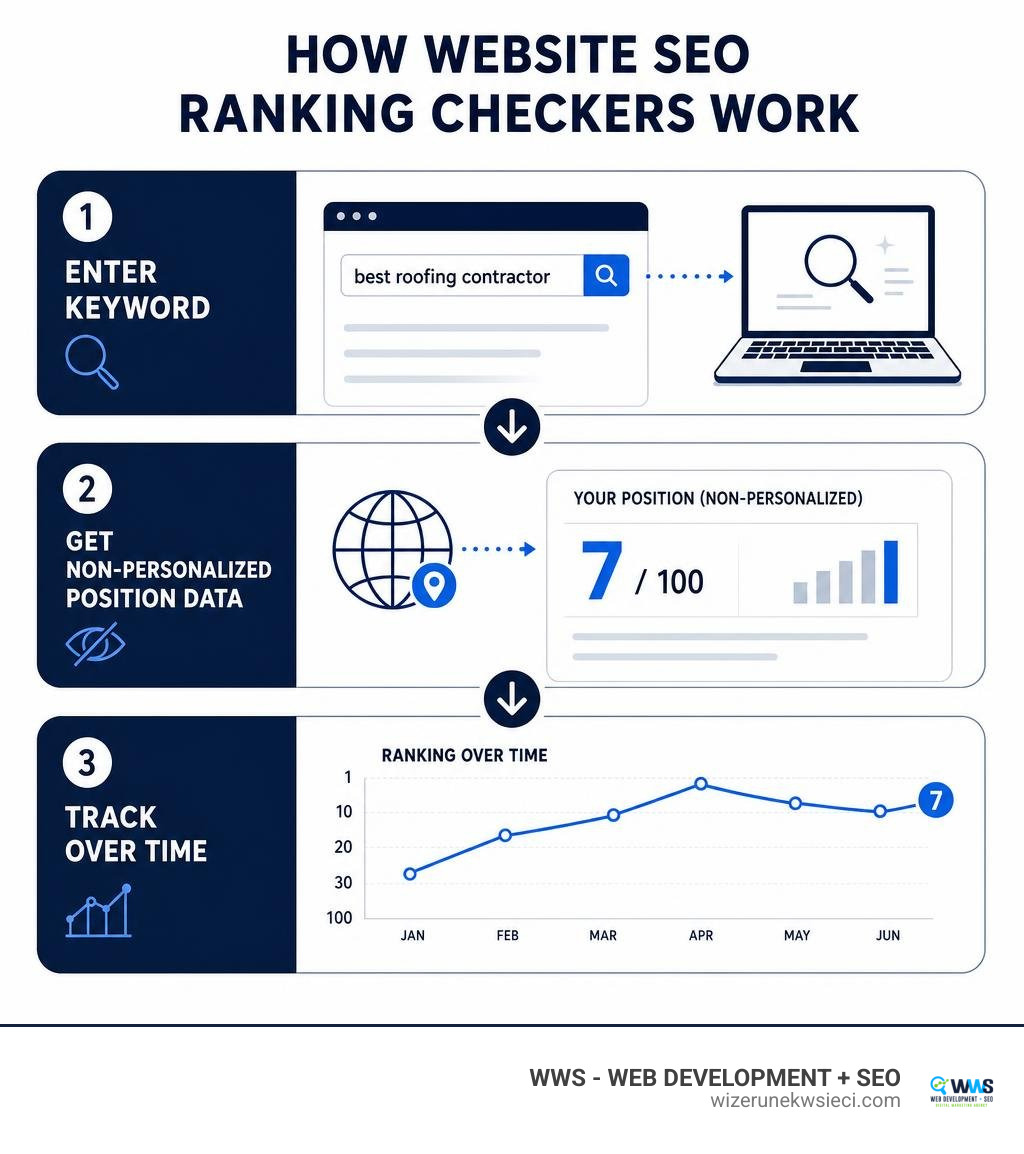
Glossary for website seo ranking checker:
What is a Website SEO Ranking Checker and How Does It Work?
To understand how a website SEO ranking checker works, we first have to look at how Google itself processes a search. When a real user types a query into Google, the search engine doesn’t just pull from a static list. It looks at the user’s physical location, their past search history, their browser settings, and even whether they are logged into a Google account. This is called personalization bias.
A rank checker tool strips all of that away. It acts like a completely neutral, clean-slate crawler. It queries Google’s servers directly, requesting non-personalized results for specific keyword positions. By doing this, it shows you the “clean” search engine results pages (SERPs) that a brand-new customer would see.
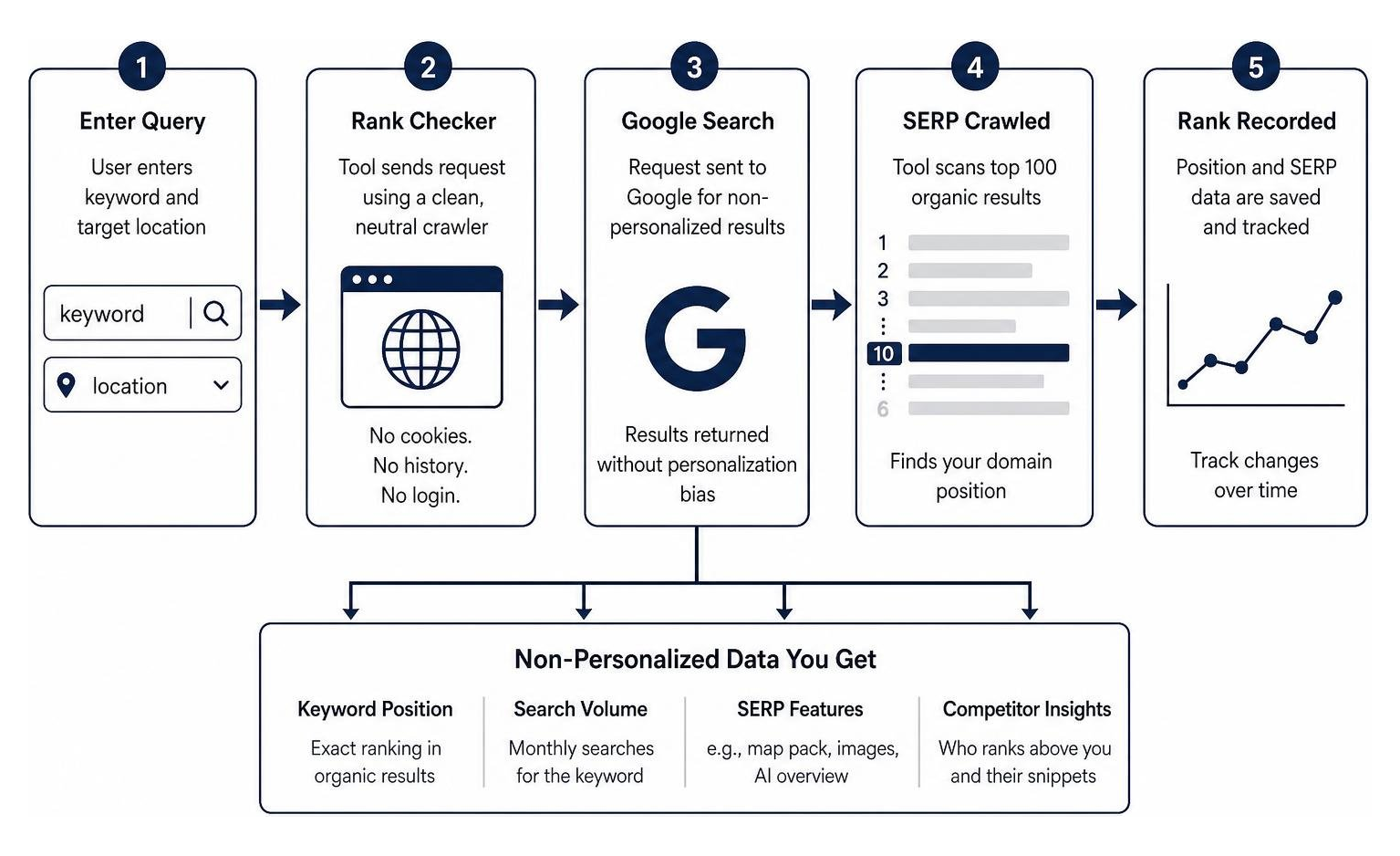
These tools crawl the top 100 organic results to find where your domain sits. Beyond just giving you a number, a high-quality ranking checker will also pull critical secondary data:
- Search volume: How many people actually search for this phrase every month.
- SERP features: Whether the page displays map packs, images, or AI-generated summaries.
- Competitor positions: Who is sitting above you and what their snippets look like.
For local service providers — like a plumber in Des Plaines or an accountant in Chicago — seeing this neutral data is eye-opening. If you want to dive deeper into how your overall site health impacts these numbers, we recommend starting with our comprehensive Website SEO services.
Additionally, if you want a complete diagnostic baseline of your current digital setup, you can look into getting a professional SEO analysis to map out your technical strengths and weaknesses. Working with a dedicated team can help you transition from simply “checking” your rankings to actively moving them upward by utilizing expert SEO Chicago services.
Key Features to Look For in a Website SEO Ranking Checker
Not all ranking checkers are built the same. Some are quick, one-off search bars, while others are comprehensive tracking suites. If you are looking for a tool to guide your business decisions, keep an eye out for these core features:
- Daily Tracking & Historical Trends: Search engines are volatile. A tool that only checks once a month won’t help you spot sudden drops from Google algorithm updates. Look for daily tracking to see how your positions fluctuate over time.
- Device Tracking (Desktop vs. Mobile): Google uses mobile-first indexing. Your desktop rankings might look fantastic while your mobile rankings are lagging behind. A good checker lets you toggle between desktop and mobile views.
- Hyper-Local Location Targeting: If you run a local business in the Chicago suburbs, national ranking data is useless to you. You need to know how you rank for someone searching from Schaumburg, Naperville, or Arlington Heights. Your tool should support city-level and zip-code-level targeting.
- Competitor Analysis: You aren’t ranking in a vacuum. A great tool automatically maps your domain against your top five rivals, showing you when they gain ground or lose positions.
- SERP Feature Tracking: Modern search results are crowded with featured snippets, people-also-ask boxes, video carousels, and local map packs. Your rank tracker must tell you if your site actually owns any of these high-value spots.
If you want to run a quick, objective test right now without signing up for complex software, we highly recommend trying the Free Website Ranking Checker | Google Keyword Rankings from Seobility. It is a fantastic, lightweight tool that lets you check your exact position for any keyword across different countries and devices without any personalization bias.
As you begin to gather this data, you might wonder how your business compares to others in the local market. Navigating the landscape of Chicago SEO agencies can give you a clearer picture of how professional teams structure their monitoring and campaign strategies to dominate the local search results.
Free vs. Paid Solutions: Accuracy and Key Metrics to Track
When deciding between a free website SEO ranking checker and a paid subscription, it helps to understand what you are actually paying for. Free tools are excellent for quick, on-the-spot diagnostics. Paid tools, however, provide the infrastructure needed for long-term campaigns.
Below is a comparison of what you can expect from each option:
| Feature | Free Rank Checkers | Paid Rank Tracking Suites |
|---|---|---|
| Search Depth | Usually limited to top 10 or 20 results | Tracks deep into the top 100 positions |
| Historical Data | None (real-time snapshot only) | Years of historical trend lines |
| Keyword Limits | 1 to 10 keywords per search | Thousands of keywords tracked daily |
| API & Integrations | None | Connects to Google Looker Studio, GA4, etc. |
| Reporting | Manual screenshot or simple CSV | Automated, branded PDF reports |
Understanding these differences is especially crucial if you run an online store. E-commerce sites often have hundreds of product pages and category terms that require constant, automated tracking. If this matches your business model, exploring our specialized Ecommerce SEO strategies will help you understand how to manage large-scale keyword portfolios effectively.
If you are ready to invest in professional monitoring, reviewing the options for SEO services packages in Chicago can help you find a plan that combines paid rank tracking with active optimization work.
How Accurate is a Free Website SEO Ranking Checker?
The short answer: Free checkers are highly accurate for the exact moment you run the search, but they lack context.
Because search engines dynamically adjust results based on real-time factors, a free tool gives you a clean, objective data point by stripping away your browser settings, search history, and incognito mode limitations. However, because search rankings are highly volatile, a single snapshot doesn’t tell the whole story. A keyword that ranks #4 at 9:00 AM might slip to #8 by afternoon due to localized search shifts or temporary server testing by Google.
For occasional checks, a free tool is perfect. For executing a growth strategy, you need the historical trend lines that only continuous tracking can provide.
Essential Metrics to Monitor Beyond Keyword Positions
Simply knowing you rank #5 for a keyword isn’t enough to build a business strategy. To turn data into revenue, you should track these additional metrics:
- Search Volume: There is no business value in ranking #1 for a term that only gets 5 searches a year. Focus your efforts on high-intent keywords with healthy monthly search volumes.
- Visibility Rate: This metric calculates your overall search presence across a cluster of keywords. It measures your traffic potential based on how many of your target terms rank on page one.
- Click-Through Rate (CTR): Position #1 gets around 28% of clicks, but that number drops sharply. If you rank #3 but have a poor title tag, your CTR might be lower than the average. Tracking CTR helps you optimize your meta titles and descriptions to earn more clicks.
- Core Web Vitals: Google prioritizes user experience. If your page loads slowly or shifts layout unexpectedly on mobile, your rankings will suffer regardless of your content quality.
Local SEO, Mobile Tracking, and the Rise of AI Search Visibility

If you want to make sure local customers can find your physical location or service area, you need to align your rank tracking with a strong local strategy. You can learn more about how we build these campaigns by reading about our Chicago Local SEO services.
Tracking Local and Mobile Search with a Website SEO Ranking Checker
For local businesses in Cook County and the surrounding suburbs, search results are deeply tied to geography. A homeowner looking for a contractor in Des Plaines, IL will see different map results than someone searching from Arlington Heights, IL.
This is why tracking the “Local Pack” (the Google Maps three-pack) is so critical. Over 30% of local searches result in a direct click or phone call from the map interface. If you aren’t tracking your rankings across specific target neighborhoods — such as Schaumburg, IL, Naperville, IL, or Elk Grove Village, IL — you are missing the actual picture of how your business appears to nearby customers. Your ranking checker must be configured to run localized, city-level queries to give you accurate data.
Optimizing for AI Search Engines and Google AI Overviews
As of 2026, the search landscape has shifted to include AI-driven results. Google AI Overviews, ChatGPT, Perplexity, and Gemini are now major sources of organic traffic. When users ask an AI agent for a recommendation — such as “Who is the most reliable web developer in Chicagoland?” — the AI scans the web, processes structured data, and cites specific brands.
This means your rank tracking must expand to cover AI Visibility. Tools like RankNibbler and SEOptimer now track whether your brand is mentioned or cited in these LLM (Large Model) responses. To rank in AI search, you must focus on:
- Structured Data & Schema Markup: Giving AI crawlers clear, structured information about your services, locations, and reviews.
- High-Quality Backlinks: AI engines prioritize highly cited, authoritative sources when pulling recommendations.
- Entity Authority: Keeping your Google Business Profile, social directories, and website content perfectly consistent so AI models can easily verify your business details.
Frequently Asked Questions About Rank Tracking
Why do my manual Google search results differ from rank checker reports?
Your personal search results are heavily influenced by personalization bias. Google remembers your past visits, your physical location down to the street block, and your search preferences. Even using incognito mode doesn’t completely strip this data, as Google can still use your IP address and browser fingerprint. A website SEO ranking checker queries Google neutrally, showing you what a brand-new user sees.
How often should a small business check its keyword rankings?
For most small businesses, checking rankings once a week or every two weeks is plenty. While paid tools track rankings daily, looking at your data too frequently can cause unnecessary stress due to minor day-to-day search volatility. Focus on the long-term monthly trend lines rather than daily micro-shifts.
Can structured data help improve my website’s search visibility?
Yes, absolutely. While structured data (schema markup) is not a direct ranking factor, it makes your website eligible for rich snippets (like star ratings, event times, and product prices) in search results. These eye-catching features dramatically improve your click-through rate (CTR). Furthermore, structured data is highly valued by AI search engines, making it easier for them to cite your business in AI Overviews and chat responses.
Conclusion
Stop guessing where your business stands online. Relying on manual Google searches only hides the truth behind personalization bias. Using a reliable website SEO ranking checker is the first step to seeing your business through your customers’ eyes — revealing exactly where you are winning and where you are losing valuable leads to your competitors.
But tracking your rankings is only half the battle. The real work lies in interpreting that data, fixing technical bottlenecks, optimizing your content, and building a local presence that search engines and AI models trust.
At Wizerunek w Sieci (WWS), we don’t believe in generic, automated strategies. Led by Tomasz Lasota, our Des Plaines-based team has spent over two decades building highly customized, high-performing websites and SEO campaigns for small and medium-sized businesses across the Chicago area and the United States. Whether you are looking to dominate the local map pack in Cook County or want to optimize your site for the 2026 AI search landscape, we treat your business with the personal attention and meticulous detail it deserves.
Stop leaving your Google visibility to chance. Partner with WWS for expert Website SEO services and let’s turn your search rankings into consistent, real-world business growth. Visit our office at 636 S River Rd #218, Des Plaines, IL 60016 or contact us online to claim your free website audit.