





Why Knowing Your Google Ranking Can Make or Break Your Business
My website Google ranking is the position your site appears in when someone searches for your products or services on Google. It directly determines how many potential customers actually find you.
Here’s a quick answer if that’s all you need:
How to check your website’s Google ranking:
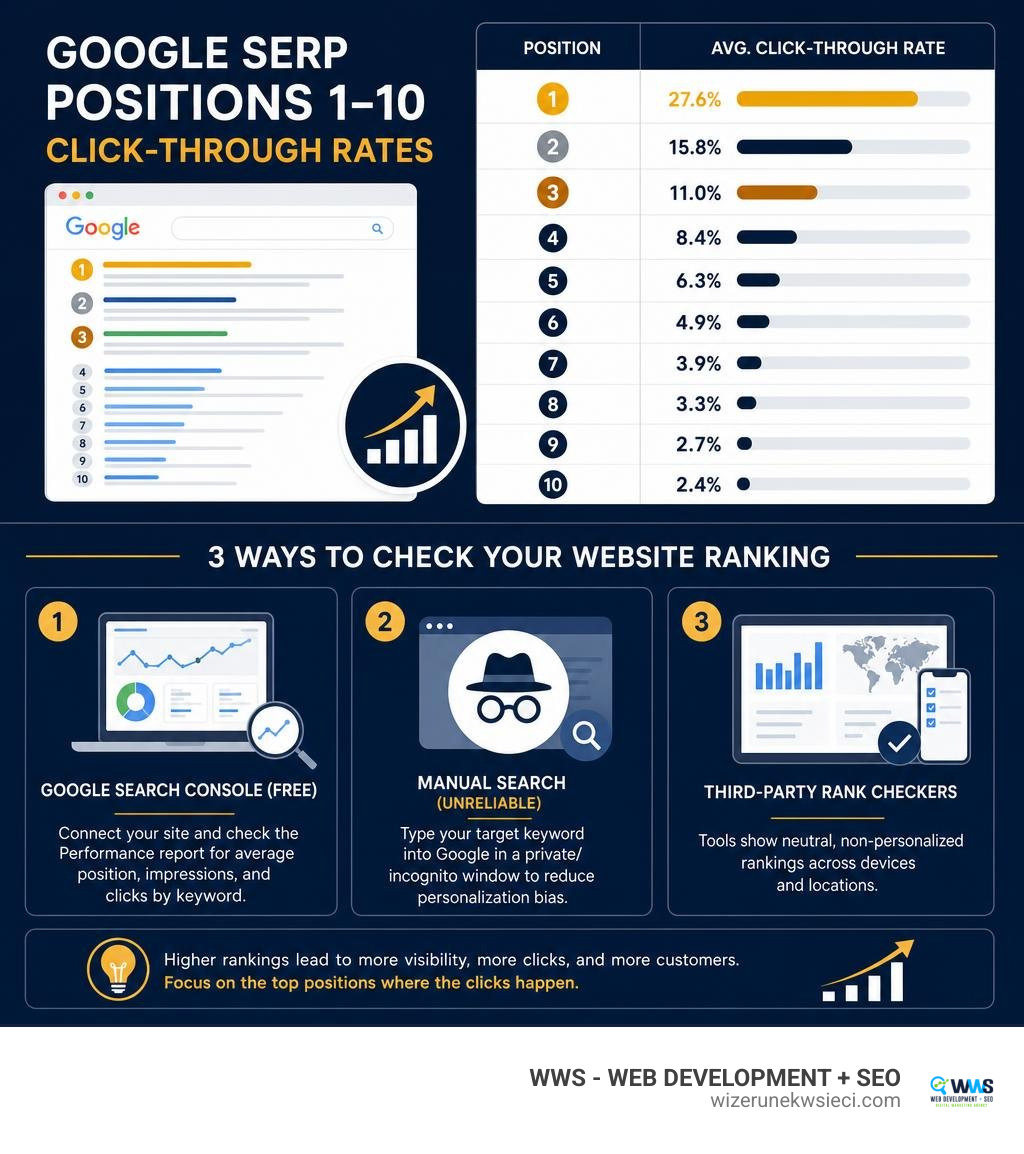
- Google Search Console (free) — Go to search.google.com/search-console, connect your site, and check the Performance report for average position, impressions, and clicks by keyword.
- Manual search (unreliable) — Type your target keyword into Google in a private/incognito window to reduce personalization bias.
- Third-party rank checkers — Tools like Seobility, Seodity, or RankNibbler show neutral, non-personalized rankings across devices and locations.
Think about this: over 75% of users never scroll past the first page of Google results. And the top 3 results alone capture more than 60% of all clicks. If your business isn’t showing up there, you’re essentially invisible to the customers who are actively looking for what you offer right now.
For small business owners — whether you run a restaurant in Wicker Park, a law firm in Naperville, or a contractor business anywhere in the Chicago suburbs — your Google ranking isn’t just a vanity metric. It’s the difference between a phone that rings and one that doesn’t.
The good news: checking where you stand is free and takes minutes. Improving that position is where strategy comes in.
I’m Tomasz Lasota, founder of WWS — Web Development + SEO in Des Plaines, IL, and over 22 years of hands-on digital marketing work have shown me exactly how my website Google ranking can transform a local business’s revenue when tracked and acted on correctly. In this guide, I’ll walk you through everything — from checking your current position for free to turning that data into a real growth strategy.
Relevant articles related to my website google ranking:
How to Check My Website Google Ranking Accurately
Checking where your website stands on Google seems like it should be as simple as typing a keyword into the search bar. However, doing so manually often gives you a highly distorted picture.
Google processes over 8.5 billion searches per day, and to make those searches as helpful as possible, it heavily personalizes what each user sees. This personalization is based on your physical location (IP address and GPS), your past search history, your browser cookies, and even whether you are logged into a Google account.
If you frequently visit your own website, Google’s algorithm notices this behavior and will artificially boost your site in your personal search results. You might see your business sitting proudly at position #1, while a potential customer down the street in Arlington Heights, IL, or Elk Grove Village, IL, might see you on page three.
To get an objective, neutral view of your rankings, you need to bypass this personalization. The official developer guidelines on Google Search Central (formerly Webmasters) | Web SEO … emphasize using structured tools to evaluate how Google truly indexes and displays your pages. Incorporating a systematic check of your Website SEO is the first step to building an online presence that actually brings in local leads.

To help you understand your options, here is a quick comparison of the three primary methods for checking your rankings:
| Method | Personalization Bias | Cost | Best For | Key Limitation |
|---|---|---|---|---|
| Manual Search | Very High | Free | Quick, casual checks | Highly inaccurate due to cookies and location tracking |
| Google Search Console | None (Uses real user averages) | Free | Tracking actual impressions, clicks, and average trends | Does not show real-time “live” search results |
| Third-Party Rank Checkers | None (Uses clean proxy servers) | Free to Paid | Precise local tracking, device comparison, and competitor analysis | Free plans usually limit the number of keywords |
Understanding Google Ranking Checkers and How They Work
A Google ranking checker is a specialized software tool designed to query Google’s search engine results pages (SERPs) in a completely neutral manner.
Instead of searching from a personal browser, these tools use automated crawling bots and clean proxy servers located in specific geographic regions. When you enter your domain and a target keyword, the tool simulates a search from a completely fresh browser with no history, no cookies, and a highly specific location.
The checker then scans the top 100 search results, identifies where your domain appears, and pairs this position with valuable search volume data. This shows you exactly how many times people search for that term each month, helping you prioritize keywords that actually drive traffic.
Manual Search vs. Automated SEO Tools for Finding Your Position
If you must check your rankings manually, you have to take steps to minimize Google’s personalization bias. Here is how you can perform a semi-reliable manual check:
- Use Private/Incognito Mode: This prevents Google from using your local browser history to customize your results.
- Clear Your Browser Cookies: Erase your cache and cookies before searching to remove previous tracking signals.
- Disable Personal Web Search: You can append the parameter
&pws=0to the end of the Google search URL to instruct Google to return non-personalized results. - Use Neutral Search Tools: For truly objective results, automated tools are always superior because they entirely bypass local IP and browser biases.
Automated SEO tools run these clean searches continuously, saving you hours of manual work and providing historical tracking that manual searches simply cannot match.
Google Search Console vs. Third-Party Rank Checkers
Google Search Console (GSC) is the gold standard for free, internal search data because it comes directly from Google. It tracks three primary metrics for your keywords:
- Impressions: How many times a user saw a link to your website in search results.
- Clicks: How many times a user clicked through to your site.
- Average Position: The average rank of your site for a specific query over a set time period.
While GSC is incredibly powerful, it represents historical average data rather than a live snapshot. If your site ranks #3 in Chicago but #15 in Naperville, GSC will average those together.
Third-party rank checkers, on the other hand, provide real-time, live data. They allow you to see exactly where you rank at this very second in a specific neighborhood or on a specific device type (mobile vs. desktop). Combining the historical data of GSC with the live, localized tracking of third-party tools gives you the complete picture of your search presence.
Choosing and Using the Right Website Rank Tracking Tools
To build a sustainable digital presence, you cannot rely on guesswork. Successful business owners in the Chicagoland area use structured rank tracking to monitor their keyword visibility and keep an eye on local competitors.
Integrating a professional rank tracker into your workflow is highly recommended. Many businesses choose to work with a dedicated agency that includes premium tracking and reporting as part of their SEO Services Packages Chicago to ensure they are always looking at clean, actionable data.
Key Features to Look For in a Professional Rank Tracker
When selecting a tool to monitor your search rankings, look for these essential features:
- Precise Geolocation: The tool must allow you to track rankings not just by country, but by specific cities, suburbs, or even zip codes. This is vital for local service providers.
- Device-Specific Tracking: Mobile searches now make up over 60% of all Google queries. Your tool must show desktop and mobile rankings separately, as search results can vary wildly between the two.
- SERP Alerts: Look for automated notifications that alert you when a keyword drops or jumps significantly, allowing you to react immediately to algorithm updates.
- Data Exporting: The ability to export clean PDF and CSV reports is crucial for sharing progress with your team or tracking long-term trends.
How to Track Keyword Positions and Competitors Over Time
Setting up a rank tracker is straightforward. First, you enter your domain name, select your target geographic region, and input your primary keywords.
To keep your data organized, group your keywords into logical clusters (for example, grouping all your “web design” terms separate from your “local SEO” terms).
Once set up, the tool will calculate a Visibility Index—a score that measures your overall search footprint based on how many of your keywords rank on the first page.
Equally important is competitor benchmarking. By adding your competitors’ domains to your tracking dashboard, you can see if they are gaining ground on your target keywords, allowing you to adjust your content and link-building strategies before they overtake your positions.
Core Factors That Determine Your Search Engine Visibility
Understanding where you rank is only half the battle; you must also understand why you rank there. Google uses over 200 ranking signals to evaluate websites, and these factors are constantly evolving.
If you want to dive deep into localized strategies, understanding how to improve your website ranking on Google in Chicago can offer great regional context. For local businesses, focusing on Local SEO is often the fastest way to drive highly qualified phone calls and store visits.
To give you a clear starting point, here is a list of the most critical Google ranking factors in 2026:
- High-Quality, Comprehensive Content: Pages that thoroughly answer user search queries with clear, factual, and helpful information.
- Technical SEO Health: Clean site architecture, secure HTTPS protocol, and crawlable links.
- Mobile-First Optimization: A website that loads quickly and displays perfectly on smartphones.
- Page Speed and Core Web Vitals: Fast loading times (LCP), quick interactivity (INP), and visual stability (CLS).
- E-E-A-T (Experience, Expertise, Authoritativeness, Trustworthiness): Demonstrating real-world credentials, clear author profiles, and transparent business information.
- Local Proximity and Citations: Having a verified Google Business Profile and consistent Name, Address, and Phone number (NAP) data across the web.
The Primary Drivers Behind My Website Google Ranking Success
To secure a spot on the first page of Google, your website must excel in three core areas:
- Technical SEO: If Google’s crawling bots cannot easily read your site, you won’t rank—no matter how great your content is. This means ensuring your robots.txt file isn’t blocking vital pages, correcting broken links, and avoiding confusing redirect loops.
- On-Page Content: Your pages must be written for humans first, but structured for search engines. This involves writing clear, descriptive title tags, using logical heading structures (H2, H3), and ensuring your content has strong topical depth.
- Backlink Profile: Links from other reputable, local websites act as “votes of confidence” in Google’s eyes. Earning high-quality backlinks from local Chicagoland business directories, news sites, and industry blogs tells Google that your business is trusted in the community.
How Mobile Optimization and Local SEO Impact Your Position
Google completed its transition to full mobile-first indexing, meaning Google exclusively uses the mobile version of your website to determine your rankings. If your desktop site is beautiful but your mobile site is slow, hard to navigate, or missing content, your desktop rankings will suffer too.
Additionally, local search intent is incredibly powerful. Local searches drive 46% of all Google queries, and an amazing 76% of people who conduct a local search on their smartphone visit a physical business within 24 hours.
To capture this traffic, you must focus on Google Business Profile Optimization. Keeping your hours updated, adding photos, and consistently responding to customer reviews directly boosts your visibility in Google’s Local Map Pack.
This hyper-local focus is exactly how businesses stand out in competitive Chicagoland suburbs. Whether you are tracking local rankings in Mount Prospect, IL, checking the 2026 Mount Prospect, IL Rankings , or optimizing your search presence in nearby areas, local visibility is key.
To help local business owners understand how to build visibility in their specific neighborhoods, here is a breakdown of localized SEO strategies across the Chicago suburbs:
- Des Plaines: Optimize your local presence right in our home base to capture high-intent searches from nearby customers.
- Arlington Heights: Implement tailored local SEO strategies to help your Cook County business stand out in local map packs.
- Schaumburg: Enhance your retail or service business visibility by targeting high-traffic local keywords.
- Naperville: Capture high-intent leads in the western suburbs by optimizing your content for localized search queries.
- Elk Grove Village: Maximize B2B and industrial search visibility to reach local partners and commercial clients.
Turning Ranking Data into Actionable SEO Growth
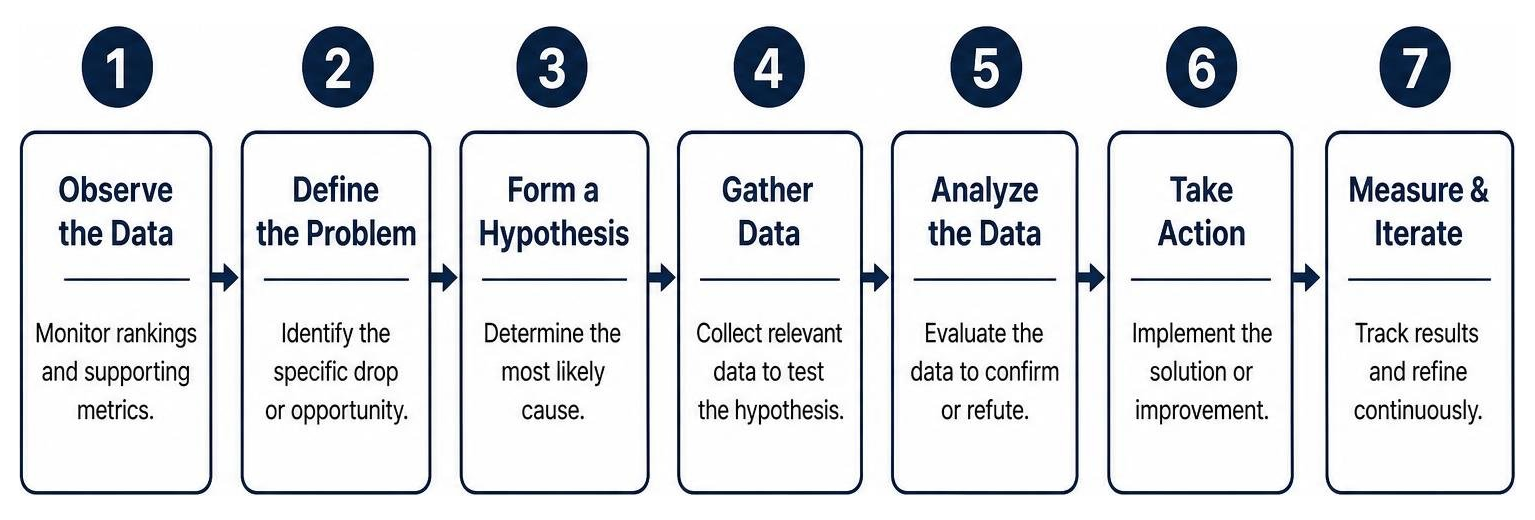
Many business owners make the mistake of tracking their rankings, seeing a drop or a rise, and simply reacting emotionally. To build real, sustainable growth, you need to treat your SEO ranking data like a science.
By shifting to a data-first mindset, you can solve search visibility issues systematically. If you want to see how a professional agency handles this process, you can explore how to Boost Your Business with Expert SEO Chicago Services to get a sense of how data translates into actual phone calls and customer inquiries.
When you notice a shift in your rankings, use this structured, 7-step scientific framework to diagnose and solve the issue:
Essential Metrics to Monitor Beyond Average Position
While knowing your average keyword position is helpful, it doesn’t tell the whole story. To truly understand how your search presence is performing, you must track these supporting metrics:
- Impressions: A rise in impressions often happens before a rise in clicks. It means your optimization efforts are working, and your pages are starting to show up for more search queries.
- Click-Through Rate (CTR): If you rank #2 for a keyword but your CTR is only 1%, your title tag or meta description might be boring or irrelevant to the searcher. Optimizing these elements can double your traffic without even changing your rank.
- Organic Conversions: At the end of the day, traffic is useless if it doesn’t turn into business. You must track how many organic visitors are filling out your contact forms, calling your office, or making purchases.
- Core Web Vitals: Google monitors how real users experience your site’s performance. Keep an eye on your page loading speeds and visual stability to ensure a poor user experience isn’t dragging down your rankings.
How to Improve My Website Google Ranking with Data-Driven Strategies
Once you have gathered your ranking data, you can implement targeted strategies to climb the search results:
- Identify Content Gaps: Compare your top-performing pages with those of your competitors. Are they covering subtopics that you missed? Adding comprehensive, high-quality sections to your existing pages can quickly push you up the rankings.
- Optimize with TF*IDF: Use term frequency-inverse document frequency (TF*IDF) analysis to understand which related terms and synonyms top-ranking pages use. This helps you write more naturally comprehensive content that aligns with Google’s understanding of the topic.
- Fix Technical Roadblocks: Run regular site scans to catch issues like duplicate title tags, missing image alt text, and broken links. Resolving these technical errors makes it easier for search engines to crawl and index your pages.
- Match Search Intent: Ensure your page directly matches what the user is looking for. If a user searches for “how to fix a leaky pipe,” they want an informational guide, not a sales pitch for plumbing services. Aligning your content with user intent dramatically improves your dwell time and rankings.
Frequently Asked Questions About Google Rankings
To help you navigate the complex world of search engine optimization, we have compiled answers to some of the most common questions small business owners ask about tracking and managing their Google positions.
How often should I check my website’s Google rankings?
For most small and medium-sized businesses, checking your keyword rankings once a week is the sweet spot.
Search engine results naturally fluctuate from day to day due to minor algorithm testing, user behavior, and localized search shifts. Checking your rankings daily can cause unnecessary panic over normal, temporary dips. Weekly checks allow you to see the broader trends while still giving you plenty of time to react to major algorithm updates or competitor moves.
What should I do if my website ranking suddenly drops?
If you notice a sudden drop in your search positions, do not panic. Follow these diagnostic steps:
- Check for Technical Issues: Use Google Search Console to see if Google has encountered any crawling or indexing errors on your site. Ensure your robots.txt file wasn’t accidentally updated to block search bots.
- Verify Site Security: Make sure your SSL certificate is active and your site hasn’t been compromised or hacked.
- Review Recent Updates: Did you recently redesign your site, change URL structures, or delete old pages? Missing redirect rules (301 redirects) are a very common cause of sudden ranking drops.
- Look for Algorithm Updates: Search industry news to see if Google rolled out a broad core algorithm update. If so, focus on improving your content depth and user experience to align with the new guidelines.
How can I use ranking data to create a better SEO strategy?
Your ranking data is a goldmine for business growth. Use it to:
- Identify “Low-Hanging Fruit”: Look for keywords where you currently rank on the second page (positions 11-20). With a few minor on-page tweaks, extra content depth, or a couple of local backlinks, you can easily push these keywords onto the first page, resulting in an immediate traffic boost.
- Build a Content Roadmap: Group your low-performing keywords and write dedicated, highly helpful blog posts or service pages to target them.
- Track Your ROI: By connecting your ranking tools with your lead-generation forms, you can see exactly which keywords are driving your most profitable customer calls, allowing you to focus your marketing budget where it matters most.
Conclusion
Finding and tracking my website Google ranking is the foundation of any successful online business strategy. Whether you monitor your positions through Google Search Console or use advanced third-party trackers, having clean, non-personalized data is what allows you to make smart, profitable marketing decisions.
At WWS (Wizerunek w Sieci), founded by Tomasz Lasota and headquartered at 636 S River Rd #218, Des Plaines, IL 60016, we know that small business owners don’t have hours to spend analyzing complex SEO software every day. You need a digital partner who can translate data into real-world results: more phone calls, more booked appointments, and steady business growth.
We specialize in custom web development, local and global SEO, and digital marketing tailored specifically for small and medium-sized businesses across the Chicago metropolitan area–including our vibrant Polish-American community (Polonia Chicago)–and clients nationwide. We treat your business as if it were our own, with meticulous attention to detail and a highly personalized approach.
Ready to see where your website truly stands and how you can climb to the top of Google’s search results?
Contact WWS today or visit wizerunekwsieci.com for a free, comprehensive website audit. Let’s work together to make your business the most visible option in your local market!
Explore more resources to grow your business: