





A citation audit finds every place your business name, address, and phone number appear online and corrects the versions that do not match. Before anything else, create one authoritative business record with your exact legal name, address, website, and main category, then scan your core listings against it to see where the mismatches start.
TL;DR:
- Consistent NAP information is crucial because mismatches can cause search engines to see multiple businesses or rank them lower, especially with duplicate profiles violating Google’s policy.
- Conducting a thorough citation audit involves preparing an authoritative record, discovering all existing listings, verifying their accuracy, fixing errors, and regularly monitoring for new discrepancies.
- Fixing the primary Google Business Profile and major data aggregators first ensures the most significant search visibility, with attention to common issues like outdated numbers and conflicting categories.
- Hand audit processes can take hours for single locations, but outsourcing to a certified team offers ongoing monitoring, correction submission, and documentation, especially for multiple or rebranded locations.
- Most businesses are surprised to find numerous outdated or duplicate listings created years earlier, underscoring the importance of regular citation checks, ideally every three to six months.
Table of Contents
- What citations and NAP consistency really mean
- The step-by-step citation audit workflow
- Tools, resources, and a spreadsheet checklist
- Which fixes to prioritize first
- When an in-house certified team makes sense
- What surprises most business owners about their own listings
- How we handle citation audits for Chicago-area businesses
- FAQ
- Sources
What citations and NAP consistency really mean
A citation is any online mention of your business’s name, address, and phone number, usually abbreviated as NAP. These mentions show up on directories, review sites, social platforms, and industry-specific listings, and each one tells Google something about where you operate and whether you are legitimate.
When your NAP varies from one listing to the next, search engines may read those entries as two different businesses instead of one. That split dilutes the trust signals your real listing has earned, and NAP consistency is treated as a meaningful ranking factor for exactly this reason.
Google’s own policy backs this up. The company allows only one Business Profile per location, and duplicate profiles violate that policy, which can get one or both versions excluded from Search or Maps entirely. A few common triggers for duplicates and mismatches:
- Moving locations without updating every directory that lists the old address.
- Changing phone numbers or area codes and forgetting legacy listings.
- Using different name formats (with or without “LLC,” abbreviations, suite numbers).
- Staff creating a second profile instead of claiming the existing one.
The step-by-step citation audit workflow
Running a citation audit is a sequence, not a single task. Skipping the preparation step is the most common reason audits run long and still miss errors.
- Prepare your authoritative record. Write down the exact business name, address format, phone number, website URL, and primary category you want to appear everywhere. This becomes your master reference for every comparison you make.
- Discover existing citations. Search your business name and old addresses, check your Google Business Profile, and look across major data aggregators, general directories, and niche industry sites. Include any press mentions or local articles that list your contact details.
- Verify and classify each listing. Sort what you find into three buckets: simple typos, conflicting information (wrong phone, old suite number), and outright duplicates. This step is where finding every NAP variation before making changes pays off, since it keeps you from creating new duplicates while fixing old ones.
- Fix what you find. Claim unclaimed listings, submit correction requests through each platform’s edit tools, and request merges for duplicates. Keep a record of submission dates and confirmation emails since some directories take weeks to process changes.
- Monitor going forward. Set a recurring reminder, quarterly for most single-location businesses, to repeat a lighter version of this process. New directories and data aggregators scrape and republish information constantly, so errors reappear even after a clean audit.
Pro Tip: Screenshot every listing before and after you request a correction. Directories occasionally revert edits during data refreshes, and a screenshot saves you from redoing verification work.
Tools, resources, and a spreadsheet checklist
You do not need expensive software to start a citation audit. Manual search, aggregator lookups (the big data providers that feed smaller directories), and dedicated citation-scanning tools each serve a different stage. Manual search catches niche sites that scanning tools miss; aggregator lookups fix the sources that feed dozens of smaller listings at once; paid scanning tools save time once you manage more than one location.
Build your audit in a spreadsheet with one row per listing and these columns:
- Business name exactly as it appears on that listing.
- Full formatted address as shown.
- Phone number as shown.
- Listing URL and site name.
- Current status (correct, typo, conflict, duplicate, unclaimed).
- Required action and the date you submitted it.
For a single-location business, a thorough manual audit of major listings and top directories commonly takes several hours to complete, and paid tools or agency services cut that time significantly for multi-location businesses. Quality matters more than volume: the exact number of citations a healthy profile needs varies by industry, so chasing a specific count matters less than making sure the listings you already have are accurate.
Which fixes to prioritize first
Not every incorrect listing deserves the same urgency. Fix your Google Business Profile first, since it carries the most search visibility, then move to major data aggregators that feed dozens of smaller sites, and finish with secondary directories and niche listings.
Watch for these recurring issues as you work through your list:
- Inconsistent punctuation or abbreviations (Street vs. St., Suite vs. Ste.).
- Old phone numbers left live on directories you forgot you claimed.
- Multiple verified Google profiles for the same address.
- Wrong primary category, which can hurt relevance even when the NAP is correct.
Pro Tip: If you find two verified Google profiles for the same location, request a merge through Google’s support process rather than deleting one yourself. A self-deletion can wipe out reviews tied to that listing.
When a directory’s self-service edit tool will not resolve a conflict, or when Google flags a profile for re-verification after you change a phone number or move locations, escalate to that platform’s direct support channel instead of resubmitting the same edit repeatedly.
When an in-house certified team makes sense
Our team operates as an official Google and Meta Partner, and every person on staff is Google and Facebook certified. We have handled this work across many client partnerships, which gives us a practical sense of where citation errors tend to hide across different industries and directory types.
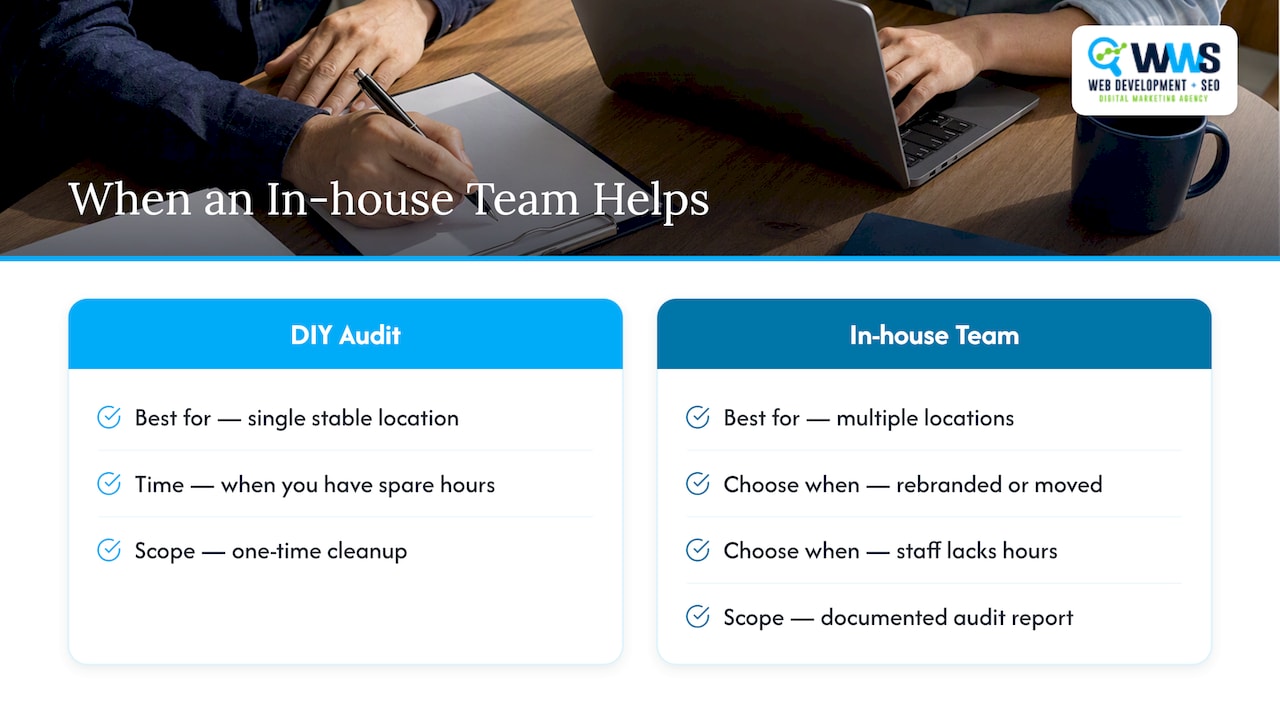
A do-it-yourself audit works well for a single, stable location with time to spare. Hiring help makes more sense when you manage multiple locations, you just rebranded or moved, or your staff simply does not have the hours to track down dozens of listings. When we take this on, the scope includes a documented audit report, submitted corrections with proof of completion, and ongoing monitoring instead of a one-time cleanup.
What surprises most business owners about their own listings
The biggest surprise in almost every audit we run is how many duplicate or outdated listings a business never knew existed, often created years earlier by a data aggregator scrape that nobody authorized. Quarterly or biannual checks catch these before they compound. Our honest take: build a citation check into your routine marketing review the same way you check your website analytics, not as a separate emergency project.
— Online Marketing Experts
How we handle citation audits for Chicago-area businesses
Cleaning up citations by hand works, but it takes hours you may not have, and the errors creep back if nobody is watching. We run the audit, submit the corrections, and document every fix so you have proof of what changed and when.
Here is what a managed engagement with us typically includes:
- A full discovery scan across major aggregators, directories, and your Google Business Profile.
- Corrections submitted and tracked until each listing matches your authoritative record.
- Ongoing monitoring so new duplicates get caught before they affect your visibility.
This fits well if you run multiple locations, just moved or rebranded, or simply do not have staff hours to chase down listings one by one. If that sounds like where you are, our Local SEO service page covers how citation audits and GBP management fit into a broader local visibility plan, and you can reach out anytime to get a scoped quote for your business.
FAQ
Is 40 citations a lot for a local business?
It depends on your industry and market, since citation counts that matter vary by vertical rather than following one fixed number. Quality and consistency across the citations you have matter more than hitting a specific count.
What are the main things a citation audit must check?
A thorough audit checks your business name, address, phone number, website URL, and primary category on every listing you can find. These are the core fields that make up your NAP consistency, and mismatches in any of them can confuse search engines about which listing is accurate.
Is having a citation good or bad for my business?
An accurate, consistent citation is good for your business since it reinforces your location and legitimacy to search engines. An inconsistent or duplicate citation can work against you, since Google may read it as a separate business and exclude one version from Search or Maps.
What are the main types of citations I should know about?
Citations generally fall into structured listings (directories with defined name, address, and phone fields), unstructured mentions (articles or blog posts that reference your business), aggregator-fed listings (data that feeds many smaller sites at once), and your Google Business Profile, which carries outsized weight in local search.
How often should I re-check my business citations?
Most single-location businesses do well with a quarterly or biannual check, since citation management works best as ongoing maintenance rather than a one-time project. Multi-location businesses or those who recently moved should check sooner and more often.
Sources
- Resolve duplicate profiles & ownership issues – Google Business Profile Help
- What is NAP in Local SEO? – Moz
- Local citations for SEO – Fit Small Business