


Google Maps ranks local businesses on three things: how well your profile matches the search (relevance), how far you are from the searcher (distance), and how well known you are (prominence). You cannot change distance, and you cannot pay for a better position. You can change relevance and prominence, and that is where almost every ranking gain comes from. This guide explains each factor, which Business Profile fields and habits feed it, and what a Chicago-area service business should fix first.
TL;DR
- Google’s own documentation says local results rest mainly on relevance, distance and prominence, and there is no paid way to request a better ranking.
- Relevance is the fastest to improve: correct primary category, complete services, an honest business name and a description that matches what people search.
- Prominence is built slowly through reviews, mentions and links across the web. Steady review volume matters more than a one-time burst.
- Distance is fixed by your address or service area, so your job is to be the most relevant and trusted option within the radius you can actually serve.
- A perfect 5.0 is not the goal. A rating in the 4.3 to 4.7 range with fresh reviews tends to earn more trust.
Table of Contents
- How Google decides who appears on the map
- Relevance: make your profile match the search
- Distance: the factor you cannot edit
- Prominence: reviews, links and your footprint
- What weighs most? A realistic view
- A 30-day action plan for a service business
- Mistakes that cost Chicago-area businesses rankings
- Our perspective: rankings follow trust you can prove
- Need help with your Maps ranking?
- FAQ
- Sources
How Google decides who appears on the map
When someone searches for “roofer” or “Italian restaurant” on a phone, Google returns local results in Maps and in Search. Google’s Business Profile help page describes the same three inputs for every one of those searches:
| Factor | What Google looks at | Can you influence it? |
|---|---|---|
| Relevance | How well your profile matches what the person typed | Yes, directly |
| Distance | How far you are from the searcher or the location named in the search | Only indirectly |
| Prominence | How well known you are, using information from across the web such as links, articles and reviews | Yes, over months |
The three factors are weighed together, which explains something owners find frustrating: a competitor who is farther away can outrank you if their profile is more relevant and better established. It also explains why you can rank first for a search made from your own block and nowhere for the same search made from the next suburb.
Relevance: make your profile match the search
Relevance is about fit. If a homeowner in Naperville searches “emergency roof repair,” Google looks for profiles that clearly say they do emergency roof repair. Vague profiles lose to specific ones.
Choose the right primary category
The primary category is the single strongest statement you make about what you are. A roofing company should choose a roofing category as primary, not a general contractor category because it sounds broader. Add secondary categories only for services you genuinely sell, such as siding or gutter work. Padding the list with loosely related categories dilutes the match.
Fill in services, products and description
List every service you perform, using the words customers use. A dentist should list dental implants, emergency visits and teeth whitening as separate services rather than one line saying “general dentistry.” A restaurant should keep its menu, hours and attributes current. Search Engine Land’s local pack guide notes that most of what Google shows in each pack comes straight from the business’s Google Business Profile, so incomplete fields are missed chances to match a query.
Keep your business name honest
It is tempting to add “Best Chicago Water Damage Restoration” to your name. Google’s guidelines say the name should reflect your real-world name as used on your storefront, website and stationery, and extra keywords can get a profile suspended. A suspension costs far more than the keyword ever gained. Put your keywords in services, description and website copy instead.
Connect the profile to a website that backs it up
Your website supports relevance by confirming what the profile claims. Give each core service its own page, mention the cities you serve, and keep your name, address and phone number identical everywhere. If your site is thin or slow, it undercuts the profile. For ideas on what makes a service-business site convert once visitors arrive, see these website design trends that drive better leads. If you want a deeper walkthrough of how the profile and site work together, our guide to Google My Business website SEO covers it step by step.
Distance: the factor you cannot edit
Distance is measured between the searcher (or the location they typed) and your business location. You cannot move closer to a customer, but you can avoid common mistakes.
- Use your real address. Virtual offices and fake addresses are against guidelines and are a common cause of suspensions.
- Set service areas accurately if you travel to customers. Plumbers, electricians and restoration crews often hide their address and list the areas they serve. Google caps how many service areas you can list, so choose the places you truly cover. We explain the limit in our piece on the 20 service area limit.
- Expect uneven results across a metro. In an area as large as Chicagoland, a Des Plaines business may lead near its office and fall behind in Orland Park. That is normal, not a penalty. If you need to compete in a distant suburb, the answer is usually a real location there, not a trick.
- Remember “near me.” Those searches lean heavily on proximity. Our near me optimization playbook maps tactics to the signals Google uses.
Prominence: reviews, links and your footprint
Prominence is how well known and trusted you are, and it is built from signals outside your profile. Google says it draws on information from across the web, including links, articles and reviews.
Reviews: quantity, rating and recency
Google states that more reviews and positive ratings can help your local ranking. Industry write-ups also list review quantity, rating and recency as the signals involved, as in this review benchmark overview. Three practical points follow:
- Ask every customer, every time. Build the request into the job: a text message with a direct review link sent the day the work is finished.
- Keep the pace steady. A consistent, natural flow of reviews is safer than a sudden spike, which can look unnatural and may trigger filters, according to one review management playbook. Three or four new reviews a month, all year, beats forty in one week and none afterward.
- Respond to all of them. Reply to praise briefly and to complaints calmly, with facts and an offer to resolve it offline. Responses show prospects you are active.
Never buy reviews, offer discounts for them or filter who you ask. Those practices break Google’s policies and put the whole profile at risk.
Is 4.7 a good Google rating?
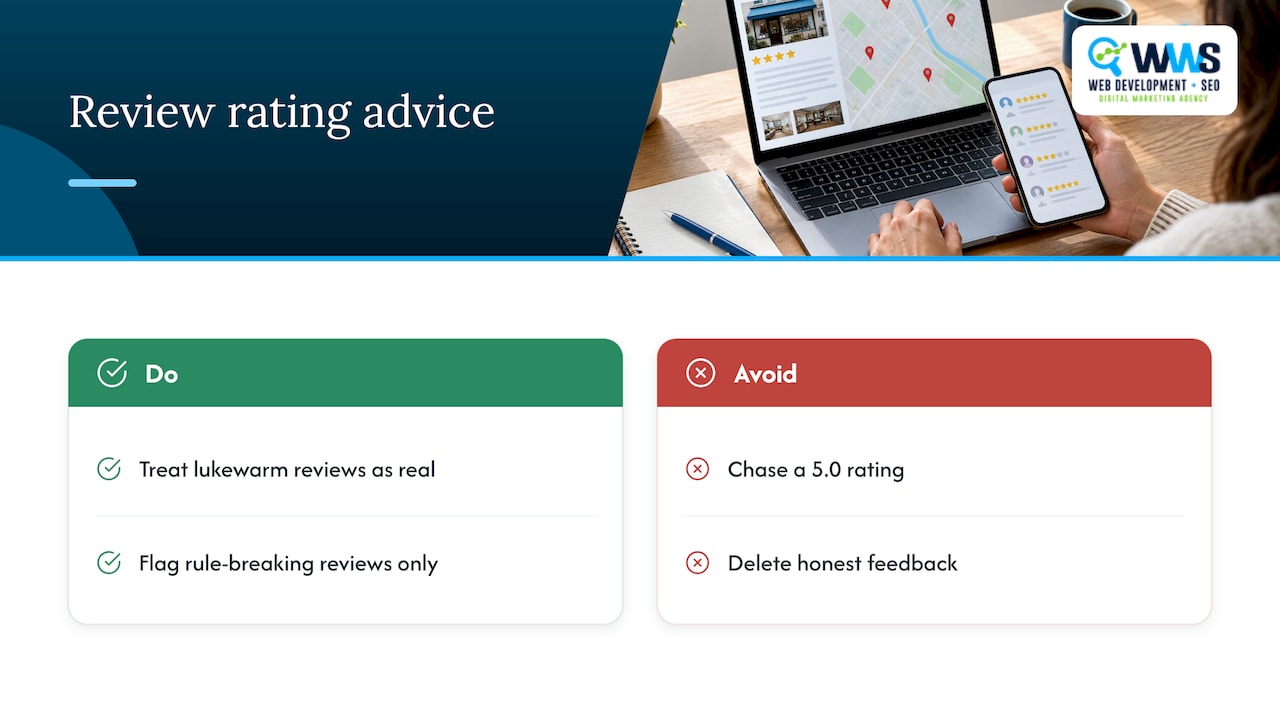
Yes. One 2026 analysis reports that trust and click-through peak between 4.3 and 4.7 stars, and that 46% of consumers in 2025 distrusted perfect ratings. Treat a few lukewarm reviews as proof that real customers wrote them. Do not chase 5.0, and do not delete honest feedback you disagree with. Flag only what truly violates Google’s rules, such as spam, fake reviews or off-topic content.
Links, mentions and citations
Links from local news, chambers of commerce, suppliers, manufacturers you install for and community sponsorships tell Google you are a real, established business. Listings in directories matter mostly for consistency: the same name, address and phone number everywhere. Inconsistent details create doubt and send customers to the wrong number.
Activity on the profile
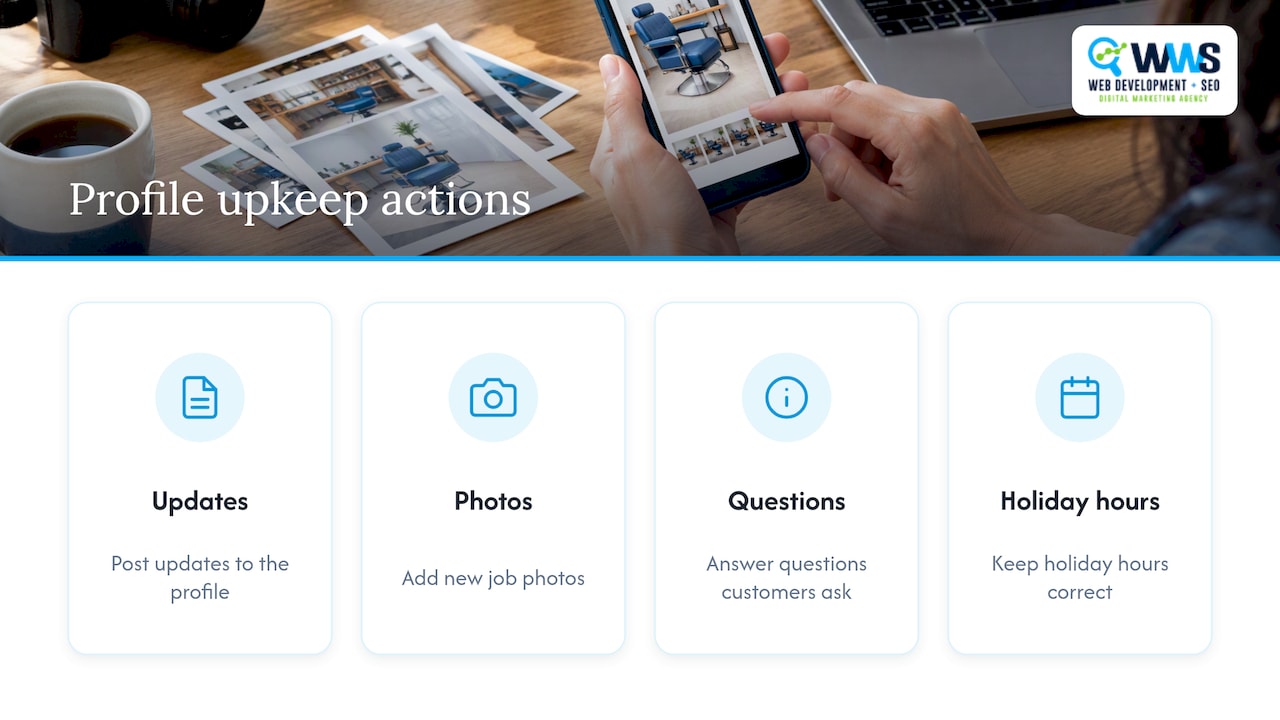
One 2026 compliance guide argues that frequent Q&A updates and timely review responses are now treated as ranking signals. Treat that as a trend reported by one source, not a confirmed rule. Either way, the habit is cheap and useful: post updates, add new job photos, answer questions that customers ask, and keep holiday hours correct.
What weighs most? A realistic view
No one outside Google knows the exact weights, and surveys of local SEO professionals are opinion, not proof. Google itself publishes only the three-factor framework. What practitioners broadly agree on, and what matches our own client work, is this order of attack:
- Fix anything that could get you suspended (name, address, categories).
- Complete every relevant field and match services to real searches.
- Build a steady review habit.
- Strengthen the website and local mentions that support the profile.
- Maintain it monthly.
Treat any article that promises a secret ranking trick with suspicion. Google’s help page says plainly that there is no way to pay for a better local ranking.
A 30-day action plan for a service business
Week 1: audit and fix the basics
- Confirm your primary category and remove categories you do not need.
- Check name, address, phone and website against what appears on your site and top directories.
- Verify service areas and hours.
Week 2: expand the profile
- Add every service with a plain description.
- Upload recent photos of real jobs, your team and your vehicles or storefront.
- Write a description that states what you do, where, and what makes you different, without stuffing keywords.
Week 3: start the review engine
- Create a short review link and a text template.
- Assign someone to send it after each completed job.
- Reply to every existing review you have not answered.
Week 4: connect the web footprint
- Make sure each service has a page on your site that mentions your cities.
- Ask two or three local partners for a link or mention.
- Set a monthly reminder to post, add photos and check the profile for edits made by others.
For a longer list, our local SEO checklist breaks the work into tasks, and the map pack mastery guide goes deeper on the three-result pack.
Mistakes that cost Chicago-area businesses rankings
- Keyword-stuffed names. Short-term bump, long-term suspension risk.
- Multiple profiles for one location. Duplicates split reviews and confuse Google.
- Listing a home address publicly when you serve customers at their homes. Hide it and use service areas instead.
- Ignoring edits. Others can suggest changes to your profile. Check it regularly so your phone number or hours are not altered.
- Treating the profile as separate from the website. The two should say the same thing.
- Stopping after launch. Competitors keep collecting reviews while you pause.
Our perspective: rankings follow trust you can prove
We work with contractors, restaurants, dental practices and other service businesses across Chicagoland, and the pattern repeats. The businesses that win the map are rarely the ones with a clever trick. They are the ones that did the unglamorous work for a year: accurate profile, a site that matches it, and a steady line of real customers leaving real reviews.
Our team is made up of Google and Facebook certified specialists, and we handle design, programming and SEO in-house, so the person fixing your profile is working from the same plan as the person building your service pages. That matters for maps, because relevance depends on the profile, website and citations all telling one consistent story. If one of them is built by one vendor and another by someone else, details drift.
Our advice to owners is to measure calls, not just positions. A map ranking is useful only if the phone rings. Track calls from the profile, direction requests and form submissions, and judge any SEO work by those numbers.
— Online Marketing Experts
Need help with your Maps ranking?
If you would rather hand this work to a team, our Local SEO service covers Google Business Profile optimization, citations, content and ongoing ranking management for service businesses around Des Plaines and greater Chicago. Where the website itself is holding you back, our website design and hosting team builds fast service-focused sites. You can also review our Google Business Profile optimization page, or contact us through our site for a conversation about your market.
FAQ
What are the ranking factors for Google Maps?
Google names three: relevance, distance and prominence. Relevance is how well your profile matches the search, distance is how far you are from the searcher, and prominence is how well known you are across the web. Reviews, links and articles feed prominence, while categories, services and descriptions feed relevance.
How do I rank higher on Google Maps?
Start with an accurate primary category, a complete list of services and an honest business name. Then build a steady flow of genuine reviews and reply to each one. Keep your name, address and phone number identical across your site and directories, and update photos and hours regularly.
Can I pay Google to rank higher in Maps?
No. Google says there is no paid way to request a better local ranking. Paid ads can appear separately, but the organic map results depend on relevance, distance and prominence.
Is 4.7 a good Google rating?
Yes. Analyses of consumer behavior put the sweet spot for trust and clicks between 4.3 and 4.7 stars, and many shoppers distrust a perfect 5.0. Recent reviews and written replies matter as much as the number itself.
Sources
- Tips to improve your local ranking on Google, Google Business Profile Help
- What Is the Google Local Pack? Search Engine Land
- GBP Reviews Management: The Operational Playbook
- Google Review Statistics, Feedback Guru
- The 4.7-Star Sweet Spot, Smart Process AI
- 2026 Google Business Profile Compliance Guide, The WebConcepts Technologies