



Why the Google Business Profile Map Pack Is the Most Valuable Real Estate in Local Search
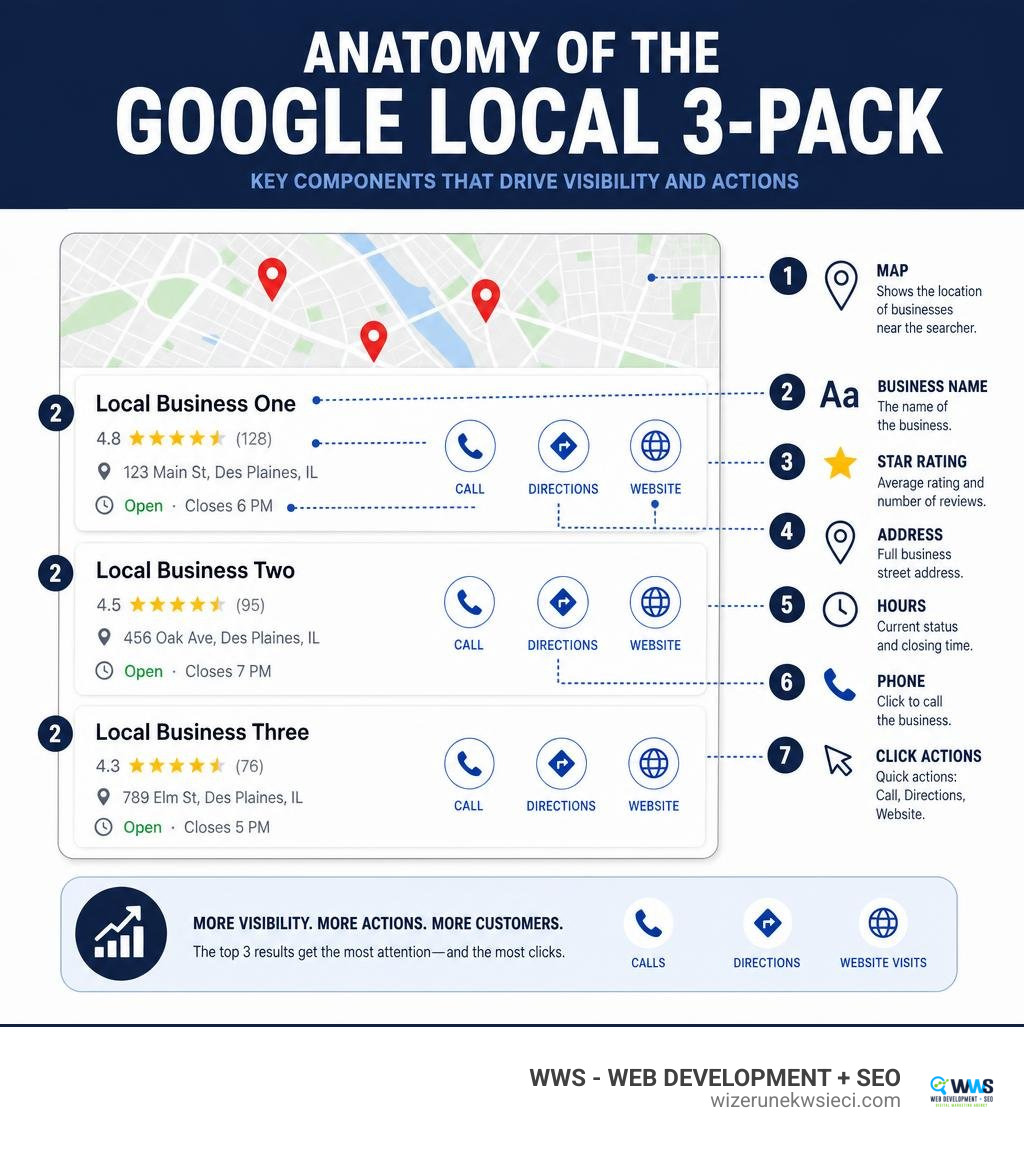
The Google Business Profile Map Pack — also called the Local 3-Pack — is the block of three local business listings that appears at the very top of Google search results when someone searches for a nearby service. It shows your business name, star rating, address, phone number, hours, and photos, all before a single organic result appears.
If your business isn’t in those three spots, here’s what you’re missing:
- 42–44% of all clicks on local search results go to Map Pack listings
- Businesses in the 3-Pack receive 93% more actions (calls, website visits, direction requests) than businesses ranked below it
- Being in the Map Pack correlates with a 126% increase in traffic compared to non-pack listings
- 46% of all Google searches have local intent — meaning millions of searches every day trigger the Map Pack
The stakes are real. Position 4 and below? According to industry data, that’s roughly a 7x drop in lead volume compared to holding a top-3 spot.
Nearly 90% of consumers use Google Maps to find local businesses. On mobile — where most local searches now happen — the Map Pack dominates the entire screen. If you’re not there, your competitors are.
I’m Tomasz Lasota, founder of WWS — Web Development + SEO in Des Plaines, IL, and over 22 years of hands-on digital marketing work — including optimizing hundreds of Google Business Profile Map Pack listings for small businesses across the Chicago area — has shown me exactly what works and what doesn’t. In this guide, I’ll walk you through every step to get your business into those coveted top-3 spots and keep it there.
What is the Google Business Profile Map Pack and Why It Matters
To survive and thrive in 2026, local business owners must treat the google business profile map pack as their primary digital storefront. When a homeowner in Niles, IL searches for “emergency plumber” or a family in Schaumburg, IL looks for “best dental clinic,” Google doesn’t just hand them a list of blue website links. It gives them a map populated with three local options.
This is the Local 3-Pack. It is highly visual, displays immediate trust signals like star ratings, and offers one-tap buttons to call, get directions, or visit your website. Because Google limits the preview display to just three businesses—due to mobile screen constraints—the competition for these spots is fierce.
Historically, Google displayed a “7-Pack,” but the shift to mobile-first indexing forced a reduction to three. If you are sitting at spot number four, you are effectively invisible to over 80% of searchers. This is why mastering local SEO is no longer optional; it is the absolute frontline of customer acquisition.
Our team at WWS (Wizerunek w Sieci) has helped local service providers across Cook County and Chicagoland make this jump. We’ve seen businesses go from struggling to pay their bills to having fully booked calendars simply by moving from position #9 to the top 3. For a step-by-step technical breakdown of getting started, you can also read this excellent resource on How to Get Into the Google Map Pack: A Step-by-Step Guide | MooseBase Blog .
How Google Determines Rankings in the Google Business Profile Map Pack
Many business owners believe that appearing in the Map Pack is either random or strictly based on how long you have been in business. This is a myth. Google’s local algorithm is a highly structured system designed to deliver the most helpful, trustworthy, and closest results to the user.
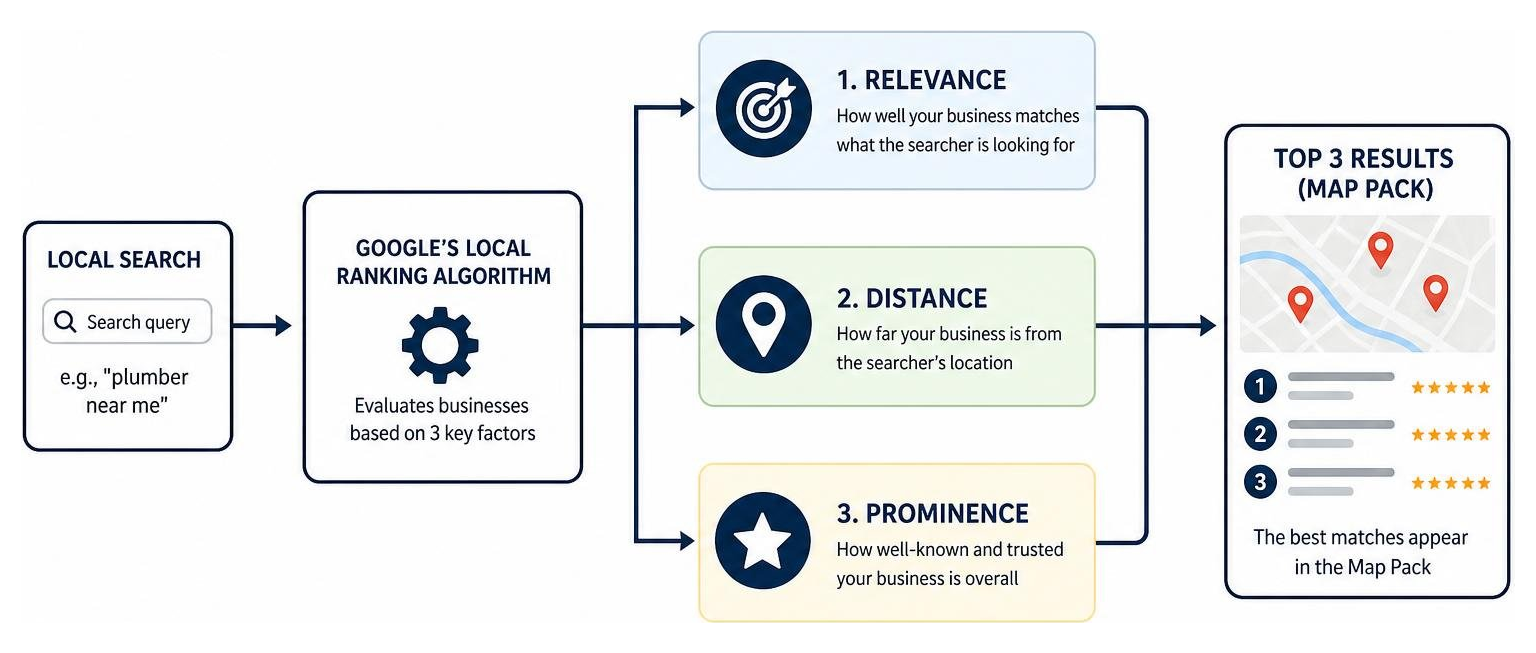
Google officially states that local rankings are determined by three primary pillars: Relevance, Distance, and Prominence. There is no option to pay Google to rank higher organically in these three spots (though sponsored local ads can sometimes appear above them). Understanding how these three forces interact is the secret to map pack mastery. To dive deeper into the local landscape and find agency support, check out our guide on Chicago SEO agencies.
Optimizing Relevance for the Google Business Profile Map Pack
Relevance is how well a local business profile matches what a user is searching for. If someone searches for “Polish-speaking accountant in Des Plaines,” Google scans its database to find profiles that explicitly prove they fit that exact query.
To maximize your relevance:
- Align your categories perfectly: Your primary category is the single most important ranking factor on Google Maps. It must match your core business offering.
- Optimize your business description: You have 750 characters to describe your business. Use this space to naturally mention your primary services and target neighborhoods (like Arlington Heights, Mount Prospect, or Glenview) without keyword stuffing.
- Build out your services list: Explicitly list every service you offer. If you are a general contractor in Park Ridge, IL, do not just write “Contractor.” Add sub-services like “kitchen remodeling,” “deck building,” and “bathroom tiling.”
Google’s official guidelines offer excellent Tips to improve your local ranking on Google , emphasizing the importance of detailed, complete information.
Distance: Proximity and the S2 Cell Selection Process
Distance measures how far a potential business is from the geographic location term used in a search, or from the user’s physical device location if they search for something “near me.”
Behind the scenes, Google’s algorithm divides the physical world into mathematical grid cells called S2 cells. When a search is performed, Google identifies the S2 cell of the user and pulls a candidate pool of businesses within or adjacent to that cell.
This means that a business located in Rosemont, IL has a massive natural advantage for searches occurring in Rosemont, but may struggle to rank in Evanston, IL without strong prominence signals. While you cannot change your physical address, you can optimize your “Service Areas” in your profile to cover up to a 2-hour driving radius (up to 20 cities, counties, or zip codes) if you operate as a service-area business (SAB) rather than a brick-and-mortar storefront.
Prominence: Building Authority and Trust
Prominence is about how well-known and reputable your business is in both the real world and the digital world. This is the factor where you have the most control and where WWS can help you outshine your competitors.
Google measures prominence using:
- Your website’s organic SEO strength: If your website ranks high in traditional search results, your Map Pack ranking will follow.
- Local backlinks and web mentions: Links from local organizations, such as the Des Plaines Chamber of Commerce, local blogs, and community sponsorships in Chicagoland, signal to Google that you are a trusted local fixture.
- Review signals: The volume, frequency, and semantic quality of your customer reviews tell Google whether you are actively providing a great experience.
Step-by-Step Guide to Optimizing Your Google Business Profile
Now that you understand the algorithm, let’s roll up our sleeves and optimize your profile step-by-step. A fully complete and optimized profile makes your business 2.7 times more reputable to customers, which directly translates into higher conversion rates.

Claiming and Verifying Your Listing
If you haven’t already, you must claim your free business listing. Go to the Get Listed on Google – Google Business Profile page to start the process.
Google will require you to verify your business. This is usually done via a postcard sent to your physical address, a phone call, or a video verification showing your physical location, tools, and business registration. If you have multiple physical locations across the Chicago suburbs (such as Arlington Heights, Schaumburg, and Naperville), you can manage them collectively using the Google business locations page .
Note: Avoid using P.O. boxes, UPS Store addresses, or co-working spaces where you do not have dedicated, branded office space. Google’s spam filters are incredibly sensitive in 2026, and using these addresses will result in immediate suspension.
Selecting Categories for the Google Business Profile Map Pack
Choosing the right categories is where many small business owners make critical mistakes. Google offers nearly 4,000 business categories, and you can select one primary category and up to nine secondary categories.
- Your Primary Category should be the most specific description of your core business. If you run a Polish bakery in Chicago, do not just select “Store.” Select “Bakery” or “Polish Restaurant.”
- Your Secondary Categories should cover your adjacent services. For example, a heating contractor in Elk Grove Village, IL should set “HVAC Contractor” as their primary category, and use “Air Conditioning Repair Service” and “Furnace Repair Service” as secondary categories.
Never add irrelevant categories simply to get more search views. This dilutes your profile’s relevance and can trigger algorithmic penalties.
Leveraging Photos, Products, and Attributes
An empty profile is a dead profile. To stand out in the google business profile map pack, you need to feed Google’s search crawlers and human visitors with rich media and clear business attributes.
- High-Quality Photos: Businesses with optimized photo galleries receive 520% more calls than the average business. Aim to upload 20 to 30 high-quality photos initially. Include exterior shots of your office (to help clients find you in Des Plaines or Park Ridge), interior shots, photos of your team, and real action shots of your work. Add 10 new photos every month to show Google your business is active.
- Products and Services: Use the built-in product showcase to display your core offerings, even if you are a service-based business. Create visual “product” cards for your main services with clear descriptions and links back to your website.
- Attributes: Select all relevant attributes offered by Google. Let customers know if your business is “Women-led,” “Veteran-owned,” or offers “Wheelchair accessible seating.” These attributes help you show up in highly specific, filtered local searches.
The Role of Reviews, Citations, and NAP Consistency
Once your profile is optimized, your ongoing local SEO strategy must focus on three pillars of trust: Reviews, Citations, and NAP (Name, Address, Phone) consistency.
| Signal Type | Core Ranking Impact | Key Metrics to Track |
|---|---|---|
| Review Signals | High (15–20% of total weight) | Star rating, review velocity, reply rate, semantic keywords in review text |
| Citation & NAP Signals | Moderate to High (~16% of performance) | Consistency of business name, address, and local phone number across 50+ directories |
| On-Page Website Signals | High (~33% combined weight) | LocalBusiness schema, page speed, location-specific pages, embedded Google Maps |
Review Velocity, Quality, and Semantic Content
We cannot overstate the power of Google reviews. However, in 2026, Google’s algorithm has evolved. It is no longer just about having the most five-star ratings; the quality, velocity, and semantic content of those reviews are what truly move the needle.
- Avoid the “5.0-Star Trap”: A perfect 5.0 rating can actually look unnatural to Google and consumers. Studies show that 80% of consumers trust 4.5 to 4.9-star ratings the most. Don’t panic if you get a 4-star review; it adds authenticity to your profile.
- Review Velocity: Google values a steady, consistent stream of reviews over sudden bursts. Getting 20 reviews in one weekend and then zero for three months looks manipulative. Aim for a steady flow of 2 to 3 reviews per week.
- Semantic Matching: Encourage your clients to write detailed reviews. A review that says “Great job!” is nice. A review that says “WWS designed an amazing mobile-friendly website for our dental practice in Niles, IL and helped us rank on Google” is gold. Google’s AI reads these reviews to match your business with long-tail search queries.
- Review Responses: You must respond to every single review. 53% of customers expect a response within 7 days, yet 63% say they have never heard back from a business after leaving a review. Furthermore, 85% of consumers read business owners’ responses to negative reviews to judge their professionalism. Be polite, avoid arguments, and show Chicagoland that you care about customer experience.
Building Local Citations and Ensuring NAP Consistency
A citation is any online mention of your business’s Name, Address, and Phone number (NAP). Google uses these citations to verify that your business actually exists at the physical location you claim.
If your business is listed as “WWS — Web Development + SEO” on Google, but “Wizerunek w Sieci” on Yelp, and “WWS Web Design” on the YellowPages, Google’s algorithm gets confused. This inconsistency can impact your local site performance by up to 16%.
To dominate the google business profile map pack:
- Audit your current citations: Clean up any duplicate listings or incorrect phone numbers.
- Build Tier 1 citations: Ensure your business is listed on major platforms like Apple Maps, Bing Places, Yelp, and Facebook.
- Build local and industry-specific citations: Get listed on local Chicago business directories and industry directories (like Houzz for contractors or Avvo for lawyers).
- Deploy LocalBusiness Schema: Add structured schema markup to your website’s code. This tells search engines exactly what your NAP is in a language they understand. Learn more about how we implement this for our clients in our guide to expert SEO Chicago services.
Common Mistakes and How to Maintain Your Rankings Over Time
Getting into the Map Pack is a massive victory, but keeping your spot requires consistent effort. The local search landscape in Cook County and the surrounding suburbs is highly competitive, and other businesses are always trying to push you down.
Avoiding Common Pitfalls That Hurt Visibility
Many business owners inadvertently trigger Google filters that hide their profiles from search results. Here are the most common mistakes we see:
- Keyword Stuffing Your Business Name: If your legal business name is “Des Plaines Auto Repair,” do not name your Google profile “Des Plaines Auto Repair – Best Cheap Mechanic Chicago.” This is a direct violation of Google’s terms of service and can lead to immediate profile suspension.
- Ignoring Public Edits: Anyone can suggest an edit to your Google Business Profile, including your competitors. If a competitor suggests that your business is “permanently closed” or changes your website URL, and you do not reject the edit, Google may apply it automatically. Monitor your profile dashboard weekly.
- Duplicate Listings: Having multiple listings for the same physical business dilutes your ranking power and confuses Google. Consolidate or delete duplicates immediately.
If your listing is completely missing from local searches, you may be experiencing a technical issue or suspension. You can find community support and troubleshooting advice on the My business is not showing up in the local map pack – Google Help thread.
Using Geo-Grid Tracking and Local SEO Tools
Traditional rank trackers only check your rankings from a single geographic point (usually the center of your city). This gives you an incomplete picture. You might rank #1 when standing inside your office in Des Plaines, but drop to #12 when someone searches from Park Ridge, just two miles away.
To truly understand your visibility, we use geo-grid tracking. This tool displays your ranking on a visual map grid, showing exactly where your visibility is strong and where it drops off.
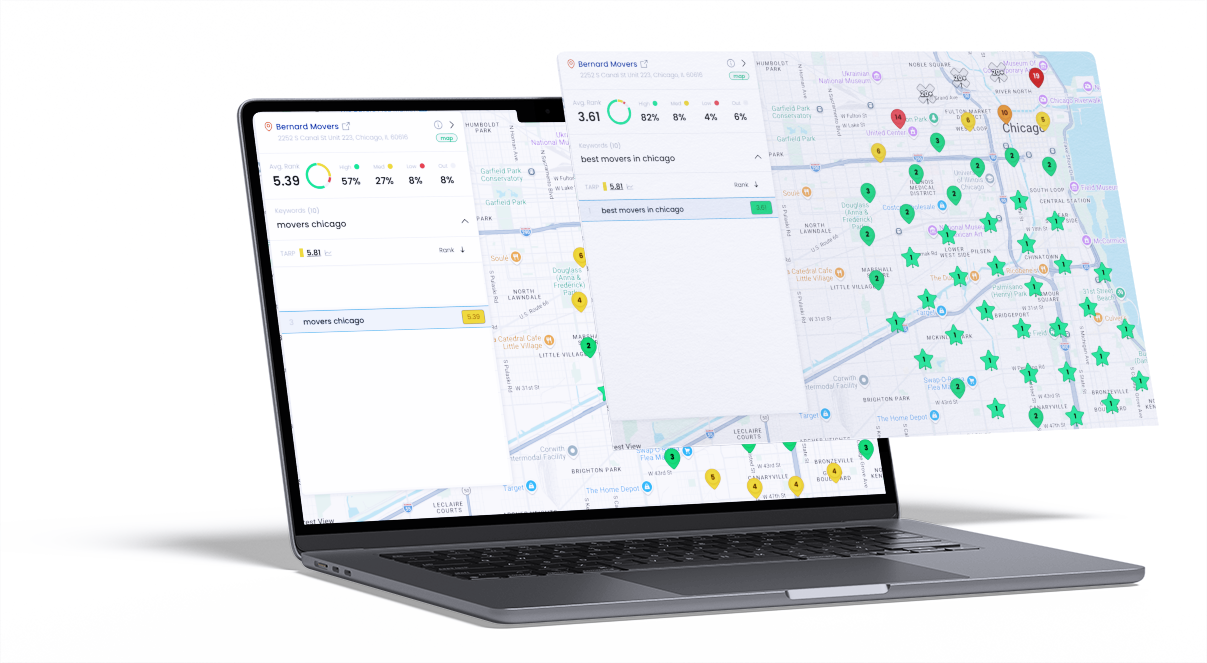
By analyzing these grids, we can identify specific S2 cells where your business is losing ground. We can then deploy localized content, targeted backlinks, and neighborhood-specific pages to expand your map pack reach.
Long-Term Strategies to Maintain Map Pack Dominance
Treat your Google Business Profile like a living marketing asset. To maintain your rankings:
- Publish Google Posts Weekly: Use Google Posts to share business updates, special offers, and blog articles. These function like social media updates directly on Google Search and keep your profile active.
- Update Your Hours Regularly: Ensure your operating hours are always accurate, especially during holidays. Google rewards businesses that keep their operational data fresh.
- Implement a Professional Website Strategy: Your website’s authority directly impacts your prominence. Ensure your site loads in under 3 seconds, is fully mobile-optimized, and features dedicated pages for the key cities you serve (like Arlington Heights, Schaumburg, or Naperville). Discover our customized local solutions in our SEO services packages Chicago page.
Frequently Asked Questions about the Google Business Profile Map Pack
Can I rank in the Map Pack without a physical storefront?
Yes! If you are a service-area business (SAB) — such as a plumber, electrician, or mobile locksmith — you can verify your profile using your home address and choose to hide your address from the public. Your profile will display a service area map instead of a specific pin.
While storefront businesses sometimes have a slight advantage for immediate “near me” searches, SABs can rank incredibly well in the google business profile map pack by building strong prominence signals and optimizing their service area settings.
Do paid Google Ads influence organic Map Pack rankings?
No. Google’s paid advertising platform and organic local search algorithms are completely separate. Running Google Ads or Local Service Ads will not directly boost your organic Map Pack rankings. However, a combined search strategy can create a powerful synergy—allowing you to capture both paid and organic real estate at the top of the search page.
How long does it take to rank in the local 3-pack?
The timeline depends heavily on your local market competition:
- Low Competition: If you are in a niche market or a smaller suburb, you can see significant ranking improvements within 1 to 3 months.
- Moderate Competition: For standard service industries in medium-sized suburbs (like Palatine or Mount Prospect), expect 3 to 6 months of consistent optimization.
- High Competition: In highly saturated markets (such as personal injury lawyers or HVAC contractors in downtown Chicago), achieving a top-3 spot can take 6 to 12+ months of aggressive local SEO and link building.
Conclusion
Mastering the google business profile map pack is the single fastest way to drive more phone calls, foot traffic, and revenue to your local business. By focusing on relevance, proximity, and prominence, and executing the optimization steps outlined in this guide, you can outshine your competitors and claim your spot in the coveted Local 3-Pack.
But you don’t have to navigate this journey alone. At WWS (Wizerunek w Sieci), based in Des Plaines, IL, we specialize in helping small and medium-sized businesses across the Chicago metropolitan area build high-ranking digital presences. Whether you want to target the local English-speaking market or connect deeply with the Polish-American community (Polonia Chicago), we treat your business with the personalized care and meticulous attention to detail it deserves.
Ready to dominate your local map? Contact us today for a free website audit and let’s put your business on the map.
- Visit our office: 636 S River Rd #218, Des Plaines, IL 60016
- Explore our services: Optimize your Google Business Profile with WWS