


Local SEO Strategy: A Step-by-Step Plan for Local Businesses
Build a local SEO strategy that brings in calls: Google Business Profile, local keywords, citations, reviews, tracking and a 90-day order of work.
 By WWS Team
12 min read

In this article16 sections
- TL;DR
- What a local SEO strategy actually is
- How Google decides who appears
- Step 1: Set up measurement before you touch anything
- Step 2: Fix the Google Business Profile fundamentals
- Step 3: Find the keywords local customers use
- Step 4: Build service and location pages that deserve to rank
- Step 5: Local SEO best practices for citations, reviews and links
- Step 6: Publish content with local substance
- A 90-day order of work
- Our perspective
- When it makes sense to bring in help
- Mistakes that stall local SEO
- FAQ
- Sources
- Recommended
A local SEO strategy is a written plan for getting your business to show up when people near you search for what you sell. It has two halves that work together: your Google Business Profile, which drives map and local pack visibility, and your website, which drives organic results. This guide gives you the order of work, the checks that matter, and how to tell whether it is paying off.
TL;DR
- Local SEO is two coordinated systems: map visibility through your Business Profile and organic visibility through your website. Neglecting either one costs you leads.
- Google says local results rest mainly on relevance, distance and prominence, so your plan should improve the first and third, since you cannot change the second.
- Measure before you change anything: save a baseline of calls, clicks, forms and booked jobs, then report weekly and monthly.
- Reviews, accurate business information and useful service and location pages are the repeatable work. Treat them as an ongoing process, not a one-time setup.
- Most service businesses can follow the 90-day sequence below, then keep running it.
What a local SEO strategy actually is
Local SEO is the practice of optimizing and promoting a business’s digital assets to increase visibility for searches tied to a particular geography, as Search Engine Land’s local SEO guide defines it. A strategy turns that definition into decisions: which services and areas you target, which assets you fix first, who owns each task, and which numbers tell you it works.
There are two places to win. Ahrefs explains that local search offers local pack listings and conventional organic results, and a business can rank in both. The practical takeaway is to treat the Business Profile and the website as one coordinated system. A strong profile pointing to a thin website leaks leads. A strong website with a neglected profile never reaches the map.
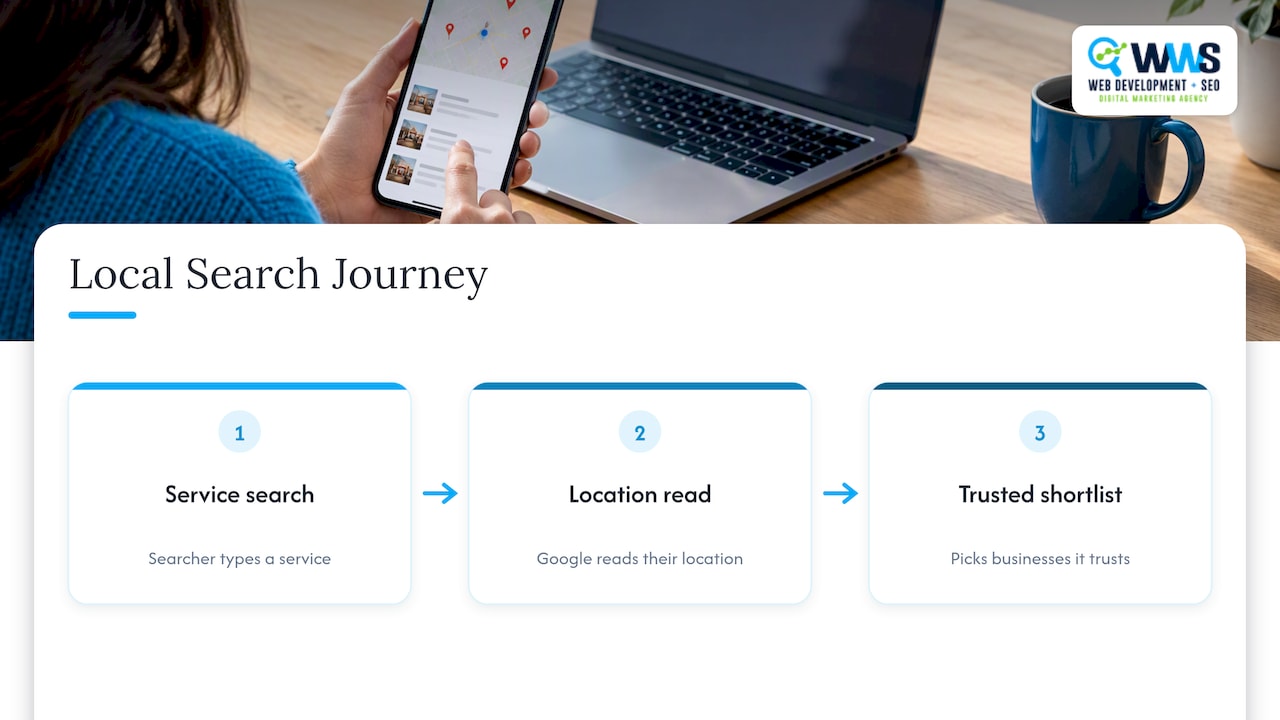
If you are a roofer in Schaumburg, a dentist in Naperville or a restaurant in Evanston, the same logic applies. The searcher types a service, Google reads their location, and then picks a short list of businesses it trusts to match.
How Google decides who appears
Google’s own guidance on local ranking says results are mainly based on three things:
| Factor | What it means | What you can do |
|---|---|---|
| Relevance | How well your profile matches the search | Complete, detailed business information, accurate categories and services |
| Distance | How far you are from the searcher | Nothing directly, but build service area and location pages that reflect where you really work |
| Prominence | How well known your business is | Reviews, quality links and citations, consistent mentions around the web |
Distance deserves a second look. Google measures it between the searcher and each business, and when the searcher does not state a location, Google estimates one from available information. That is why rankings differ from block to block and why a single rank-check from your office is misleading. Your strategy should aim to be relevant and prominent enough that you win in the neighborhoods you actually serve.
Our own deeper breakdown of this is in Google Maps ranking factors.
Step 1: Set up measurement before you touch anything
Most businesses start by changing things and only then wonder whether it worked. Reverse that. Search Engine Land’s 90-day plan for service businesses says measurement should come before optimization, and it recommends setting up:
- Google Analytics 4 and Search Console
- Business Profile Insights
- UTM-tagged links from your Business Profile to your website
- Call tracking, form tracking and booking tracking
- Weekly and monthly reporting
The same plan suggests saving a baseline first: Business Profile calls and website clicks, form submissions, booked jobs, and Search Console impressions and clicks for seven-day and 28-day periods. Put these in one spreadsheet. In three months, that sheet is the only honest answer to the question “is local SEO working?”
For a business with several locations, the same publication’s scalable local SEO guide recommends one measurement layer covering search views, direction requests, calls, conversions, review sentiment, listing health and entity consistency. One dashboard beats five disconnected ones.
Step 2: Fix the Google Business Profile fundamentals
The profile is usually the fastest lever. Google’s guidance says to verify the business, keep information complete and accurate, respond to reviews, and add photos and videos. Work through this list:
- Claim and verify the profile so you can edit it. Google may reject edits on unverified profiles, according to its policy overview.
- Use your real business name. Google expects merchants to accurately represent their identity, and its policy overview warns that attempts to significantly change a business’s nature can lead to rejection or removal. Do not add keywords to the name.
- Choose the right primary category, then add secondary categories that reflect services you really provide.
- List every service with a plain description. Relevance comes from detail.
- Set service areas honestly if you travel to customers. Our guide to Google Business Profile setup for service areas covers the details contractors tend to miss.
- Add real photos: your crew, trucks, finished jobs, storefront. Add them regularly.
- Keep hours, phone number and website current, including holiday hours.
This is the single most important profile; we explain the full process in our Google Business Profile optimization page and in the map pack guide.
Step 3: Find the keywords local customers use
Skip the guessing. Semrush’s local keyword research guide recommends starting with the words customers use in calls, chats, reviews, staff notes and community conversations, then adding service, problem, neighborhood, city, ZIP code and landmark terms. Validate each with Google results, Autocomplete, People Also Ask and competitor pages.
A caution from Search Engine Land’s local keyword guide: keyword tools often cannot report local search volume accurately, especially for smaller U.S. towns. Its advice is to research the core, unlocalized terms and add geographic modifiers when you map pages. In practice:
- Start with the service plus the problem (“water heater leaking”, “emergency roof repair”).
- Add the city or suburb (“Des Plaines”, “Orland Park”).
- Map one primary phrase to one page. Do not stuff five suburbs on a single page.
- Treat volume numbers as direction, not truth. A term with a handful of searches can still be the one that books a $9,000 job.
Step 4: Build service and location pages that deserve to rank
The website half of the strategy comes down to pages. For each core service, create a dedicated page. For each area you want to be known in, create a location page only if you have something real to say about it: jobs completed there, local regulations, neighborhood-specific issues, photos, reviews from customers there.
Each page should include:
- A clear headline with the service and place, written like a person would say it
- The business name, address and phone number matching your profile exactly
- Proof: project photos, certifications, review excerpts
- A visible phone number and a short form, since a visitor who cannot contact you quickly leaves
- An embedded map and internal links to related services
Speed and mobile layout matter as much as the words. Most local searches happen on phones, and a slow page costs calls. If your site needs a rebuild, our contractor website design guide covers the elements that turn clicks into calls, and the SEO-friendly website guide covers the technical side.
Step 5: Local SEO best practices for citations, reviews and links
These three build prominence. They are slower than profile edits but they separate the businesses that hold the top spots from those that flicker in and out.
Citations and business information
A citation is any mention of your name, address and phone number on another site. The rule is consistency: the same name, address, phone and website everywhere, from your own site to the major directories, industry directories and the Apple and Bing equivalents. Fix duplicates, and update every listing when you move or change your number. For Apple’s side, see our Apple Business Connect setup guide.
Prioritize quality over volume. A handful of accurate listings on major platforms and in your trade beats hundreds of junk directories.
Reviews
Reviews feed prominence and also persuade the person comparing three roofers on a phone. Build a habit:
- Ask every customer, right after the job, with a direct link to your review form.
- Reply to every review, positive or negative, promptly and politely.
- Never offer anything in exchange. Google’s prohibited and restricted content policy addresses fake and misleading content, and merchants who offer incentives or review-gate risk removed reviews or a restricted profile.
A simple tool can help you send requests consistently. See our free Google reviews app.
Local links
Links from local sources tell Google you are a real part of the community. Realistic sources for a Chicago-area business include:
- Chambers of commerce and business associations in your suburb
- Local sponsorships of youth teams, charity events and school programs
- Suppliers, manufacturers and trade associations that list certified installers
- Local news or neighborhood blogs when you have something worth reporting
Ask for links in the course of real relationships. Purchased link packages are a risk you do not need.
Step 6: Publish content with local substance
Localized content works when it answers questions your customers actually ask. A kitchen remodeler can write about permit steps in a specific municipality. An HVAC company can explain what a Chicago winter does to furnaces in older homes. A dentist can answer what implants involve and what to ask during a consultation.
Write from the call log: every question that comes up three times is an article or a service page FAQ. Add photos and a named author or technician, because specifics are what generic competitors cannot copy.
A 90-day order of work
The February 2026 Search Engine Land plan recommends tracking before changes, fixing Business Profile fundamentals, building useful service and location pages, collecting reviews consistently, and reporting results. BrightLocal’s local SEO guide lists six starting tasks: claim and optimize the profile, research keywords, study competitors, build local listings, obtain reviews and create localized content. Combined, a workable calendar looks like this:
| Period | Focus | Output |
|---|---|---|
| Weeks 1 to 2 | Measurement and baseline | Analytics, Search Console, call tracking, baseline spreadsheet |
| Weeks 2 to 4 | Business Profile | Verified profile, categories, services, photos, hours |
| Weeks 3 to 6 | Keywords and competitors | Keyword map, notes on who ranks and why |
| Weeks 4 to 8 | Website pages | Service pages, priority location pages, faster mobile experience |
| Weeks 5 to 10 | Citations and reviews | Consistent listings, a review request routine |
| Weeks 8 to 12 | Content and links | Local articles, two or three local link wins |
| Ongoing | Reporting | Weekly check, monthly summary, quarterly review |
BrightLocal’s sequence also presents local SEO as an operating process rather than a one-time setup, and that is the correct mindset. Rankings move as competitors change, so the review and reporting work never ends. For a printable version of the tasks, use our local SEO checklist.
Our perspective
We see the same pattern in Chicago-area businesses: owners buy a website and a profile as separate projects, then wonder why the phone is quiet. The site was built without the keyword map, and the profile points to a homepage that does not match the service the customer searched for. The fix is rarely exotic. It is joining the pieces and keeping them current.
Our team handles design, programming, SEO and local optimization in-house, so the person who finds the keyword is working alongside the person who builds the page. We work with over 200 client partnerships, mostly contractors, restaurants, medical providers and other service businesses, and the businesses that do best are the ones that treat local SEO as a weekly habit: answer reviews, update photos, publish a useful page, check the numbers.
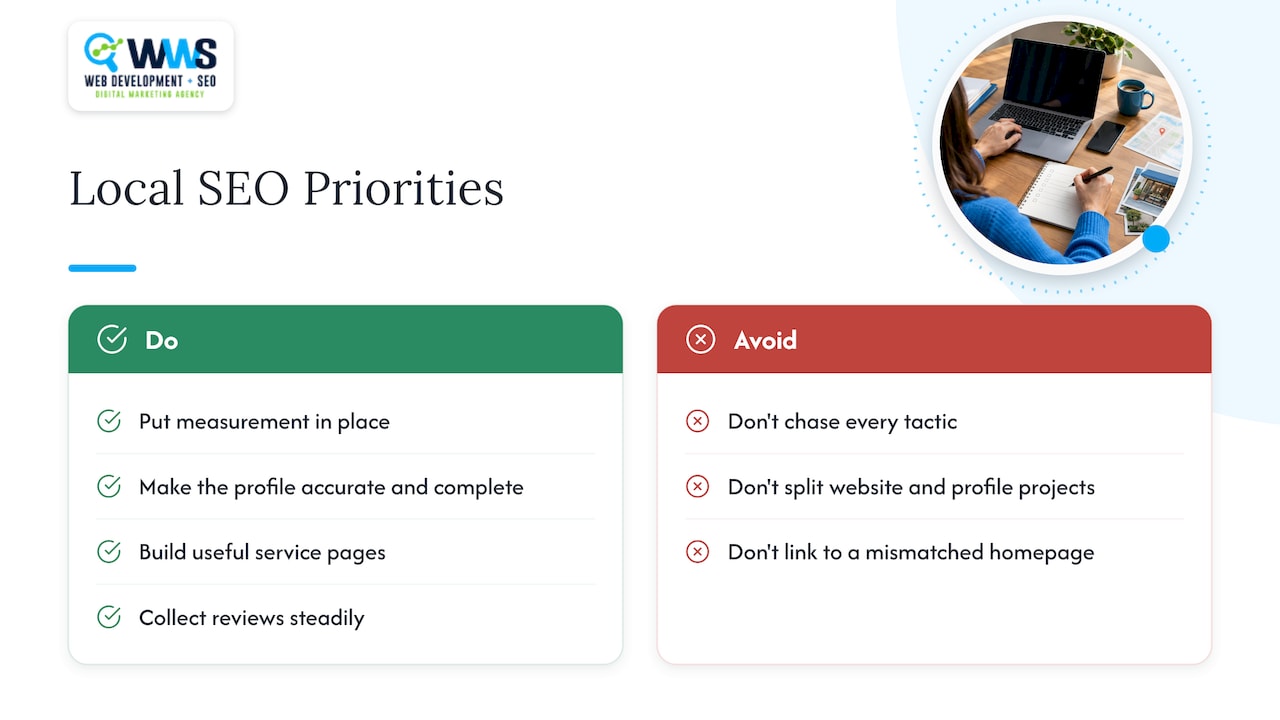
Our advice: do not chase every tactic. Get measurement in place, make the profile accurate and complete, make the service pages good enough that you would send a friend to them, and collect reviews steadily. Then widen the net.
— Online Marketing Experts
When it makes sense to bring in help
You can do much of this yourself, and the checklist above shows how. Owners usually bring in an agency when they lack time for weekly upkeep, when the website itself is the bottleneck, or when competitors in a dense market like Chicago are well ahead. If that is you, our local SEO service combines profile management, citations, content and ongoing ranking management, and our website design team builds the pages the strategy depends on. Tell us the services and suburbs you want to win, and we will show you what a plan for them looks like.
If your site needs the technical foundation first, our Website SEO service covers it, and for a broader view of how local fits into overall marketing, read our guide to SEO for local businesses.
Mistakes that stall local SEO
- Inconsistent contact details. A different phone number on the site and the profile confuses both customers and Google.
- Keyword stuffing the business name. Policy risk with little upside.
- One page for every suburb. Thin copy with the city name swapped rewards nobody.
- Ignoring negative reviews. A calm, specific reply helps the next reader as much as the unhappy customer.
- No tracking. Without call and form tracking, you cannot tell SEO from word of mouth.
- Stopping after launch. Local rankings respond to continuing activity.
FAQ
What is a local SEO strategy?
It is a plan for improving your visibility in searches tied to a place, covering your Google Business Profile, your website, citations, reviews and local content. It also defines what you measure and how often. Done well, it brings calls and visits from people already looking for your service nearby.
How do I target local SEO?
Start with the terms customers use for your services, add the cities, suburbs and neighborhoods you serve, and map each to a page. Then make sure your profile, site and listings all show the same business details. Check results in Search Console and your profile insights.
Is local SEO effective?
For businesses that serve a defined area, it is one of the most direct ways to reach people ready to buy, because the searcher already wants a local provider. Effectiveness depends on your market and your execution, so set a baseline and track calls, forms and booked jobs rather than rankings alone.
What are the most important things to do first?
Verify and complete your Business Profile, set up tracking, build service pages with clear contact details, and collect reviews consistently. Google says local results rest mainly on relevance, distance and prominence, and these tasks improve the two you can influence.
How long does it take to see results?
Profile fixes can change visibility within weeks, while pages, links and reviews build over several months. Treat the first 90 days as setup and early signals, and judge progress against your saved baseline instead of a single ranking check.
Sources
- Tips to improve your local ranking on Google, Google Business Profile Help
- Overview of Google Business Profile policies
- Prohibited and restricted content, Google Business Profile Help
- What Is Local SEO? Guide to Ranking in Local Search Results, Search Engine Land
- How to Find and Use Local Keywords for Better SEO, Search Engine Land
- Local SEO sprints: A 90-day plan for service businesses, Search Engine Land
- Scalable Local SEO Practices That Actually Work, Search Engine Land
- Local SEO: The Complete Guide, Ahrefs
- Local SEO keyword research: A step-by-step guide, Semrush
- What is Local SEO and How Do You Do It?, BrightLocal
Recommended
A Des Plaines, IL team helping local service businesses get found, get called and get booked since 2005: local SEO, Google Ads, conversion-focused websites and AI search optimization.
Meet the teamKeep reading
All articles
GA4 for Local Business: Setup, Key Events and Reports
Set up GA4 for a local business: create the property, track calls, forms and direction clicks as key events, verify them and read the reports that matter.
Local Advertising on Google for Small Businesses Ready to Grow
Master local advertising on Google with expert strategies for Local Services Ads, Maps, and Performance Max to attract nearby customers and grow your business.
6 Local SEO Examples Proving Proximity Is Power for Local Brands
See how 6 local SEO examples prove proximity drives revenue for trade services, multi-location brands, and local businesses in Chicago.