


AI Overviews SEO: How Chicago Businesses Stay Visible
AI Overviews SEO explained for local service businesses: how Google picks sources, what it requires, what to fix first, and how to measure results.
 By WWS Team
12 min read
In this article15 sections
- TL;DR
- What AI Overviews are and when they appear
- How Google chooses the sites it links
- The technical requirements: shorter than most agencies imply
- What actually helps: foundational, people-first SEO
- Your Google Business Profile is part of AI visibility
- How AI Overviews affect clicks and leads
- How to measure AI Overview performance
- Perspective: what we see working for Chicago-area businesses
- Where WWS fits in
- Common mistakes to avoid
- A 30-day starting plan
- FAQ
- Sources
- Recommended
AI Overviews SEO is not a separate discipline. Google says the pages most likely to be linked in an AI Overview are the ones that already meet the basics of Google Search: they are indexed, eligible to show a snippet, and genuinely useful to people. For a Chicago-area contractor, dentist, or restaurant, that means the work that wins map pack and organic rankings is the same work that earns a place in AI answers. This guide explains what AI Overviews are, how Google chooses links, what to fix first, and how to measure the outcome.
TL;DR
- AI Overviews need no special markup, AI text file, or trick. Google’s documentation says standard Search requirements apply: indexed and snippet-eligible.
- Ranking well still matters most. One analysis found roughly 75% of links cited in AI Overviews came from the top 12 organic results.
- For local businesses, a complete Google Business Profile and unique, people-first service pages are the strongest levers.
- Clicks on informational queries may fall, so judge success by calls, form fills, and booked jobs, not clicks alone.
- Track performance in Search Console and ignore tools that claim to show Google’s internal AI metrics.
What AI Overviews are and when they appear
Google describes AI Overviews as AI-generated snapshots that give key information on a topic with links to explore further. According to Google’s support page, they appear when Google’s systems decide generative AI can be especially helpful, and they are available to all users in the United States.
Two details matter for a business owner.
First, you do not choose whether a search shows one. Google decides query by query. Questions like “why is my basement flooding after rain” or “how long does a roof replacement take” are more likely to get a summary than a search like “emergency plumber Des Plaines”, where the person wants a business, a phone number, and a map.
Second, the overview is a jumping-off point. Google says it surfaces relevant links so people can find information quickly and explore content they might not have discovered otherwise. Your page can be one of those links, and a visitor arriving from that link already has context on your topic.
How Google chooses the sites it links
Google has not published a ranking formula for AI Overview citations, so anyone promising a guaranteed spot is guessing. What public evidence does show is a strong link to classic rankings. An analysis of more than 120,000 queries suggested that about 75% of links cited in AI Overviews came from the top 12 organic positions. That study dates from 2024 and the feature has changed since, so treat the figure as a direction, not a rule.
The practical reading is simple:
- Pages that rank get considered. Pages buried on page five rarely do.
- Pages that answer the question clearly, in plain language, give Google something quotable.
- Pages from businesses with a consistent, verifiable identity (name, address, phone, reviews, service area) are easier for Google to trust.
That last point is where local businesses have an edge over national publishers. Google can confirm you exist, where you work, and what customers say about you.
The technical requirements: shorter than most agencies imply
Many articles on this topic list a dozen technical tasks. Google’s own position is shorter. Its guidance states there are no additional technical requirements beyond the standard ones for Search: the page must be indexed and eligible to appear with a snippet. No special schema, no AI-specific text file, and no particular AI markup is needed.
That does not mean technical SEO is irrelevant. It means the basics decide eligibility. Check these first:
- Crawlable and indexed. Search your own domain in Google and confirm your service pages show up. A page blocked by a robots rule or a “noindex” tag cannot be cited.
- Snippet allowed. If a snippet-blocking directive is on the page, Google cannot show it as a supporting link.
- Fast, mobile-friendly pages. Most local searches happen on a phone, often from someone standing in a flooded basement or a broken-furnace living room. Slow pages lose that visitor whether or not an AI Overview is involved.
- Clean site structure. Service pages should be reachable in a few clicks, with short, descriptive URLs. Our guide on URL structure and shallow paths covers how this supports AI citations.
- Content in text. Key facts such as services, service area, hours, and pricing approach should be readable text, not buried in images or scripts.
If your site was built years ago on a bloated template, a rebuild can solve several of these at once. Our guide to building an SEO-friendly website walks through the checklist.
What actually helps: foundational, people-first SEO
Google’s guide to optimizing for generative AI features says the most effective approach is foundational SEO: unique, non-commodity content, clear site architecture, and a good user experience. It also advises against AEO and GEO “hacks”. That is worth repeating, because many vendors now sell rebranded versions of ordinary SEO at a premium.
For a local service business, here is what that looks like in practice.
Write pages only you could write
A page that says “We offer quality roof replacement” is commodity content. Thousands of sites say it. A page that explains how Chicago’s freeze-thaw winters affect shingle choice, what a typical tear-off involves on a bungalow versus a two-flat, how permits work in your municipality, and what the homeowner should expect day by day is something an AI summary can draw on, because it contains specifics.
Useful ingredients:
- Real project photos with captions naming the neighborhood or suburb
- The questions customers ask on the phone, answered directly under their own headings
- Process steps, timelines, and what affects cost, without inventing numbers you cannot support
- Credentials, licenses, and insurance you actually hold
Answer the question first
Put the direct answer in the first two sentences under a heading, then add detail. This helps human readers and makes your content easy to quote. It is the same pattern used in this article.
Cover the service and the place
Build a distinct page for each core service and, where it makes sense, for each major area you serve, such as Naperville, Schaumburg, or Evanston. Each should have real local content, not the same text with the city name swapped. Our local SEO best practices guide explains how to do this without creating thin pages.
Match what you say everywhere
Your name, address, phone number, hours, and services should read the same on your site, your Google Business Profile, and your major directory listings. Inconsistency makes it harder for any system, AI or otherwise, to trust you.
Your Google Business Profile is part of AI visibility
Google’s guidance notes that local businesses can use Merchant Center feeds and Google Business Profiles to help their products and services appear in AI responses and other Search results. For most service businesses, the Business Profile is the relevant piece.
An up-to-date profile should include:
- The correct primary and secondary categories
- Service areas that match where you actually work
- A full list of services with descriptions
- Current hours, including holiday changes
- Recent photos of real work and your team
- A steady flow of genuine reviews, with replies
If you take calls from customers who never visit a storefront, a service-area setup matters. We cover this in our guide to Google Business Profile setup for service areas, and the broader ranking factors in map pack mastery.
No schema trick replaces this. A verified, active, well-reviewed profile is the most direct signal of local legitimacy you control.
How AI Overviews affect clicks and leads
The honest answer is that it depends on the query type. Here is what the available evidence shows.
| Finding | Source and scope |
|---|---|
| Organic click-through rate on informational queries with an AI Overview fell from 1.76% to 0.61% | Seer Interactive data, June 2024 to September 2025, reported by a US analytics blog |
| Total local search views down 6.6% while total clicks finished 0.4% higher by Q4 | Rio SEO 2026 local search report, US data for 2025 |
| Direction clicks rose 6.4% in 2025 while local listing visibility declined | Rio SEO 2026 local search report |
| Clicks from AI Overviews are higher quality, with users more likely to spend time on the site | Google Search Central blog, 2025 |
Read together, these point in one direction. Top-of-funnel, informational traffic is shrinking. People who do click through, especially in local searches, tend to be closer to acting. The local report suggests shorter journeys, where fewer people browse and more go straight to calling or getting directions.
For a business that earns revenue from phone calls and booked estimates, this shifts priorities. A blog post that once drew 1,000 casual visitors may now draw fewer, but the leads that come from your service pages, map listing, and reviews are still decided by the same factors. The Seer figures also describe informational queries, not “roofer near me” searches, so do not assume your lead flow will drop by the same proportion.
How to measure AI Overview performance
Google recommends using the Generative AI performance report in Search Console to measure how your site performs in generative AI features. It also cautions against third-party tools claiming access to Google’s internal metrics. Take that seriously: if a vendor shows you an “AI visibility score” with no explanation of where the data comes from, ask before paying for it.
A workable measurement routine for a local business:
- Search Console monthly. Review impressions and clicks for your service queries and the generative AI report.
- Spot-check key searches. Search 10 to 20 of your most valuable questions and note whether an overview appears and which sites it links. Do this logged out or in a private window, and expect variation.
- Track conversions, not just traffic. Google suggests evaluating visits by conversion indicators such as sales or signups rather than focusing too much on clicks. For you, that means tracked calls, form submissions, and booking requests.
- Ask every new customer how they found you. Add the question to your intake script. “I saw it in Google’s summary” is useful information no dashboard will give you.
- Watch Business Profile actions. Calls, direction requests, and website clicks show whether local visibility is converting.
One caution: SEO performance is increasingly tied to AI presence, so tracking the specific queries that trigger overviews is worthwhile. Still, a handful of cited queries should not outweigh the number of calls your phone receives.
Perspective: what we see working for Chicago-area businesses
We build websites and run SEO under one roof for local service businesses, so we see the same pattern in the field: the businesses that stay visible are the ones with a fast, clear website, a well-managed Google Business Profile, and content that reflects real work in real neighborhoods. When a new search feature appears, vendors rush to sell a new acronym. Our advice is to fix what you already have before paying for anything new.
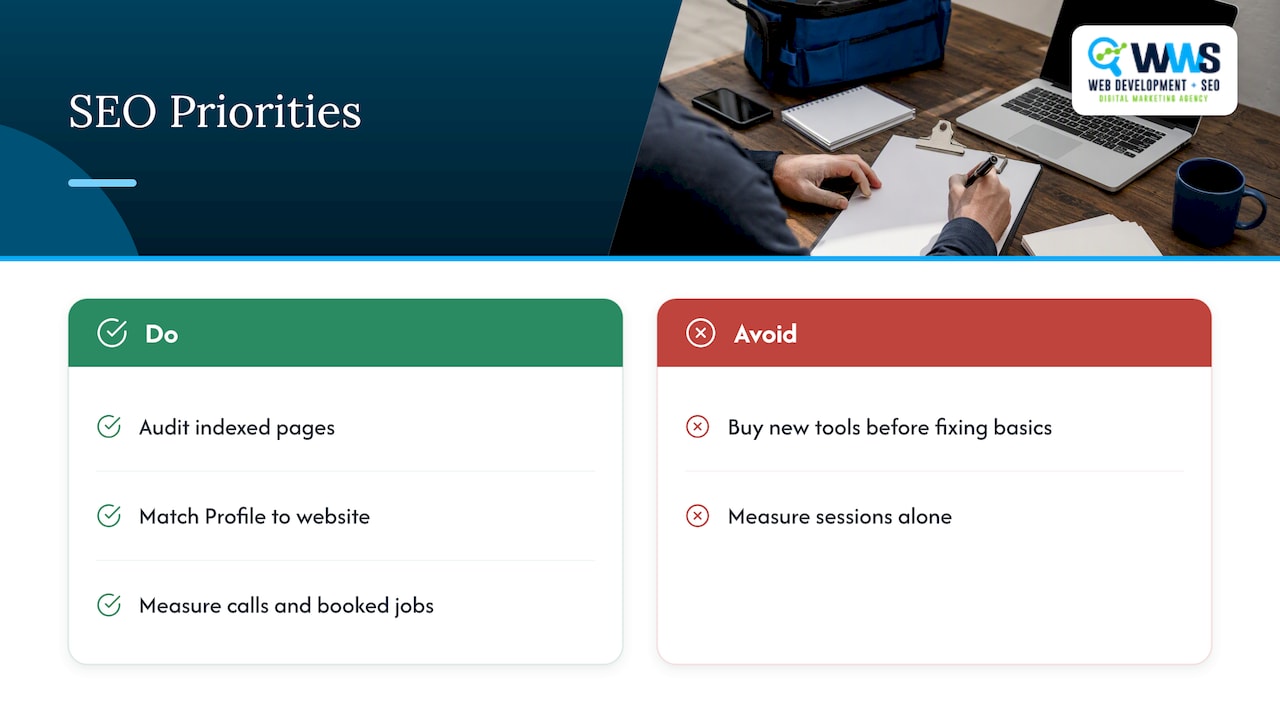
In practice, we start with an audit of three things: whether the right pages are indexed, whether the Business Profile matches the website, and whether each service page says something a competitor’s page does not. Most sites we review have gaps in all three. Closing them helps map pack rankings, organic rankings, and AI citations together, which is why we do not treat AI Overviews as a separate product.
We also push owners to measure calls and booked jobs rather than sessions. A smaller number of better-informed visitors is a fine trade if your phone keeps ringing.
— Online Marketing Experts
Where WWS fits in
If you would rather hand this work to a team that handles design, development, and search under one roof, WWS is a Google and Meta Partner based in Des Plaines, serving the greater Chicago area, with all work done in-house. Our Local SEO service covers Business Profile management, citations, and local content, and our Website SEO service handles the technical and content foundation that AI Overviews draw on. If your site itself is the obstacle, our website design and hosting team can rebuild it for speed and structure. Prices are scoped to each project, so contact us for a quote.
Common mistakes to avoid
- Paying for “AI Overview optimization” that is really repackaged SEO. Ask what specifically will be changed on your site and profile.
- Adding schema and expecting a guarantee. Structured data can help Google understand a page, but Google states no special markup is required for AI features.
- Publishing generic AI-written filler. Content that repeats what everyone else says gives Google no reason to cite you. Use AI as a drafting aid if you like, but add your own project details, pricing approach, and local knowledge.
- Ignoring the basics. A noindex tag left over from a site launch can quietly remove your best pages from Search.
- Neglecting reviews. Review volume and recency influence local visibility, and unanswered reviews signal an inattentive business.
- Chasing clicks over calls. Reporting that celebrates traffic while leads stagnate is hiding the real picture.
For a broader view of how generative search treats local companies, see our generative engine optimization guide for local businesses, and for the full local framework, our local SEO guide.
A 30-day starting plan
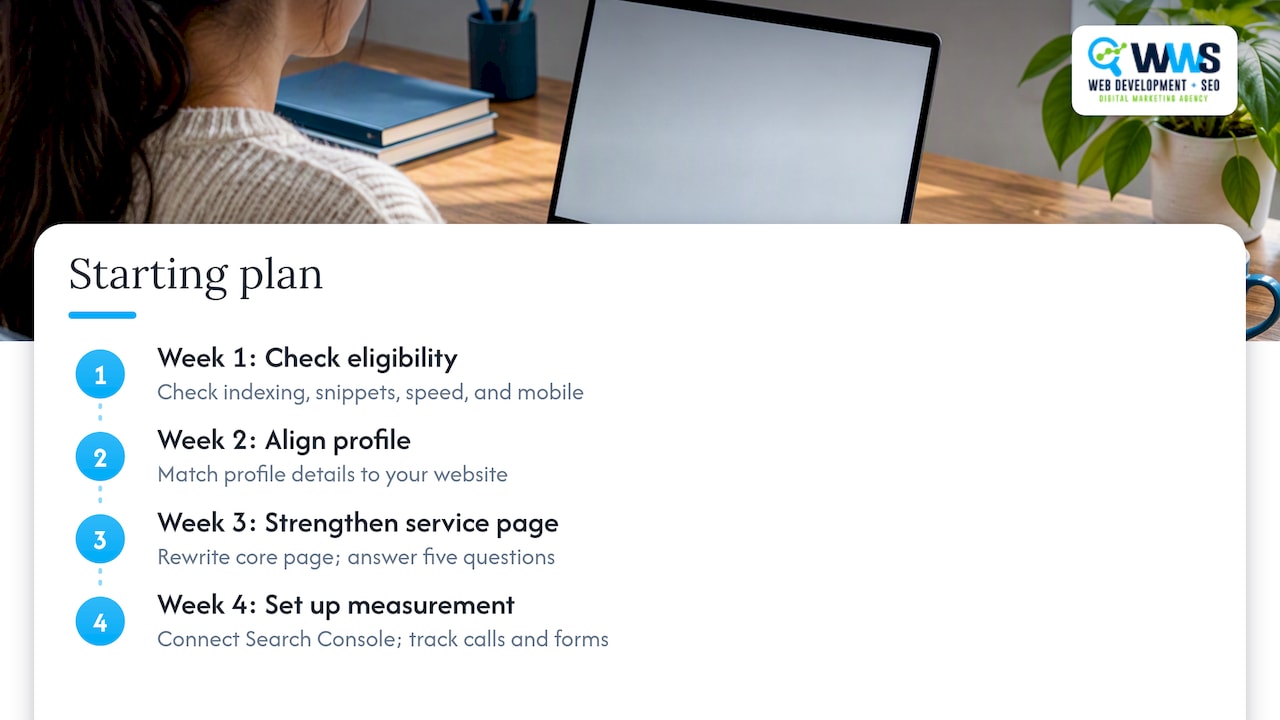
Week 1: Check eligibility. Confirm your service pages are indexed and not blocked from snippets. Fix speed and mobile problems on your top three pages.
Week 2: Align your profile. Audit your Google Business Profile categories, services, service areas, hours, and photos. Match name, address, and phone to your website exactly.
Week 3: Strengthen the pages that earn money. Rewrite one core service page with a direct answer up top, a clear process, local specifics, and real photos. Add a short section answering the five questions customers ask most.
Week 4: Set up measurement. Connect Search Console, set up call and form tracking, and record a baseline for your key searches. Review monthly, not daily.
This plan does not require new tools or special markup, which is the point. It builds the same foundation that both traditional rankings and AI summaries rely on.
FAQ
Do I need special schema or an AI file to appear in AI Overviews?
No. Google’s documentation says there are no additional technical requirements beyond being indexed and eligible for a snippet, and no special schema or AI-specific text file is needed. Structured data can still help in other ways, but it is not an entry ticket.
Will AI Overviews reduce my website traffic?
Possibly for informational queries. One analysis of US data found organic click-through on those queries fell sharply when an overview appeared. Local, high-intent searches behave differently, and US local data showed clicks roughly flat even as views declined, so track your own results.
Is optimizing for AI search different from regular SEO?
Google says AI Overviews are not a separate SEO category. Standard technical quality, unique helpful content, and a good user experience remain the main levers, and it advises against AEO or GEO hacks.
How do I know if my site appears in AI Overviews?
Use the Generative AI performance report in Search Console, and spot-check your key searches manually. Be cautious with third-party tools that claim to reveal Google’s internal AI metrics.
Does my Google Business Profile affect AI results?
Google’s guidance says local businesses can use Business Profiles to help their services appear in AI responses and other Search results. A complete, accurate, actively managed profile is one of the most direct steps you can take.
Sources
- AI Features and Your Website, Google Search Central
- Find information faster and easier with AI Overviews, Google Search Help
- Google’s Guide to Optimizing for Generative AI Features on Search
- Top ways to ensure your content performs well in Google’s AI experiences, Google Search Central Blog
- Analysis: 75% of Google AI Overview links come from top 12 organic rankings, Search Engine Land
- AI Overview vs AI Mode: What the 86% Gap Means for SEO
- 2026 Local search report: AI and what’s working, Rio SEO
Recommended
A Des Plaines, IL team helping local service businesses get found, get called and get booked since 2005: local SEO, Google Ads, conversion-focused websites and AI search optimization.
Meet the teamKeep reading
All articles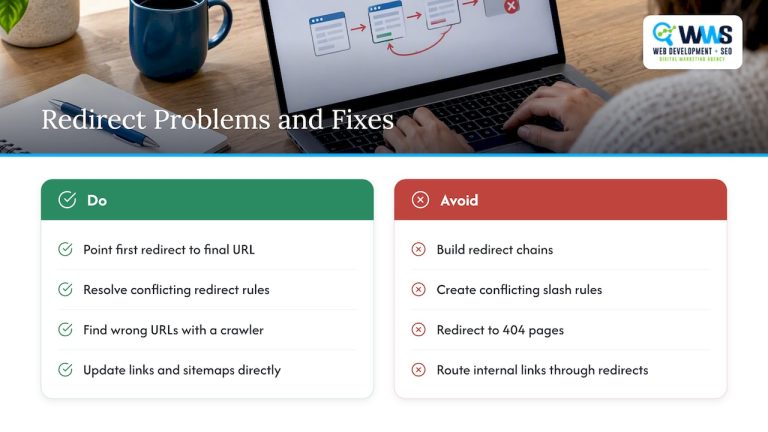
Redirect Strategy for SEO: 301, 302 and Canonical Rules
A practical redirect strategy for SEO: when to use 301 vs 302, when a canonical tag is better, how to avoid chains and loops, and how to verify the result.
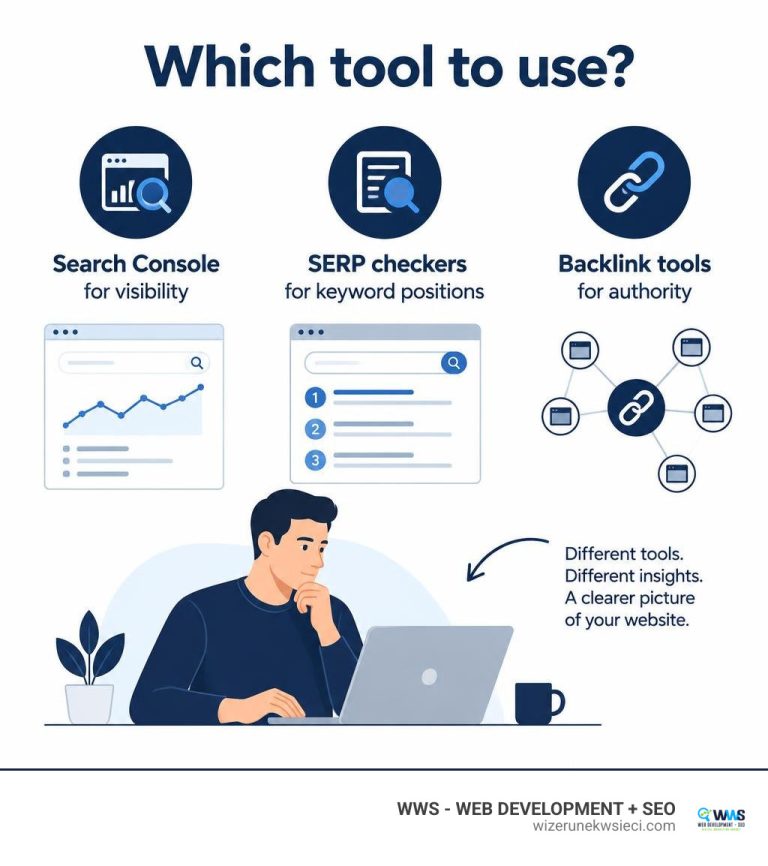
The Best Page Rank Checker Online Tools for Modern SEOs
Use a page rank checker online to audit link equity, track SERP positions, and boost organic visibility with modern SEO authority metrics.
The Best Page Rank Checker Online Tools for Modern SEOs
Use a page rank checker online to audit link equity, track SERP positions, and boost organic visibility with modern SEO authority metrics.