


The Best Page Rank Checker Online Tools for Modern SEOs
Use a page rank checker online to audit link equity, track SERP positions, and boost organic visibility with modern SEO authority metrics.
 By WWS Team
8 min read
In this article7 sections
- How to Check Your Website’s Rank Online
- Understanding PageRank: From Google’s Original Algorithm to Modern Authority Metrics
- Why Using a Page Rank Checker Online Still Matters for Modern Authority Audits
- Core Technical SEO and Monitoring Tools Provided by Google
- Best Practices and Mistakes to Avoid in Rank Tracking
- Frequently Asked Questions About Page Rank and SERP Tracking
- Conclusion
How to Check Your Website’s Rank Online
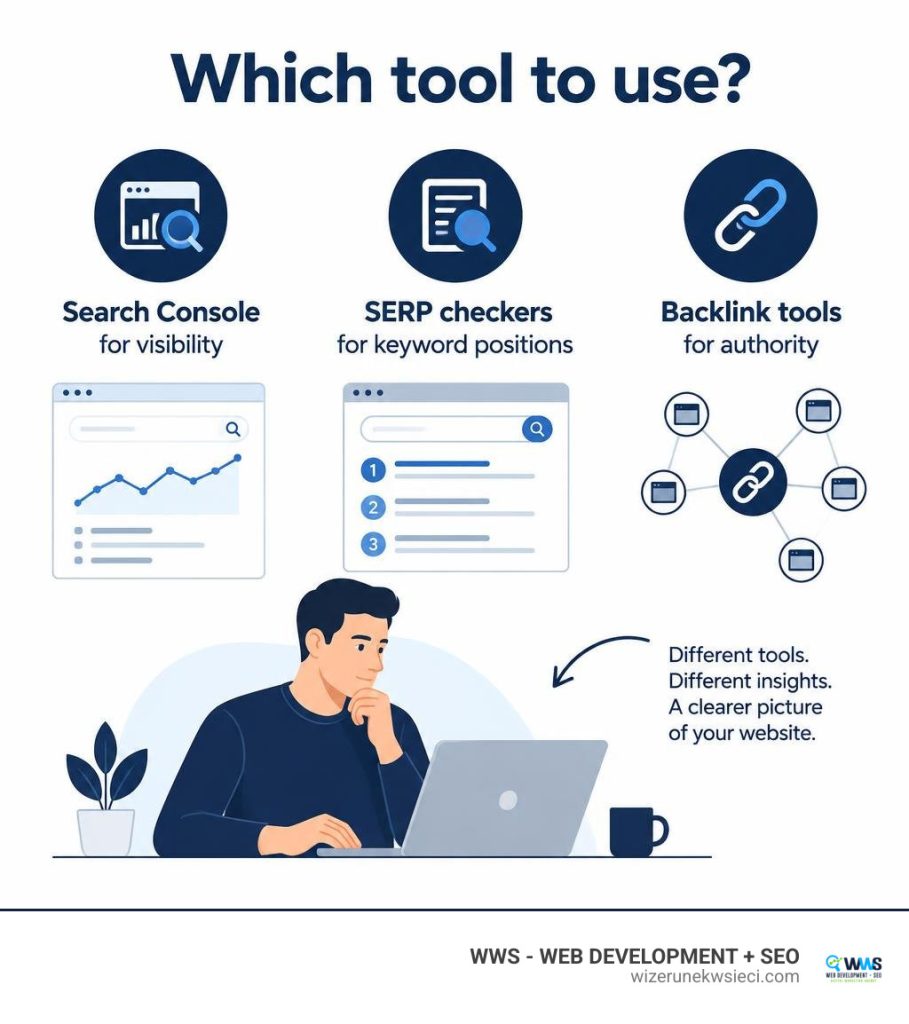
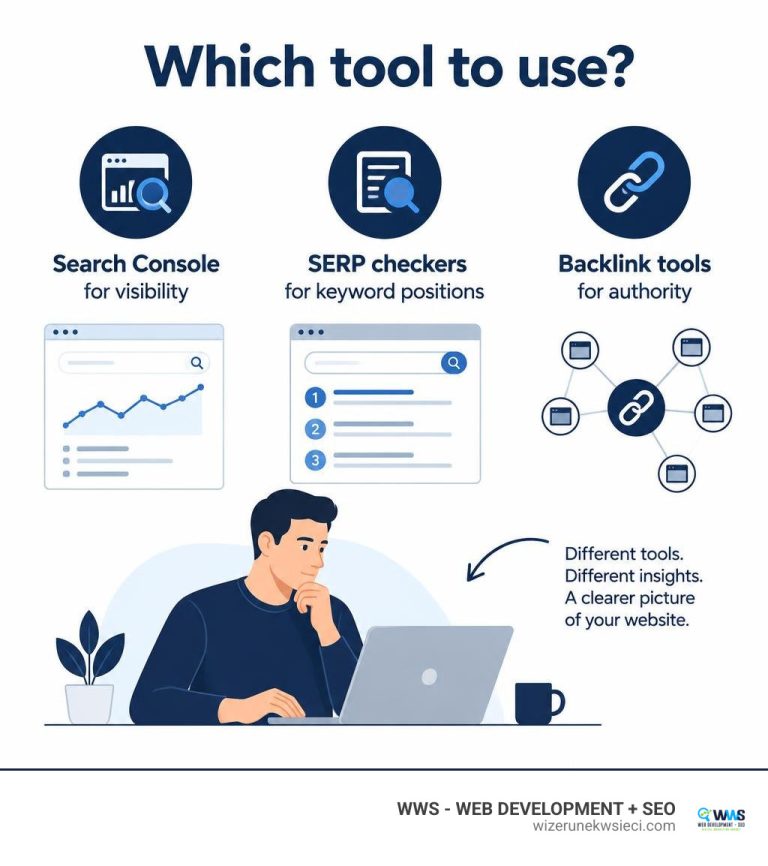
Want to check your site’s rank? First, decide what you need to measure. Use Google Search Console to see which searches bring up your site, its average position, and its clicks. For a specific keyword, use a SERP checker and select your customers’ location and device. To assess link authority, use a third-party backlink metric, but treat it as an estimate.
No online tool can show your current, official Google PageRank score. Google stopped publishing that number in 2016. Today’s “PageRank checkers” measure different things, so the right choice depends on whether you’re checking keyword positions, inbound links, or how links connect pages on your own site.
I’m Tomasz Lasota, founder of Wizerunek w Sieci / WWS – Web Development + SEO. After more than 22 years helping businesses improve their online presence, I use a page rank checker online as one piece of a broader SEO review – especially when helping Chicago-area owners connect search visibility with calls and leads.
Page rank checker online basics:
Understanding PageRank: From Google’s Original Algorithm to Modern Authority Metrics
To evaluate website authority today, it helps to understand where the concept originated. In 1998, Larry Page and Sergey Brin developed PageRank at Stanford University. The fundamental premise was elegant: the web functions as a democratic citation network. When one web page links to another, it acts as a vote of confidence.
However, Google did not treat every vote equally. The algorithm evaluated votes based on the authority of the linking page. PageRank used a logarithmic scale from 0 to 10, meaning moving from a score of 4 to 5 required significantly more link equity than moving from 1 to 2. It also incorporated a “damping factor” (traditionally set around 0.85), which modeled the probability that an imaginary surfer would continue clicking links rather than starting a fresh browsing session. Reviewing how search engine optimization fundamentals operate helps clarify how this foundational link math still powers modern search ranking architectures.
The Evolution and Deprecation of Public Google PageRank
In the early 2000s, Google allowed webmasters to see this score directly via the Google Toolbar. The toolbar queried a specific endpoint (toolbarqueries.google.com) using a checksum hash to return a green bar showing a site’s public score.
Because webmasters began manipulating this public number through spam link networks, Google froze public updates in December 2013 and officially shut down the public toolbar in March 2016. Understanding the deprecation of legacy public PageRank confirms that no third-party tool has access to Google’s live internal scoring.
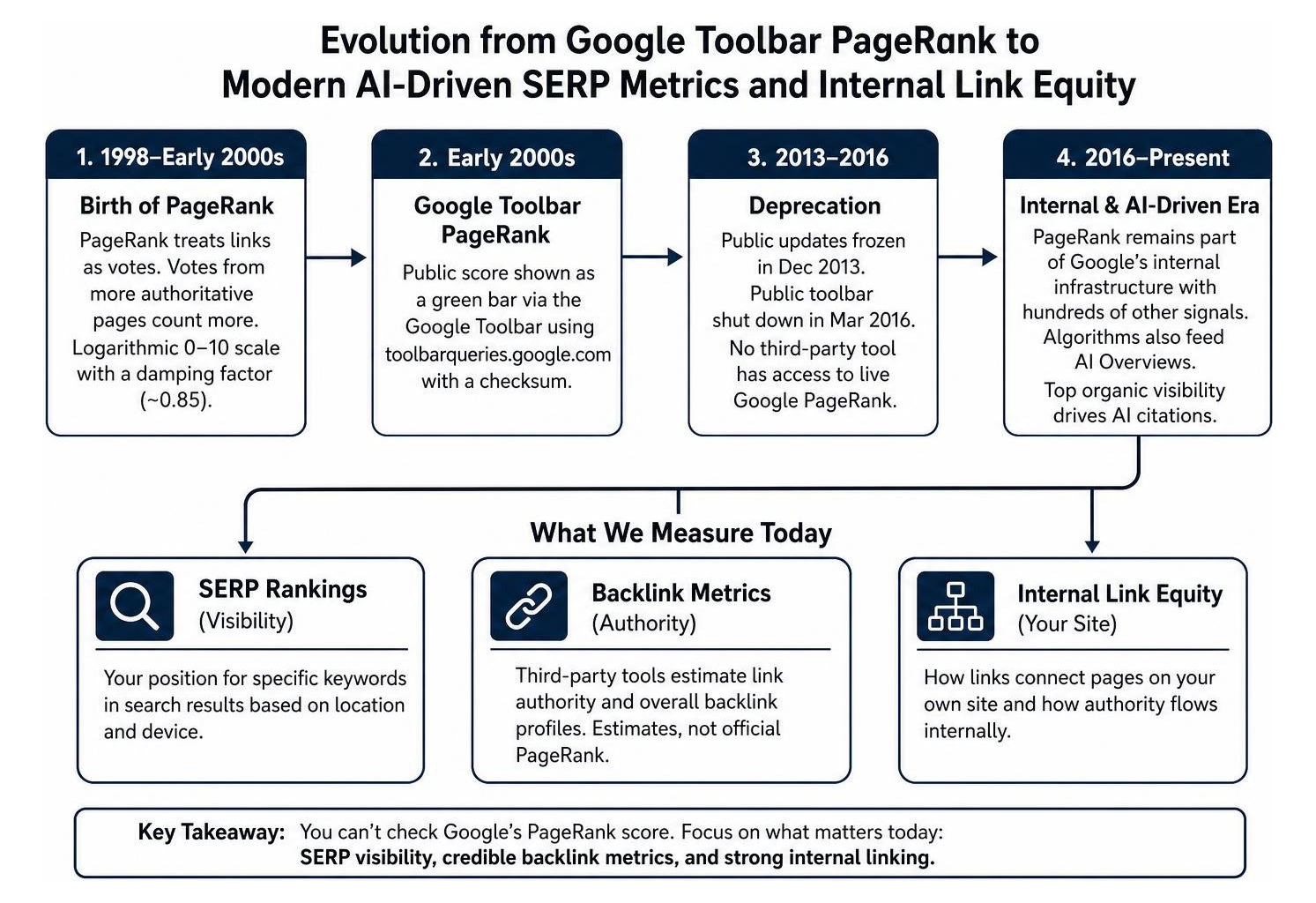
Google still uses PageRank internally as part of its core ranking infrastructure, along with hundreds of other signals, to dictate crawl priority and organic positioning. In 2026, search algorithms also feed AI Overviews, where 91% of AI search citations go to pages already holding organic positions in the top 20.
PageRank vs. SERP Ranking vs. Backlink Profiles
Small business owners often confuse three distinct SEO concepts: page authority, search engine results page (SERP) positions, and backlink auditing.
| Metric Category | What It Measures | Primary Data Source | Actionable Business Value |
|---|---|---|---|
| PageRank / Authority | Overall trust and link equity of a URL | Proprietary 3rd-party models or internal crawl algorithms | Benchmarking brand power and link equity distribution |
| SERP Ranking Position | The exact organic position of a URL for a specific search query | Live search engine results pages | Tracking local lead visibility and keyword rankings |
| Backlink Profile | The quantity, source quality, and anchor text of external inbound links | Web crawlers indexing the public web | Identifying referral partners and removing spammy links |
Tracking search results directly shows where your business appears when potential clients search for your services. Using established methods to check search engine positions allows you to separate backlink equity from actual customer visibility.
Why Using a Page Rank Checker Online Still Matters for Modern Authority Audits

While the public green bar is gone, modern tools calculate authority proxies to help business owners gauge search competitiveness. Today, the global SEO market is valued at over $80 billion, and North America holds the largest share due to widespread digital adoption. Over 70% of SEO professionals use rank checkers daily to monitor their organic footprint.
Auditing authority is essential when navigating search engine positioning strategies. Modern checkers give you a clear baseline to compare your digital authority against competitors in your local market.
Choosing the Right Page Rank Checker Online for Live SERP Analysis
When running live queries, personalization can distort your data. Google adjusts search results based on browsing history, device type, geographic IP, and active cookies. If you search for your own business repeatedly, your browser may show your site at position #1, while a prospective client down the road sees you on page two.
To get neutral ranking data:
- Use clean query testing that strips personalization parameters (such as appending
&pws=0to query URLs). - Use privacy-focused check suites such as 4Rank or live query tools on PR-CY for multi-market spot checks.
- Isolate geographic locations down to city and zip code level.
- Check both desktop and mobile layouts separately, as mobile indexing dictates primary rank.
When querying live domain authority and PageRank metrics, reputable platforms test neutral search positions across diverse data centers. Combining these checks with effective tools for tracking search engine rankings ensures your marketing decisions are based on accurate data.
Evaluating Internal Link Equity with a Page Rank Checker Online
PageRank is not just about external backlinks; it is equally determined by internal site architecture. Internal link equity determines how search engine crawlers navigate your website and discover high-priority commercial pages.
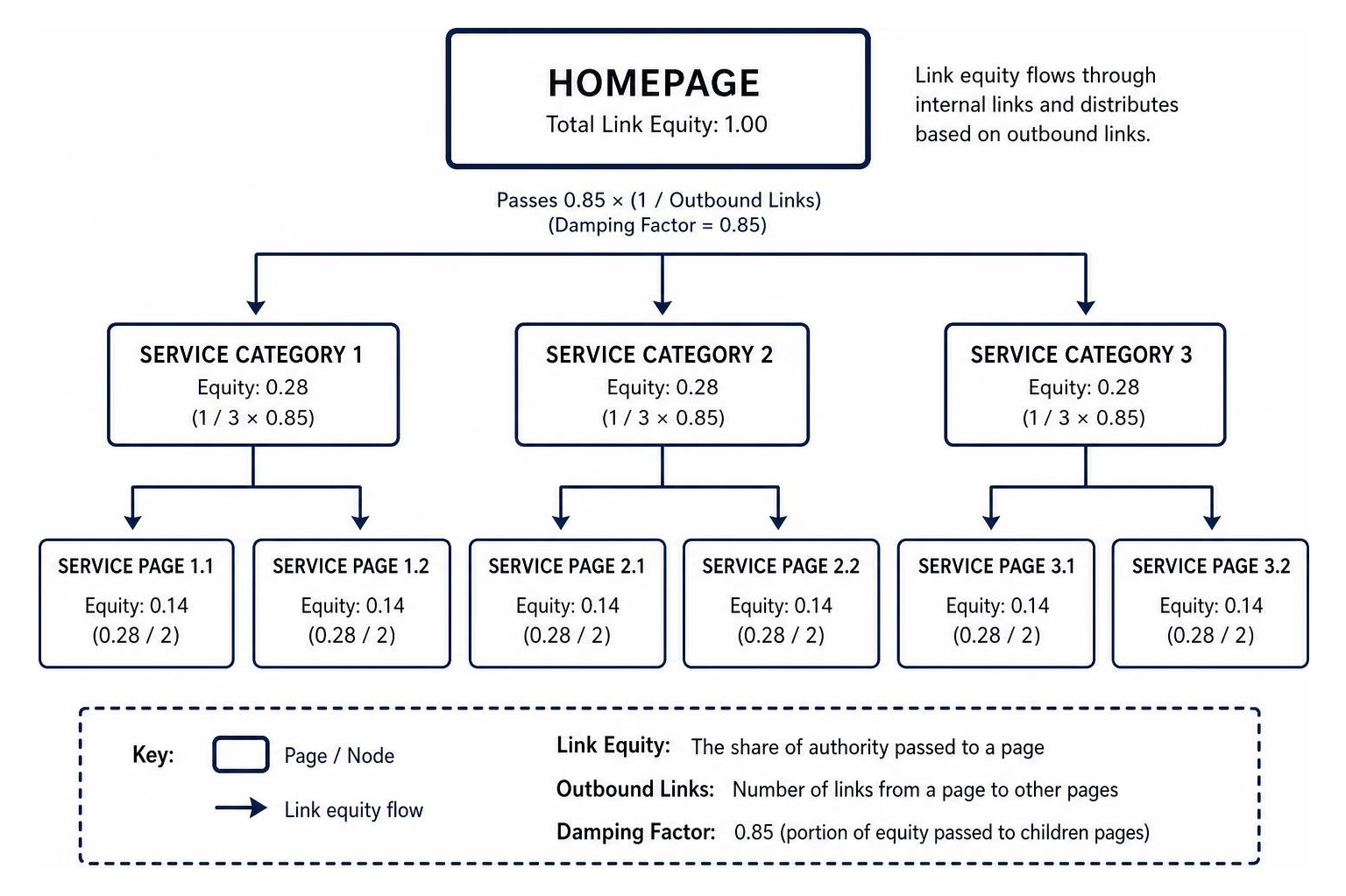
When internal architecture is neglected, critical service pages become “orphan pages”—pages with few or no incoming links—preventing them from ranking. By auditing internal link equity using dedicated calculation tools, you can calculate internal equity distributions (often modeled using formulas such as Sum(0.25 / Outbound Links) * 0.85) to ensure link value flows to your most important service pages.
Pairing internal link modeling with discovering exact page-level Google rankings helps business owners identify which pages need internal link support to climb the search results.
Core Technical SEO and Monitoring Tools Provided by Google
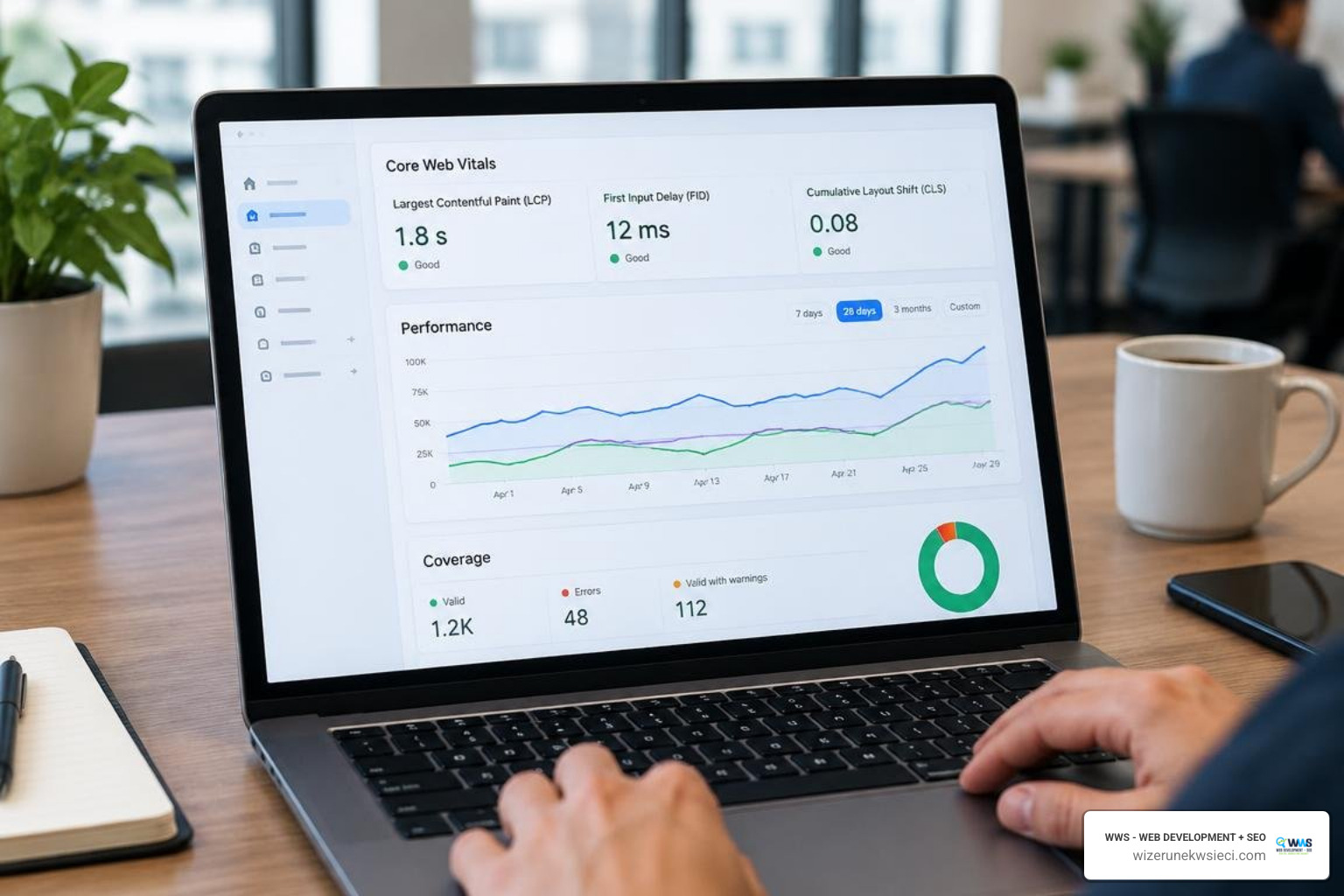
Google provides several free diagnostics that every business owner should use before investing in third-party software.
Auditing Performance with Google Search Console and Lighthouse
Google Search Console (GSC) is the official platform for monitoring organic search performance. It provides verified search data, including:
- Total Impressions & Clicks: Exactly how many people saw and clicked your listings.
- Average Position: Neutral ranking positions across desktop and mobile devices.
- Index Coverage: Diagnostic alerts identifying pages with crawl errors or indexing issues.
Alongside GSC, Google’s PageSpeed Insights and Chrome DevTools run Lighthouse audits to measure Core Web Vitals (Largest Contentful Paint, Interaction to Next Paint, and Cumulative Layout Shift). Fast, mobile-responsive pages rank higher and convert more visitors into paying customers.
Tracking Backlinks and Neutral SERP Positioning
Within Google Search Console, the “Links” report shows your top linking domains, your most linked pages, and the anchor text patterns Google has indexed.
For monitoring high volumes of target keywords across multiple locations, performing automated bulk Google ranking audits saves time and provides reliable ranking trend lines.
Best Practices and Mistakes to Avoid in Rank Tracking
Accurate rank tracking requires sound methodology. Here are the most common pitfalls to avoid when tracking search performance:
- Ignoring SERP Layout Changes: Organic position #3 can be pushed down the screen by Google Ads, local map packs, and AI Overviews. Track visual layout position alongside numerical rank.
- Overreacting to Daily Fluctuations: Search engines constantly test minor algorithm adjustments. Reacting to day-to-day position shifts leads to unnecessary changes.
- Focusing on Low-Value Keywords: Ranking #1 for an obscure phrase with no search volume produces zero phone calls. Target high-intent commercial keywords that drive leads.
- Failing to Cross-Verify Data: Validate critical rank data across multiple tools rather than relying on a single snapshot.
For ongoing campaigns, using comprehensive tools for professional website positioning keeps your data organized and actionable.
Avoiding False Ranking Signals and Personalization Bias
A common mistake is checking search rankings in a standard personal browser window. Cached data, previous clicks, and Google account profiles create confirmation bias. Even standard incognito windows can retain geographic signals from your internet service provider.
Always configure your rank tracking tools to query search engines from the exact service areas where your prospective customers live and work.
Establishing Healthy Monitoring Frequencies for Actionable Data
Checking rankings multiple times a day creates anxiety without providing actionable insights. Instead, follow a structured schedule:
- Weekly Checks: Review primary target keywords to spot meaningful trends.
- 14-Day Post-Launch Buffers: When publishing new content or refreshing existing pages, allow 14 to 28 days for search crawlers to index and stabilize the page’s position.
- Monthly Technical Audits: Review site-wide crawl health, backlink acquisitions, and conversion performance.
Selecting the right platform is simple when selecting dedicated rank tracking software matched to your business size and operational goals.
Frequently Asked Questions About Page Rank and SERP Tracking
Can I still check my original Google PageRank score?
No. Google permanently retired the public PageRank Toolbar score in March 2016. While Google still uses an updated, proprietary version of PageRank internally within its ranking systems, no public tool or API has access to that number. Modern tools report third-party authority metrics or measure live search engine placement.
How often should small businesses monitor their search rankings?
Small business owners should review ranking reports on a weekly or bi-weekly schedule. Weekly monitoring provides a clear view of true trends while filtering out daily algorithmic testing. Technical health and backlink audits are best conducted once per month.
What is the most reliable way to check neutral keyword positions?
The most reliable method is using a dedicated rank tracker that queries search engines via localized data centers with personalization parameters disabled. For aggregate historical data, Google Search Console’s Performance Report offers the most accurate, unfiltered view of organic impressions and average positions.
Conclusion
Understanding how to check and interpret your search rankings is essential for growing your business online. True search visibility requires balancing internal link architecture, clean technical code, quality backlinks, and content that matches what your customers are searching for.
At WWS (Wizerunek w Sieci), we help small and medium-sized businesses turn search visibility into tangible business growth. Based in Des Plaines, IL (636 S River Rd #218), we combine the technical capabilities of a full-service agency with the direct communication and personal care of a dedicated local partner. Whether you serve clients across Chicagoland—from Schaumburg and Arlington Heights to Naperville and Chicago—or operate nationwide, our bilingual team (English & Polish) builds search campaigns designed to generate calls, leads, and revenue.
If you are ready to evaluate your website’s search performance, explore our professional website SEO and digital marketing services. Contact WWS today or visit wizerunekwsieci.com to claim your free website audit and discover how strategic search positioning can grow your business.
A Des Plaines, IL team helping local service businesses get found, get called and get booked since 2005: local SEO, Google Ads, conversion-focused websites and AI search optimization.
Meet the teamKeep reading
All articles
Redirect Strategy for SEO: 301, 302 and Canonical Rules
A practical redirect strategy for SEO: when to use 301 vs 302, when a canonical tag is better, how to avoid chains and loops, and how to verify the result.
The Best Page Rank Checker Online Tools for Modern SEOs
Use a page rank checker online to audit link equity, track SERP positions, and boost organic visibility with modern SEO authority metrics.

AI Overviews SEO: How Chicago Businesses Stay Visible
AI Overviews SEO explained for local service businesses: how Google picks sources, what it requires, what to fix first, and how to measure results.