



What Is Search Engine Optimization with Example — and Why It Matters for Your Business
What is search engine optimization with example is one of the most searched questions by business owners trying to grow online — and for good reason. If your website isn’t showing up on Google, you’re invisible to the customers already searching for exactly what you offer.
Here’s a quick answer:
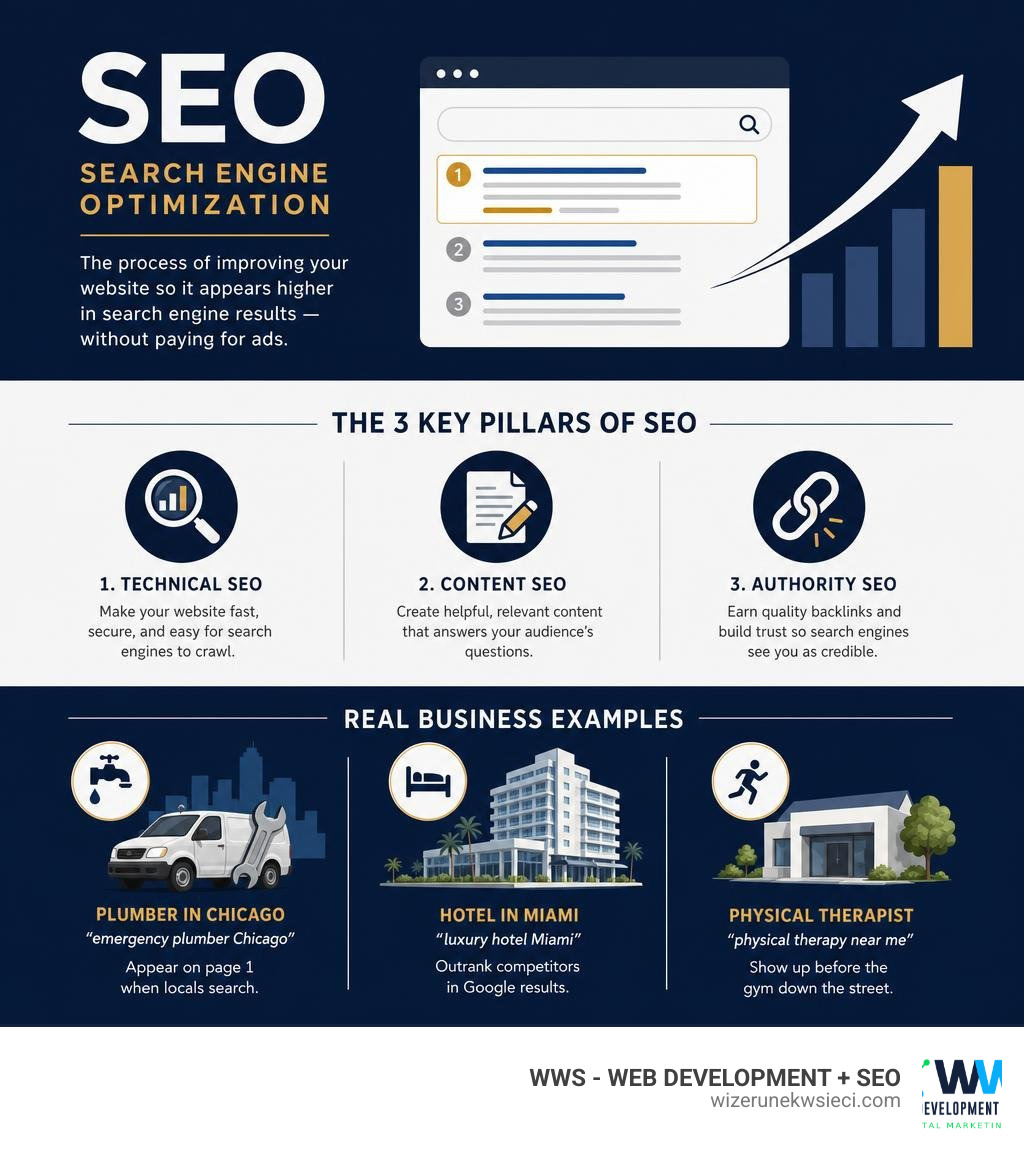
Search Engine Optimization (SEO) is the process of improving your website so it appears higher in search engine results — without paying for ads. Higher rankings mean more visitors, more calls, and more customers.
Simple real-world example:
| Business Type | What They Want to Rank For | What SEO Helps Them Do |
|---|---|---|
| Plumber in Chicago | “emergency plumber Chicago” | Appear on page 1 when locals search |
| Hotel in Miami | “luxury hotel Miami” | Outrank competitors in Google results |
| Physical therapist | “physical therapy near me” | Show up before the gym down the street |
The stakes are high. Organic search drives 53% of all website traffic — making it the single largest traffic source for most websites. And only 2–3% of searchers ever click past the first page of results.
In other words: if you’re not on page one, you’re practically not on Google at all.
The good news? SEO is learnable, and the fundamentals haven’t changed as much as you might think — even with AI reshaping how search works.
I’m Tomasz Lasota, Digital Development and Technology Director with over 22 years of experience building and optimizing digital products for businesses of all sizes — and understanding what search engine optimization is with real-world examples is exactly where every successful project starts. In this guide, I’ll walk you through how it all works so you can start making smarter decisions for your online presence.
Handy what is search engine optimization with example terms:
How Search Engines Work: Crawling, Indexing, and Ranking
Before we can optimize our websites, we must understand how search engines process information. Google is a fully automated search engine that uses specialized programs called “crawlers” or “bots” to constantly explore the web.
To get a complete grasp of this process, we can refer to the official Search Engine Optimization (SEO) Starter Guide or the SEO Starter Guide: The Basics | Google Search Central | Documentation | Google for Developers provided by Google. These guides outline the exact stages a web page goes through before it can appear in front of a user.
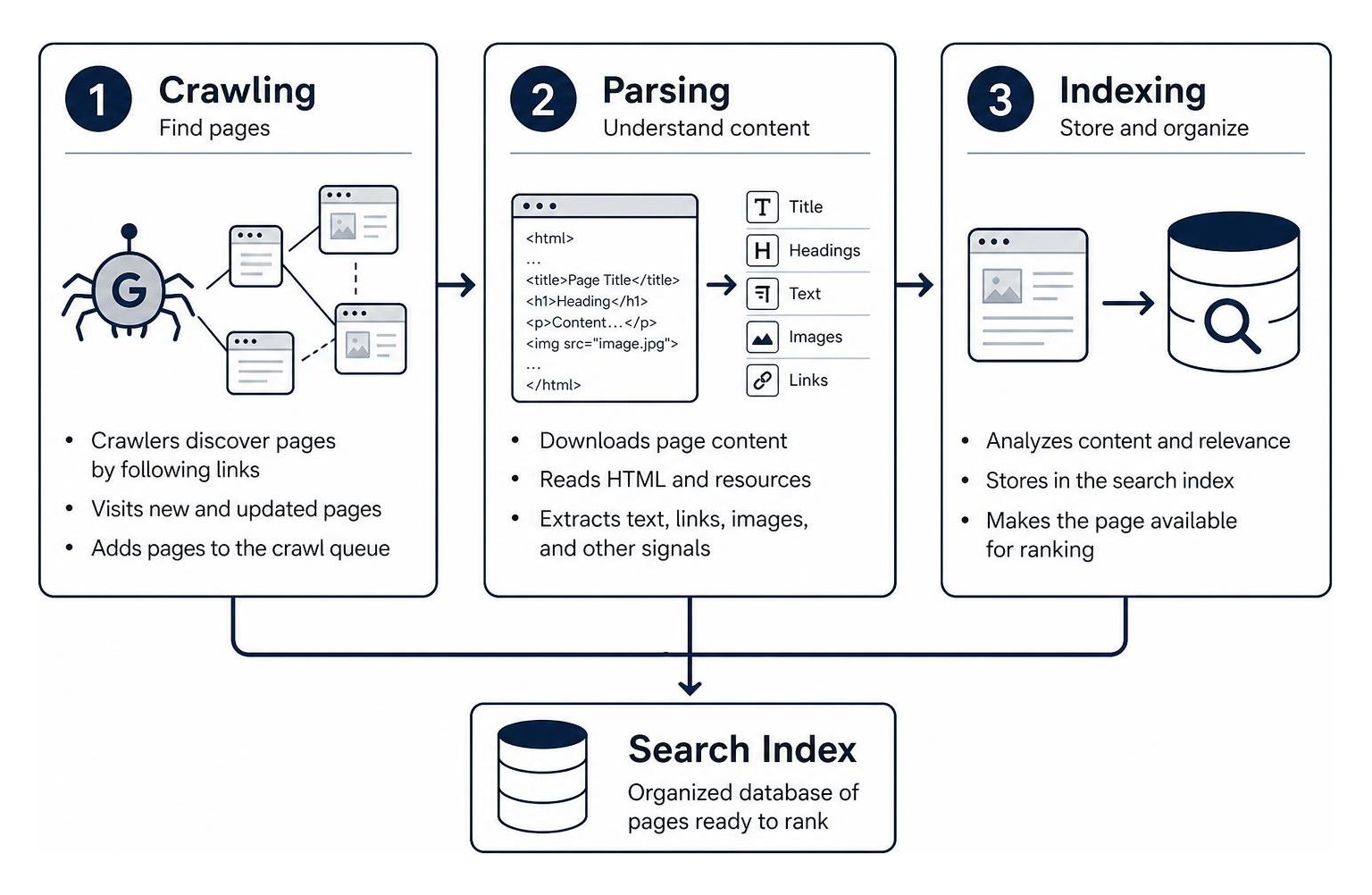
The search engine journey is broken down into three core phases: crawling, indexing, and ranking.
Crawling and Discovery
Crawling is the discovery stage. Google’s primary crawler, Googlebot, finds new and updated pages to add to the Google database.
- Discovery via Links: The vast majority of new pages Google finds every day are discovered through links from other pages it has already crawled.
- XML Sitemaps: To help crawlers find your pages faster, you can submit an XML sitemap via Google Search Console. Think of this as a roadmap of your website.
- Robots.txt: This is a text file on your site that tells search engine crawlers which pages or files they can or cannot request from your site. It is crucial for preventing the crawling of duplicate or private administrative pages.
- Internal Links: A clean site structure with logical internal links allows Googlebot to easily flow from page to page, ensuring no important content is left undiscovered.
Indexing and Rendering
Once Googlebot finds a page, it must understand what the page is about. This is the indexing and rendering phase.
The crawler parses the HTML code, but it also renders the page using a browser engine to see exactly what a user sees, including images, videos, and complex JavaScript. Historically, Google’s indexation capabilities took a massive leap forward with the Google Caffeine update, which allowed Google to index web content dynamically and provide 50% fresher results.
If Google decides your content is helpful, unique, and easy to read, it adds the page to its massive database—the Search Index. If a page has duplicate content issues, Google will typically select a single canonical URL to represent that content and exclude the duplicate versions from the index.
Ranking and Search Intent
Ranking is where the algorithm does its magic. When a user types a query into Google, the engine searches its index for the most relevant, high-quality pages to display.
Google uses hundreds of ranking signals to evaluate pages. Key user signals, such as how long a user stays on a page (dwell time) and whether they click back to the search results (pogo-sticking), help Google determine if a search result satisfied the user’s search intent.
Google also relies heavily on E-E-A-T (Experience, Expertise, Authoritativeness, and Trustworthiness). While E-E-A-T itself is not a direct individual ranking factor with a numerical score, Google uses it as a guideline to train its quality evaluators and refine its ranking algorithms to favor highly credible sources.
What is Search Engine Optimization with Example?
To put it in the most accurate terms, search engine optimization is both an art and a science. According to Wikipedia’s SEO Overview, it is the practice of improving the visibility and performance of websites in search engine results pages (SERPs) by increasing organic traffic.
Let’s look at a concrete, step-by-step example of how this looks in the real world.
Imagine you own a local service business in Illinois, such as an electrical company.
- The Search Query: A homeowner in Des Plaines searches for “emergency electrician Des Plaines IL”.
- The Optimization: You have a page on your website specifically optimized for this term. It features a descriptive URL (
desplaines-electrician.com/services/emergency-electrician-des-plaines), a clear heading (H1) containing the keyword, helpful safety tips for electrical emergencies, and a fast-loading layout. - The Result: Because your page directly answers the searcher’s intent and provides clear contact options, Google ranks it at the top of the organic results. The user clicks, calls your business, and books a service.

What is Search Engine Optimization with Example in E-commerce?
E-commerce websites face unique SEO challenges because they often have thousands of product pages that can easily suffer from duplicate content. Successful Ecommerce SEO relies on structured hierarchy, high-quality media, and unique product descriptions.
Let’s look at an e-commerce example:
Suppose you run an online store selling eco-friendly pet supplies. Instead of trying to rank for a highly competitive head term like “dog toys”, you focus on a long-tail keyword like “organic cotton dog chew toys”.
- Category Pages: You optimize your main category page for “eco-friendly dog toys”, grouping all topically similar products together.
- Product Pages: Each product page has a descriptive title, unique copy (no copy-pasting from the manufacturer!), structured data markup showing the price and availability, and optimized images with descriptive alt text like
alt="organic cotton rope dog chew toy". - Keyword Targeting: By targeting specific, high-intent keywords, you attract buyers who are ready to make a purchase, resulting in higher conversion rates.
What is Search Engine Optimization with Example for Local Businesses?
For local service providers, appearing in front of nearby customers is the lifeblood of the business. This is where local search engine optimization comes into play. To learn more about this specialization, read our comprehensive guide on What is SEO?.
Let’s look at how local SEO works for contractors in the Chicago area:
- Google Business Profile (GBP): A Chicago roofing company sets up and optimizes its GBP. They fill out their operating hours, add high-quality photos of completed roof installations, and consistently collect 5-star reviews from local clients.
- Local Citations: The business ensures its Name, Address, and Phone number (NAP) are completely consistent across directories like Yelp, YellowPages, and local Chicago business associations.
- Service-Specific Pages: To capture highly targeted search traffic, the business creates dedicated landing pages. For example, they might implement SEO for Contractors Chicago, SEO for Roofing Companies Chicago, or SEO for Electricians Chicago.
When a local homeowner searches for “roof repair Chicago”, Google matches the searcher’s location with the company’s optimized local signals, displaying them in the coveted “Local Map Pack” at the very top of the search results page.
The Three Pillars of Modern SEO
To build a website that ranks consistently, you must address the three core pillars of optimization. You cannot rely on just one; they must work together like a well-oiled machine.
| SEO Pillar | Focus Area | Key Actions | Impact on Search Visibility |
|---|---|---|---|
| Technical SEO | Website Infrastructure | Speed, mobile responsiveness, secure HTTPS, clean crawl paths. | Helps search engines discover, render, and index your pages without errors. |
| On-Page SEO | Content & HTML Elements | Keyword research, title tags, high-quality copy, image alt text. | Helps search engines understand the context and relevance of your pages. |
| Off-Page SEO | Authority & Trust | Backlinks, digital PR, local reviews, brand mentions. | Signals to search engines that your website is credible and trusted by others. |
Technical SEO (The Foundation)
Technical SEO is the defensive backbone of your website. If your site has crawl errors, loads slowly, or isn’t secure, even the best content in the world won’t rank. You can learn more about securing these foundations in our dedicated guide on Website SEO.
- Site Speed & Core Web Vitals: Google uses page speed as a ranking factor. Ensure your images are compressed, code is minified, and server response times are fast.
- Mobile-Friendliness: With 63% of Google searches in the US occurring on mobile devices, having a responsive design is mandatory. Google operates on mobile-first indexing, meaning it primarily uses the mobile version of your content for indexing and ranking.
- HTTPS Security: Security is a ranking signal. A secure site (using SSL certificates) protects user data and builds trust with both visitors and search engines.
- Academic & Technical Standards: Technical optimization is highly valued by institutions. For instance, the Search Engine Optimization | Red Multisite resource by the University of Illinois Chicago emphasizes that web accessibility improvements (like proper heading structures and screen-reader compatibility) inherently benefit search engine crawler navigation.
On-Page SEO (The Content)
On-page SEO is where you optimize the visible elements of your website to match user queries. To guide your on-page optimization, you can read the classic What is SEO? • SEO for beginners • Yoast guide, which focuses heavily on content readability and structure.
- Keyword Research: Identify the exact terms your target audience uses. Tools like Google Ads Keyword Planner can help you find search volume and competition levels. For local insights, the SEO: Search Engine Optimization Tips – Illinois Extension guide recommends focusing on natural language patterns that everyday people use when looking for help.
- Title Tags & Meta Descriptions: Keep your title tags under 70 characters and your meta descriptions under 150 characters to prevent them from being cut off in search results. Make them unique, compelling, and include your primary keyword naturally.
- Header Tags (H1-H6): Use a clean heading hierarchy to organize your content. Your page should have only one H1 tag containing your primary topic, followed by H2 and H3 tags for subtopics.
- Descriptive Anchor Text: When linking to other pages, avoid generic phrases like “click here.” Instead, use descriptive anchor text like “view our SEO Services Packages Chicago” to give search engines context about the linked page.
Off-Page SEO (The Authority)
Off-page SEO is about building your website’s reputation and authority across the web. While you have direct control over your technical setup and on-page copy, off-page signals are earned through relationship building and credibility.
- Backlinks: A backlink is a link from another website to yours. In the eyes of search engines, backlinks act as “votes of confidence.” However, quality always beats quantity. A single link from an authoritative, relevant site (like an educational institution or a major industry publication) is worth far more than a hundred links from spammy, low-quality blogs.
- Digital PR: Creating original research, data-backed infographics, or hosting local events in areas like Des Plaines or Chicago can naturally earn your business editorial links and media coverage.
- Brand Mentions: Even unlinked mentions of your brand name across reputable websites are tracked by Google as signals of your business’s real-world footprint and authority.
SEO vs. SEM, PPC, and AI Search Optimization
As digital marketing evolves, the terminology can get confusing. Let’s clarify how organic SEO compares to other search engine marketing strategies and the emerging landscape of AI-driven search.

Organic SEO vs. Paid PPC
Search Engine Marketing (SEM) is an umbrella term that historically included both organic Search Engine Optimization (SEO) and paid Pay-Per-Click (PPC) advertising. Today, most marketers use SEM to refer specifically to paid search.
- PPC (Paid Search): You pay Google every time a user clicks on your ad. These ads appear at the very top of the SERP, labeled as “Sponsored.” PPC offers instant visibility and is highly effective for short-term promotions or highly competitive transactional keywords.
- SEO (Organic Search): You do not pay for clicks. While SEO requires an upfront investment of time, content creation, or agency fees, it delivers a much higher long-term ROI. Once your organic rankings are established, they continue to drive traffic and leads day and night without ongoing ad spend.
Many businesses find that combining both strategies yields the best results. For example, you can use PPC to capture immediate leads while building your long-term organic presence using Boost Your Business with Expert SEO Chicago Services.
Optimizing for AI and Generative Search (GEO)
The search landscape is changing rapidly. With the rise of AI Overviews (formerly Search Generative Experience) and conversational platforms like ChatGPT, users are increasingly getting direct answers without needing to click through to a website. In fact, 82% of consumers find AI-powered search more helpful than traditional search result lists.
This shift has introduced a new discipline called Generative Engine Optimization (GEO).
To optimize your content for AI search engines, you should:
- Structure for Direct Extraction: Use clear Q&A formats in your content so Large Language Models (LLMs) can easily extract your answers for direct queries.
- Build Entity Authority: Ensure your business is widely cited across authoritative directories, industry wikis, and news sites so AI models recognize your business as a trusted entity.
- Focus on Semantic Depth: Go beyond simple keyword matching. Write comprehensive, deep-dive content that covers a topic thoroughly, addressing secondary questions your readers are likely to ask.
Frequently Asked Questions about Search Engine Optimization
How long does it take to see results from SEO?
SEO is a long-term strategy, not an overnight fix. Depending on your website’s history, current technical health, and competitor strength, it typically takes 3 to 6 months to see meaningful improvements in organic rankings and traffic.
New websites with low domain authority will take longer to build trust with Google, while established sites correcting technical crawl errors can sometimes see positive movement within a few weeks. Consistency is key; search engines reward sites that publish helpful, up-to-date content over time.
What are the most common SEO mistakes to avoid?
- Keyword Stuffing: Artificially cramming keywords into your content to trick the algorithm. This makes your copy unreadable and can trigger a Google penalty.
- Duplicate Content: Copying product descriptions or blog posts from other websites. Google values original perspectives and helpful, unique content.
- Buying Backlinks: Purchasing cheap links from link farms. Google’s spam detection algorithms easily spot these patterns and will penalize your domain.
- Neglecting Mobile Users: Having a site that loads slowly or displays poorly on mobile phones.
What tools are best for tracking SEO performance?
To successfully manage your SEO campaign, you should utilize a mix of free and premium tools:
- Google Search Console: A free tool from Google that shows how often your site is crawled, which pages are indexed, and the exact search queries driving traffic to your site.
- Google Analytics: Essential for tracking user behavior, conversions, and overall organic traffic trends.
- SEO Platforms: Premium platforms like Ahrefs, Semrush, or Moz are excellent for competitor analysis, backlink audits, and tracking your keyword rankings over time.
Conclusion
Understanding what search engine optimization is with real-world examples is the first step toward unlocking sustainable, compound growth for your business. By building a strong technical foundation, creating genuinely helpful content that matches your users’ search intent, and earning authority across the web, you can outrank your competitors and secure a steady stream of qualified leads.
If you are looking to partner with experienced professionals to elevate your digital presence, we are here to help. At Wizerunek w Sieci (WWS), we are a dedicated digital marketing agency specializing in building high-performing websites and running integrated, conversion-focused SEO and Google Ads campaigns for local service businesses.
Whether you need to design a custom website from scratch or want to scale your local lead generation, explore our specialized Website SEO solutions. To find the right partner for your business, check out our guide on Chicago SEO Agencies: Your Guide to Ranking Up and let us help you deliver measurable growth today.