





Essential Features of a High-Performing Local Funeral Home Website
A high-performing local funeral home website must serve two distinct audiences simultaneously: families in immediate crisis (at-need) and individuals planning for the future (pre-need). Balancing these user paths requires thoughtful planning, clear visual hierarchy, and absolute transparency.
To build trust upfront, modern funeral websites must prioritize pricing transparency. Providing an easily accessible General Price List (GPL) directly online helps meet FTC Funeral Rule transparency requirements while building upfront trust.
We can map the digital journey of these two primary user groups to understand how the website’s structure must adapt to their unique needs:
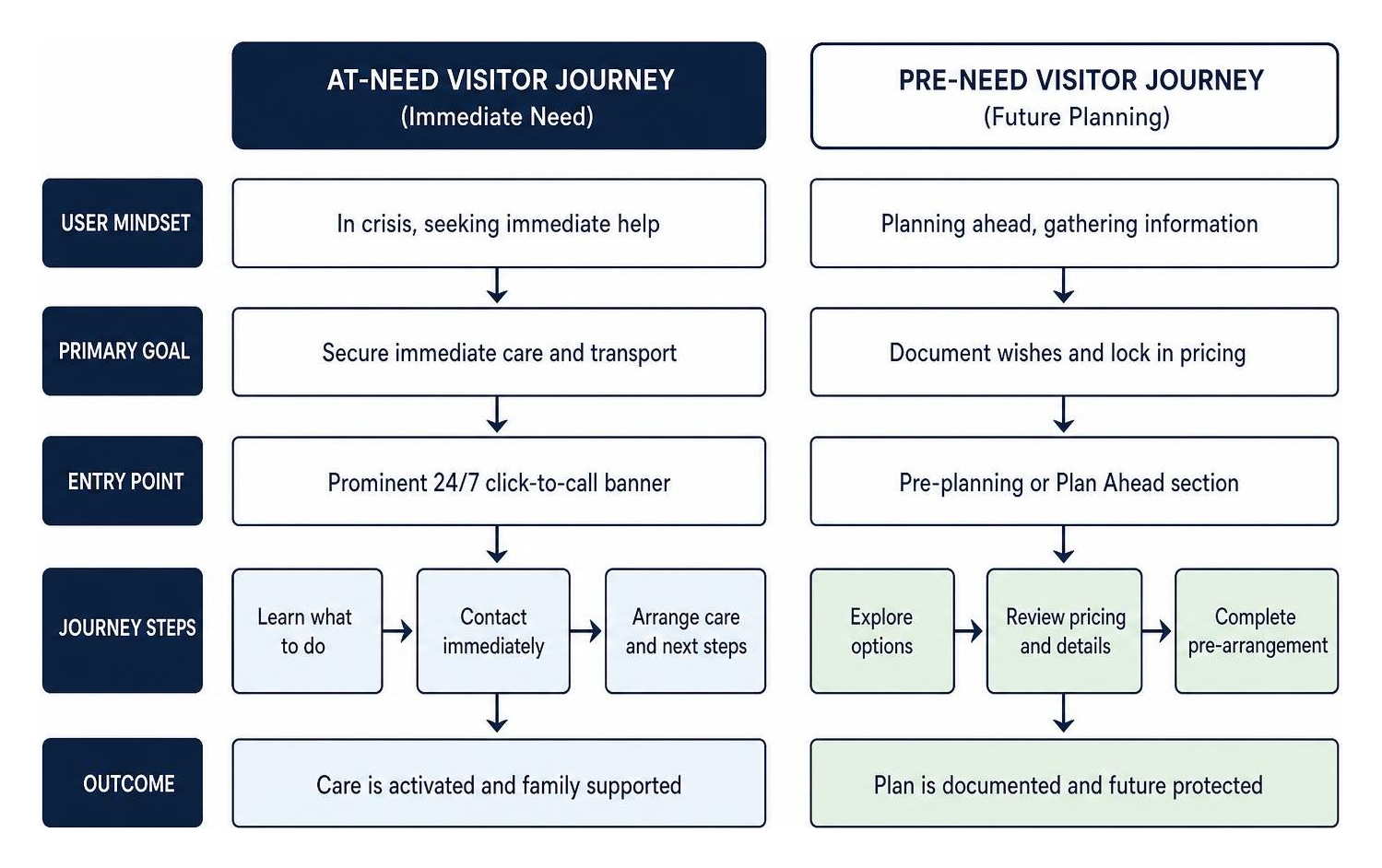
| Website Feature | At-Need Families (Immediate Crisis) | Pre-Need Planners (Future Planning) |
|---|---|---|
| Primary Goal | Secure immediate care and transport | Document wishes and lock in pricing |
| Key Website Element | Prominent 24/7 click-to-call phone banner | Detailed online pre-arrangement forms |
| Information Required | “What to do when death occurs” guide | Service options, packages, and GPL |
| Emotional State | High stress, grief, urgency | Calm, reflective, proactive |
| Secondary Feature | Obituary creation and florist integration | Transferability options for existing plans |
Designing a Compassionate User Experience for Grieving Families on a Local Funeral Home Website
When designing a website for the deathcare industry, user experience (UX) is not just about conversion rates; it is about empathy. Grieving users may be experiencing cognitive overload, making complex navigation menus or bright, jarring colors incredibly frustrating.
To create a comforting digital environment, we recommend:
- A Calming Color Palette: Soft earth tones, muted blues, warm grays, and forest greens convey dignity and peace. Avoid stark black-and-white layouts, which can feel cold and clinical, or overly vibrant primary colors.
- Clear, Accessible Typography: Use highly legible serif or clean sans-serif fonts with generous line spacing. Ensure the text size is adjustable or naturally large enough for older family members to read without straining.
- Intuitive Navigation: Keep the main menu simple and direct. Avoid industry jargon. Use straightforward labels like “Obituaries,” “Our Services,” “Pre-Planning,” and “Contact Us.”
- Mobile Responsiveness: A massive portion of local search traffic comes from mobile devices, especially when families are at a hospital or hospice facility. The mobile site must load instantly and present the most critical information—the phone number and physical address—front and center.
Partnering with an agency that understands these sensitive design choices makes all the difference. Our team at WWS specializes in professional website design that respects your brand’s dignity while ensuring a seamless user experience.
Balancing Compassion with Clear Calls-to-Action
It is a common misconception that a compassionate website cannot have strong calls-to-action (CTAs). In reality, clear CTAs are a form of customer service. A family in crisis does not want to hunt through multiple pages to find out how to contact you.
To balance empathy with action:
- Implement an “Immediate Need” Banner: Place a prominent, high-contrast banner at the top of every page stating, “Available 24/7, 365 Days a Year. Call Us Immediately at (555) 123-4567.” Make sure this phone number is a click-to-call link for mobile users.
- Low-Friction Pre-Planning Forms: For pre-need visitors, provide a simple, step-by-step online form to start the arrangement process from the comfort of their homes. Do not overwhelm them with too many fields initially; gather the essentials and allow them to save their progress.
- Low-Stress Communication Channels: Some users may not be ready to speak on the phone. Provide a secure, easy-to-use contact form for general inquiries, ensuring your staff responds promptly and respectfully.
Driving Community Engagement Through Online Obituaries and Notifications
Online obituaries are the single largest driver of recurring traffic to a local funeral home website. While service pages are visited occasionally, the obituary section is visited daily by local community members looking to pay their respects, share memories, or send flowers.
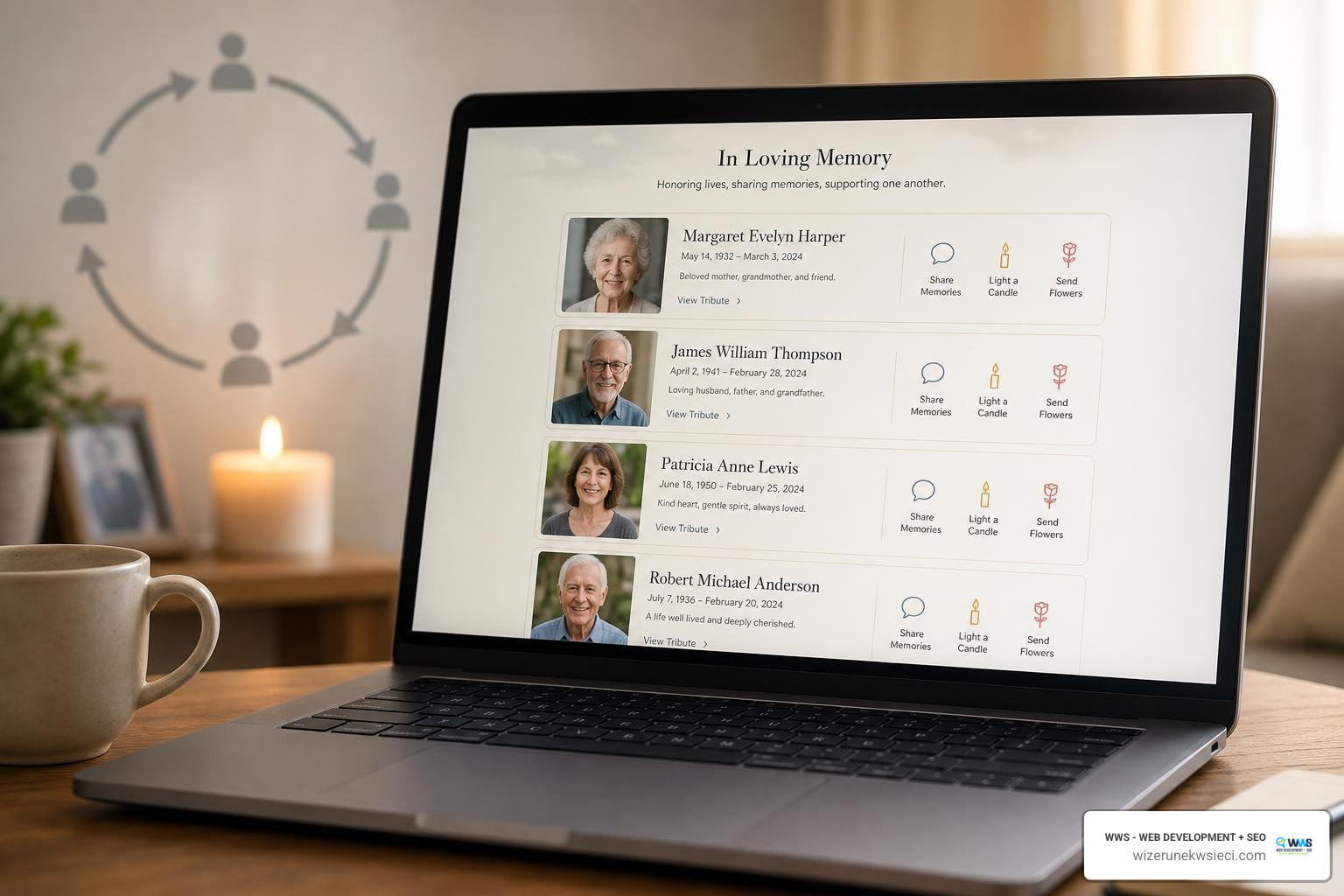
Modern obituary platforms do far more than list service times. They serve as interactive memorial pages where family and friends can:
- Post digital condolences, share photos, and light virtual candles.
- Order sympathy flowers directly from the page. By integrating your obituary pages with local florists, you provide a seamless experience for visitors while supporting local businesses and creating auxiliary revenue streams for your funeral home.
- Access live-streamed services for remote family members who cannot travel.
The Role of Obituary Email Notifications on a Local Funeral Home Website
To turn your website into a true community hub, you should offer an obituary email subscription service. This feature allows local residents to sign up and receive email alerts whenever a new death notice is published.
This creates a powerful local engagement loop:
- Community Connection: Local residents stay informed about passings in their neighborhood.
- Consistent Traffic: Each email notification drives high-intent local traffic back to your website.
- Long-Term Trust: When those community members eventually need funeral services, your brand is already familiar and trusted.
In addition to obituary alerts, offering daily grief support emails for a full year after a service is an incredible way to extend your care. This automated touchpoint provides daily comfort to grieving families, establishing your funeral home as a compassionate, long-term community resource.
Building Trust and Conveying Your Unique Value Proposition
The funeral industry is highly personal, built on generations of trust. Your website must communicate what makes your funeral home unique and why families should trust you during their most vulnerable moments.
Whether your business has over a century of family-owned heritage, operates as a community-owned non-profit cooperative, or specializes in specific cultural traditions, your web content must reflect these values:
- Highlight Your Heritage: If you are a multi-generational family business, feature your history, historic photos of your facility, and genuine staff bios. Showing the faces of your licensed funeral directors builds immediate human connection.
- Promote Specialized Services: If you offer specialized care, make it prominent. For example, detail how you coordinate military honors and VA benefits for veterans. If you operate an on-site crematory, emphasize this as a key trust factor, reassuring families that their loved one never leaves your professional care.
- Showcase Authentic Social Proof: Display genuine testimonials and reviews from local families you have served. Hearing about your compassionate care in the words of their neighbors is incredibly reassuring to prospective clients.
Working with a professional agency helps you articulate these unique qualities. You can learn more about how a local web designer can help your business stand out from corporate, investor-backed competitors by humanizing your digital brand.
Local SEO Strategies to Dominate “Near Me” Searches
When a death occurs, families often search Google for terms like “funeral home near me,” “cremation services in Chicago,” or “best funeral home in Des Plaines.” To ensure your business appears at the top of these high-intent searches, you must implement a robust local SEO strategy.
The foundation of local search is the Google Map Pack (the top three local map results). To claim your spot there, you need a multi-faceted approach:

- Google Business Profile (GBP) Optimization: Claim and verify your listing. Ensure your business hours are accurate, add high-quality interior and exterior photos of your chapel, and regularly post updates or resources.
- Absolute NAP Consistency: Your Name, Address, and Phone number (NAP) must be identical across your website, GBP, and all online directories (citations) like Yelp, YellowPages, and local Chamber of Commerce sites.
- Encourage and Manage Reviews: Reviews are a critical ranking factor. Implement a respectful, structured system to request reviews from the families you serve once the services are complete. Always respond to reviews with the utmost professionalism and empathy.
For a deeper dive into these strategies, explore our guides on local SEO optimization and Google Business Profile optimization to learn how to capture local search traffic.
Technical SEO and Schema Markup for Deathcare Providers
To help search engines fully understand and index your website, you must implement structured data, specifically Schema Markup.
For deathcare providers, using the specialized FuneralService schema markup tells Google exactly what services you offer, your physical locations, your service area, and your pricing page. This technical optimization increases your chances of appearing in rich snippets and voice search results.
Additionally, your technical SEO foundation must include:
- Fast Page Speed: Grieving families will not wait for a slow website to load.
- Mobile-First Indexing: Ensure your mobile layout is flawless, as Google prioritizes mobile performance.
- Targeted Local Keywords: Integrate location modifiers (e.g., “funeral home in Arlington Heights” or “creation services in Schaumburg”) naturally into your headings, meta descriptions, and page content.
By focusing on these technical ranking factors, you improve your search engine positioning and ensure your business is visible when local families need you most. If you are new to these concepts, our SEO starter guide breaks down how search engines crawl and rank local business sites.
Frequently Asked Questions about Funeral Home Web Design
What are the most important features of a local funeral home website?
A successful website must include a prominent 24/7 click-to-call phone number, an active and searchable obituary feed with email subscription options, comprehensive pre-planning resources, and dedicated grief support materials. It should also feature a transparent General Price List (GPL) to build trust and ensure legal compliance.
How does local SEO help a funeral home get more families?
Local SEO optimizes your digital presence so your funeral home appears at the top of Google Maps and local search results when families search for immediate or pre-need services in your geographic area. By ranking in the top three Map Pack results, you capture the vast majority of local search clicks. You can read more about overall search visibility in our guide to website SEO.
Why is a General Price List (GPL) required on the website?
The Federal Trade Commission (FTC) enforces the Funeral Rule, which requires funeral providers to give consumers accurate, itemized pricing information. Providing your GPL directly on your website not only ensures legal compliance but also demonstrates absolute transparency, which is a massive trust-builder for modern consumers who prefer to research options online before making contact.
Conclusion
Your local funeral home website is much more than a digital brochure; it is an extension of your chapel’s front door. By combining a compassionate, highly accessible user experience with powerful local SEO strategies, you can serve your community with dignity while ensuring your business remains the trusted first choice for families in their time of need.
At WWS (Wizerunek w Sieci), based in Des Plaines, IL, we specialize in building highly optimized, respectful, and custom-coded websites for local service providers throughout the Chicago metropolitan area—including Chicago, Arlington Heights, Schaumburg, Naperville, and the surrounding Northwest Suburbs. Whether you want to better serve the local Polish-American community (Polonia) with bilingual web design or dominate the local Map Pack, we treat your business with the personalized care it deserves.
Ready to elevate your digital presence? Visit wizerunekwsieci.com today for a free website audit. Let us build a digital front door that reflects the true heart of your community service.