





Most businesses spend between $15,000 and $80,000 on a website redesign, with mid-market projects clustering around $35,000 to $65,000 depending on scope, according to industry buyer’s guide data. A basic template refresh can run a few thousand dollars, while an enterprise replatform with custom integrations can push past $100,000, per pricing breakdowns from Tenet. The right move isn’t picking a number off a chart. It’s setting three numbers: a low estimate, a target budget, and a stretch figure for scope creep.
Before you request a single quote, build in room for the costs agencies routinely leave off page one of a proposal.
- Content creation (copywriting, photography, video)
- SEO migration and redirect mapping
- Post-launch support and maintenance
Pro Tip: Ask every agency to itemize discovery, content, and SEO migration in the initial quote. Bids that bury these become change orders later, and change orders always cost more than planning did.
Key Takeaways
Website redesign cost depends far more on scope and migration complexity than on page count alone, and the safest budget always includes discovery, content, and SEO migration as explicit line items.
| Point | Details |
|---|---|
| Set three budget numbers | Establish a low, target, and stretch figure before requesting quotes, not after. |
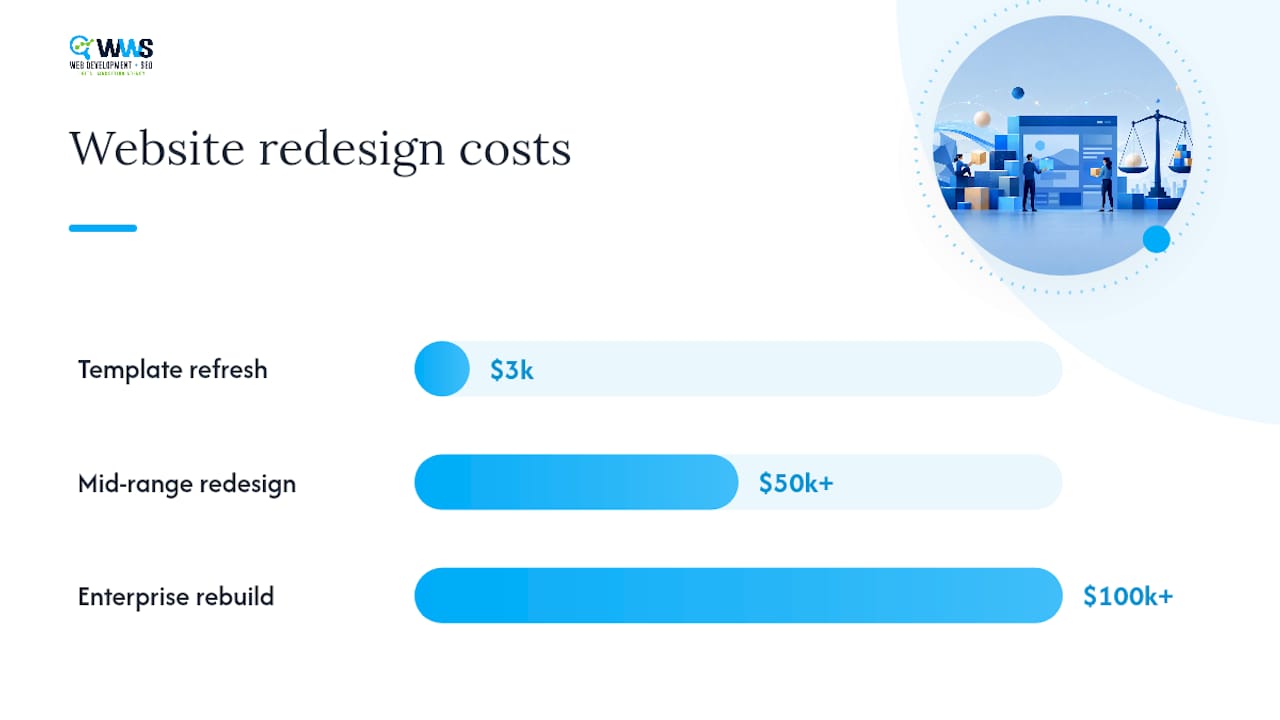
| Match tier to real scope | Template refreshes run $3,000 to $15,000; mid-range redesigns run $15,000 to $50,000; enterprise builds often exceed $100,000. |
| Budget for hidden costs upfront | Content creation, SEO migration, and post-launch support are the three most commonly underscoped line items. |
| Content readiness sets the timeline | Delayed copy or photography delays launch more often than design or development delays do. |
| WWS bundles the whole build in-house | WWS – Web Development + SEO handles design, development, and SEO migration under one certified team, with post-launch retainers built into the plan. |
Table of Contents
- How Much Does a Website Redesign Cost by Tier?
- What Drives a Website Redesign Quote Up or Down?
- What Line Items Should Appear in a Redesign Quote?
- How Long Does a Website Redesign Take, and How Does Timeline Affect Cost?
- How Can You Cut Redesign Costs Without Hurting Performance?
- What Should You Ask an Agency Before Signing a Quote?
- Why WWS’s In-House Process Changes the Budget Conversation
- What the Data Actually Tells Buyers to Prioritize
- Get a Redesign Budget Built Around Your Business, Not a Template
- Sources
- FAQ
How Much Does a Website Redesign Cost by Tier?
Redesign pricing splits into four rough tiers, and knowing which one applies to your business saves you from comparing quotes that were never meant to be compared.
- Template refresh ($3,000 to $15,000). A designer customizes an existing theme, updates copy and images, and cleans up navigation. Good for a five to ten page brochure site with no custom functionality.
- SMB or mid-range redesign ($15,000 to $50,000). This is where most local service businesses land. It includes custom design, a handful of unique templates, basic integrations (booking forms, CRM sync, review widgets), and content migration.
- Advanced or custom build ($50,000 to $100,000). Expect a design system, multiple content types, e-commerce or membership functionality, and deeper API work. Discovery and UX research get real budget here, not an afterthought.
- Enterprise or full replatform ($100,000+). Large content libraries, multi-language support, headless CMS architecture, and compliance requirements (ADA, HIPAA, PCI) push cost well past six figures.
Agencies quote ranges instead of flat prices because two projects at the “same” page count can differ wildly in labor hours. A 20-page site with a single template and stock content might cost a third of a 20-page site with custom illustrations, a booking engine, and a CRM integration. Page count is a rough proxy for cost, not the driver itself. The actual driver is how much of the work is unique versus repeatable, a distinction covered further in the website design process most agencies follow when scoping a project.
What Drives a Website Redesign Quote Up or Down?
Six variables move a quote more than anything else, and understanding them lets you negotiate scope instead of just negotiating price.
- Page count and template uniqueness. Ten pages built from three reusable templates costs far less than ten pages that each need custom layout work.
- Custom functionality and integrations. CRM connections, e-commerce checkout, client portals, and third-party APIs each add development hours and, often, licensing fees for certified integrations that show up separately from the build estimate.
- CMS choice and migration complexity. Moving from WordPress to WordPress is simple. Moving from a legacy custom system to a modern CMS with thousands of pages of content is not.
- Design depth. A basic design pass costs less than a full design system with documented components, motion design, and custom iconography.
- SEO migration risk. Sites with existing organic traffic need redirect mapping and schema preservation, or they risk losing rankings built over years.
- Accessibility and compliance. ADA-compliant color contrast, keyboard navigation, and screen-reader support add QA hours that budget-tier quotes often skip.
The line item most commonly underscoped is SEO migration. A budget guide from Refact notes that sites with established organic traffic benefit from a standalone SEO migration budget, since missing redirects or altered URL structures can quietly erase months of search visibility. Coordinating this work with website SEO planning from the start, rather than as an afterthought, keeps rankings intact through launch.
What Line Items Should Appear in a Redesign Quote?
A complete quote reads like a project plan, not a single number. Here’s what should show up, and why skipping any of these lines usually means the real cost shows up later as a change order.
- Discovery and strategy. Stakeholder interviews, competitive analysis, and technical audits. Skipping this phase is the single biggest reason projects blow past their original budget, since decisions get made twice: once without data, once after the redesign reveals the data was needed.
- UX, information architecture, and wireframes. Low-fidelity layouts and site maps. User testing gets added here for sites with complex conversion paths, like multi-step quote forms or e-commerce checkout.
- Visual design and design systems. Full mockups, brand application, and component libraries that developers build from.
- Development. Static sites cost least; CMS-driven sites (WordPress, Webflow) sit in the middle; custom web applications with user accounts or dashboards cost the most.
- Integrations and third-party licenses. API connections, payment gateways, and any recurring software fees tied to the platform, which are covered in more depth when evaluating professional website positioning tools.
- Content: copy, photography, video. Nearly every buyer guide flags this as the most commonly underestimated line item, according to Windmark’s 2026 cost breakdown.
- Project management, QA, and user acceptance testing. Someone has to catch broken forms and cross-browser bugs before launch, not after.
- Hosting, security, and recurring subscriptions. CDN, SSL, backups, and monitoring. Weak security posture carries real financial risk, and IBM’s data breach research makes the cost of skipping this line item concrete rather than theoretical.
Pro Tip: If a quote doesn’t list discovery, content, and QA as separate line items, ask why. Quotes that bundle everything into one number make it nearly impossible to know what you’re actually paying for, or what you can trim.
How Long Does a Website Redesign Take, and How Does Timeline Affect Cost?
A template refresh typically runs four to six weeks. A mid-range redesign takes eight to fourteen weeks. Advanced custom builds run three to six months, and enterprise replatforms often stretch past six months when multiple stakeholders and compliance reviews are involved.
- Content readiness controls the schedule more than design or development does. A team that delivers final copy and images on day one moves through the whole project faster than a team still writing copy in week eight, regardless of how skilled the development team is.
- Rushing a timeline adds cost, not just stress. Compressing a fourteen-week project into eight weeks usually means running design and development in parallel instead of sequentially, which requires more staff hours and more coordination, both of which cost money.
- Phased rollouts spread cost and reduce risk. Launching core pages first (home, services, contact) and rolling out secondary pages afterward lowers the upfront bill and gets a working site live sooner.
- Contingency belongs in the initial budget, not added later. Setting aside 10% to 15% of total project cost for scope adjustments gives you room to negotiate without derailing the launch date, and it’s an easier number to defend to stakeholders than an unplanned change order.
How Can You Cut Redesign Costs Without Hurting Performance?
Cost reduction works best when it targets scope, not quality. A few tactics consistently protect the budget without gutting the outcome.
- Launch a minimum viable site with core conversion pages first, and add secondary pages (blog archives, detailed service pages, resource libraries) in a second phase.
- Customize a proven template or component library instead of commissioning a fully bespoke build, particularly for pages that don’t carry unique conversion logic.
- Bundle copywriting and SEO migration into the main project instead of treating them as add-ons quoted separately, since separate contracts often carry their own project management overhead.
- Spend where it moves a metric: lead capture forms, booking flows, and page speed. Decorative animation and custom illustration rarely move the needle the way a faster checkout or a clearer call to action does.
What Should You Ask an Agency Before Signing a Quote?
Comparing two quotes only works when both quotes cover the same scope. Ask these questions before signing anything.
- Can you itemize the scope, including what’s explicitly out of scope? A quote without an exclusions list leaves room for disagreement later about what “redesign” was supposed to include.
- What’s the SEO migration and rollback plan? You want a documented redirect map and a plan for reverting if rankings drop after launch, not a verbal assurance that “we’ll handle it.”
- Who owns the design files, code, and content after the project ends? Some agencies retain rights to custom components or lock content into a proprietary system. Get this in writing before the first invoice.
- What are the payment milestones, and what does post-launch support cost? Ask for the warranty window (30, 60, or 90 days is typical) and a real number for ongoing retainer or maintenance costs, not “we’ll figure it out.”
- Does the proposal include discovery, QA, and a rollback plan? Their absence is the clearest red flag in any quote. A proposal that jumps straight from “kickoff” to “launch” with no research or testing phase is a proposal missing real cost.
Why WWS’s In-House Process Changes the Budget Conversation
WWS – Web Development + SEO operates as a Google and Meta Partner, and every designer, developer, and SEO specialist on staff is Google and Facebook certified. Nothing gets outsourced, which means the discovery findings, the design decisions, and the SEO migration plan all stay inside one team instead of getting lost between three vendors.
The Kitchen and Bath Direct case study shows what disciplined budgeting produces in practice: a mid-market redesign scope that prioritized lead capture forms and local search visibility over decorative extras, paired with local SEO work.
The businesses that get the most from a redesign budget aren’t the ones who spend the most. They’re the ones who spend on discovery, content, and search visibility first, and treat everything else as negotiable.
WWS structures most local business engagements with a post-launch retainer covering monitoring, content updates, and ongoing SEO management, rather than a one-time build with no follow-through.
What the Data Actually Tells Buyers to Prioritize
The conventional advice on redesign budgeting treats price as the main decision point. That’s backwards. Two agencies can quote the identical $40,000 figure and deliver wildly different value, because one bundled discovery and SEO migration into that number and the other left both out, planning to bill them separately once the project started.
The research points to a clearer priority: evaluate what’s included before comparing what it costs. A quote that skips discovery isn’t cheaper. It’s the same project with the risk shifted onto you, discovered halfway through when the “simple” redesign turns out to need a CMS migration nobody scoped. Businesses with existing organic traffic have the most to lose here. An SEO migration budget isn’t optional protection; it’s the line item standing between a redesign and a traffic collapse that takes months to recover from.
If you take one thing from this guide, take this: ask what’s excluded before you ask what’s included. The exclusions list tells you more about the real cost than the price tag does.
Get a Redesign Budget Built Around Your Business, Not a Template
WWS – Web Development + SEO is the alternative to juggling separate design, development, and SEO vendors for your Chicago-area redesign. Every discovery session, design decision, and SEO migration plan stays with one certified, in-house team, so nothing gets lost in handoffs between agencies and nobody bills you twice for the same coordination work.
That matters most for local businesses in southern California, where a redesign only pays off if it also protects the search rankings that already bring in calls. WWS pairs every website design project with SEO migration planning from day one, backed by a team that’s worked with over 200 Chicago-area businesses on exactly this problem. If you’re a contractor, restaurant, or service provider in Des Plaines or the surrounding suburbs weighing a redesign budget right now, request a scoped quote for your local business and get a line-itemed proposal instead of a single number with no breakdown behind it.
Sources
For readers who want to verify these ranges independently, the Launch Day Advisors buyer’s guide and Tenet’s pricing breakdown both offer detailed tier examples. Forbes Advisor covers freelancer versus agency rate structures in more depth.
- Website Redesign Cost: 2026 Buyer’s Guide | Launch Day Advisors
- The True Website Redesign Cost in 2026 (Pricing Breakdown) | Tenet
FAQ
How Do You Redesign an Existing Website Without Losing SEO Value?
Start with a full technical audit and a redirect map for every existing URL before any design work begins, since SEO migration planning done after launch usually means recovering lost rankings instead of preserving them.

How Much Does It Cost to Hire Someone to Design Your Website?
Costs range from $3,000 for a template refresh to $50,000 or more for a mid-range custom redesign, with enterprise rebuilds often exceeding $100,000, depending on functionality and content volume.
What Is the 3 Second Rule in Website Design?
It refers to the idea that visitors form an impression of a site, and decide whether to stay, within about three seconds of the page loading, which is why page speed and clear above-the-fold messaging get prioritized in redesign budgets.
How Long Should a Website Redesign Take?
A template refresh takes four to six weeks, a mid-range redesign takes eight to fourteen weeks, and advanced custom builds typically run three to six months, with content readiness usually determining whether the timeline holds.
Should a Small Business Redesign In-House or Hire an Agency?
In-house redesigns save on agency fees but usually take longer and lack dedicated SEO expertise, while a certified in-house agency team, such as WWS – Web Development + SEO, combines design, development, and SEO migration under one contract with clearer accountability.