


Why Search Engine Marketing Leads Are the Lifeblood of Local Business Growth
Search engine marketing leads are prospects who find your business through Google and similar search engines — either through paid ads or organic results — and then take an action like calling, filling out a form, or booking a service.
If your schedule isn’t full, this is likely where the gap is.
Here’s a quick breakdown of what SEM leads are and how to get them:
| What You Want | How SEM Delivers It |
|---|---|
| More phone calls | Paid search ads targeting high-intent keywords |
| More form submissions | Optimized landing pages tied to ad campaigns |
| Consistent organic leads | SEO content that ranks and converts over time |
| Cheaper leads over time | Combined SEO + PPC strategy that compounds |
| Better lead quality | Negative keywords, intent targeting, and message matching |
Over 80% of people use search engines when looking for a product or service. That includes your future customers — right now, actively searching for what you offer.
The problem most local service businesses face isn’t a lack of demand. It’s not showing up when that demand exists.
Search engine marketing (SEM) fixes that. It puts your business in front of people at the exact moment they’re looking — whether through a paid ad at the top of Google or an organic listing that’s earned its place through SEO.
But showing up is only half the battle. The real goal is turning those clicks into qualified leads — people who actually call, book, or buy.
That’s what this guide is about.
I’m Tomasz Lasota, Digital Development and Technology Director with over 22 years of experience designing and deploying digital solutions that drive search engine marketing leads for both B2B and B2C businesses. In the sections ahead, I’ll walk you through exactly how to build an SEM strategy that fills your pipeline — not just your analytics dashboard.
Demystifying Search Engine Marketing Leads: SEO vs. PPC
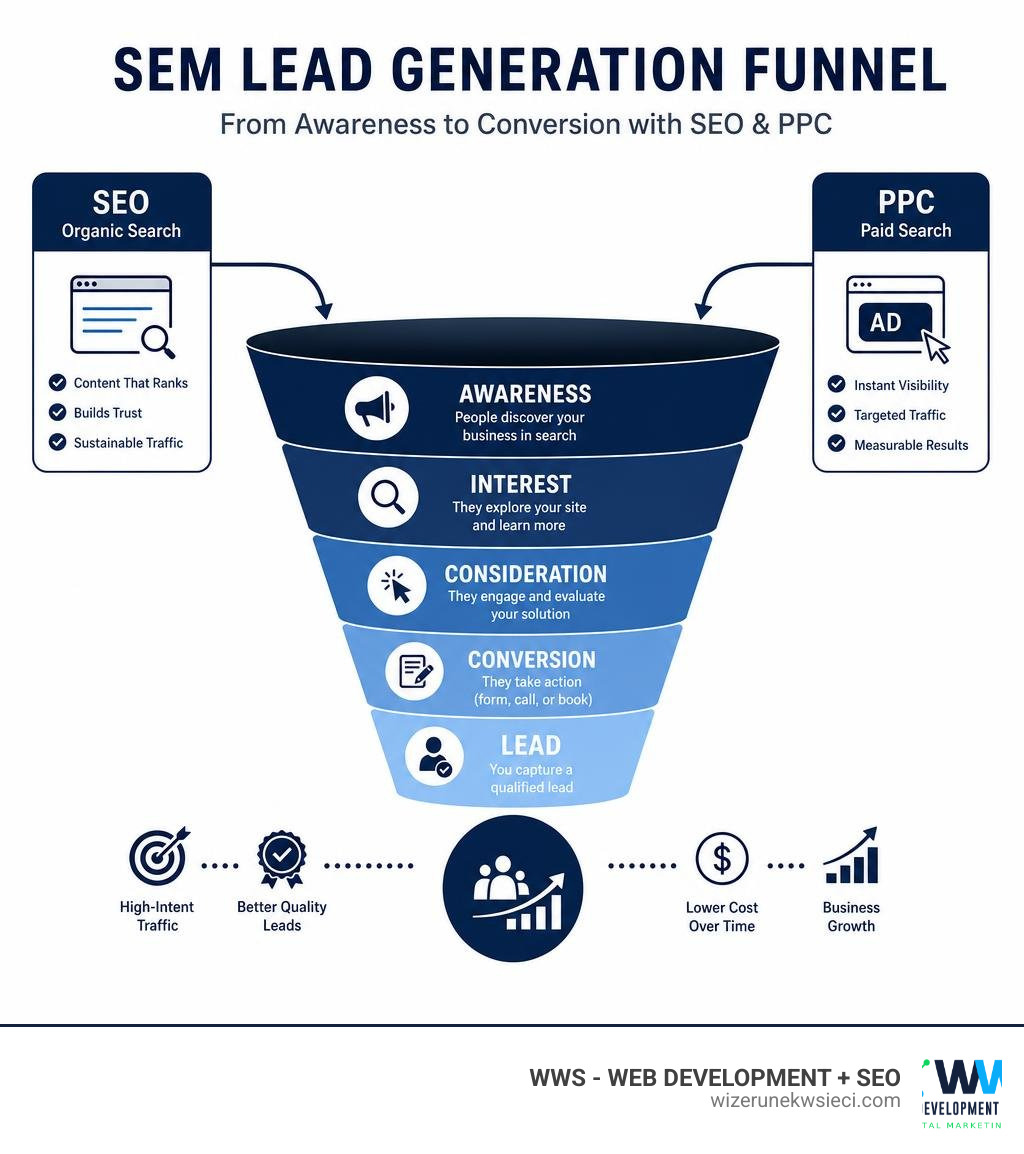
To build a highly efficient lead generation engine, we must first understand the relationship between the two primary pillars of search marketing: Search Engine Optimization (SEO) and Pay-Per-Click (PPC) advertising.
Historically, some marketers viewed these as competing channels. In reality, they are two sides of the same coin. When we talk about capturing search engine marketing leads, we are talking about a coordinated strategy that leverages both paid and organic search to dominate the search engine results pages (SERPs).

| Feature | Search Engine Optimization (SEO) | Pay-Per-Click (PPC) |
|---|---|---|
| Cost Structure | Investment in content, technical optimization, and authority building (no cost-per-click). | Direct payment to Google for every click received. |
| Speed of Results | Typically takes 3 to 6 months to generate consistent, predictable organic leads. | Can go live and generate high-intent traffic and leads within hours. |
| Long-Term ROI | Compounding returns; content continues to generate leads long after publication. | Traffic and lead flow stop the moment the ad budget is paused. |
| SERP Real Estate | Appears in the organic “blue links,” local map packs, and featured snippets. | Appears at the very top and bottom of the SERP, labeled as “Sponsored.” |
Defining SEM in 2026
In modern digital marketing, the definition of Search Engine Marketing has evolved. While some industry veterans historically used SEM as an umbrella term for both paid and organic search, the modern consensus restricts SEM primarily to paid search activities, such as Google Ads.
However, at Wizerunek w Sieci (WWS), we believe that separating paid and organic search into isolated silos is a costly mistake.
Paid search campaigns rely on sponsored listings to capture immediate traffic. With Google maintaining a commanding 90.39% global search market share as of June 2026, bidding on these sponsored placements is the fastest way to get your local business noticed in Chicago, Des Plaines, or the broader Illinois market.
To learn more about structuring these paid efforts for maximum return, explore our guide on Paid Campaigns.
How to Attract High-Intent Search Engine Marketing Leads
Generating leads is not merely a game of driving raw traffic. If you drive 10,000 visitors to your website but none of them call your office or request a quote, your campaign is a failure. True success lies in capturing high-intent searchers.
When someone in Des Plaines searches for “emergency plumber near me” or “best tax accountant in Chicago,” they are exhibiting immediate, high-intent behavior. They do not want to read a 5,000-word blog post about the history of copper piping; they want to speak with a professional immediately.
By structuring our campaigns around these specific commercial-intent search queries, we ensure that our budget is spent on clicks that actually convert. For local service businesses, targeting these localized, urgent queries is the absolute foundation of successful Local SEO and paid search integration.
The Power of a Unified SEM Strategy: Combining SEO and PPC
The magic happens when you stop treating SEO and PPC as separate budgets and start running them as a unified search marketing strategy. 69% of marketers report that new-customer acquisition is getting harder due to deeper, more independent buyer research. To combat this, businesses must establish a omnipresent search footprint.
Coordinating your organic and paid search efforts allows you to run highly effective Marketing Campaigns that protect your brand, lower your overall cost per acquisition, and maximize your conversion rates.
Synergy in Action: Visibility and Trust
When a prospective customer searches for a service in Chicago and sees your business name in a paid ad at the top of the page, and as the top listing in the local map pack, and as the first organic result, something powerful happens. This is known as SERP dominance.
This multi-touch visibility significantly boosts your brand trust and overall click-through rates (CTR). Consumers subconsciously perceive businesses with multiple listings on a single page as the absolute authority in their space.
This concept, known as “search perception impact,” means your organic search presence actually improves the performance of your paid ads, and vice versa.
Consider the real-world impact: a private religious university in Louisiana integrated their SEO and PPC efforts, resulting in a staggering 138% increase in total paid conversions and a 159% increase in organic traffic. By coordinating messaging and keyword targets, they dominated their niche’s search results and built an incredibly efficient enrollment funnel.
Sharing Keyword Insights and Retargeting
One of the most immediate benefits of a unified SEM strategy is the rapid exchange of data. SEO takes time to show results, which makes testing new target keywords organically a slow process.
PPC, however, provides instant feedback. By running paid search campaigns on highly specific, long-tail keywords, we can determine within weeks which terms actually drive phone calls and form submissions. Once we identify these high-converting goldmines, we can immediately pass that data to our SEO team to build long-term organic rankings around those exact terms.
Furthermore, we can leverage paid retargeting to re-engage the high-quality organic traffic we attract. If a user finds your Des Plaines local business through an organic search, reads your service page, but leaves without filling out a form, we can use Google Display or YouTube retargeting ads to stay top-of-mind. This ensures that the organic traffic you worked so hard to earn doesn’t go to waste.
Effective Keyword Strategies for Capturing Search Engine Marketing Leads
Keyword strategy is where most local businesses lose money. Bidding on broad, highly competitive terms like “plumber” or “lawyer” in a major metro area like Chicago will quickly drain your budget on unqualified clicks from people who are just looking for DIY advice or career information.
To prevent this, you must build a highly targeted keyword framework. You can read more about Google’s official recommendations in their guide on Best practices for generating high-quality leads – Google Ads Help .
Mapping Keywords to the Student and Buyer Journey
Whether you are trying to attract prospective students to a local educational program or homeowners to a local home service business, you must map your keywords to the exact stages of the buyer’s journey:
- Top of Funnel (TOFU) – Awareness: Users are identifying a problem. Keywords are educational (e.g., “why is my basement damp”).
- Middle of Funnel (MOFU) – Consideration: Users are evaluating solutions. Keywords are comparison-based (e.g., “french drain vs sump pump”).
- Bottom of Funnel (BOFU) – Decision: Users are ready to buy. Keywords are highly commercial and transactional (e.g., “sump pump installation Des Plaines IL”).
For local service businesses, we focus the vast majority of our initial PPC budget on BOFU keywords to secure immediate leads, while using our Website SEO strategy to build out content that captures TOFU and MOFU searchers over the long term.
Structuring Campaigns for Maximum Relevance
To achieve a high Quality Score in Google Ads — which directly lowers your cost-per-click (CPC) and improves your ad placement — you must organize your campaigns into tightly themed ad groups.
If you run an HVAC company in Chicago, do not lump “AC repair” and “furnace installation” into the same ad group. Create separate ad groups for each service. This allows you to write highly specific ad copy that matches the exact search intent of the user.
Additionally, you must master keyword match types:
- Exact Match: Captures searches that match the exact meaning of your keyword. Highly relevant, lower volume.
- Phrase Match: Captures searches that include the meaning of your keyword. Great balance of reach and control.
- Broad Match: Captures related searches. Use this with caution, and only when paired with Google’s Smart Bidding and a robust list of negative keywords.
Negative keywords are your best friend. By adding terms like “free,” “jobs,” “salary,” or “course” to your negative keyword list, you prevent your ads from showing to unqualified searchers, saving you hundreds of dollars in wasted ad spend every single month.
Optimizing Landing Pages and Content for Maximum Conversions
Generating the click is only half the battle. If your landing page is slow, confusing, or doesn’t match the promise of your ad, the user will hit the back button, and you will have paid for a wasted click.

Aligning Messaging and Branding Across Channels
To maximize your conversion rates, you must maintain absolute message match between your search ad and your landing page. If your Google Ad promises a “10% Off First Plumbing Service in Chicago,” that exact offer must be prominently displayed above the fold on the landing page.
If the user has to hunt for the offer, they will leave.
Infuse your brand personality consistently across all touchpoints. Use clear, problem-oriented headlines that speak directly to the searcher’s pain points, and back up your claims with strong trust signals like local reviews, industry certifications, and clear social proof.
Technical and Content Best Practices for SEO and PPC
A high-converting landing page must satisfy both search engine algorithms and human visitors. Here are the core technical and content standards we implement:
- Page Speed: Your page must load in under 3 seconds. For every second of delay, your conversion rate drops significantly.
- Mobile Responsiveness: Over 60% of search traffic comes from mobile devices. Your lead forms must be incredibly easy to fill out on a smartphone.
- Frictionless Lead Forms: Keep your forms as short as possible. Every additional field you add can reduce conversions by 5% to 10%. Only ask for the essentials: Name, Email, Phone, and one qualifying question (e.g., “How can we help?”).
- Clear Call to Action (CTA): Use a single, high-contrast CTA button (e.g., “Get My Free Quote” or “Schedule Service Now”) that remains visible as the user scrolls.
For businesses looking to scale their lead generation across multiple Google channels using artificial intelligence, we highly recommend reviewing the Performance Max best practices for lead generation – Google Ads Help .
Navigating the Future: AI, GEO, and Modern Lead Generation
The search landscape is undergoing its most radical transformation in decades. As of June 2026, generative search and AI-driven search experiences are completely reshaping how consumers find local businesses.
Marketers must adapt to this new reality. To stay ahead of these rapid shifts, working with leading Chicago SEO Agencies: Your Guide to Ranking Up is essential for maintaining your search footprint.
The Rise of Generative Engine Optimization (GEO)
With 94% of B2B buyers now using AI tools during their purchasing journey, and Google’s AI Overviews dominating transactional search queries, traditional SEO is expanding into Generative Engine Optimization (GEO).
GEO is the practice of optimizing your online presence so that Large Language Models (LLMs) like Gemini, ChatGPT, and Claude recommend your brand when users ask conversational questions.
To win in the age of GEO, your website content must be highly structured for machine readability. This means implementing advanced schema markup, focusing on entity-first SEO (aligning your content with Google’s Knowledge Graph), and actively managing your off-domain reputation.
LLMs continuously analyze third-party review sites, directories, and social mentions to gauge brand sentiment. If you want AI search engines to recommend your Des Plaines local business, you must maintain a spotless reputation across the entire web.
Measuring the Success of Your Search Engine Marketing Leads
In 2026, measuring success purely through website traffic or click-through rates is an outdated approach. To build a highly profitable lead generation engine, you must track revenue-focused metrics.
The gold standard of modern tracking is Offline Conversion Tracking (OCT) integrated with your CRM. By capturing the unique Google Click Identifier (GCLID) when a lead fills out a form on your website, we can track that prospect through your entire sales pipeline.
When that lead progresses from a “Qualified Lead” to a “Closed-Won Deal,” we automatically feed that data back into Google Ads.
This training data allows Google’s machine learning bidding algorithms to optimize for actual revenue and closed sales, rather than just cheap, low-quality form fills. This feedback loop is the ultimate secret to driving down your cost per qualified lead while scaling your business growth.
Frequently Asked Questions about Search Engine Marketing Leads
How long does it take for SEO and PPC to generate measurable leads and ROI?
PPC is designed for immediate results. Once your Google Ads campaigns are set up and approved, you can start driving high-intent traffic and capturing search engine marketing leads within 24 to 48 hours. However, keep in mind that Google’s automated bidding strategies require a “learning phase” of about 1 to 2 weeks to stabilize performance.
SEO, on the other hand, is a long-term investment. It typically takes 3 to 6 months of consistent content optimization, technical fixes, and local authority building to rank on the first page of organic results and generate predictable, compounding organic leads.
Why is my organic traffic high but my lead conversion low?
High traffic with low conversions usually points to a mismatch between user intent and your landing page experience. If you are ranking organically for broad, informational keywords, those visitors may just be looking for free information rather than ready to hire a professional.
Other common culprits include missing or unclear Calls to Action (CTAs), slow page load times, complex lead forms that create friction, or a lack of trust signals like reviews and case studies on your service pages.
Should I use Google Ads lead form extensions or landing pages?
We recommend using both, but for different offers. Google Ads lead form extensions are excellent for low-friction, top-of-funnel offers like downloading a free guide, a checklist, or a coupon, as they allow users to submit their information directly from the search results page.
However, for high-consideration local services (like residential remodeling or professional accounting), a dedicated, highly optimized landing page is far superior. A landing page allows you to educate the prospect, build trust with reviews and photos, and pre-qualify the lead before they submit their contact details.
Conclusion: Partner with Chicago’s Integrated Search Experts
Building a highly efficient system to capture search engine marketing leads is not a set-it-and-forget-it project. It requires deep technical expertise, continuous optimization, and a unified strategy that bridges the gap between paid ads, organic SEO, and conversion-focused web design.
At Wizerunek w Sieci (WWS), we specialize in helping local service businesses in Des Plaines IL, Chicago IL, and throughout Illinois generate highly qualified leads that turn into paying customers. We don’t just chase vanity metrics like clicks and impressions; we build conversion-focused digital engines designed to grow your bottom line.
Ready to dominate your local search market and fill your calendar with high-quality leads?
- To learn more about our tailored organic strategies, explore our SEO Services Packages Chicago.
- Check out how we compare to other leading local agencies in our guide on Chicago Marketing Agencies Who’s Hot Right Now.
- Discover why partnering with local search specialists is your best path to growth by reading how to Boost Your Business with Expert SEO Chicago Services.
Take the first step toward predictable, scalable business growth today. Get started with Website SEO and let Wizerunek w Sieci build the ultimate lead generation engine for your business.