




What Factors Most Significantly Influence Web Development Pricing?
A professional website typically costs between $2,500 and $8,500 for a standard small business service website, while custom e-commerce stores and advanced platforms range from $5,000 to $25,000+. Professional web development pricing is driven by structural complexity, custom functionality, and technical depth required to help your business win customers in competitive markets like Chicago and the surrounding suburbs.
1. Scope, Architecture, and Page Volume
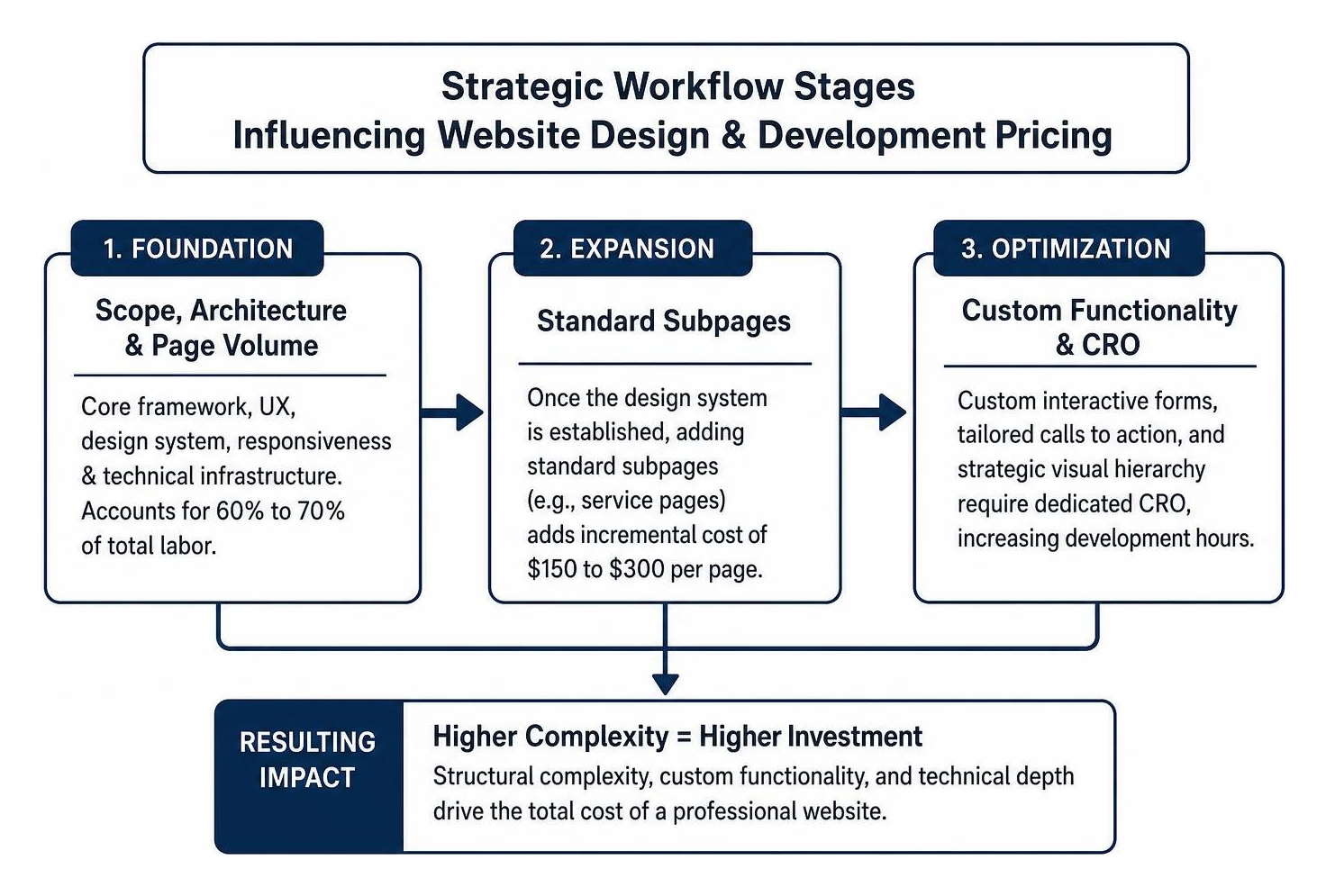
A common misconception among business owners is assuming a 10-page website costs exactly twice as much as a 5-page site. In reality, the foundation—setting up the core framework, user experience (UX) wireframing, typography, global styling, responsiveness, and technical infrastructure—accounts for 60% to 70% of total labor.
Once the primary design system is established, expanding standard subpages (such as individual service landing pages) generally adds an incremental cost of $150 to $300 per page. However, creating high-converting lead generation websites with custom interactive forms, tailored calls to action, and strategic visual hierarchy requires dedicated conversion rate optimization (CRO), which increases development hours.
2. Custom-Coded Builds vs. Flexible Content Management Systems (CMS)
The platform you select dictates both upfront development time and long-term operating flexibility:
- Custom CMS Development (e.g., WordPress, Webflow, Shopify): Typically ranges from $2,500 to $15,000+. WordPress powers over 43% of the internet because it offers complete data ownership, unlimited scalability, and zero monthly platform lock-in fees. Building a custom WordPress theme ensures lightweight, clean code tailored precisely to your brand.
- Bespoke Full-Stack Web Applications (React, Next.js, Node.js): These projects start at $25,000 to $80,000+. Fully custom-coded web applications are built for enterprise platforms requiring proprietary databases, complex user portals, or heavy real-time data synchronization.
3. Third-Party Integrations and Advanced Functionality
A simple informational brochure site requires far fewer development hours than a site that automates your daily operations. Common advanced features that adjust project pricing include:
- Custom Booking & Scheduling: Adding seamless website booking integration allows clients in Des Plaines, Schaumburg, or Naperville to schedule consultations directly into your calendar ($300–$1,500).
- CRM & Email Marketing Syncing: Integrating dynamic lead forms directly with platforms like HubSpot, Salesforce, or Mailchimp ($300–$1,200).
- Bilingual or Multi-Language Capabilities: Implementing structured multi-language switchers (such as English and Polish for businesses serving the Chicago Polonia community) requires dedicated URL routing, hreflang tags, and localized navigation ($500–$2,500).
4. Content Creation, Copywriting, and Visual Assets
Content readiness is the single most common cause of project delays and budget inflation. Supplying your own polished text, high-resolution photography, and brand vector files keeps costs at the lower end of a proposal. If your web partner provides strategic SEO copywriting, custom iconography, or commercial brand styling, expect to invest an additional $1,000 to $4,000 in professional asset creation.
5. Preserving Existing Authority During a Website Redesign
If your company already has an active digital presence, your website redesign cost must account for search equity protection. A strategic redesign involves auditing legacy URLs, mapping 301 redirects, preserving historic backlink equity, and structuring Core Web Vitals optimizations so you do not lose existing Google search rankings when the new site launches.
How Much Does a Custom E-Commerce Website Cost Compared to a Service Website?
An e-commerce website involves dynamic product databases, secure financial transactions, automated inventory tracking, and checkout funnel optimization. Consequently, building a professional online store requires a larger upfront investment than a standard service-based business site.
- Standard Small Business Service Website: $2,500 to $8,500. Focuses on communicating your value proposition, displaying client reviews, detailing specific service offerings across local Chicagoland suburbs, and driving inbound phone calls or quote inquiries.
- Custom E-Commerce Store (Shopify or WooCommerce): $5,000 to $25,000+. Covers detailed catalog structuring, automated tax and shipping calculations, merchant gateway security, customer accounts, transactional email automations, and cart abandonment recovery workflows.
- High-Volume Enterprise E-Commerce: $25,000 to $75,000+. Required for multi-warehouse management, ERP syncing, customized product filtering systems, and high-concurrency traffic handling.
How Do Freelancer Rates Compare to Web Design Agency Pricing?
When sourcing quotes from web developers in the Chicago area or nationally, you will encounter diverse pricing tiers and billing methodologies.
Hourly Rates vs. Fixed-Project Milestone Pricing
Developers typically bill under one of two pricing structures:
- Hourly Rates: According to national industry benchmarks in the 2026 Website Developer Cost guide, web developer hourly rates range between $25 and $85 per hour for mid-level developers, reaching $95 to $150+ per hour for senior technical specialists and agency leads. While hourly billing can work well for minor bug fixes or ad-hoc tasks, open-ended hourly contracts introduce the risk of scope creep and unexpected billing overruns on full builds.
- Fixed-Fee Milestone Pricing: This is our standard approach at WWS. A fixed-scope proposal outlines every deliverable, wireframe phase, integration, and revision round upfront. You know the exact financial commitment before development begins, with payments tied directly to completed project milestones (such as initial design approval, staging site deployment, and final launch).
Comparing Developer Hiring Models
| Provider Type | Typical Price Range | Average Turnaround | Best Suited For | Key Considerations |
|---|---|---|---|---|
| Marketplace Freelancer | $500 – $2,500 | 1 – 3 weeks | Micro-projects, template tweaks | Often lacks strategic UX, technical SEO, or post-launch support |
| Senior Independent Developer | $2,000 – $8,000 | 3 – 6 weeks | Small business sites, custom redesigns | Direct communication, high technical skill, limited capacity |
| Boutique Digital Agency (WWS) | $4,500 – $20,000 | 4 – 8 weeks | Growing local businesses, competitive lead gen | Comprehensive strategy, custom coding, built-in SEO, dedicated support |
| Large Corporate Agency | $20,000 – $75,000+ | 12 – 24+ weeks | Large enterprises, national consumer brands | High overhead, complex project management layers, slower delivery |
Hiring a boutique digital agency offers the balance many small-to-midsize businesses need: the collaborative, personalized attention of a dedicated senior developer paired with the technical resources, SEO capabilities, and marketing focus of a full-service agency.
What Hidden and Ongoing Costs Should You Budget for After Launch?
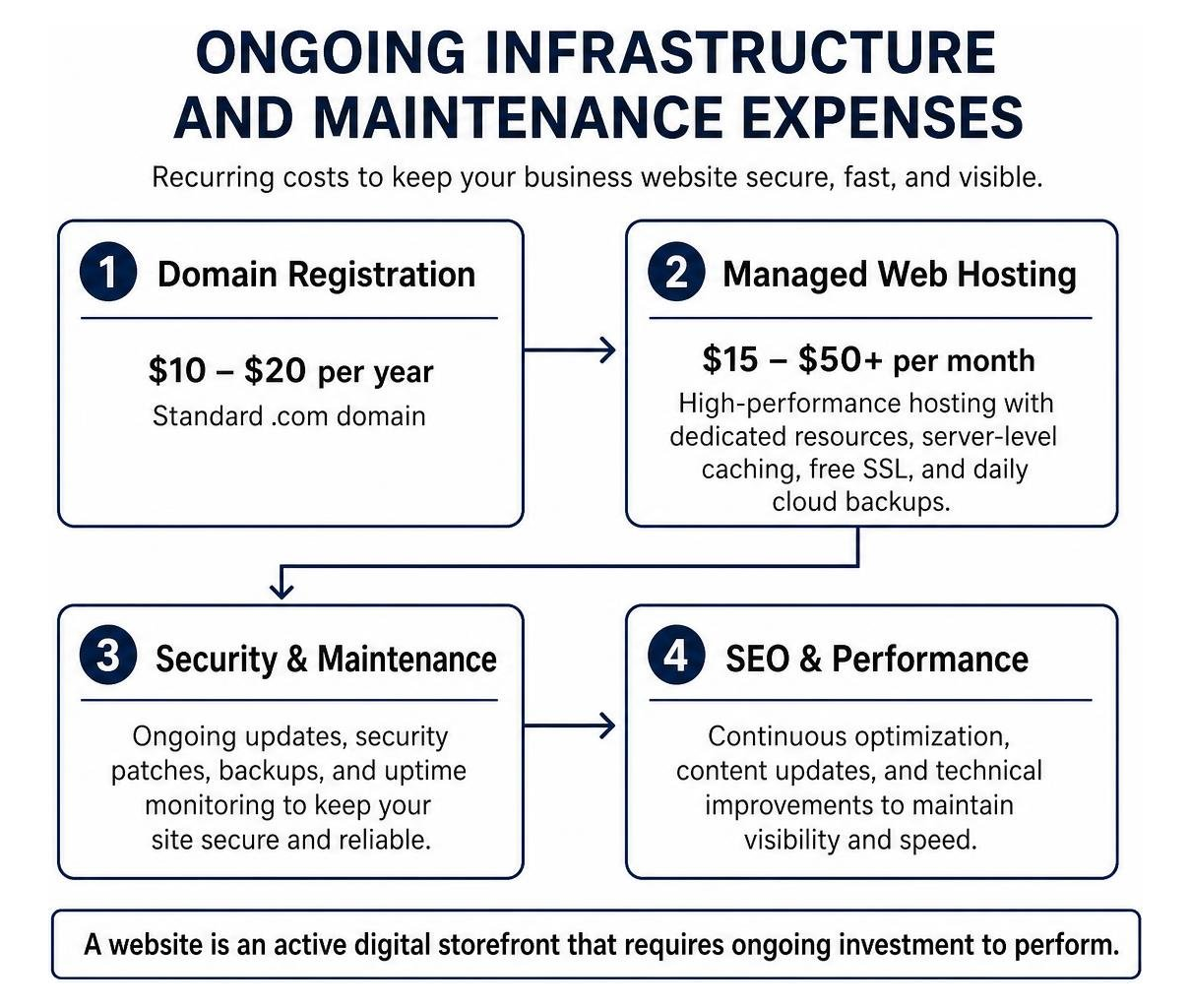
A website is an active digital storefront that requires ongoing maintenance, security, and optimization to remain secure, fast, and visible in search engines.
When reviewing data from the Website Design Cost in USA 2026 — Full Pricing Guide, business owners should factor the following recurring expenses into their annual operating budget:
1. Domain Registration and Managed Web Hosting
- Domain Name Registration: $10 to $20 per year for a standard
.comdomain. - Premium Managed Web Hosting: $15 to $50+ per month. While budget shared hosting is available for a few dollars, it forces your website to share server resources with thousands of unrelated sites, leading to slow load times and security vulnerabilities. Our high-performance managed hosting infrastructure delivers dedicated server resources, server-level caching, free SSL certificates, and daily automated cloud backups.
2. Routine Software Maintenance and Security Patching
Modern content management systems and their underlying server environments require regular software updates. Budgeting $50 to $200 per month for professional maintenance covers:
- Weekly core, theme, and plugin security updates performed in a staging environment.
- 24/7 uptime monitoring and automated malware scanning via Web Application Firewalls (WAF).
- Database optimization to prevent bloat and maintain rapid database query speeds.
- Routine disaster recovery testing to ensure full backups can be restored instantly if an issue occurs.
3. Foundational Search Engine Optimization and Visibility
Launching a beautifully designed website will not generate revenue if prospective customers cannot find it on Google. Incorporating foundational SEO web design during the initial build ensures that proper heading hierarchies (H1–H3), Open Graph data, schema markup, semantic HTML, XML sitemaps, and mobile viewport optimizations are baked directly into your codebase.
To capture market share in competitive service sectors across Cook County and the Chicago metropolitan area, businesses frequently pair their new build with continuous website SEO services ($500 to $2,500+ per month), focusing on localized keyword rankings, Google Business Profile optimization, technical audits, and content expansion.
How Can You Find and Vet Top-Rated Web Developers in Your Local Area?
Working with a local web development agency provides substantial strategic advantages over hiring distant offshore contractors or impersonal national service mills.

A local partner understands the regional business climate, local search intent, and geographic service boundaries. When evaluating local web design companies in the Chicago suburbs, use this vetting checklist before signing an agreement:
- Verify Live Production Websites: Do not settle for static screenshots or design mockups. Request links to live, functioning client sites so you can test real-world mobile responsiveness, page speed on Google PageSpeed Insights, and interactive usability.
- Demand 100% Asset and Code Ownership: Ensure your contract explicitly states that upon final payment, your business retains full legal ownership of the domain, custom code, graphic assets, database, and hosting accounts.
- Evaluate Local Search Expertise: Discover how a local web designer can help your business structure location-specific landing pages. A developer familiar with Chicagoland will understand how to build geo-targeted architectures that capture searchers in Arlington Heights, Park Ridge, Mount Prospect, Schaumburg, Glenview, and beyond.
- Require Clear Communication Channels: Ensure you have direct access to the actual team building your site, rather than being routed through outsourced ticketing queues or junior account managers.
Why Chicagoland Businesses Choose WWS
At Wizerunek w Sieci (WWS — Web Development + SEO), founded by Tomasz Lasota, we have spent more than two decades designing custom, high-converting digital platforms for small-to-medium businesses, trade contractors, healthcare providers, legal professionals, and entrepreneurs across the Chicago metropolitan area, Cook County, Lake County, and nationwide.
Headquartered at 636 S River Rd #218, Des Plaines, IL 60016, our boutique team combines enterprise-grade technical coding with hands-on, personalized service. We are proud of our deep roots in the Polish-American community (Polonia Chicago), offering full bilingual capabilities (English and Polish) to help businesses communicate with diverse consumer bases. We treat every client’s business with the meticulous attention to detail we give our own.
Our tailored local business website design solutions are engineered from day one for maximum search engine visibility, rapid load times, intuitive mobile usability, and measurable customer acquisition.
What Are the Most Frequently Asked Questions About Website Pricing?
Is It Cheaper to Redesign an Existing Website or Build a New One from Scratch?
It depends on the quality of your existing codebase. If your website is built on a clean, modern CMS and simply requires updated typography, fresh brand imagery, and reorganized page sections, a visual refresh is generally 20% to 40% less expensive than a ground-up build.
However, if your site relies on an outdated theme, bloated visual builder plugins, deprecated PHP versions, or messy legacy code, attempting to patch the old framework often costs more billable hours than starting fresh. A clean build allows our developers to implement streamlined code, modern Core Web Vitals optimizations, and an updated mobile structure without inheriting legacy technical debt.
What Should a Small Business Expect to Pay for Monthly Website Maintenance?
For most small-to-medium businesses, a monthly maintenance retainer between $50 and $200 per month provides complete peace of mind. This investment covers managed cloud backups, active plugin and core updates, uptime monitoring, security firewalls, and minor monthly content tweaks. Proactive maintenance prevents security vulnerabilities, broken forms, and downtime that could cost thousands of dollars in lost customer inquiries.
What Is the Typical Timeline for Developing a Professional Custom Website?
- Focused Landing Pages & Microsites: 1 to 2 weeks.
- Standard 5 to 10-Page Small Business Websites: 4 to 8 weeks.
- Custom E-Commerce & Complex Web Applications: 8 to 16 weeks.
Production timelines depend heavily on client collaboration. Providing your branding assets, photography, and text content promptly, combined with fast feedback during concept review rounds, ensures your project launches on schedule.
How Should You Budget for Your Next Web Design Project?
Budgeting for a website comes down to viewing the build as an active revenue generator rather than an overhead expense. A well-engineered website serves as your 24/7 sales representative—establishing credibility, answering customer questions, and converting organic search visitors into paying clients.
Before requesting proposals, run through this practical preparation checklist:
- Clarify Your Primary Goal: Are you looking to generate local phone calls, capture email leads, book service appointments, or sell physical products directly online?
- Determine Your Page Requirements: Outline your core pages (e.g., Home, About, Individual Service Pages, Case Studies/Gallery, Contact, Service Area Landing Pages).
- Gather Existing Assets: Collect your logo files, high-resolution job photos, customer testimonials, and core service descriptions.
- Define Your Launch Timeline: Establish realistic deadlines that provide sufficient time for proper design, technical development, SEO audits, and pre-launch quality assurance testing.
If you are ready to invest in a fast, secure, and search-optimized digital platform that drives real business growth, contact our team at WWS — Web Development + SEO.
Visit wizerunekwsieci.com to claim your free website audit and consultation. Let us build a high-performing website design tailored to elevate your business across Chicagoland and beyond.