

What Qualities Define the Top-Performing Advertising Agencies for Paid Ads and Social Media?
Finding the right digital advertising agency nearby can mean the difference between a high-performing lead generation engine and thousands of dollars wasted on unqualified clicks. When business owners search for top-performing partners to manage their paid media, they often encounter flashy sales presentations and broad marketing jargon. However, true performance marketing comes down to a clear, three-question evaluation framework:
- Can they do it? Do they possess deep, hands-on technical skill across paid platforms, or are they a generalist firm spreading themselves thin across disconnected services?
- Can they prove it? Can they demonstrate verifiable results with data, client longevity, and vertical-specific case studies?
- Can you afford it? Do their pricing structure and contract terms align with your cash flow and protect your business from unnecessary risk?
Top-performing agencies distinguish themselves by specializing in high-return Paid Campaigns that combine commercial search capture with multi-platform paid social nurturing. Instead of treating Google Ads and social channels as separate silos, elite teams orchestrate them into an integrated growth engine.
Hands-On Technical Specialization
The digital advertising landscape evolves constantly. Platforms update machine-learning algorithms, bidding strategies, and audience targeting rules on a monthly basis. High-performing boutique agencies thrive because their leadership and senior specialists remain directly involved in day-to-day account optimization.
In contrast, large legacy agencies often assign high-ticket sales directors to close deals before handing actual campaign execution off to entry-level coordinators or outsourced contractors. This disconnect leads to uninspired keyword targeting, broad-match budget waste, and cookie-cutter social media ad sets. Top performers maintain rigorous technical standards across Google Search, Shopping, Performance Max, Meta Ads, and dynamic video channels to keep client accounts lean and profitable.
Account Ownership and Full Data Transparency
A major standard that separates trustworthy agencies from bad actors is account ownership. You must always retain 100% administrative ownership of your Google Ads accounts, Google Tag Manager containers, Google Analytics 4 properties, and Meta Business Managers.
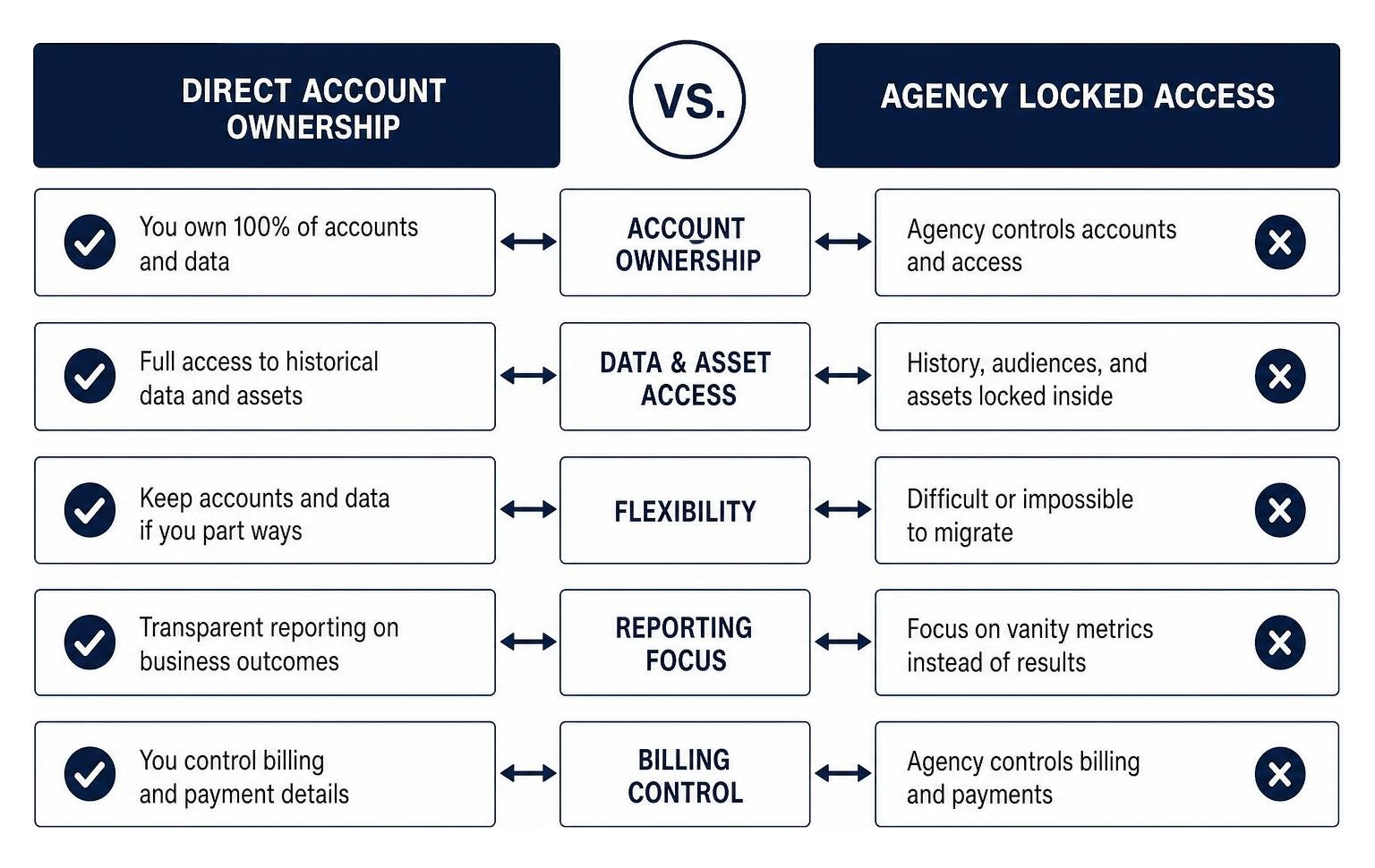
Some agencies attempt to lock businesses into proprietary master accounts, preventing clients from accessing historical conversion metrics, search query logs, or custom audience lists if they ever choose to part ways. Top performers operate with total transparency. We believe you should always own your historical data, creative assets, and billing setup. Regular reporting should highlight meaningful business metrics—such as qualified phone calls, cost per acquisition (CPA), return on ad spend (ROAS), and net revenue—rather than vanity metrics like raw impressions.
How Can You Verify an Agency’s Track Record and Proven Claims?
Anyone can assemble a polished portfolio of cherry-picked statistics. To find an agency that genuinely moves the needle, business owners must dig past surface-level marketing claims and evaluate verifiable performance benchmarks.

When vetting local agencies, focus on tangible proof of competence in your specific business model. For service-based firms and lead generation, an agency should understand local buying behavior and local bidding nuances, such as those detailed in A Quick Start Guide to Google Ads for Local Businesses. If you operate within specialized, competitive markets, ask how they build dedicated funnels, similar to the frameworks explored in Google Ads for Realtors: A Guide to High-Intent Lead Generation.
Validating Client Retention and Real Performance Data
The single most reliable indicator of agency performance is client longevity. Ask prospective agencies: “Who is your longest-standing active client, and what is your average client retention rate?”
Agencies that rely on rapid client churn and aggressive outbound sales usually lose clients after three to six months due to poor campaign optimization. Conversely, agencies that retain clients for two, three, or five-plus years consistently produce profitable returns. When examining case studies, look for detailed breakdowns that explain:
- The initial baseline metrics (cost per lead, conversion rate, wasted spend)
- The concrete technical strategies implemented to resolve the problem
- The resulting cost per acquisition (CPA) and customer lifetime value (LTV) improvements over time
Strategic Reference Outreach
One of the most effective ways to assess an agency is to speak directly with their existing or past clients. When speaking with a reference, avoid asking generic questions like “Are they good?” which often elicit polite, non-committal answers. Instead, ask specific, non-confrontational questions that reveal how the agency operates during day-to-day management:
- What does this agency do particularly well compared to other providers you have used?
- How proactive is their communication when a campaign faces market shifts or seasonal downturns?
- Do they provide clear explanations of what is working and what isn’t on your monthly reports?
- Who handles your account directly, and how quickly do they implement critical campaign changes?
- If you could change one aspect of how they manage your campaigns, what would it be?
These targeted questions allow references to speak comfortably while giving you an unvarnished view of the agency’s work ethic, responsiveness, and technical capability.
Which Agency Pricing Model and Contract Structure Best Fits Your Budget?
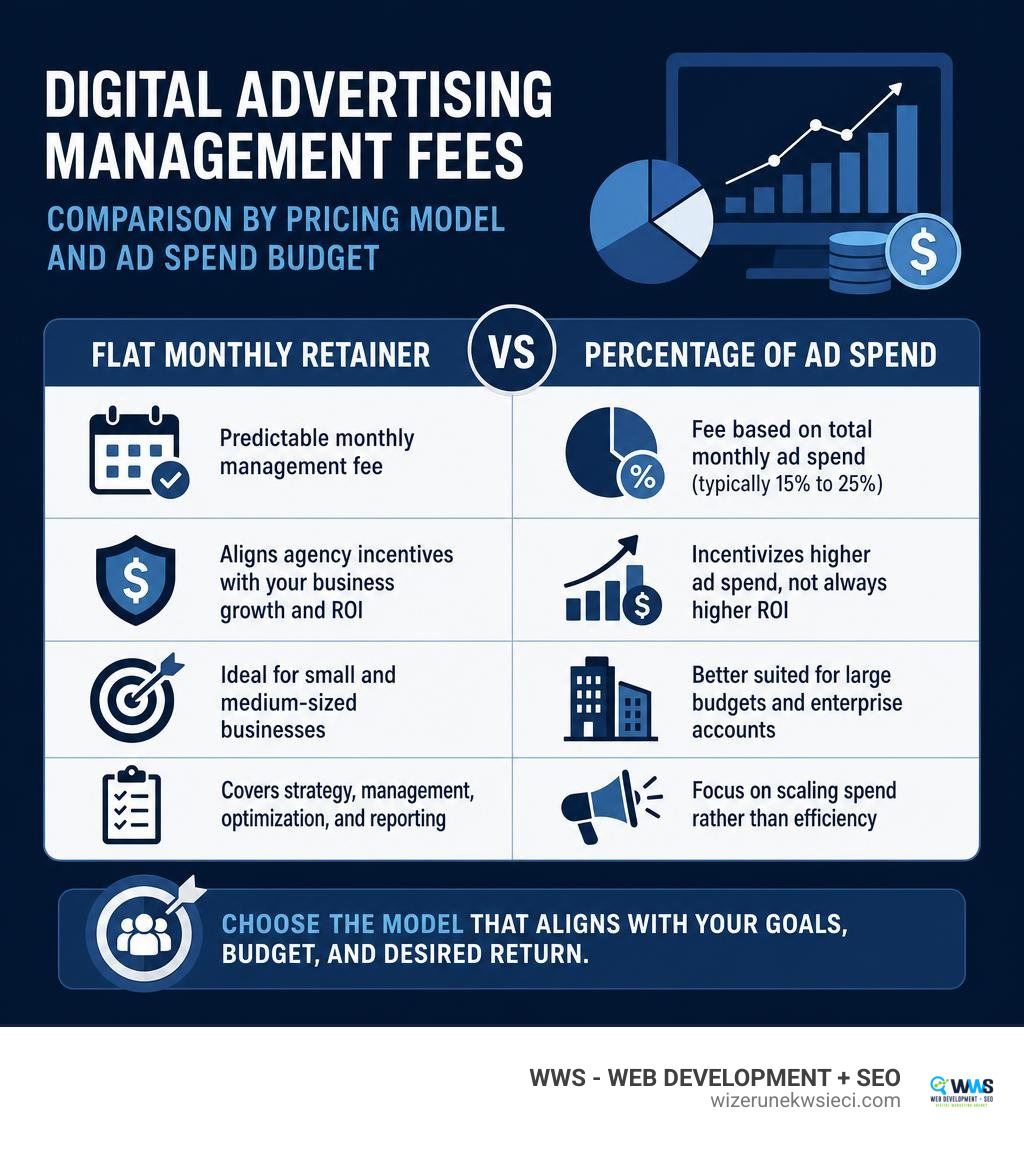
Understanding how advertising agencies structure their fees helps you protect your marketing budget and ensure your agency’s financial incentives align with your growth goals. Digital marketing agencies generally bill using one of two primary fee structures: percentage of ad spend or a fixed monthly retainer.
Flat Monthly Retainers vs. Percentage of Ad Spend
The fixed monthly retainer model provides cost predictability for small and medium-sized businesses. Under this structure, you pay a consistent management fee based on the complexity of your campaigns, channels managed, and scope of creative deliverables, while paying your ad platform expenses directly to Google and Meta.
The percentage-of-ad-spend model charges a fee based on your total monthly media expenditure (typically 15% to 25% of ad spend). While this structure can work for enterprise accounts scaling large budgets, it creates an inherent conflict of interest for small and medium-sized businesses: it incentivizes the agency to encourage higher monthly ad spend even when expanding the budget does not produce a higher return on investment.
| Evaluation Metric | Flat Monthly Retainer | Percentage of Ad Spend |
|---|---|---|
| Budget Predictability | High; consistent agency fee each month | Low; agency fee fluctuates with ad spend |
| Agency Incentive Alignment | Focuses on conversion efficiency and lower CPA | May incentivize higher ad spend to increase fees |
| Suitability for SMBs | Ideal for predictable cash flow and local growth | Best suited for large enterprise accounts ($50k+/mo spend) |
| Scope Transparency | Clear deliverables and structured optimization cycles | Can result in paying higher fees without added work |
Contract Flexibility and Realistic Evaluation Timelines
Unlike search engine optimization (SEO), which requires months of organic authority building, paid advertising produces immediate performance data. Search queries, click-through rates, landing page bounce rates, and cost-per-click metrics populate within hours of launching a campaign.
Two months of active management is usually enough to see whether things are heading in the right direction. Within 60 days, an experienced campaign manager can identify winning keywords, weed out negative search terms, test creative variations, and optimize bid strategies to demonstrate positive momentum.
For this reason, small business owners should avoid restrictive 6-to-12-month lock-in contracts. Top performers earn your continued business through measurable performance and clear reporting. Look for agreements structured around a 60-to-90-day onboarding period followed by flexible month-to-month terms or clear 30-day exit clauses.
How Do Top Agencies Integrate Google Ads With Paid Social Media Campaigns?
The most effective advertising strategies do not isolate search and social; they connect them into a unified customer acquisition funnel. Google Ads and paid social platforms serve complementary roles at distinct stages of the buyer journey.
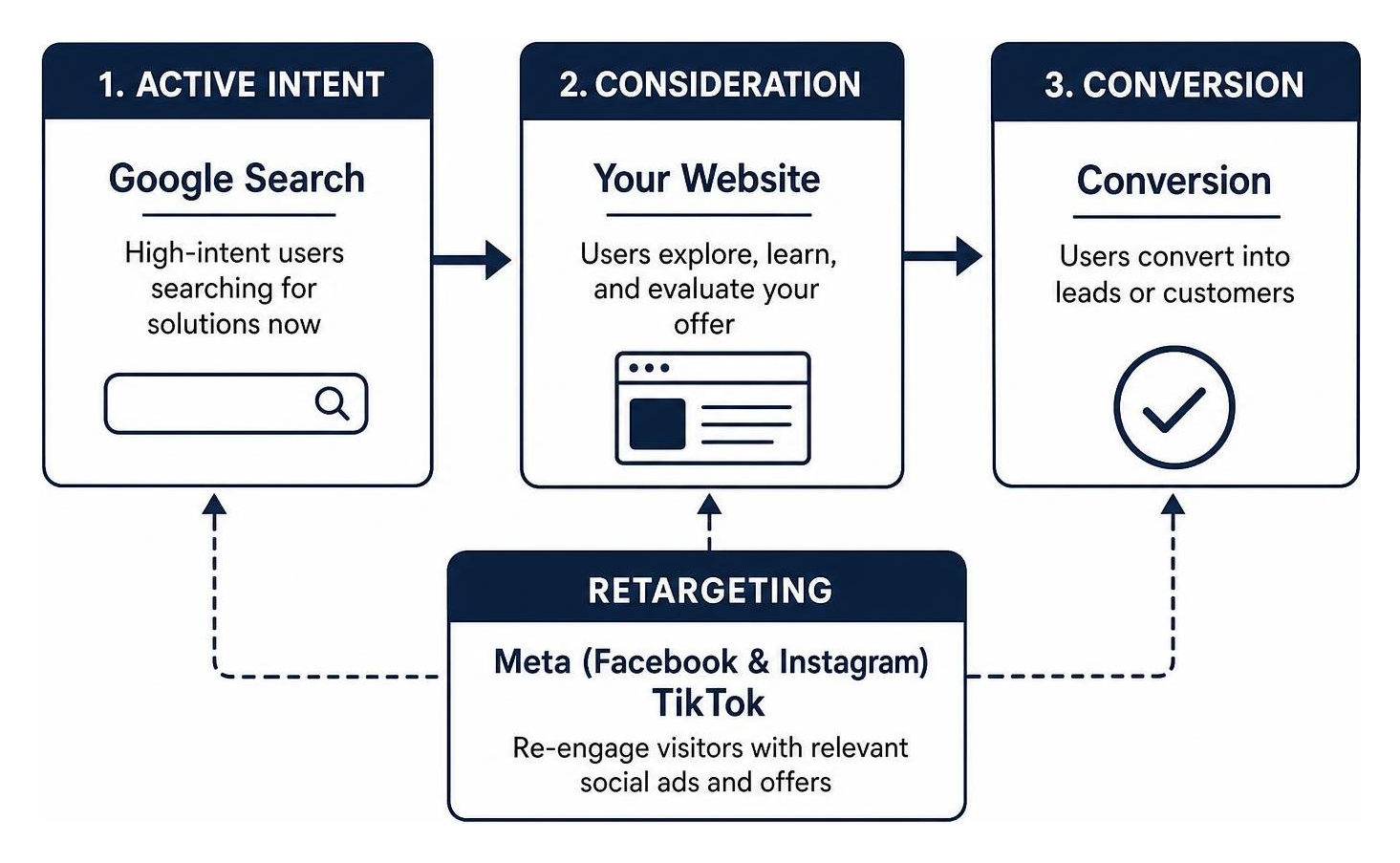
Google Search captures active intent—users typing specific queries looking for immediate solutions, services, or products. Meanwhile, platforms like Meta (Facebook and Instagram) and TikTok excel at passive discovery, audience generation, and visual retargeting. Top agencies orchestrate these touchpoints so that every marketing dollar works harder.
Multi-Platform Funnel Architecture
An integrated cross-channel campaign operates through distinct stages:
- Capturing High Commercial Intent: Deploying tightly themed Google Search campaigns to capture users searching for your exact services or products right now.
- Top-of-Funnel Discovery: Building custom interest-based and lookalike audiences on Meta to introduce your brand to potential customers based on specific demographic and geographic profiles. You can learn how to structure these initial creative campaigns through How to Master Paid Social Media Ads Without Losing Your Mind.
- Dynamic Retargeting: Serving sequential video ads, testimonials, and limited-time offers on Instagram and Facebook to users who clicked your Google ad or visited key service pages but did not convert immediately.
- Frictionless Lead Capture: Utilizing native lead forms for mobile users to capture inquiries directly inside social platforms, as outlined in our guide on Capturing High-Intent Leads Using Facebook Lead Ads to Scale.
Aligning paid discovery ads with broader organic brand engagement through proactive Social Media management ensures that when prospects click through to your business profiles, they find an active, credible, and trustworthy brand.
Creative Strategy and Fast Iteration
Social media platforms experience rapid creative fatigue. An ad image or video that delivers outstanding results in week one can see performance dip sharply by week four as your target audience sees it repeatedly.
Top-performing agencies maintain an active testing roadmap. They continually test ad angles, headlines, visual assets, and calls to action while tracking cross-channel attribution to ensure your marketing budget is directed toward the highest-yielding platform combinations.
Why Does Partnering With a Nearby Marketing Agency Deliver Better Results?
While digital advertising can be managed from anywhere in the world, partnering with a nearby agency provides substantial advantages that fully remote or offshored teams cannot replicate.

Regional Market Nuance vs. Offshored Execution
Local agencies understand your target market’s culture, regional economic climate, and geographic patterns. If your business serves customers in Chicago, Des Plaines, Arlington Heights, Schaumburg, or Naperville, an agency familiar with Chicagoland knows how geographic traffic flows, seasonal shifts, and neighborhood demographics impact customer decisions.
Offshored teams often miss these regional subtleties, resulting in wasted ad spend on irrelevant geographic radiuses or awkward ad copy that fails to resonate with local buyers. When looking at regional agency landscapes, resources like Chicago Marketing Agencies Who’s Hot Right Now showcase the value of local market fluency.
Furthermore, pairing targeted paid search acceleration with long-term organic search authority creates lasting market dominance, a strategy explored in detail in Chicago SEO Agencies Your Guide to Ranking Up.
Personalized Campaign Management With WWS Digital Marketing
At Wizerunek w Sieci / WWS — Web Development + SEO, we provide small and medium-sized business owners with the ideal middle ground: the advanced technical expertise and data capabilities of a full-scale digital agency paired with the responsive, personalized service of a dedicated local partner.
Wizerunek w Sieci / WWS — Web Development + SEO is headquartered at 636 S River Rd #218, Des Plaines, IL 60016, can be reached at (773) 814-2992, and is online at wizerunekwsieci.com. We specialize in crafting custom-tailored Google Ads, Meta Ads, social media campaigns, and GEO-targeted web solutions. We understand the competitive dynamics of Cook County, Lake County, and the broader Chicago metropolitan area, while also serving growth-focused businesses across the United States.
Our team takes pride in:
- Bilingual Campaign Capabilities: Expertly crafting and optimizing campaigns in both English and Polish to engage the vast Polish-American community (Polonia) throughout Chicagoland alongside broad English-speaking audiences.
- Direct Access to Experts: You work directly with experienced campaign practitioners who know your account inside and out – no account coordinators or gatekeepers.
- Transparent, Performance-Driven Growth: You maintain full administrative ownership of your ad accounts, receive straightforward monthly reporting, and benefit from flat, transparent retainer structures.
Whether you run a local home service company in the Northwest Suburbs, a medical practice in Glenview, or a professional B2B firm in Chicago, we treat your marketing budget as if it were our own.
If you are ready to evaluate your current advertising setup, request a complimentary performance audit or schedule an initial consultation through our Contact page.
What Are the Most Common Questions About Hiring a Paid Ads Agency?
How long does it take to evaluate if a Google Ads agency is performing well?
Two months of active campaign management is generally sufficient to assess whether an agency is heading in the right direction. Within 60 days, an agency should have established accurate conversion tracking, eliminated irrelevant search queries with negative keyword lists, conducted initial A/B ad split tests, and demonstrated a clear improvement in conversion quality and cost efficiency.
Should small businesses choose a fixed monthly retainer or a percentage-of-ad-spend model?
For small and medium-sized businesses spending between $1,000 and $15,000 per month on ads, a fixed monthly retainer is almost always the better choice. A fixed retainer provides predictable monthly costs and ensures the agency’s goal is maximizing conversion efficiency and profitability rather than simply pushing you to inflate your ad spend.
What are the biggest red flags to avoid when selecting an advertising agency?
The biggest red flags include:
- Guarantees of specific returns or #1 rankings: No agency controls platform algorithms or market bidding costs.
- Withholding account access: Refusing to grant you direct administrative access to your Google Ads or Meta Business Manager accounts.
- Mandatory long-term lock-ins: Demanding 6-to-12-month non-cancellable contracts before demonstrating any baseline performance.
- Vague, impression-only reporting: Focusing solely on clicks, impressions, or traffic without tracking actual phone calls, form leads, or revenue.
Take Control of Your Paid Growth Today
Selecting the right advertising agency nearby does not have to be a guessing game. By applying the three-pillar evaluation framework—ensuring the team has the technical chops to do the work, the verifiable data to prove it, and a transparent pricing model you can afford—you protect your business and set your marketing up for sustainable growth.
To build an enduring digital presence that pairs immediate paid leads with long-term organic authority, explore our comprehensive strategies for Local SEO.
Ready to see how strategic Google Ads and paid social media campaigns can accelerate your business? Contact Tomasz Lasota and the team at WWS — Web Development + SEO through wizerunekwsieci.com to claim your free website and campaign audit today.