



Why Google Ads for Realtors Is One of the Fastest Ways to Generate High-Intent Leads
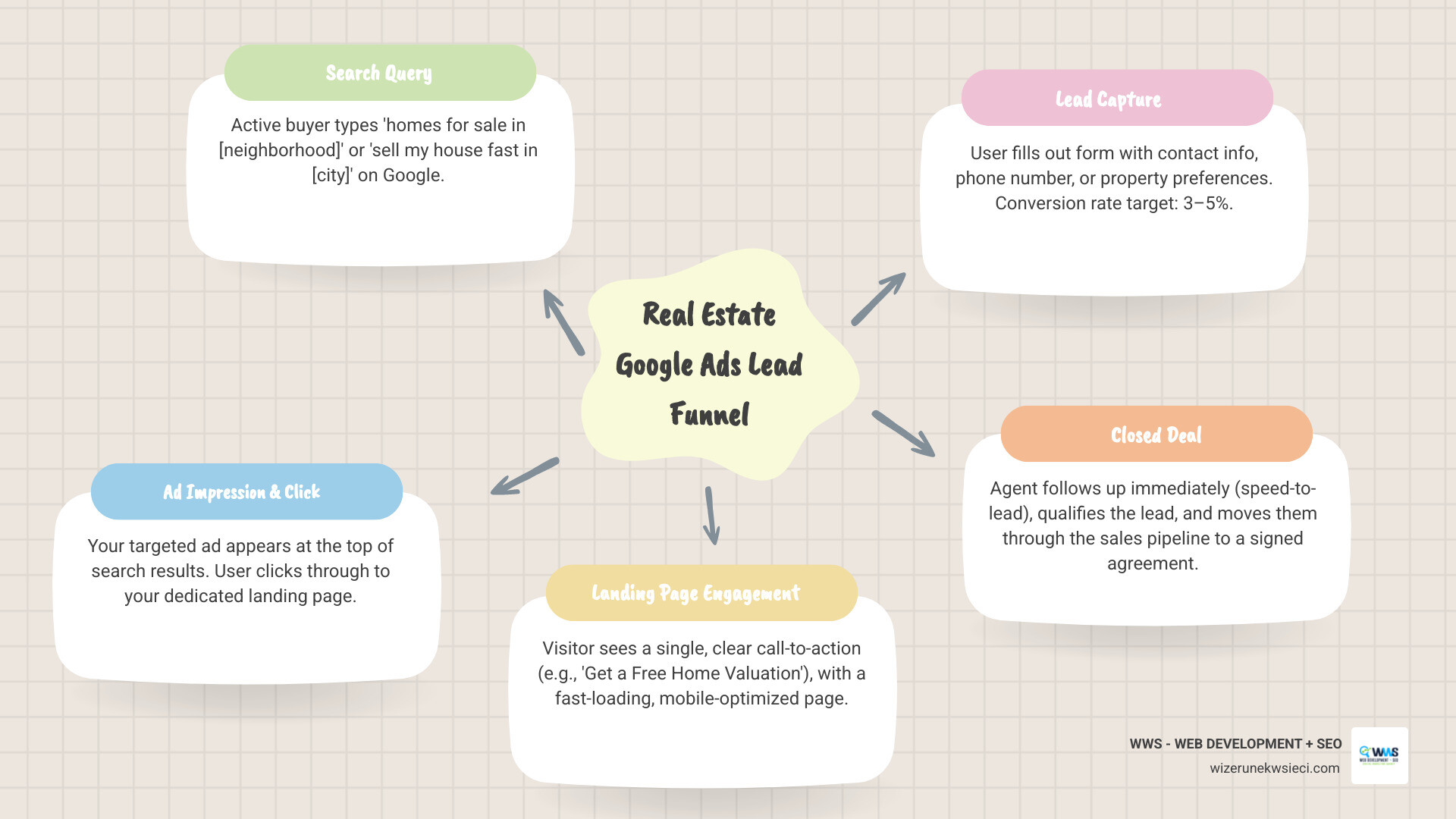
Google Ads for realtors works by placing your listings and services in front of buyers and sellers at the exact moment they’re searching — not scrolling passively through social media, but actively typing things like “homes for sale in [neighborhood]” or “sell my house fast in [city].”
Here’s a quick snapshot of what you need to know:
| Question | Quick Answer |
|---|---|
| What are Google Ads for realtors? | Paid placements on Google Search, YouTube, and partner sites targeting active buyers and sellers |
| Best campaign type for leads? | Search Ads + Local Services Ads (LSAs) |
| Recommended starting budget | $500 – $1,500/month ($20 – $50/day) |
| Strong conversion rate benchmark | 3–5% |
| Time to first leads | Days to weeks, depending on optimization |
| Biggest mistake agents make | Sending ad clicks to a generic homepage instead of a dedicated landing page |
| Do you need a landing page? | Yes — always |
Over 70% of home buyers start their search on mobile. That means your future clients are already on Google right now, searching for exactly what you offer. The agents who show up at that moment — with the right message and a focused landing page — win the lead. The agents who don’t, pay for clicks that go nowhere.
Too many realtors treat Google Ads like a slot machine: throw money in, hope something comes out. That approach burns budgets fast and produces little to show for it. Done right, with tight keyword targeting, proper conversion tracking, and a landing page built for one purpose, Google Ads becomes one of the most predictable lead generation tools in real estate.
I’m Tomasz Lasota, Digital Marketing Strategist and founder of WWS — Web Development + SEO in Des Plaines, IL, and over my 22+ years in digital marketing I’ve helped real estate professionals and local service businesses across the Chicago area build Google Ads for realtors campaigns that generate real conversations, not just clicks. In this guide, I’ll walk you through exactly how to set up, target, and scale your campaigns the right way.
Google ads for realtors vocab to learn:
Why Google Ads for Realtors is the Ultimate Lead Generation Tool
When someone wants to buy or sell a home in the Chicago suburbs, they do not wait for a postcard to show up in their mailbox. They do not hope a billboard catches their eye on I-90. They open their phone, open Google, and search.
This is the power of search engine marketing (SEM). Unlike passive marketing channels where you interrupt people who are looking at family photos or watching funny videos, Google Ads intercepts users at the exact millisecond of high-intent search. In the digital marketing landscape of July 2026, capturing this bottom-of-funnel intent is the single most efficient way to grow your pipeline.
Because over 70% of home buyers start their search on mobile, appearing at the very top of those mobile search results is critical. A healthy, well-optimized campaign can achieve a 3–5% conversion rate, turning cold searchers into warm inquiries. To understand how to capture these active searchers, we must look closely at how search engine marketing works to attract ready-to-act clients. You can read more about capturing these high-value prospects in our guide on The Ultimate Guide to Search Engine Marketing Leads and How to Capture Them.
Traditional Marketing vs. Google Ads for Realtors
For decades, real estate marketing relied heavily on traditional methods: park benches, grocery cart advertisements, billboards, and direct mail flyers. While these methods can build general brand awareness over years, they are incredibly passive, expensive, and virtually impossible to track accurately.
Traditional marketing is a “spray and pray” approach. You pay to show your face to thousands of people, most of whom have absolutely no interest in moving. Google Ads, on the other hand, operates on a pay-per-click (PPC) model. You only pay when someone who is actively looking for real estate services in your specific target market clicks on your ad.
| Feature | Traditional Real Estate Marketing | Google Ads for Realtors |
|---|---|---|
| Targeting | Broad geographic area (everyone sees it) | Hyper-local (only active searchers see it) |
| Cost Model | Flat upfront fee (regardless of results) | Pay-per-click or Pay-per-lead |
| Intent Level | Passive (interrupted browsing) | Active (high-intent search) |
| Tracking | Guesswork and promo codes | Exact conversion and ROI tracking |
| Mobile Focus | Low | High (optimized for 70%+ mobile searches) |
| Speed to Market | Weeks of design and printing | Live within hours |
By shifting your marketing budget from outdated billboards to targeted search campaigns, you gain instant local market visibility exactly where your next client is looking.
The Best Google Ads Campaign Types for Real Estate Agents
Google’s advertising ecosystem is vast, and choosing the right campaign type is the first step toward success. Many realtors make the mistake of setting up a single campaign and hoping it covers all bases. In reality, different campaign types serve different purposes in your marketing funnel.

Google Search Ads: Capturing Bottom-of-Funnel Intent
Google Search Ads are the bread and butter of digital lead generation. These are the text-based ads that appear at the very top of the search results page when someone types a specific query.
For realtors, Search Ads are the ultimate lead magnet because they align perfectly with user intent. When a user searches for “best listing agent in Arlington Heights” or “homes for sale in Glenview IL,” your ad can appear instantly with a tailored value proposition. By utilizing localized targeting, we can ensure your ads only show to users in the specific neighborhoods, ZIP codes, or suburbs you service. For a deeper look into structuring these campaigns for maximum ROI, explore this breakdown on Google Ads For Real Estate | How To Generate More Leads & Sales .
Google Local Services Ads (LSAs) vs. Traditional Google Ads for Realtors
Google Local Services Ads (LSAs) are a game-changer for local service providers, including real estate agents. LSAs appear at the very top of Google Search results, even above traditional Google Search Ads.
The core differences between traditional Google Ads and LSAs include:
- Pay-Per-Lead vs. Pay-Per-Click: With traditional Google Ads, you pay every time someone clicks your ad, regardless of whether they contact you. With LSAs, you pay strictly per verified lead (a direct phone call or message through the platform).
- The Google Verified Badge: To run LSAs, you must pass Google’s rigorous screening and verification process, which includes license and background checks. Once passed, your ad displays a “Google Verified” badge, which builds immediate trust with local home sellers and buyers.
- Expanded Home Listings: In our current 2026 landscape, Google’s expanded Home Listing ad format for LSAs is active nationwide. This format pulls rich, real-time property data (pricing, photos, and features) powered by platforms like HouseCanary directly into the ad, allowing searchers to view home details and book an appointment with you instantly.
While LSAs are incredibly powerful, they should be treated as a supplementary lead-capture tool rather than a complete replacement for a comprehensive Google Search Ads strategy. Local eligibility and category availability can vary, so we always recommend checking your specific market availability first.
YouTube and Display Ads: Building Trust and Retargeting
If Search Ads capture active buyers, Google Display and YouTube Ads are your tools for building brand familiarity and nurturing passive buyers.
- Google Display Ads: These visual banner ads appear across millions of partner websites. They are highly cost-effective and work exceptionally well for remarketing—showing your ads to people who have already visited your website or clicked on your Search Ads but didn’t fill out a form.
- YouTube Ads: Video is the most powerful medium for real estate. You can use short, 15-to-30-second video walkthroughs or market updates with strong video hooks to build trust at scale.
By layering high-intent search ads with visual retargeting on YouTube and the Display Network, you create a compounding trust loop that keeps your name top-of-mind. To learn more about balancing search campaigns with visual social platforms, read our guide on How to Master Paid Social Media Ads Without Losing Your Mind.
High-Intent Keyword Strategy and Avoiding Wasted Ad Spend
The fastest way to burn through your marketing budget is by bidding on the wrong keywords. Many realtors launch campaigns targeting broad, generic terms like “real estate” or “homes for sale.” These terms have massive search volume, but they also have incredibly low intent and astronomical costs-per-click.
To build a profitable campaign, we must focus on highly localized, long-tail keywords that indicate a user is ready to make a decision.
Targeting Localized, High-Intent Search Phrases
Instead of bidding on generic terms, your keyword strategy should target specific, local phrases that align with your exact services. For example:
- For Seller Leads: Target phrases like “how much is my home worth in Schaumburg,” “listing agents in Naperville IL,” or “sell my house fast Cook County.”
- For Buyer Leads: Target phrases like “luxury homes for sale in Lake County,” “3 bedroom houses in Mount Prospect,” or “new construction homes in Palatine IL.”
By focusing on these specific search terms, you filter out casual browsers and attract serious, motivated clients. For an in-depth blueprint on selecting high-converting keywords and setting up your campaign structure, check out Google Ads for Real Estate Agents: The 2026 Guide | Krista Mashore .
Common Pitfalls: Why Your Google Ads for Realtors Campaign is Burning Money
If you have tried Google Ads in the past and felt like you were throwing money into a black hole, you likely fell victim to one of these common pitfalls:
- Bidding on Broad Match Keywords: Broad match allows Google to show your ad for any search query it deems vaguely related to your keyword. If you bid on “real estate agent” as a broad match, Google might show your ad to someone searching for “how to get a real estate license” or “real estate agent salaries.” Use phrase match or exact match to maintain tight control.
- Ignoring Negative Keywords: Negative keywords are search terms you explicitly exclude from your campaigns. If you do not want to pay for clicks from job seekers, FSBO (For Sale By Owner) listings, or DIY home repair, you must add terms like “jobs,” “free,” “FSBO,” and “cheap” to your negative keyword list.
- Quitting the Campaign Too Early: Google’s machine-learning algorithm requires time to optimize. The first week of a campaign is what we call “paying tuition”—it is when the system gathers data. A campaign that looks unprofitable in week one often performs beautifully by week six once the algorithm has learned who is most likely to convert.
- Sending Clicks to a Generic Homepage: This is the single biggest mistake in real estate advertising, which we will explore in detail below.
The Critical Role of Dedicated Landing Pages and Budgeting
Driving high-intent traffic to your website is only half the battle. The other half is converting that traffic into a lead. This is where most real estate marketing campaigns fail.
Why a Dedicated Landing Page Beats a Homepage Every Time
When an agent spends $5 per click to send a user to their generic website homepage, they are essentially wasting their money. A homepage is designed to be an digital business card. It has navigation menus, a biography, links to active listings, blog posts, and a smiling headshot.
When a user who searched for “free home valuation in Elk Grove Village” lands on a generic homepage, they have to hunt for the home valuation tool. If they don’t find it within three seconds, they click the back button. Your money is gone, and you have nothing to show for it.
Instead, every ad group must point to a dedicated, single-action landing page.
- If your ad promises a Home Valuation, the landing page should have one clear headline: “What is your Elk Grove Village home worth?” and a simple, single-field form to enter their address.
- If your ad promises a List of Foreclosures, the landing page must only offer that list.
By removing all navigation links and focusing on a single call-to-action, you drastically increase your conversion rates and prevent costly bounces. Learn how to optimize your site to capture these leads in our article Stop Bouncing and Start Buying: How to Capture Leads From Your Website, and compare the best platforms for the job in our review of Lead Generation Websites: The X Best Options Compared.
Setting and Scaling Your Real Estate Google Ads Budget
How much should you spend? We recommend that real estate agents start with a modest daily budget of $20 to $50 (roughly $500 to $1,500 per month).
This starting budget allows you to test a tight, highly controlled group of local keywords without overcommitting. Once you have established conversion tracking and can see exactly how much it costs to generate a qualified phone call or form submission, you can begin scaling your budget based on your actual return on investment (ROI).
Scaling should be data-driven. Do not increase your budget until your campaign has completed its initial learning phase and is producing consistent results. For help structuring your overall digital marketing spend, read our complete guide on planning successful Marketing Campaigns.
Frequently Asked Questions about Google Ads for Realtors
How quickly can real estate agents expect to see results from Google Ads?
Because Google Ads is a search-based platform, it can generate clicks and initial leads within days of launching your campaign. However, achieving consistent lead quality and a stable cost-per-lead typically takes 4 to 6 weeks of ongoing optimization. During this period, the campaign gathers performance metrics, allowing us to refine bidding strategies, eliminate negative keywords, and improve landing page conversion rates.
How should realtors combine Google Ads with Facebook Ads?
The most successful real estate marketing systems use a hybrid strategy where Google and Facebook act as teammates rather than rivals.
Use Google Ads as your primary tool for lead acquisition, catching high-intent searchers at the bottom of the funnel. Then, use Facebook Ads as your primary tool for database nurturing. By uploading your Google-generated leads into Facebook as a custom audience, you can run visual retargeting ads (such as video walkthroughs, client testimonials, and new listings) to stay top-of-mind until they are ready to transact.
What is a good conversion rate for real estate Google Ads?
In the real estate industry, a landing page conversion rate of 3% to 5% is considered strong and healthy. This means that for every 100 users who click on your ad and land on your dedicated page, 3 to 5 of them submit their contact details. To maintain this benchmark, you must ensure your landing page loads lightning-fast on mobile devices and offers an immediate, high-value proposition.
Conclusion
Building a high-performing campaign for google ads for realtors is not about spending the most money; it is about building a precise, localized system. By targeting high-intent keywords, leveraging Google’s Local Services Ads, directing traffic to dedicated landing pages, and avoiding common budget-burning mistakes, you can build a predictable pipeline of ready-to-act buyers and sellers.
At Wizerunek w Sieci (WWS), we treat your business as if it were our own. Based in Des Plaines, IL, our bilingual team (English & Polish) specializes in helping small business owners and real estate professionals across the Chicago metropolitan area—from Schaumburg and Arlington Heights to Naperville and the North Suburbs—dominate their local markets online.
Whether you need a custom-built landing page that actually converts, or a fully managed Google Ads campaign designed to scale your ROI, we are here to help. Discover how we build high-performing Paid Campaigns that deliver real business outcomes, or contact us today at (773) 814-2992 or via wizerunekwsieci.com for a free website audit.