



Why Most Plumbers Waste Money on Google Ads (And How to Stop)
Google Ads for plumbers is the fastest way to put your business in front of homeowners who need a plumber right now — but only when it’s set up correctly.
Here’s a quick breakdown of what works:
| Strategy | What It Does | Best For |
|---|---|---|
| Google Local Services Ads (LSA) | Pay per lead, shows above all other ads, Google Guaranteed badge | Emergency calls, high-intent “near me” searches |
| Google Search Ads | Pay per click, full keyword/bid control | Specific services, scheduled work |
| Dedicated Landing Pages | Matches ad intent, drives calls | Converting clicks into booked jobs |
| Emergency vs. Scheduled Campaigns | Separate budgets and bidding | Avoiding wasted spend, better ROI |
| Call + Conversion Tracking | Ties every lead back to spend | Measuring real ROI |
| Negative Keywords | Blocks irrelevant clicks | Cutting wasted budget |
Most plumbing companies start seeing solid results with $1,000–$3,000/month, with many hitting over 200% return on ad spend once campaigns are properly structured.
The challenge? Most plumbers either never set up tracking, mix emergency and scheduled keywords into one campaign, or send all their paid traffic to a homepage that doesn’t convert. The result: money gone, phone quiet.
Over 72% of consumers use Google to find local businesses. When someone’s pipe bursts at midnight, they’re not scrolling social media — they’re typing “emergency plumber near me” and calling whoever shows up first. If that’s not you, it’s your competitor.
Getting this right requires more than just turning on ads. It takes the right structure, the right keywords, and a clear path from click to booked job.
I’m Tomasz Lasota, Digital Development and Technology Director with over 22 years of experience building and optimizing digital systems for service businesses — including google ads for plumbers and other local contractors. In this guide, I’ll walk you through exactly how to build a campaign that fills your schedule, not just your click report.
Understanding the Ecosystem: Google Ads for Plumbers vs. Local Services Ads (LSA)
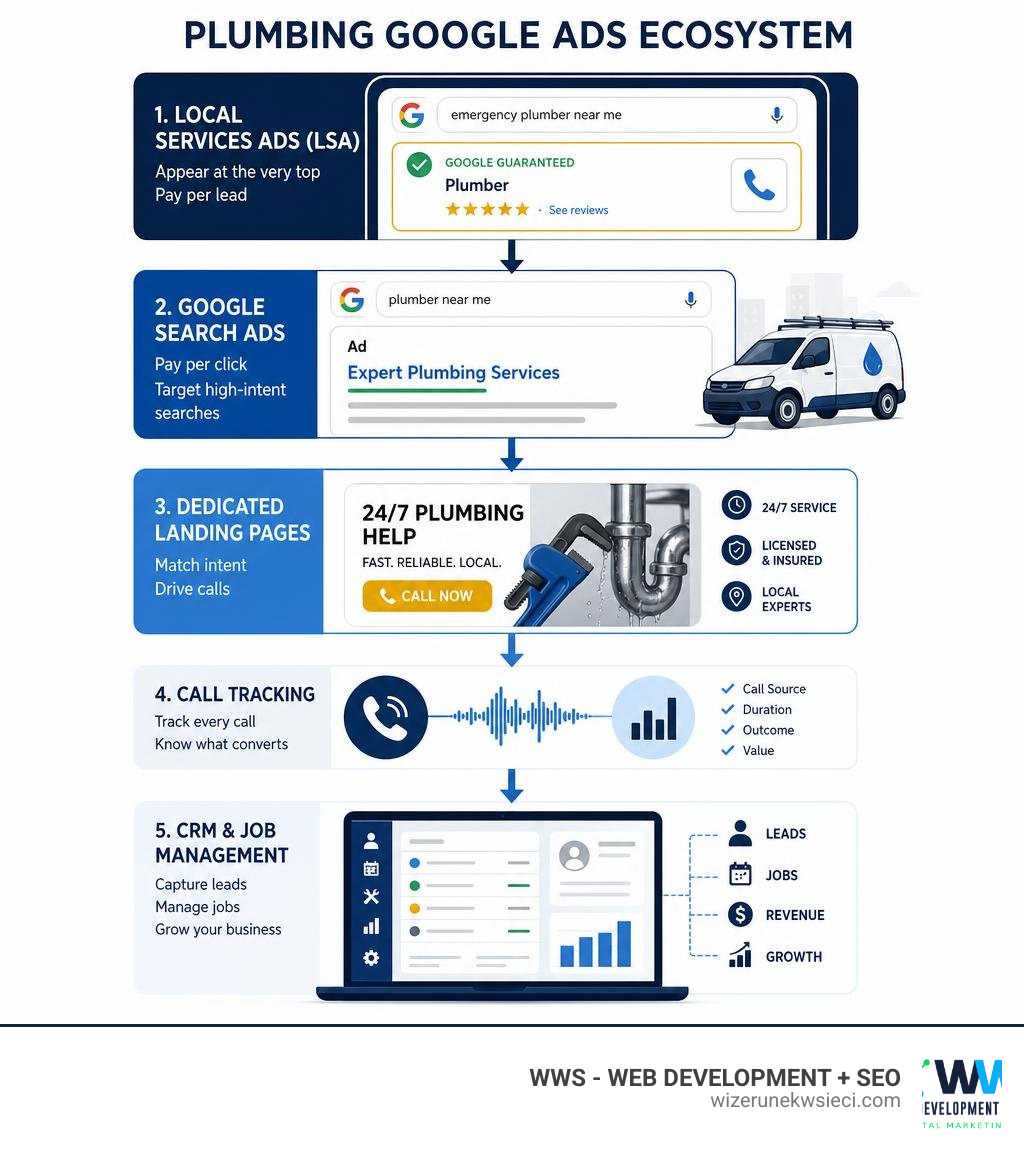
To dominate the search results in competitive Illinois markets like Chicago and Des Plaines, you must understand how Google divides its search engine real estate. When a homeowner searches for a plumbing contractor, they are met with three distinct layers of Google marketing options.
The table below outlines the core differences between the two main paid channels:
| Feature | Google Local Services Ads (LSA) | Traditional Google Search Ads |
|---|---|---|
| Payment Model | Pay-per-lead (Only pay for actual calls or bookings) | Pay-per-click (Pay for every user who clicks your ad) |
| Ad Placement | Absolute top of the search results page | Directly below LSAs, above organic listings |
| Trust Signal | Google Guaranteed Badge (Green checkmark) | Ad extensions, reviews, and custom copy |
| Targeting Style | Category and zip-code level | Keyword-specific with match types |
| Landing Page | Google-hosted business profile | Custom landing page or website |
| Ranking Factors | Reviews, response time, proximity | Quality Score, bid amount, ad relevance |
Google Local Services Ads (LSA)
LSAs are the absolute first thing a user sees at the top of the search page. For plumbing businesses, they are incredibly powerful because they operate on a pay-per-lead model rather than pay-per-click. This means you do not pay when someone merely browses your profile; you only pay when they call or message you directly through the platform.
To run LSAs, you must pass Google’s verification process to earn the Google Guaranteed badge. This process involves background checks, license verification, and proof of general liability insurance. In our local service area—spanning Chicago IL, Des Plaines IL, and the wider Illinois region—having that green shield next to your name instantly builds trust with homeowners in a panic.
Furthermore, LSA rankings are heavily influenced by your response times and customer reviews. If you let calls go to voicemail or take hours to reply to messages, Google will quietly push your LSA profile down.
Traditional Google Search Ads
Traditional Search Ads appear directly below LSAs. Unlike LSAs, these run on a pay-per-click (PPC) model. While they require more active management, they give you absolute control over your messaging, bidding, and keyword targeting. You can write highly specific ad copy, target precise long-tail keywords, and direct users to custom-built landing pages designed to convert.
Google Display Ads
Display Ads are visual banner ads that appear across Google’s partner websites and apps. For plumbing companies, Display Ads are rarely used for direct lead generation because they lack the high-intent urgency of search queries. However, they are highly effective for remarketing—showing ads to people who previously visited your website to keep your brand top-of-mind for future scheduled services.
Using both LSAs and Search Ads simultaneously is often the most effective strategy. This approach allows you to capture urgent, “tap-to-call” emergency leads via LSA while securing high-ticket, planned installations (like tankless water heaters or sewer line repiping) through targeted Search campaigns.
Best Practices for Setting Up Google Ads for Plumbers
Setting up a traditional Google Search campaign requires a clean, logical structure. If your campaign is messy, Google’s algorithm will struggle to match your ads with the right searches, driving up your costs.
First, organize your account into tightly themed ad groups. Instead of throwing all plumbing keywords into a single bucket, create dedicated ad groups for each service you offer. For example:
- Ad Group 1: Drain Cleaning (Keywords: drain cleaning near me, rooter service Chicago, unclog main sewer line)
- Ad Group 2: Water Heater Repair (Keywords: water heater repair Des Plaines, hot water tank fix, local water heater plumber)
- Ad Group 3: Emergency Plumbing (Keywords: emergency plumber 24/7, urgent pipe repair, emergency plumbing service)
Second, pay close attention to your match types. Avoid using broad match keywords when starting out. Broad match allows Google to show your ads for loosely related terms, which often results in paying for clicks from people looking for “DIY plumbing tips” or “plumbing apprenticeship programs.” Stick to Phrase Match (e.g., "drain cleaning service") and Exact Match (e.g., [emergency plumber Chicago]) to keep your targeting tight and relevant.
Lastly, write compelling ad copy that pre-qualifies callers before they click. Your headlines should clearly state your value proposition, location, and a strong call-to-action (CTA). Highlight credentials like “Licensed, Bonded & Insured,” “Master Plumbers,” or “Same-Day Service Available.”
By ensuring your ads speak directly to the user’s search intent, you improve your click-through rates and lower your overall acquisition costs. For a deeper look at managing these types of paid traffic channels, explore our dedicated guide to Paid Campaigns.
Structuring Your Campaigns: Emergency vs. Scheduled Services
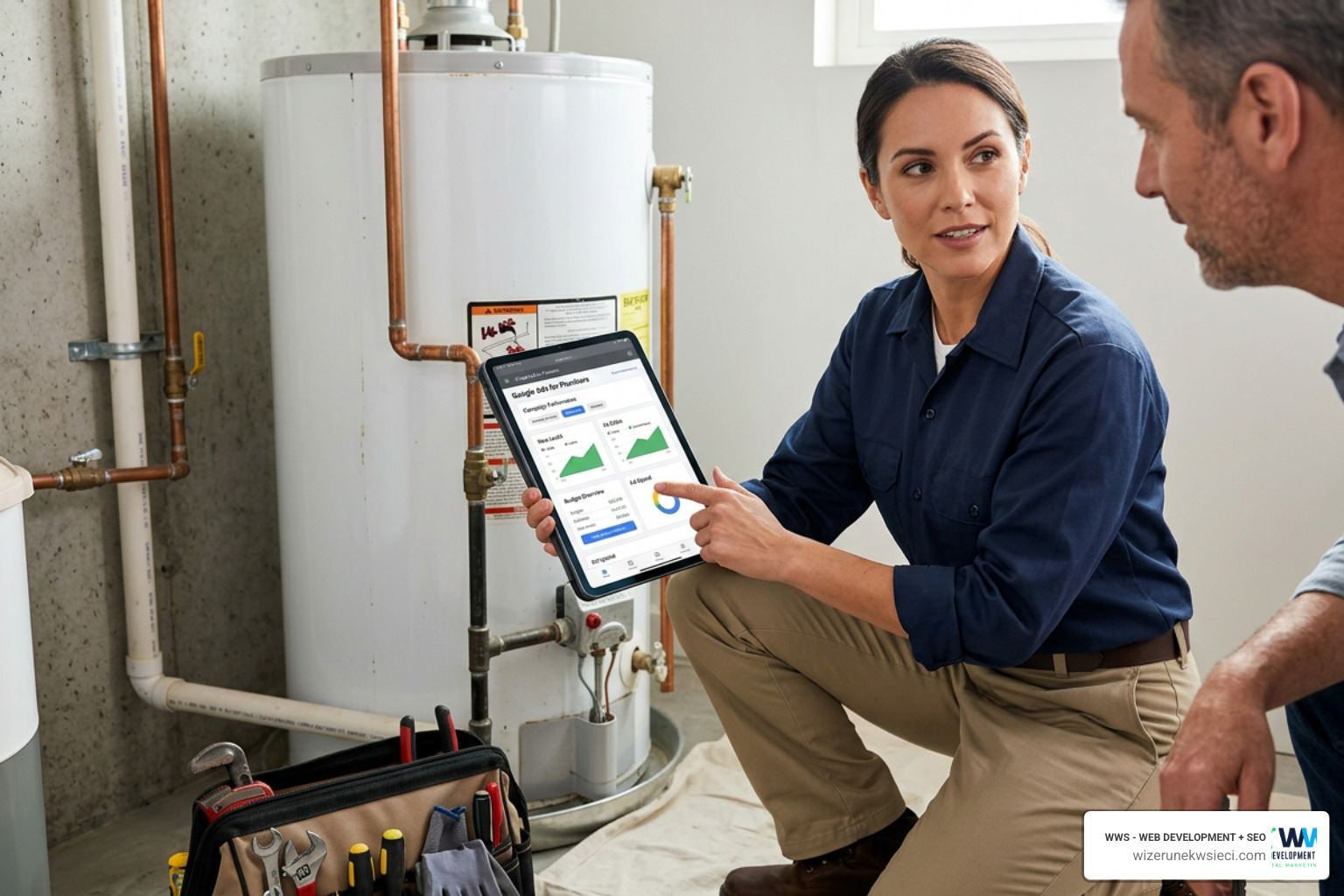
One of the costliest mistakes a plumbing business can make is mixing emergency and scheduled services into the same campaign. These two types of services have completely different customer behaviors, conversion rates, and ticket values.
Emergency Campaigns
An emergency campaign targets high-urgency keywords like “burst pipe repair,” “sewer backup,” or “clogged toilet 2am.” These customers are not shopping around or reading blog posts; they need a technician at their house immediately.
- Bidding Strategy: These keywords are highly competitive and can command high costs-per-click (CPCs). You must bid aggressively to ensure your ad appears in the top positions.
- Ad Scheduling (Dayparting): Emergency campaigns should run 24/7. However, you should apply positive bid adjustments (bidding higher) during nights, weekends, and holidays when other plumbing offices are closed.
- Device Targeting: Focus heavily on mobile devices. Over 85% of emergency searches happen on smartphones.
- Ad Format: Use Call-Only ads or responsive search ads with prominent click-to-call extensions so the customer can call you directly from the search results page without even clicking through to your website.
Scheduled Campaigns
Scheduled campaigns target planned, high-ticket services like “tankless water heater installation,” “whole-home repiping,” or “water softener system install.” These customers are in the research phase and will compare quotes, read reviews, and look at your past work.
- Bidding Strategy: Focus on maximizing conversions or target CPA (Cost Per Acquisition) to capture qualified leads within a reasonable budget.
- Ad Scheduling: Run these campaigns primarily during business hours when your office staff is fully staffed to answer detailed questions, schedule consults, and follow up on form submissions.
- Conversion Path: Direct this traffic to highly optimized, service-specific landing pages that showcase your expertise, financing options, and customer reviews.
To see a step-by-step walkthrough of how to build out this dual-campaign framework, check out this video on Google Ads for Plumbers (Updated Setup for 2026) – YouTube.
How to Optimize Google Ads for Plumbers to Lower Cost Per Lead
To maximize your return on investment, you must continuously optimize your campaigns to lower your Cost Per Lead (CPL). This is achieved by focusing on three core areas: Quality Score, landing page relevance, and geographic bid adjustments.
Quality Score Optimization
Google assigns a Quality Score (from 1 to 10) to every keyword in your account. A higher Quality Score lowers your cost-per-click and improves your ad position. Quality Score is calculated based on three factors:
- Expected Click-Through Rate (CTR): How likely people are to click your ad.
- Ad Relevance: How closely your ad copy matches the user’s search query.
- Landing Page Experience: How helpful, fast, and relevant your landing page is to the person who clicked.
Landing Page Relevance
Do not send paid traffic to your website’s homepage. If a user searches for “sump pump repair” and lands on a homepage talking about bathroom remodeling, they will click the back button. This “bounce” tells Google your page isn’t relevant, which tanks your Quality Score and increases your costs.
Instead, build dedicated, mobile-first landing pages for each service. Ensure they load in under 1.5 seconds, feature a clear tap-to-call button above the fold, and display trust signals like your Illinois license number and local reviews.
Geographic Bid Adjustments
If your shop is in Des Plaines, IL, you probably have certain zip codes or neighborhoods that yield much higher-value jobs than others. Analyze your geographic performance data within Google Ads. Apply positive bid adjustments (e.g., +15%) to wealthy suburbs or older neighborhoods with aging plumbing infrastructure, and apply negative bid adjustments or exclusions to areas outside your target service radius.
For more technical tips on optimizing your digital assets and landing pages, you can browse our collection of digital marketing Resources.
Keyword Strategy and Budgeting: Maximizing ROI and Eliminating Waste
A successful campaign is built on a foundation of thorough keyword research and aggressive negative keyword management. In the highly competitive plumbing niche, letting irrelevant search terms slip through can drain your budget in days.
High-Intent Keywords Worth Bidding On
Focus your budget on search queries that indicate a clear intent to hire.
These keywords may have lower search volumes than generic terms like “plumber,” but they convert at a much higher rate. For a breakdown of keyword selection strategies, read the Google Ads Guide for Plumber (2026) – RankMeTop.
The Shield: Negative Keywords
Negative keywords tell Google where not to show your ads. This is your primary tool for eliminating wasted ad spend. You should build a comprehensive negative keyword list before launching your campaigns, categorized into:
- DIY Terms: how to, tutorial, fix it yourself, DIY, parts, schematics, copper pipe fittings
- Job Seekers: jobs, hiring, salary, apprentice, training, resume, careers
- Low-Intent Queries: cheap, free, wholesale, rental, landlord responsibilities
- Competitors: If you don’t want to pay high CPCs to bid on other local plumbing brands, add competitor names as negatives.
Regularly audit your Search Terms report to find and exclude new irrelevant queries. For a deeper look at structuring these lists, check out the strategies outlined in Google Ads For Plumbers – Rescue Marketing.
Determining Your Budget
How much should you spend? A realistic starting budget for a plumbing company in a suburban or mid-sized market is $1,000 to $3,000 per month. In highly competitive metro areas like Chicago, established contractors often spend $4,000 to $8,000 per month to maintain top visibility.
To see a real-world example of how strategic budget allocation and campaign restructuring can scale a local plumbing business, watch this video: How a Plumber Added $130K in 30 Days Using This Google Ads ….
Tracking, CRM Integration, and the Multi-Channel Search System
If you are running Google Ads without tracking your leads down to the booked job and closed revenue, you are flying blind. You cannot optimize a campaign based on “clicks” alone; you must optimize based on profitability.

Call Tracking & Conversion Tracking
Because the vast majority of plumbing leads come through phone calls, you must implement robust call tracking. By using dynamic number insertion (DNI) through tools like CallRail, your website automatically displays a unique tracking phone number to each visitor based on the specific Google Ads campaign, ad group, and keyword they clicked.
When they call, the system attributes that lead directly to the source. We recommend setting your primary conversion action to track phone calls that last longer than 60 to 90 seconds, filtering out short, non-lead calls.
CRM Integration (ServiceTitan, Jobber, Housecall Pro)
The ultimate setup involves integrating Google Ads with your field service management software or CRM (such as ServiceTitan).
When a call comes in, the CRM matches the tracking number with the customer’s job file. Once the technician completes the job and collects payment, that revenue data is fed back into Google Ads.
This allows you to see exactly which keywords generate high-ticket sewer repairs versus those that only drive cheap drain snaking calls. Google’s Smart Bidding algorithm can then use this revenue data to automatically target high-value jobs.
By connecting your organic SEO efforts with your paid search campaigns, you create a unified lead-generation system. Learn how to align your paid campaigns with long-term organic growth by reading about Contractor SEO Chicago and exploring our broader Marketing Campaigns.
Frequently Asked Questions About Plumbing Google Ads
What is the difference between Google Ads and SEO for plumbers?
The main difference is speed vs. equity. Google Ads is a paid channel that delivers immediate visibility and leads within days of launching. However, once you stop paying, the leads stop.
Search Engine Optimization (SEO) is a long-term investment that builds organic rankings over time. While it takes several months to start ranking in the Google Map Pack and organic search results, it eventually generates highly qualified leads at a much lower cost per acquisition because you do not pay for individual clicks.
For local businesses, a combined strategy works best: use Google Ads for immediate cash flow and targeted high-ticket jobs, while building long-term authority through local SEO. To learn more about building organic authority in our local Illinois market, check out our guide on SEO for Contractors Chicago.
What are the most common mistakes plumbers make with Google Ads?
The four most common mistakes we see when auditing underperforming accounts are:
- Wasted ad spend on DIY terms: Failing to build a robust negative keyword list, causing them to pay for clicks from people trying to unclog their own toilets.
- Sending traffic to the homepage: Directing users to a generic homepage with too many distractions instead of a fast, service-specific landing page.
- Missing or broken conversion tracking: Running campaigns without knowing which keywords actually drive phone calls and booked jobs.
- Mixing emergency and scheduled campaigns: Averaging out their bids and ad copy, which makes them uncompetitive for urgent emergency calls and inefficient for planned installations.
How much should a plumbing company spend on Google Ads?
Your monthly budget should be determined by your market size, competition, average job ticket size, and capacity.
In smaller markets or suburbs, a starting budget of $1,500 to $2,500 per month is usually enough to generate a steady flow of leads. In highly competitive metro areas like Chicago, where emergency plumbing clicks can cost anywhere from $40 to over $100, established companies typically spend $4,000 to $8,000+ per month.
To determine your budget, calculate your “profitability ceiling.” Look at your average ticket size, your close rate on inbound calls, and your target cost-per-lead, then scale your budget to match the volume of jobs your technicians can realistically handle.
Conclusion
Running a successful google ads for plumbers campaign isn’t about spending the most money; it’s about spending your budget smarter than your competitors. By separating your emergency and scheduled services, building high-converting landing pages, aggressively managing negative keywords, and integrating your CRM with call tracking, you can turn Google into a highly predictable lead-generation engine.
At Wizerunek w Sieci (WWS), we specialize in building integrated, conversion-focused digital marketing strategies for local service businesses in Chicago, Des Plaines, and across Illinois. We don’t just report on clicks; we focus on the metrics that actually matter to your bottom line: booked jobs, lower acquisition costs, and measurable revenue growth.
Ready to unclog your lead pipeline and keep your technicians busy? Contact us today to discuss how we can build a custom search system for your business through our specialized Paid Campaigns management.