





Google Ads for Real Estate Agents: Start With Intent, Tracking, and Fast Follow-Up
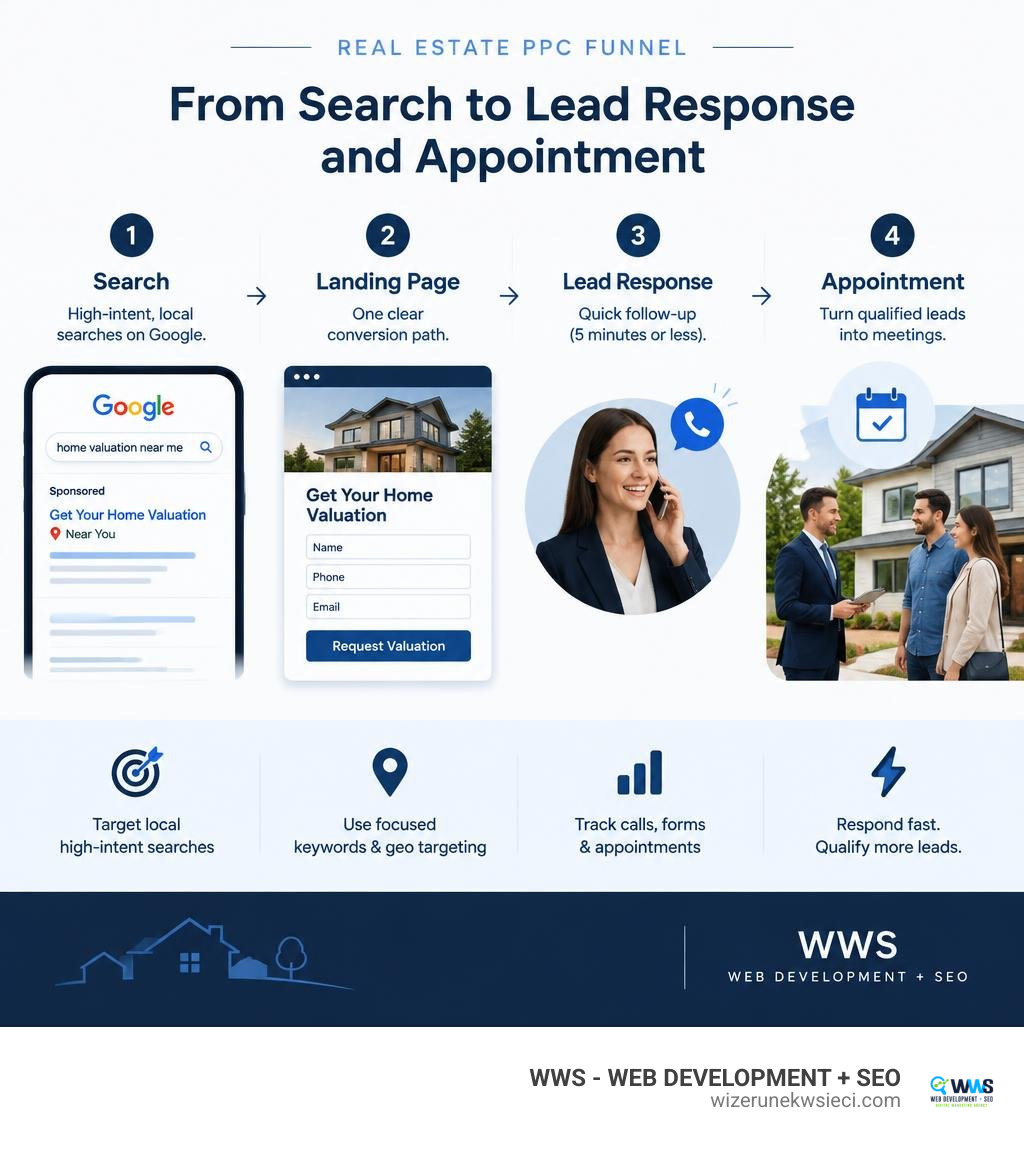
Google Ads for real estate agents work best when they target local, high-intent searches, send prospects to one clear conversion path, and measure every call and form submission. Start with a focused Search campaign around services such as property valuations, buyer representation, or listing consultations. Use tight geographic targeting, phrase or exact-match keywords, and negative keywords to block irrelevant searches.
A practical starting framework:
- Choose one lead goal, such as valuation requests or consultation calls.
- Build a dedicated landing page or use a native Google lead form asset.
- Track submitted forms, phone calls, and booked appointments before launch.
- Respond quickly. A lead contacted within five minutes is far more likely to qualify than one contacted 30 minutes later.
- Review search terms each week and remove queries that do not match your service.
Real estate PPC can produce clicks quickly, but efficient results take testing. Industry benchmarks place real estate Google Ads at roughly a 8.43% click-through rate, $2.53 average cost per click, and about $100 per lead. Your results will depend on your market, offer, keyword competition, landing-page quality, and follow-up process.
Google Ads is also subject to housing advertising rules. In the United States and Canada, agents must avoid restricted targeting based on protected characteristics, including age, gender, parental status, marital status, and ZIP code targeting. Strong campaigns compete on relevance and service quality, not narrow audience filters.
I am Tomasz Lasota, Digital Marketing Strategist and founder of Wizerunek w Sieci / WWS — Web Development + SEO in Des Plaines, Illinois. With more than 22 years in digital development and marketing, I help local businesses create measurable Google Ads for real estate agents through clear campaign strategy, conversion-focused websites, and careful performance tracking.
Terms related to Google Ads for real estate agents:
Core Campaign Types of Google Ads for Real Estate Agents
Achieving a predictable flow of inquiries requires selecting the right campaign type for your specific commercial goals. Navigating pay-per-click advertising means understanding how different ad networks serve distinct stages of the consumer journey. For real estate professionals across Cook County and the greater Chicago metropolitan area, Google offers multiple ad placements that satisfy both immediate transactional searches and top-of-mind brand recognition.
Building high-intent lead generation strategies begins by identifying whether your prospective client is ready to hire an agent today or merely researching the local market. Standard Search campaigns capture users actively typing transactional queries into the search bar, making them the primary vehicle for acquiring motivated seller listings and active home buyers.
Display retargeting, on the other hand, keeps your brand visible across thousands of partner websites to individuals who previously visited your site. Meanwhile, native lead form assets capture prospect information directly within the search interface, cutting down friction for mobile users.
| Ad Channel / Format | Primary Billing Model | Target Intent Level | Best Use Case for Agents | Typical Conversion Rate |
|---|---|---|---|---|
| Google Search Ads | Pay-Per-Click (PPC) | High (Active Problem Solving) | Capturing motivated sellers and immediate buyer inquiries | 3.0% – 5.0% |
| Google Local Services Ads | Pay-Per-Lead (PPL) | Very High (Direct Hiring) | Direct phone calls for local representation and consultations | 15.0% – 25.0% (to contact) |
| Google Display Retargeting | Pay-Per-Click / Impressions | Medium to Low (Brand Recall) | Re-engaging past website visitors and listing viewers | 0.5% – 1.5% |
| Meta (Facebook/Instagram) Ads | Pay-Per-Click / Impressions | Low to Medium (Discovery) | Promoting neighborhood guides, open houses, and new inventory | 1.0% – 3.0% |
Google Local Services Ads and Screened Verification
Google Local Services Ads (LSAs) represent a distinct model compared to standard pay-per-click Search campaigns. Operating entirely on a pay-per-lead system, LSAs position your profile at the very top of Google Search results, positioned even above traditional search advertisements. For real estate professionals in markets like Arlington Heights, Glenview, and Northbrook, LSAs provide premier digital real estate.
One of the standout elements of this format is the Google Screened badge. To earn this verification, real estate agents and brokerages must pass extensive background checks, license checks, and proof of insurance verifications. This trust badge instantly signals credibility to potential clients searching on mobile devices.
Understanding the Google Guaranteed and Screened benefits helps agents leverage this placement effectively. Local Services Ads have integrated MLS listing data, allowing users to browse property cards directly from the verification module.
Because you only pay when a consumer directly calls or messages you through the ad unit, LSAs provide exceptional budget protection. Furthermore, invalid inquiries—such as wrong numbers, solicitations, or individuals seeking services outside your designated geographic territory—can be disputed directly within the platform dashboard for credit.
Google Search Ads vs. Meta Advertising for Realtors
A common dilemma for small business owners and real estate professionals is deciding whether to allocate marketing spend toward Google Search or Meta (Facebook and Instagram) Ads. Both platforms offer significant value, but they operate on fundamentally opposite consumer behaviors.
- Active Search Intent vs. Passive Discovery: Google Search targets active intent. When a homeowner searches “how to sell my house fast in Des Plaines,” they are actively seeking an immediate professional solution. Meta Ads rely on passive discovery, placing targeted visual media into a user’s feed while they browse social content.
- Lead Quality vs. Lead Volume: Meta campaigns often yield a higher volume of raw inquiries at a lower upfront cost per contact. However, these leads frequently require months of top-of-funnel nurturing because the user was not necessarily seeking an agent at that precise moment. Google leads generally carry higher transactional intent and shorter sales cycles.
- Audience Restrictions: While Meta enforces strict Special Ad Category restrictions that remove demographic and geographic micro-targeting, Google Search circumvents these constraints by allowing you to target explicit keyword intent.
Many established real estate teams succeed by scaling with paid social lead ads to generate broad neighborhood awareness while running Google Search campaigns to capture bottom-of-funnel, transaction-ready sellers and buyers.
High-Converting Keyword Strategy and Audience Targeting
The backbone of any profitable Google Ads campaign is a finely structured keyword architecture. Bidding recklessly on generic terms will quickly deplete your marketing resources without delivering tangible listing appointments. Applying proven real estate PPC practices requires categorizing your search terms by buyer intent, seller motivation, and geographic specificity.
In the real estate sector, keyword costs vary drastically based on commercial intent:
- Broad Informational Terms: Searches such as “homes for sale near me” generate massive monthly search volume (over 368,000 monthly searches in the US) with a low average cost per click around $0.90. However, these searchers are often casual browsers or early-stage researchers, resulting in lower conversion rates for individual listing agents.
- High-Intent Agent Searches: Phrases like “realtor near me” command significant commercial intent with over 90,500 monthly searches and an average CPC around $11.50. Users running these queries are actively seeking professional representation.
- Distressed and Fast-Action Seller Queries: Keywords such as “sell my house fast” carry intense seller urgency, driving average CPCs up to $103.75 in competitive metropolitan markets.
Under Google’s housing advertising policy across the United States and Canada, real estate campaigns fall under strict compliance standards. Advertisers cannot target users based on age, gender, parental status, familial status, or postal ZIP codes. Instead, successful campaigns rely on radius-based geographic boundaries (targeting a specific mile or kilometer radius around communities like Park Ridge, Rosemont, or Naperville) and high-intent keyword phrasing.
Structuring Google Ads for Real Estate Agents by Search Intent
To maximize your ad Quality Score and lower your cost per acquisition, you must structure your account using granular ad groups divided strictly by user intent. Never lump buyer keywords and seller keywords into the same campaign.
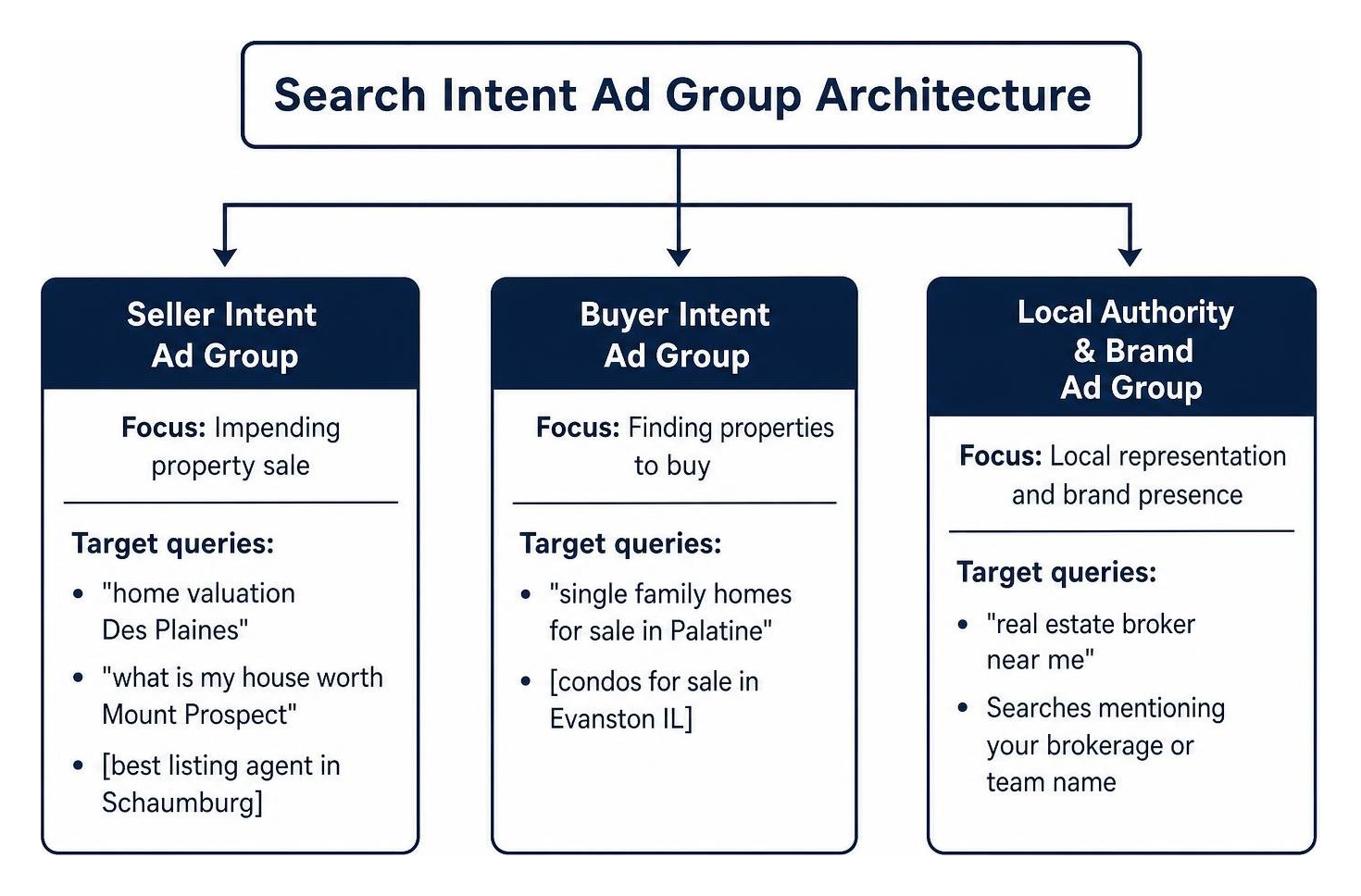
When organizing your campaign, focus heavily on phrase match ("keyword") and exact match ([keyword]) to retain tight control over which search queries trigger your ads:
- Seller Intent Ad Group: Focus on queries signaling an impending property sale, such as
"home valuation Des Plaines","what is my house worth Mount Prospect", or[best listing agent in Schaumburg]. - Buyer Intent Ad Group: Target specific property types and localities, such as
"single family homes for sale in Palatine"or[condos for sale in Evanston IL]. - Local Authority & Brand Ad Group: Capture searches for hyper-local representation, including
"real estate broker near me"or searches mentioning your specific brokerage or team name.
Applying sound methodologies for capturing search engine marketing leads guarantees that when a prospect searches for a property valuation, they see an advertisement and landing page dedicated entirely to calculating home equity—not a generic list of buyer properties.
Negative Keyword Architecture to Prevent Wasted Spend
Negative keywords act as your primary defense against wasted ad spend. Without a comprehensive negative keyword list configured prior to campaign launch, Google will display your ads for completely irrelevant searches, draining your budget on clicks that will never convert into paying clients.
Before launching your campaigns, add negative match terms across the following categories:
- Rental & Temporary Housing:
rent,rental,apartments for rent,section 8,cheap sublease,Airbnb,VRBO. - Career & Licensing Inquiries:
jobs,salary,real estate exam,licensing course,how to become a realtor,broker commission split. - DIY & Legal Research:
free contracts,FSBO paperwork,wholesale contract template,squatter rights,property tax lookup. - Unrelated Commercial Real Estate: (If focusing on residential):
industrial warehouse,commercial lease,retail space for rent.
Conducting regular search term audits ensures that you identify and exclude unexpected query variations every single week.
Step-by-Step Google Ads Campaign Setup for Real Estate
Setting up a high-performing real estate campaign requires a structured, methodical approach in Google Ads Expert Mode. Bypassing simplified “Smart Campaigns” is essential, as automated simplified setups strip away the granular bidding, keyword matching, and negative keyword controls necessary to manage your acquisition costs. Following A Quick Start Guide to Google Ads for Local Businesses provides a solid foundation for local service campaigns.

Here is the step-by-step process to deploy your campaign:
- Account Creation & Goal Selection: Log into Google Ads, switch to Expert Mode, and select “Create a campaign without a goal’s guidance” or select “Leads”. Choose Search as your campaign type.
- Network Settings: Uncheck the “Display Network” option. Display placements bundled within Search campaigns often waste spend on accidental mobile game clicks and low-quality placements. Keep the search partners network optional based on initial test results.
- Geographic Targeting & Exclusions: Define your specific geographic service area by selecting target municipalities (such as Schaumburg, Elk Grove Village, and Rolling Meadows) or setting a defined radius (e.g., a 15-mile radius around your office in Des Plaines, IL). Crucially, select “Presence: People in or regularly in your targeted locations” under location options, rather than the default “Presence or interest,” to avoid paying for clicks from users located overseas. Add negative location exclusions for countries and states outside your licensing jurisdiction.
- Bidding Strategy Configuration: For new campaigns without historic conversion data, begin with Maximize Clicks while setting a conservative maximum CPC bid limit (e.g., $3.50 to $5.00 depending on the keyword group). Once your campaign records 30 or more tracked conversions within a 30-day window, transition the bidding strategy to Maximize Conversions or Target CPA (Cost Per Acquisition) to leverage Google’s Smart Bidding algorithms.
- Conversion Tracking Implementation: Install your Google Ads conversion tracking code and Google Tag Manager containers across your website before turning ads on. Configure conversion actions for form submissions, phone call clicks, and calls originating directly from ad call assets.
Responsive Search Ads and High-Converting Copy
Responsive Search Ads (RSAs) allow you to provide up to 15 headlines and 4 descriptions. Google’s machine learning rotates these assets to identify the best-performing combinations for each search query.
To stand out in competitive Chicagoland real estate markets:
- Pin Critical Elements Intelligently: Pin your primary keyword and local modifier into Headline Position 1 (e.g., “Top Real Estate Agent in Niles”), while using Headline Position 2 for a compelling value proposition (e.g., “Accurate Home Equity Valuation”).
- Highlight Clear Solutions: Address homeowner anxieties directly with headlines like “Sell Your Home in Under 30 Days” or “Get Full Market Value for Your Property.”
- Incorporate Local Trust Signals: If you serve specialized communities, mention them explicitly. For instance, in Northwest Chicago suburbs like Niles, Park Ridge, and Norridge, highlighting bilingual capabilities (such as English and Polish speaking support) builds instant rapport with the local Polonia community.
- Deploy Comprehensive Ad Assets (Extensions): Utilize every applicable asset type, including Sitelink Assets (linking to “Free Valuation,” “Recent Sales,” and “Client Reviews”), Callout Assets (“Local Market Experts,” “Full-Service Marketing”), Structured Snippets, and Call Assets.
Dedicated Landing Pages vs. Native Lead Forms
Where you send paid ad traffic directly determines your overall return on investment. The single most costly mistake an agent can make is routing paid search clicks to a generic brokerage homepage filled with distracting navigation menus, blog links, and multiple unrelated calls to action.
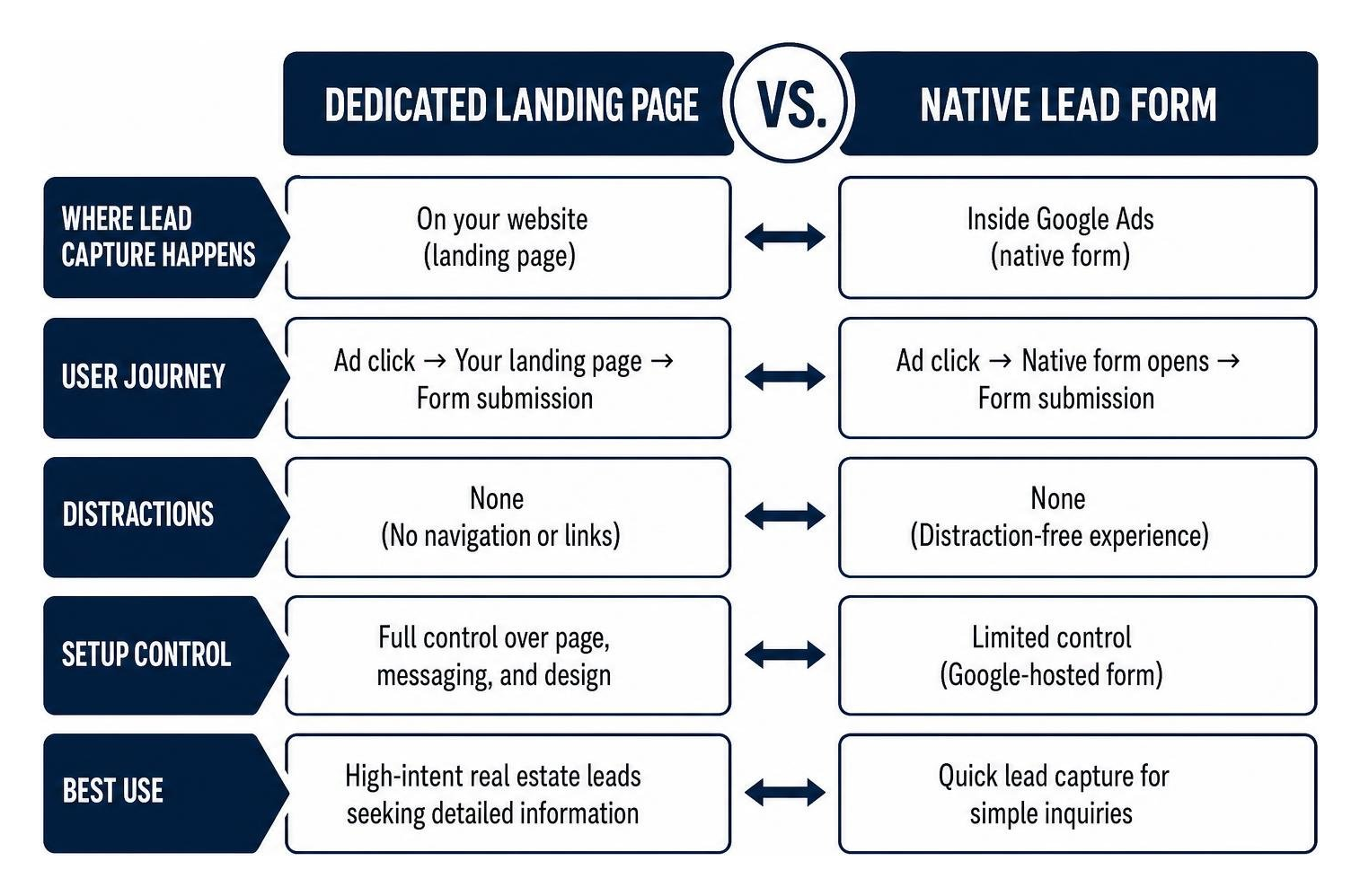
A dedicated real estate landing page must feature:
- A headline that directly mirrors the search query and advertisement copy.
- A single, unobstructed call to action (e.g., a short form requesting a property address for a market report).
- Zero external navigation links or header menus that permit visitors to click away without converting.
- Sub-3-second mobile load times and prominent trust signals (local credentials, client testimonials, and brokerage licensing details).
Alternatively, Google native lead form assets capture user information directly within the Google search interface. Because Google pre-fills user contact details from their account profile, lead form assets reduce mobile friction and often lower initial cost-per-lead to $30–$60.
However, landing page submissions often exhibit higher overall qualification rates because the prospect actively engaged with your custom brand presentation.
Budgeting, Tracking, and Lead Nurturing for Maximum ROI
Driving consistent revenue through Google Ads requires viewing digital marketing as an end-to-end operational pipeline. Securing the click is merely the first transaction; converting that digital inquiry into a signed listing agreement or buyer representation contract requires rigorous tracking and disciplined lead response workflows. Evaluating local market dynamics and agent performance demonstrates that responsiveness separates top producers from the rest of the pack.

The speed at which your business responds to digital inquiries dictates your conversion rate. Industry research shows that contacting an online real estate lead within five minutes makes that prospect 21 times more likely to enter the qualification cycle compared to waiting 30 minutes.
To capture this advantage:
- Connect your Google Ads account to your CRM (such as Follow Up Boss, kvCORE, or custom webhooks) using instant API integrations.
- Implement automated SMS and email notifications that alert you the second a form is submitted.
- Deploy an immediate, personalized autoresponder confirming receipt of the request while initiating a phone call attempt during business hours.
Budgeting and ROI Benchmarks for Google Ads for Real Estate Agents
Understanding real estate PPC economics enables you to set realistic monthly budgets and evaluate campaign profitability. While the overall real estate sector sees average costs per click of $2.53 to $3.22 and average click-through rates of 8.43%, individual sub-sectors experience varying metrics:
- Average Real Estate Conversion Rate: 3.28% (with dedicated, conversion-optimized landing pages).
- Average Cost Per Lead (CPL): Approximately $100 across broad campaigns. Direct residential search leads sent to landing pages average around $157.59 due to early-stage search habits, whereas specialized property management keywords achieve conversion rates of 10.24% with a lower CPL of $76.71.
- Recommended Starting Budget: A solo real estate agent operating in suburban markets like Buffalo Grove, Wheeling, or Libertyville should budget between $900 and $2,000 per month. This budget guarantees sufficient click volume (300 to 600 monthly clicks) to generate 10 to 20 qualified inquiries per month.
From an ROI perspective, closing a single residential transaction from a $1,200 monthly ad spend can easily yield $8,000 to $15,000 in gross commission income—representing an immediate 6x to 12x return on advertising spend.
Critical Mistakes That Drain Realtor Ad Budgets
Avoiding standard pay-per-click traps ensures that your marketing investment remains profitable month after month:
- Directing Traffic to a Generic Homepage: A standard homepage offers too many distractions. Always direct ad traffic to a dedicated landing page designed around a single action.
- Prematurely Pausing Campaigns: The Google Ads Smart Bidding algorithm requires a 14- to 30-day learning phase to calibrate bidding around user conversion behaviors. Pausing or radically altering budgets every 3 days resets this learning phase and destabilizes ad delivery.
- Relying on Unrestricted Broad Match Keywords: Bidding on broad match terms without strict negative keyword lists allows Google to show your ads for searches like “free real estate license classes” or “cheap rentals.”
- Failing to Track Inbound Phone Calls: Over 40% of high-intent mobile search conversions occur via direct phone calls rather than form fills. Failing to deploy dynamic call tracking leaves your campaigns blind to their most profitable conversions.
- Neglecting Search Term Reports: Failing to conduct weekly search term audits allows negative search queries to continuously siphon marketing funds.
Frequently Asked Questions About Real Estate PPC
How quickly can real estate agents expect results from Google Ads?
Real estate agents can begin receiving clicks and initial lead inquiries within 7 to 14 days of launching a well-structured Search campaign. However, optimal campaign efficiency is typically achieved within the 60- to 90-day window. During this initial timeframe, your negative keyword list expands based on real user queries, ad copy is refined through A/B testing, and Google’s Smart Bidding algorithm completes its calibration phase.
Because real estate transaction cycles often range from 30 to 120 days, the full pipeline and revenue return on investment mature over several months of continuous optimization.
What is the ideal monthly budget for a solo real estate agent?
A solo real estate professional should plan for a monthly ad spend between $900 and $2,000 to maintain consistent lead acquisition. In suburban markets such as Palatine, Highland Park, and Barrington, this budget allows for an allocation of roughly 60% toward high-intent seller campaigns (such as property valuation and listing agent queries) and 40% toward targeted buyer terms.
Teams and expanding brokerages operating across larger territories (such as full county coverage across Cook County and Lake County) typically scale budgets from $3,000 to $7,000+ per month to capture dominant impression share across multiple localized markets.
Does Google’s Housing Policy restrict ZIP code targeting for realtors?
Yes. Under Google’s Personalized Advertising and Fair Housing policies in the United States and Canada, housing-related advertising cannot target audiences based on postal ZIP codes, age, gender, parental status, or marital status. Real estate professionals must utilize radius-based location targeting (such as a 3- to 15-mile radius around an office or focal community) or city/county boundary selections.
To capture localized intent without violating housing regulations, agents should incorporate hyper-local neighborhood and community names directly into their keyword architecture and responsive ad copy (e.g., targeting "homes for sale near downtown Des Plaines").
Conclusion
Mastering Google Ads provides real estate professionals with an invaluable competitive advantage: a consistent, predictable stream of bottom-of-funnel property buyers and motivated home sellers. Rather than relying solely on unpredictable referral networks, a structured pay-per-click system allows you to control your transaction pipeline and scale your local market presence methodically.
Success in real estate digital advertising requires a complete system: combining high-intent keyword selection, non-discriminatory geographic targeting, dedicated conversion landing pages, and lightning-fast lead follow-up.
At WWS — Web Development + SEO (Wizerunek w Sieci), based in Des Plaines, IL (636 S River Rd #218), we combine the strategic depth and advanced technical capabilities of a major agency with the dedicated, personalized attention of a local partner.
With deep knowledge of the Chicago metropolitan area and specialized bilingual capabilities supporting both English and Polish-speaking business communities, we build custom paid campaigns designed for sustainable growth.
Whether you are an independent real estate broker or an established team looking to dominate your local market, we are here to help you turn search clicks into closed transactions.
Ready to accelerate your real estate lead generation? Contact WWS today for a comprehensive marketing consultation and free website audit by visiting wizerunekwsieci.com.