





The fastest way to fill more tables in Chicago is to optimize your Google Business Profile and pair it with one focused local promotion, such as Chicago Restaurant Week or a neighborhood activation. Three quick wins to start today: update your hours, menu, and ordering link on your profile; schedule three high-quality photos of food and interior; and publish one time-limited offer promoted through a Google post and a local social ad.
TL;DR:
- Ensuring your Google Business Profile is fully optimized with accurate hours, menu, and ordering links is essential for immediate local discovery.
- Regularly updating your menu, responding to reviews, and posting high-quality photos significantly boost your profile’s visibility and customer engagement.
- Focusing on targeted promotions during peak local events, like Chicago Restaurant Week or neighborhood activations, can generate quick spikes in bookings and interest.
- Tracking key metrics from Google Profile insights and your booking system allows you to measure ROI and adjust tactics effectively within weeks.
- Outsourcing or automating profile updates and campaigns with a local expert can save time and amplify results without sacrificing control.
Table of Contents
- 1. Top Marketing Tactics for Chicago Restaurants, Ranked by Impact
- 2. Turning the List Into a Plan: Timeline and Cost Bands
- 3. Chicago Event Playbook: Restaurant Week and Neighborhood Moments
- 4. Measuring Results: KPIs, Dashboards, and ROI Basics
- 5. How an In-House Chicago Partner Executes These Tactics
- 6. Engagement Strategies for Chicago Delivery Apps
- 7. Building Campaigns That Reflect Chicago’s Communities
- What Actually Moves the Needle for Chicago Restaurants
- Get Local Marketing Support Built for Chicago-Area Restaurants
- FAQ
- Sources
1. Top Marketing Tactics for Chicago Restaurants, Ranked by Impact
Most restaurant owners in Indiana and across the Chicago area waste marketing budget on tactics that look good but produce no measurable traffic. The ideas below are ordered by how quickly they tend to move the needle, starting with the channel that controls local discovery.
- Fully optimize your Google Business Profile. Set accurate hours, attributes, menu content, ordering links, and respond to every post and review; this is the hub Google uses to decide who shows up in local search. Google’s own guidance covers how restaurants add and edit this information, and profile insights show you which parts of your listing actually drive action.
- Keep your menu current everywhere. Use the menu editor to upload a PDF or build sections item by item; note that updates can take 24 to 48 hours to appear on Search and Maps, so plan seasonal changes a few days ahead.
- Set a preferred ordering link. Google lets you add a custom “Place an order” link or choose a preferred provider so customers land on the page that actually makes you money instead of a third party that takes a cut. Google Business Profile’s ordering tools explain both link types and how to switch providers.
- Build a review and reputation routine. Ask for reviews at the point of payment, reply to every review within a day or two using a short template, and have a plan for escalating a bad one rather than ignoring it. Our guide to handling negative reviews walks through response language that defuses rather than inflames.
- Invest in photography and user-generated content. Rotate fresh shots of plated dishes, the dining room, and the exterior every few weeks, and repost tagged guest photos with permission; stale, dim photos are often the single biggest reason a strong menu underperforms online.
- Build neighborhood landing pages on your website. A page built around your specific neighborhood and cuisine, with structured data marking up your menu and business details, helps you show up for searches tied to that area; for deeper training on GEO/AEO tactics and local search optimization, explore the Local SEO + AEO + GEO Academy. Our local SEO overview breaks down how this pairs with your profile.
- Run tightly geo-targeted paid social. Narrow your radius to the blocks around your restaurant, schedule ads around lunch and dinner dayparts, and build creative around specific menu items rather than generic branding.
- Collect email and text contacts at the table. A short sign-up at checkout feeds a brief winback sequence for lapsed guests and a reservation reminder that cuts no-shows.
- Partner with neighboring businesses. Cross-promote with a nearby theater, hotel, or retail shop: a dinner-and-show bundle or a shared loyalty perk reaches an audience that is already nearby and spending.
- Build promotions around local events. Chicago Restaurant Week, sports schedules, and theater openings all create predictable demand spikes; build a prix-fixe or bundled offer ahead of the date rather than scrambling the week of.
- Run micro-influencer campaigns with clear terms. Give a handful of local food accounts a specific deliverable, a unique discount code, and a deadline so you can track exactly what the partnership produced.
- Add simple loyalty and referral mechanics. A punch card, a digital loyalty app, or a flat discount for referring a friend keeps repeat guests coming back without heavy lifting.
Pro Tip: Pick two tactics from this list to run this month instead of all twelve at once: a half-finished list of ideas produces less than two tactics executed well.
2. Turning the List Into a Plan: Timeline and Cost Bands
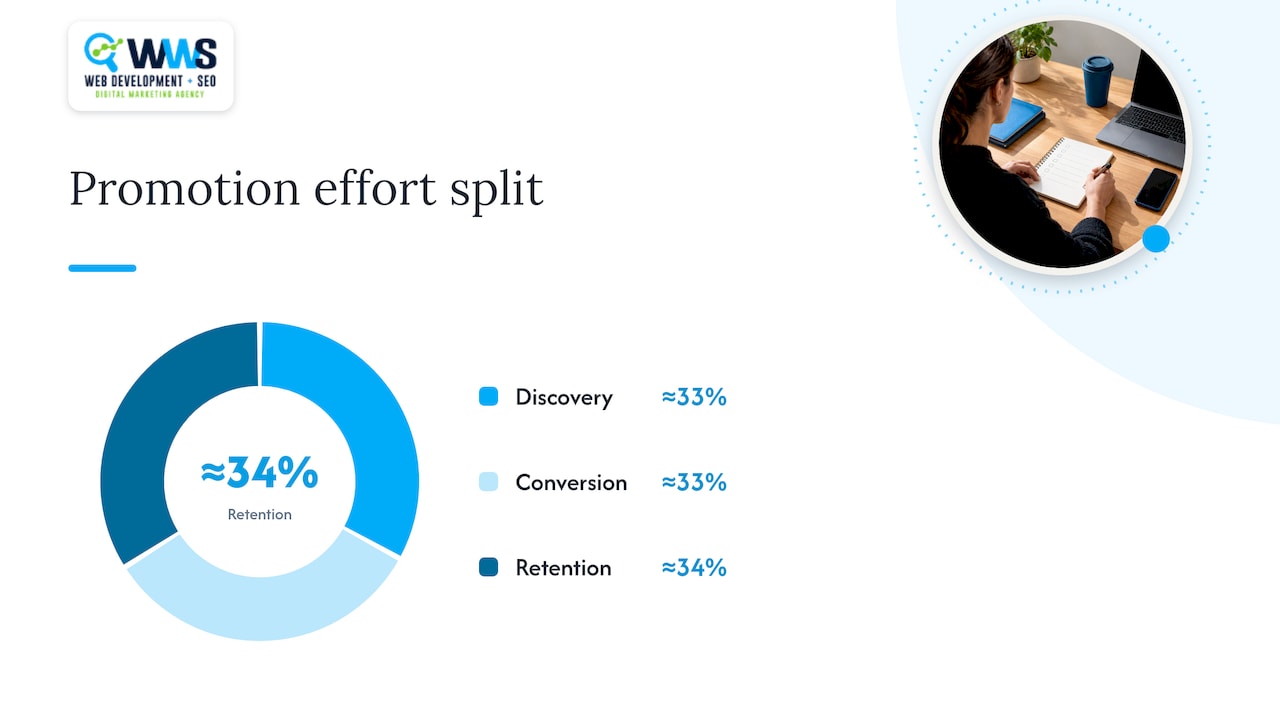
A list of tactics only helps once someone owns each task and a deadline. The 30/30/30 rule gives a simple way to split a promotion’s effort: roughly a third of the work goes to discovery (getting found), a third to conversion (getting the booking or order), and a third to retention (getting the guest back). For a dinner promotion, that might mean a third of your prep time on the Google post and social ad, a third on the ordering link and reservation page, and a third on the follow-up email or text after the visit.
A compact checklist mapped to who owns it:
- Owner or manager: approve the offer and pricing, roughly 30 minutes.
- Manager or staff: update hours, menu, and ordering link on the profile, about an hour.
- Staff: collect reviews and reply to recent ones, 15 minutes a day.
- Photographer or staff member with a phone: capture three to five usable photos, under an hour per session.
- Agency or in-house marketer: build and launch the geo-targeted ad, a few hours including creative.
A quarter of Google’s recommended profile insights (searches, menu clicks, and bookings) come directly from the Business Profile performance tab, with no extra tool required. Google notes these as the metrics worth watching for restaurants, which makes them the cheapest data source available to any owner.
Cost bands run roughly as follows: a DIY approach using free tools costs only staff time; a hybrid approach adding paid ads or a photographer runs a modest out-of-pocket cost per month; an agency-assisted approach that hands-off profile management, ads, and campaigns to a team costs more but frees owner time. Expect early signals like menu clicks and search impressions within days, and booking or revenue shifts within two to four weeks.
3. Chicago Event Playbook: Restaurant Week and Neighborhood Moments
Choose Chicago’s announcement of Chicago Restaurant Week 2026 participants shows how the program works: restaurants build prix-fixe menus and open reservation inventory well ahead of the dates, then lean on the city’s own promotion to bring in diners who might not otherwise find them. Treat the lead-up weeks as your busiest marketing period of the year, not an afterthought.
- Lock in a prix-fixe menu that highlights signature dishes without overloading the kitchen during a high-volume week.
- Open extra reservation slots early and promote them through your Business Profile posts and email list.
- Pair a Restaurant Week push with a smaller neighborhood activation, such as a pop-up tasting with a nearby retailer or a joint promotion with a local theater’s evening showtimes.
- Target tourists through hotel concierge partnerships and the Choose Chicago event calendar, and target locals through geo-targeted social ads tied to the exact event dates.
4. Measuring Results: KPIs, Dashboards, and ROI Basics
You do not need expensive software to know whether a promotion worked. Four places hold nearly everything you need: your Business Profile insights, your reservation or booking system, your point-of-sale data, and Google Analytics if your website runs it.
| Metric | Where to find it | What it tells you |
|---|---|---|
| Local searches and map views | Google Business Profile insights | How visible you are before someone decides to visit |
| Menu clicks | Google Business Profile insights | Interest in your offerings before a booking |
| Calls and direction requests | Google Business Profile insights | Intent to visit or order |
| Reservations and bookings | Your booking system | Actual conversion from interest to a seated guest |
| Repeat visits | Point-of-sale records | Whether a promotion built loyalty or just a one-time bump |
A minimal dashboard is a single spreadsheet tab updated weekly with these five rows. For a quick ROI check, divide the ad or promotion cost by the number of new reservations it produced to get a cost per reservation, then compare that week’s covers against a normal week to see the uplift from the promotion itself.
- Track menu clicks and search impressions weekly rather than daily; daily swings are usually noise.
- Compare promotion weeks against the same weekday the month before, not against your busiest week of the year.
5. How an In-House Chicago Partner Executes These Tactics
Running all twelve tactics well, every month, is a full-time job on top of running a restaurant. As a Google and Meta Partner with a fully in-house team, we handle Business Profile optimization, local SEO, menu integration, paid social, photography direction, and SMS or email campaigns under one roof, which keeps communication direct and strategy consistent across channels. With over 200 client partnerships across the Chicago area, our work centers on the kind of measurable outcomes covered above: map visibility, menu clicks, and bookings.
- GBP optimization and ongoing posting so your profile stays current without manager time drained weekly.
- Local SEO builds, including neighborhood landing pages and schema markup for menus and business details.
- Paid social campaigns with geo-targeting and dayparting built around your actual menu.
- Photography direction and SMS or email flows that turn a one-time diner into a repeat guest.
Pro Tip: If updating your profile and running one ad campaign already feels like more than your team can keep up with, that is the signal to bring in outside help rather than let the basics slip.
6. Engagement Strategies for Chicago Delivery Apps
Third-party delivery apps put your restaurant in front of people actively searching for food nearby, but the relationship works best when you treat the app as one channel among several rather than your only online presence. Keep your menu, photos, and pricing synced across your delivery app listings and your Google Business Profile so a customer never sees a conflicting price or an outdated dish.
Respond to delivery app reviews with the same speed and tone you use on Google, since a slow or defensive reply there damages trust just as much. Offer an app-exclusive item or a small bundle during slow dayparts like mid-afternoon to pull in orders during hours your dining room sits empty. When a delivery platform lets you run a limited-time discount, time it to the same promotion window as your Google post and social ad so the message reaches the same audience from multiple directions instead of competing offers running at once. Track which platform actually produces repeat customers rather than one-time discount hunters, and shift budget toward the one that performs.
7. Building Campaigns That Reflect Chicago’s Communities
Chicago’s neighborhoods carry distinct food cultures, languages, and traditions, and a campaign that ignores that context reads as generic no matter how polished the design looks. A promotion built around a specific neighborhood’s dining habits, from a Pilsen taqueria’s weekend specials to a Chinatown restaurant’s Lunar New Year menu, tends to resonate more than a one-size-fits-all citywide offer.
Build creative and copy that reflect the language and holidays your actual customer base celebrates, and involve staff who know the neighborhood in reviewing the message before it goes out. A menu description, a social caption, or a promotional flyer written with real cultural familiarity reads as authentic, while a translated or borrowed version often reads as an afterthought. Partner with local cultural organizations or community calendars when planning a seasonal promotion, since that visibility reaches people who already trust the source. The goal is not a separate campaign for every community but a willingness to tailor the same core offer so it speaks naturally to the neighborhood you are actually serving.
What Actually Moves the Needle for Chicago Restaurants
Most advice aimed at restaurant owners treats marketing as a long list of equally important tasks, which leaves busy managers paralyzed instead of productive. The honest judgment is that your Google Business Profile is not one tactic among twelve, it is the foundation every other tactic depends on: a brilliant Instagram campaign sends people to search your name, and if your profile has a stale menu or no ordering link, that traffic leaks away before it reaches a table.
The conventional advice oversells novelty, chasing the newest platform or influencer trend, while undervaluing the unglamorous work of keeping hours, menus, and reviews current. Influencer posts and clever social campaigns work best as amplifiers of a profile that is already solid, not as a substitute for it. If you do only one thing this month, make it the profile audit, then layer in a single local promotion timed to an event like Chicago Restaurant Week. Everything else on this list compounds on top of that foundation; nothing on it replaces it.
— Online Marketing Experts
Get Local Marketing Support Built for Chicago-Area Restaurants
Executing even half of these tactics well takes time most owners do not have between service shifts and staffing headaches. We build and manage restaurant marketing entirely in-house as a Google and Meta Partner, which means the team optimizing your profile is the same team running your ads and managing your reviews, with no outsourcing and no gaps in communication.
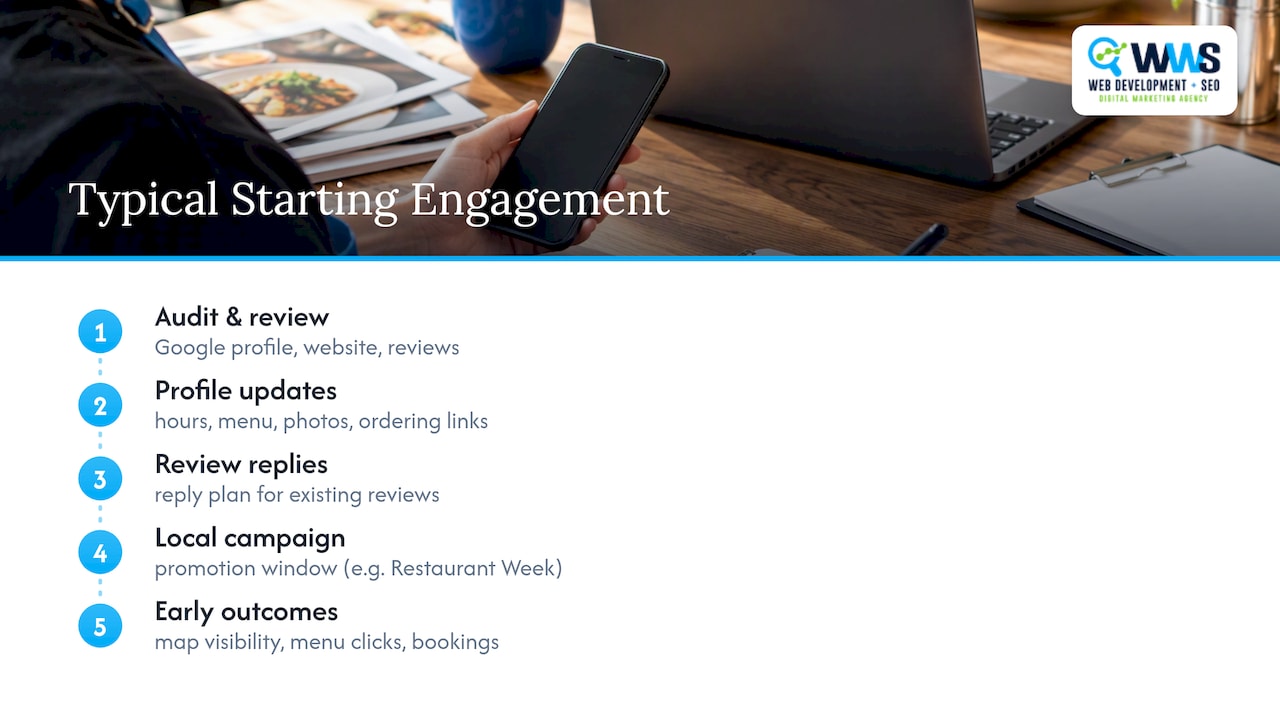
A typical starting engagement includes a quick audit of your current Google Business Profile, website, and review history; updates to hours, menu, photos, and ordering links, plus a reply plan for existing reviews; and one local campaign built around a promotion window, such as a neighborhood event or Restaurant Week.
Early outcomes usually show up as better map visibility, more menu clicks, and a measurable bump in bookings within the first few weeks. If you would rather hand the profile work and the local campaign to a certified in-house team, our local SEO services are built specifically for Chicago-area restaurants and service businesses. Reach out to schedule a consultation and see what a focused first campaign could look like for your dining room.
FAQ
What are some unique marketing ideas for restaurants?
Beyond the standard social posts, consider a micro-influencer deal with a specific deliverable and a unique discount code, a cross-promotion with a nearby theater or retailer, or a limited-time menu item tied to a neighborhood event. Pairing any of these with an optimized Google Business Profile gives the promotion a discovery channel instead of relying on social reach alone.
What is the 30/30/30 rule for restaurants?
The 30/30/30 rule splits promotional effort roughly into thirds: discovery work that helps people find you, conversion work that turns that attention into a booking or order, and retention work that brings the guest back. Applying it to a single dinner promotion keeps a team from over-investing in the ad and under-investing in the follow-up.
What are the 7 P’s of marketing for restaurants?
Definitions vary, but a common version adapts the classic marketing mix to product (menu and food quality), price, place (location and delivery reach), promotion, people (staff and service), process (how orders and service flow), and physical environment (interior and exterior presentation). Each P maps to a tactic covered above, from menu photography to review management.
How do I prepare for Chicago Restaurant Week?
Build a prix-fixe menu that highlights signature dishes, open extra reservation inventory ahead of the dates, and promote the offer through your Business Profile and email list before the week starts. Choose Chicago’s Restaurant Week announcements list participating restaurants and dates each year, which gives you a firm planning window.
What are some hidden gems for food in Chicago?
Chicago’s neighborhoods each carry their own food identity, from family-run spots in Pilsen to longstanding kitchens in Chinatown and Albany Park, and much of that reputation builds through word of mouth and strong local search presence rather than citywide advertising. A restaurant earns “hidden gem” status online largely through consistent reviews and an accurate, well-photographed Business Profile that lets nearby searchers find it in the first place.
Sources
- Get started with a Business Profile for your restaurant – Google Business Profile Help
- Choose Chicago reveals Chicago Restaurant Week 2026 participating restaurants | Choose Chicago