


Generative engine optimization (GEO) is the practice of improving your visibility in answers written by AI search tools such as Google’s AI Overviews and AI Mode, ChatGPT and similar assistants. It is also called answer engine optimization. For a local service business, the practical meaning is simple: when someone asks an AI tool who can fix a roof, replace windows or install an implant near them, you want your business named in the answer and your website cited as a source. Most of the work builds on good SEO, with a few additions that matter more than they used to.
This guide explains what GEO is, what the research says works, and what a contractor, dentist, restaurant or home service company in the Chicago area can do about it this quarter.
TL;DR
- GEO means earning mentions and citations inside AI-generated answers, not only ranking blue links.
- Google says SEO best practices remain relevant for its generative AI features, so GEO extends your SEO rather than replacing it.
- Citations, statistics, clear structure and original expertise raise visibility. Keyword stuffing does not.
- For local businesses, consistent listings, reviews and clear service pages tell AI systems what you do and where.
- You can now measure part of this in Google Search Console.
Table of Contents
- What generative engine optimization means
- GEO vs. SEO: what actually changes
- What the research says works
- How AI systems decide which local business to name
- A practical GEO plan for a local service business
- Why AI traffic can be worth more than its volume
- How to measure your progress
- Common GEO mistakes to avoid
- Our perspective: GEO is local SEO done thoroughly
- Where we can help
- FAQ
- Sources
What generative engine optimization means
Traditional search returns a list of pages and lets the user choose. Generative search reads many sources, writes a summary and, in most products, shows a handful of links as citations. The goal shifts from ranking position to being one of the sources the model draws on and names.
You will see several labels for roughly the same job: GEO, generative search optimization, answer engine optimization, and SEO for AI search. The names differ, but the target is the same: be the business or page an AI system trusts enough to include.
This is not a niche behavior. OpenAI began rolling out search inside ChatGPT to paying users in late 2024, with free users planned afterward, and Google now shows AI Overviews and AI Mode in its own results. Your prospects can meet an AI answer before they ever see your website.
GEO vs. SEO: what actually changes
The short version is that the foundations are shared and the emphasis moves.
| Area | Traditional SEO | GEO |
|---|---|---|
| Goal | Rank a page for a query | Be cited or named in a generated answer |
| Unit of success | Position and click | Mention, citation, and the click that follows |
| Content style | Targeted pages with keywords | Direct answers, facts, sources, original expertise |
| Local signals | Proximity, Google Business Profile, links | Same, plus consistency across the whole web footprint |
| Measurement | Rankings, traffic, calls | Same, plus AI impressions and brand mentions in AI tools |
Google’s own guidance is blunt on the main point. Its documentation on AI features and your website says the SEO best practices still apply to AI Overviews and AI Mode. There is no separate secret markup or special file you need to add to appear in them.
So if someone tells you SEO is dead and GEO is a brand-new discipline that needs a separate budget and tricks, be skeptical. If your site is slow, thin, confusing or untrusted, no AI label fixes that.
What the research says works
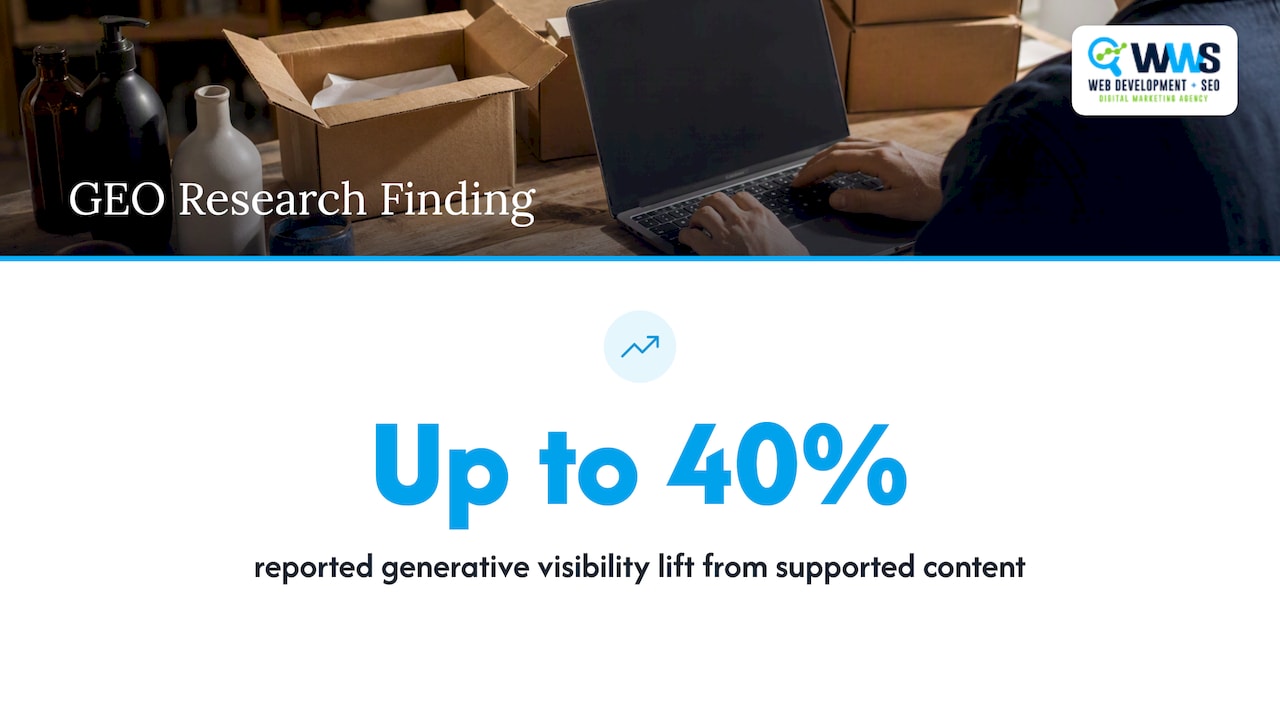
The most cited academic work on this is the GEO study presented at KDD 2024. The authors tested ways of changing content to see whether generative engines would feature it more. Their reported finding was that methods such as adding authoritative citations, quotations and relevant statistics could raise visibility in generative responses by up to 40%. Keyword stuffing, the old habit of repeating a phrase, did not perform well.
Two cautions about that number. It comes from a controlled test on a research benchmark, not from a Chicago roofing site, so treat it as a direction, not a promise. And “up to” means the best case. What transfers cleanly is the principle: AI systems favor content that is specific, supported and easy to extract.
Google adds a second principle. Its guidance stresses what some call non-commodity content: original, first-hand perspective that a model cannot simply assemble from common knowledge. Content built only to manipulate AI results, on the other hand, can run into Google’s spam policies when mass-produced with little value. A page explaining why a 1950s Chicago bungalow needs a different roof ventilation plan, written by someone who has done it, is worth more than a generic page on roofing.
How AI systems decide which local business to name
Local searches are where small businesses win or lose, and the signals are changing in a useful way for operators who do the basics well.
A 2026 paper on local search discoverability, published in IJSRET, argues that generative models do not rely on proximity and a city name in the title alone. They appear to weigh a business’s wider online footprint: the sentiment of its reviews, the consistency of its citations, and the depth of its expertise on a topic. It is a single paper, so read it as a signal, not settled fact, but it matches what we see in practice: a business that is described the same way everywhere, with real reviews and clear specialties, is easier for any system to recommend.
That has concrete consequences for a business in Des Plaines, Naperville or Evanston:
- Name, address and phone must match everywhere. Inconsistent listings give an AI system conflicting facts to reconcile. Our local citations strategy and five-step citation audit show how to find and fix mismatches.
- Reviews should describe the work. A review that mentions a furnace replacement in Skokie gives more context than “great service.” Ask customers to name the job and the town, naturally.
- Say what you specialize in. “Water and mold restoration for Chicago homes” is more useful than “we do it all.”
- Keep Google Business Profile complete. Categories, services, hours, photos and answers are the structured facts many systems read first. See our guide to Google Maps ranking factors.
A practical GEO plan for a local service business
Here is the order we would work in. Each step is useful for classic SEO too, which is the point.
1. Make sure the site can be crawled and understood
AI features draw on pages that search engines can already find and index. Check that important pages are not blocked, load quickly, work on phones and use clean, shallow paths. Our piece on URL structure and AI citations covers the structure side. If you are building or rebuilding, how to make an SEO-friendly website lists what to settle before launch.
2. Write pages that answer the question first
Open each service page with a direct answer: what the service is, who it is for, the area you cover, and what happens next. Then add detail. A dentist’s implant page might state the steps of treatment, the typical consultation process and who is a poor candidate, in plain language. A model can lift a clear paragraph like that. It cannot lift a wall of marketing adjectives.
3. Add facts that can be checked
This is where the research points most clearly. Where you make a claim, support it: cite a code requirement, a manufacturer specification, a licensing body or a recognized study, and link to it. Include your own numbers when you have them, such as the number of jobs completed or the years in the trade, and keep them accurate.
4. Publish first-hand expertise
Use what only your team knows. Photos from real jobs, before and after notes, common mistakes you fix, what a Chicago winter does to a particular material. This is the non-commodity content Google describes, and it is also the hardest thing for a competitor to copy.
5. Build your footprint beyond your own site
AI answers lean on what others say about you. Earn reviews, keep directory listings accurate, and get mentioned in local trade groups, chambers of commerce and community publications. Our local SEO best practices and local SEO checklist cover the groundwork.
6. Use structured data where it fits
Schema markup for your business, services and FAQs helps machines read your facts. It is not magic, and Google does not require it for AI features, but accurate markup removes guesswork about who you are and where you operate.
7. Watch for new machine-readable channels
Some AI assistants are moving beyond answers toward actions. OpenAI’s documentation describes local services “Get Quote” plugins in ChatGPT, currently in beta and limited to approved partners. They depend on structured business data, including precise coordinates and standard service definitions. Most small businesses cannot join that program today, and you should not pay anyone for access that does not exist. What you can do is keep your business data clean, structured and consistent, so you are ready if and when such channels open.
Why AI traffic can be worth more than its volume
AI answers may send fewer clicks than a classic results page, so it is fair to ask whether this is worth the effort. Google reports that clicks from AI Overviews and AI Mode are higher quality than ordinary organic clicks, with visitors spending more time on the destination site. The reasoning is that the generated answer has already filtered the question, so the person who clicks is further along.
For a service business, that matches how leads behave. Someone who has read a summary of what a kitchen remodel involves, then clicks through to your page, is closer to calling. That is why we focus on phone calls and form fills, not raw traffic, when we judge whether this work pays.
How to measure your progress
Measurement used to be the biggest complaint about AI visibility. It has improved. Google announced Search Generative AI performance reports in Search Console and states that, as of August 31, 2026, they are available to all websites worldwide. The reports show impressions from AI Overviews, AI Mode and generative features in Discover, with breakdowns by country, device and page.
A simple tracking routine for a local business:
- Monthly: open the AI performance data in Search Console and note which pages earn impressions and clicks.
- Monthly: ask the main AI assistants the questions your customers ask, with your city and service, and record whether your business is named and which sources are cited.
- Ongoing: track calls, form submissions and booked jobs by source, so you can connect visibility to revenue.
- Quarterly: compare the pages that get cited with those that do not, and improve the weak ones.
AI answers vary between sessions and users, so treat manual checks as a sample, not a ranking. If you want to understand your baseline first, our guide to checking your website’s Google ranking is a good start.
Common GEO mistakes to avoid
- Chasing tricks. Hidden text, keyword repetition and prompt-style instructions on your pages do not help, and Google has no special requirement here.
- Mass-producing AI content. Publishing dozens of generic articles generated by a tool adds nothing a model has not already seen. Google’s guidance on generative AI content treats usefulness as the standard, whoever or whatever writes the page.
- Ignoring the basics. A slow site, a half-finished Google Business Profile or conflicting phone numbers will cost you more than any missing GEO tactic.
- Buying guarantees. No one controls what an AI system says. Be wary of any vendor promising a fixed placement in ChatGPT or AI Overviews.
- Forgetting the sale. A citation that sends visitors to a page with no clear call to action is a wasted opportunity. Make the next step obvious.
Our perspective: GEO is local SEO done thoroughly
We work with local service businesses around Des Plaines and the greater Chicago area, and we handle design, development, SEO and local optimization in-house. That setup shapes how we see GEO.
We do not treat it as a new product category. When we look at why a business gets named in an AI answer, the reasons are familiar: a clear site, accurate listings, real reviews and pages written by people who do the work. What has changed is the cost of vagueness. A weak page used to lose a position. Now it may not be quoted at all.
Our advice to a roofing company, a med spa or a restaurant is the same. Fix the foundation first, then add the proof: specific service pages, facts with sources, consistent listings and content that reflects your actual jobs. Measure calls, not just impressions. And ignore anyone selling a shortcut.
— Online Marketing Experts
Where we can help
If you would rather have this handled than add it to your own list, our team builds the pieces GEO depends on. We develop fast, crawlable websites through website design, handle local SEO including listings and Google Business Profile work, and run website SEO for content and technical health. As an official Google and Meta Partner with a fully in-house, certified team, we keep strategy, design and development under one roof. Contact WWS to talk through where your business stands today.
FAQ
Is generative engine optimization different from SEO?
The two overlap heavily. Google says its SEO best practices still apply to AI Overviews and AI Mode, so strong SEO is the base. GEO adds a focus on being cited in generated answers: direct answers, supported facts, original expertise and a consistent presence across the web.
Do I need schema markup or a special file to appear in AI answers?
Google’s guidance does not require special markup for its AI features. Structured data can still help machines read your business details accurately, so use it where it fits, but do not expect it to guarantee a mention.
Can a small local business really show up in ChatGPT or Google’s AI answers?
Yes, especially for specific local questions where a clear, well-reviewed specialist is easy to recommend. Visibility is never guaranteed, because answers vary. Consistent listings, detailed service pages and genuine reviews give you the best chance.
How do I know whether GEO is working?
Use the AI performance reports in Search Console, check key questions in AI assistants each month, and track calls and form submissions. The business result, more qualified leads, is the measure that matters.
Sources
- GEO: Generative Engine Optimization (KDD 2024)
- GEO: Generative Engine Optimization, ACM Digital Library
- Google’s guide to optimizing for generative AI features
- AI features and your website, Google Search Central
- Google Search’s guidance on generative AI content
- Search Generative AI performance reports in Search Console
- GEO: A Geospatial AI Framework for Local Search Discoverability, IJSRET
- Local services Get Quote conversion spec, OpenAI
- ChatGPT Search Now Live, Search Engine Roundtable
- Generative engine optimization, Wikipedia