


Marketing Attribution for SMBs: A Practical Guide
Learn which attribution model fits a small business, what to track from calls, forms and Google Maps, and how to tie marketing spend to booked revenue.
 By WWS Team
9 min read
In this article14 sections
- Key takeaways
- What marketing attribution means for a local business
- The main attribution models, explained
- Which model fits a small business
- How to track leads from calls, forms, Search and Maps
- A worked example: HVAC company, one month
- Metrics worth reviewing each month
- Limits of attribution you should plan for
- Our perspective
- Put attribution to work with WWS
- A simple 30-day setup plan
- FAQ
- Sources
- Recommended
Marketing attribution is how a small business works out which marketing efforts produce leads, booked jobs and revenue. For most local service companies the best starting point is simple: record the source of every lead, use first-touch or last-touch credit, and follow each lead through to the invoice. You don’t need an enterprise platform to do this. You need consistent records.
This guide explains the main attribution models in plain terms, shows which ones suit a business with a short customer journey, and lays out a tracking setup you can run for calls, forms, Google Search, Google Maps and paid ads.
Key takeaways
- Attribution assigns value to the customer actions that marketing influenced, so you can move budget toward what drives revenue (G2).
- Small businesses with simple funnels should start with first-touch or last-touch attribution, then add complexity only when the data justifies it.
- Google-reported calls and clicks are interactions, not qualified leads. Record qualification, booking and revenue yourself.
- Review enquiries, customers and revenue by source, plus cost per enquiry on paid channels, not impressions or clicks alone.
- Every model has blind spots, such as privacy limits and cross-device journeys, so treat attribution as a decision aid, not a verdict.
What marketing attribution means for a local business
Attribution identifies and assigns value to the customer actions, across the buyer’s journey, that your marketing influenced. The practical purpose is to see which programs drive value and adjust the budget to support revenue, as G2’s attribution overview describes it.
In a local business, that turns into questions like these:
- Did this roofing job come from Google Maps, a Facebook ad, a postcard or a referral?
- Which channel brings in calls that actually become estimates?
- Is the money spent on paid search producing booked work, or only clicks?
A restaurant, a dentist’s office, an HVAC company and a remodeler all face the same problem. The phone rings, a form arrives, and nobody records where the person came from. Attribution fixes that gap.
The main attribution models, explained
An attribution model is a rule for splitting credit among the touchpoints a customer had before converting. Nielsen’s guide to multi-touch attribution describes the common ones:
| Model | How credit is assigned | Best for |
|---|---|---|
| First touch | 100% to the first interaction | Finding which channels bring new leads |
| Last touch | 100% to the final interaction before conversion | Seeing which touchpoints close the deal |
| Linear | Equal credit to every touchpoint | Longer journeys where each step matters |
| Position-based | More credit to the first and last touchpoints | Balancing discovery and closing |
| Time decay | Credit grows toward the last touchpoint | Longer sales cycles with a clear closing stage |
| Algorithmic (data-driven) | Statistical modeling and machine learning allocate credit | Businesses with high data volume |
The first five are rule-based, which means you can apply them with a spreadsheet. The last one needs software and a large volume of conversions. Amplitude notes that data-driven attribution uses machine learning and predictive analytics to find influential touchpoints, but is more expensive and more complicated to implement.
A quick example
Imagine a homeowner who sees your Facebook ad on Monday, searches your company name on Wednesday, and calls from your Google Business Profile on Friday.
- First touch credits Facebook.
- Last touch credits Google Business Profile.
- Linear gives each of the three one third.
None of these is wrong. Each answers a different question. First touch asks what started the relationship. Last touch asks what prompted the call.
Which model fits a small business
Start with first-touch or last-touch attribution. According to G2, these single-channel models suit simple funnels and small businesses: first touch shows which channels bring in new leads, and last touch shows the high-impact touchpoints at the bottom of the funnel.
A practical way to choose:
- Short journey, mostly calls (emergency repair, same-week appointments): use last touch. The final click or call source usually tells you what to fund.
- Longer journey, considered purchase (kitchen remodel, dental implants, roof replacement): record both first and last touch. Compare them monthly.
- Multiple locations or high lead volume: consider linear or position-based credit once you have several months of clean data.
The goal is not the most sophisticated model. It is the model you will actually keep updated.
How to track leads from calls, forms, Search and Maps
The core idea is to send marketing channel data along with each lead into a CRM. Then you can report which channels and campaigns drive leads, customers and revenue, as Zapier’s guide to marketing channel data explains.
For a local service business, set it up in this order.
1. Tag every campaign link
Use consistent campaign tags on links in ads, emails, text messages and newsletters, so the source travels with the visitor to your site. Keep one naming pattern, for example the same spelling of channel names every time.
2. Capture the source in every form
Add hidden fields to your contact and quote forms that store the source and campaign. A short form with a clear call to action tends to be easier to keep consistent; our notes on why simple contact forms win cover the design side.
3. Track calls, not just clicks
For many contractors, medical providers and restaurants, the phone is the main conversion. Unique tracking numbers per channel show which source produced each call. Our guide to call tracking setup walks through the steps.
4. Treat Google Business Profile data as a signal
Google-reported calls and website clicks are interactions, not proof of qualified leads, bookings or revenue. ShiftFlow’s Google Business Profile tracking guide recommends adding these fields to the call, estimate, booking or customer record:
- Source
- Qualified
- Estimate sent
- Booked
- Booked revenue
The profile can report that someone interacted. Only you can record whether that person became a customer.
5. Move everything into one record
Whether you use a spreadsheet or software, each lead needs a single row or card. A contractor tracking worksheet can record lead source, spend, contact, qualification, estimate, booked job, completion, revenue and gross profit.
When volume grows past what a spreadsheet handles well, a CRM for inspection professionals shows the kind of all-in-one setup that keeps scheduling, invoicing and client communication in one place, so a lead’s source stays attached to the job.
A worked example: HVAC company, one month
The numbers below are illustrative, not client results.
| Source | Leads | Qualified | Booked | Revenue |
|---|---|---|---|---|
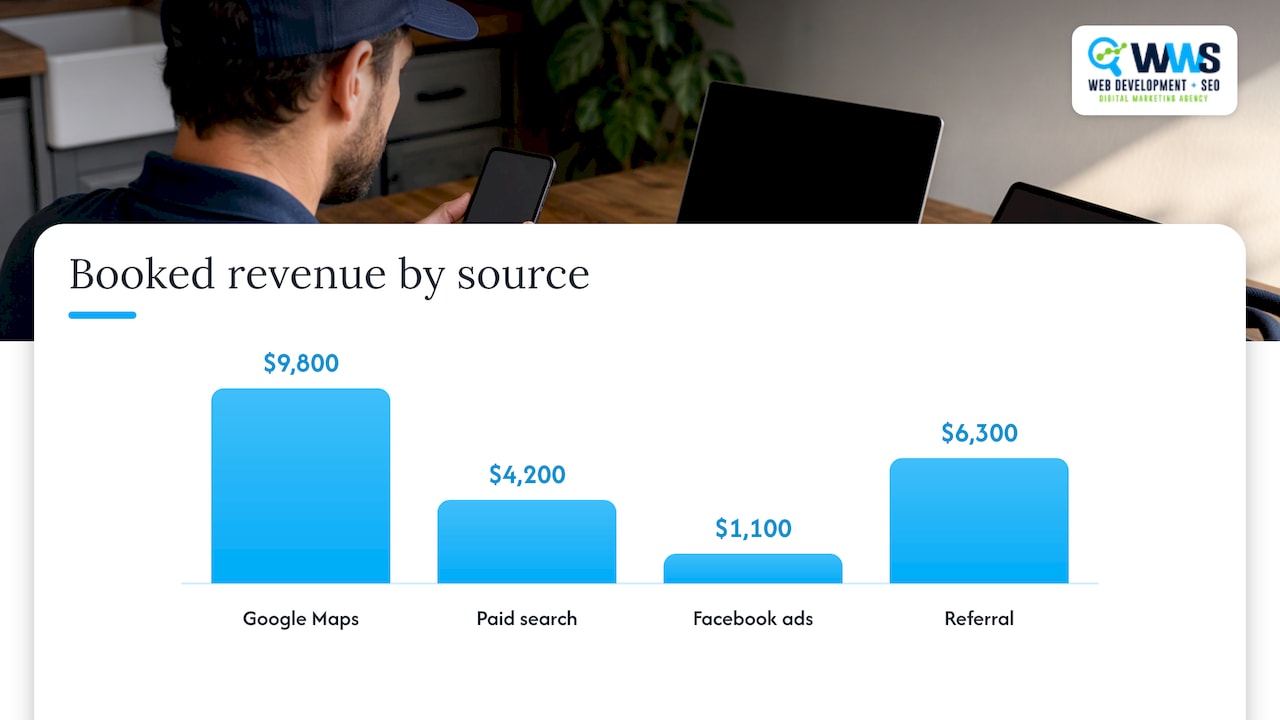
| Google Maps | 40 | 28 | 14 | $9,800 |
| Paid search | 30 | 15 | 6 | $4,200 |
| Facebook ads | 20 | 6 | 2 | $1,100 |
| Referral | 10 | 9 | 7 | $6,300 |
Read by lead count alone, Google Maps and paid search look similar. Read by booked revenue, the gap is clear. If paid search spend was $2,000 that month, cost per qualified enquiry is about $133, and cost per booked job is about $333. That is the kind of figure a budget decision can rest on.
Notice what drives the insight: the extra columns after “Leads.” A raw lead count is where attribution starts, not where it ends.
Metrics worth reviewing each month
A lightweight dashboard beats a complex one that nobody opens. Based on Leadsource’s dashboard guidance, review:
- Enquiries, customers and revenue by source
- Cost per enquiry for paid channels
- Landing-page performance
- Time to first reply
The same guidance points out that impressions, click-through rate and cost per view measure paid activity, not business health. They are useful for diagnosing an ad, but they do not tell you whether the phone is producing revenue.
Time to first reply deserves attention. A channel can look weak in your data simply because leads from it waited a day for a response.
Limits of attribution you should plan for
No attribution setup captures everything. Know the main gaps so you read the data sensibly.
- Privacy rules. Regulations constrain access to deterministic identifiers, and researchers are working on privacy-preserving approaches such as federated learning and explainable attribution, according to a 2022 academic review of attribution modeling.
- Cross-device journeys. A homeowner may research on a phone and call from a desktop number. Tracking restrictions and device switching can leave multi-touch data incomplete.
- Offline word of mouth. Referrals rarely carry a tag. Ask every caller “How did you hear about us?” and log the answer.
The practical response is to combine tracked data with a simple human question at intake. The two together are more reliable than either alone.
Our perspective
We build attribution into the website and the Google Business Profile from day one, because a lead that arrives without a source is a lead you cannot learn from.
Local service businesses rarely need a complicated model. They need a website whose forms and phone numbers record where each enquiry came from, a Google Business Profile managed with the same discipline, and a monthly review that connects those enquiries to booked work.
Because web development, local SEO and campaigns are handled in-house at WWS, the tracking is planned together with the pages and campaigns it measures, instead of bolted on afterward. Our goal is measurable calls and leads, and measurement is how we show them.
Online Marketing Experts
Put attribution to work with WWS
If you want the tracking, the website and the local visibility handled by one team, WWS serves Des Plaines and the greater Chicago area. Our Local SEO service focuses on map pack visibility and phone-call leads, and our Website Design work builds the forms and pages that capture each lead’s source.
If you also run paid ads, our Paid Campaigns and Marketing Campaigns services can be planned around the same lead records. You can start from our home page to see how to get in touch.
A simple 30-day setup plan
- Week 1: List every place a lead can come from: website forms, phone, Google Business Profile, ads, email, referrals.
- Week 2: Add source fields to forms, set up tracking numbers and agree on campaign naming.
- Week 3: Build the lead record with the fields Source, Qualified, Estimate sent, Booked and Booked revenue.
- Week 4: Run your first review. Compare first-touch and last-touch views, calculate cost per enquiry for paid channels and decide one budget change.
If you need more lead-capture options, our overview of lead generation tools for small businesses is a good next step.
FAQ
What is the simplest attribution model for a small business?
First-touch or last-touch attribution. Both give 100% of the credit to a single interaction, so they are easy to apply in a spreadsheet. First touch shows which channels bring new leads, and last touch shows what closes them (G2).
Do I need special software to track attribution?
Not at the start. A spreadsheet or CRM with fields for source, qualification, booking and revenue is enough for a local business. Software becomes useful when lead volume grows or when you want algorithmic models, which are more complex and costly to run.
Can Google Business Profile show me which leads became customers?
It reports interactions such as calls and website clicks, not whether the person was qualified or booked. You record those outcomes in your own call, estimate or customer record, then compare them by source.
How often should I review attribution data?
Monthly works well for most local businesses. It is frequent enough to adjust spend and slow enough for patterns to show. Review enquiries, customers and revenue by source, and cost per enquiry on paid channels.
Sources
- What Is Marketing Attribution? How to Measure It (G2)
- Methods & Models: A Guide to Multi-Touch Attribution (Nielsen)
- A Beginner’s Guide to Attribution Model Frameworks (Amplitude)
- How to use marketing channel data to grow your business (Zapier)
- How to Track Leads From Google Business Profile (ShiftFlow)
- Lead Generation for Contractors: Best Channels, Websites, and Tracking Setup
- Build a Marketing Attribution Dashboard, No Data Team (Leadsource)
- Systematic Review of Attribution Modeling Methods (2022)
Recommended
A Des Plaines, IL team helping local service businesses get found, get called and get booked since 2005: local SEO, Google Ads, conversion-focused websites and AI search optimization.
Meet the teamKeep reading
All articles
Local On Page SEO Demystified: The Formula for Service and Location Pages
Master local on page SEO for service and location pages with WWS's formula to boost rankings, drive conversions, and dominate local search results.

Site Speed for SEO: What Matters and How to Fix It
How site speed affects SEO and local rankings, which Core Web Vitals targets to hit, and the image and hosting fixes that move the numbers for Chicago-area businesses.

Master Organic Traffic Growth Strategy for Long-Term Website Authority
Master your organic traffic growth strategy with proven SEO tactics for long-term authority. Learn to build sustainable visibility and leads.