


Local On Page SEO Demystified: The Formula for Service and Location Pages
Master local on page SEO for service and location pages with WWS's formula to boost rankings, drive conversions, and dominate local search results.
 By WWS Team
12 min read

In this article9 sections
- How Local On-Page SEO Helps Customers Find Your Business
- Understanding Local On Page SEO and Its Core Ranking Impact
- Local Keyword Research and Content Strategy for High-Intent Queries
- The Blueprint for High-Converting Local Service Pages
- Scaling Multi-City Location Pages Without Duplicate Content Penalties
- Technical Foundations: Structured Data and Internal Linking
- Common On-Page Mistakes That Derail Local Visibility
- Frequently Asked Questions About Local On-Page SEO
- Conclusion
How Local On-Page SEO Helps Customers Find Your Business
Good local on page seo starts with a simple match: one useful page for each service or location your customers search for. Find the phrases they use, put the service and city in a clear page title and heading, and answer the questions they ask before contacting you. Add accurate contact details, an easy way to call or request a quote, and links to related pages. If you serve several cities, give each location page real, distinct details rather than swapping city names.
I’m Tomasz Lasota, founder of Wizerunek w Sieci / WWS - Web Development + SEO in Des Plaines. For more than 22 years, I’ve helped small businesses strengthen their websites and online presence; this guide breaks down the local on page seo work that makes service and location pages more useful to nearby customers.
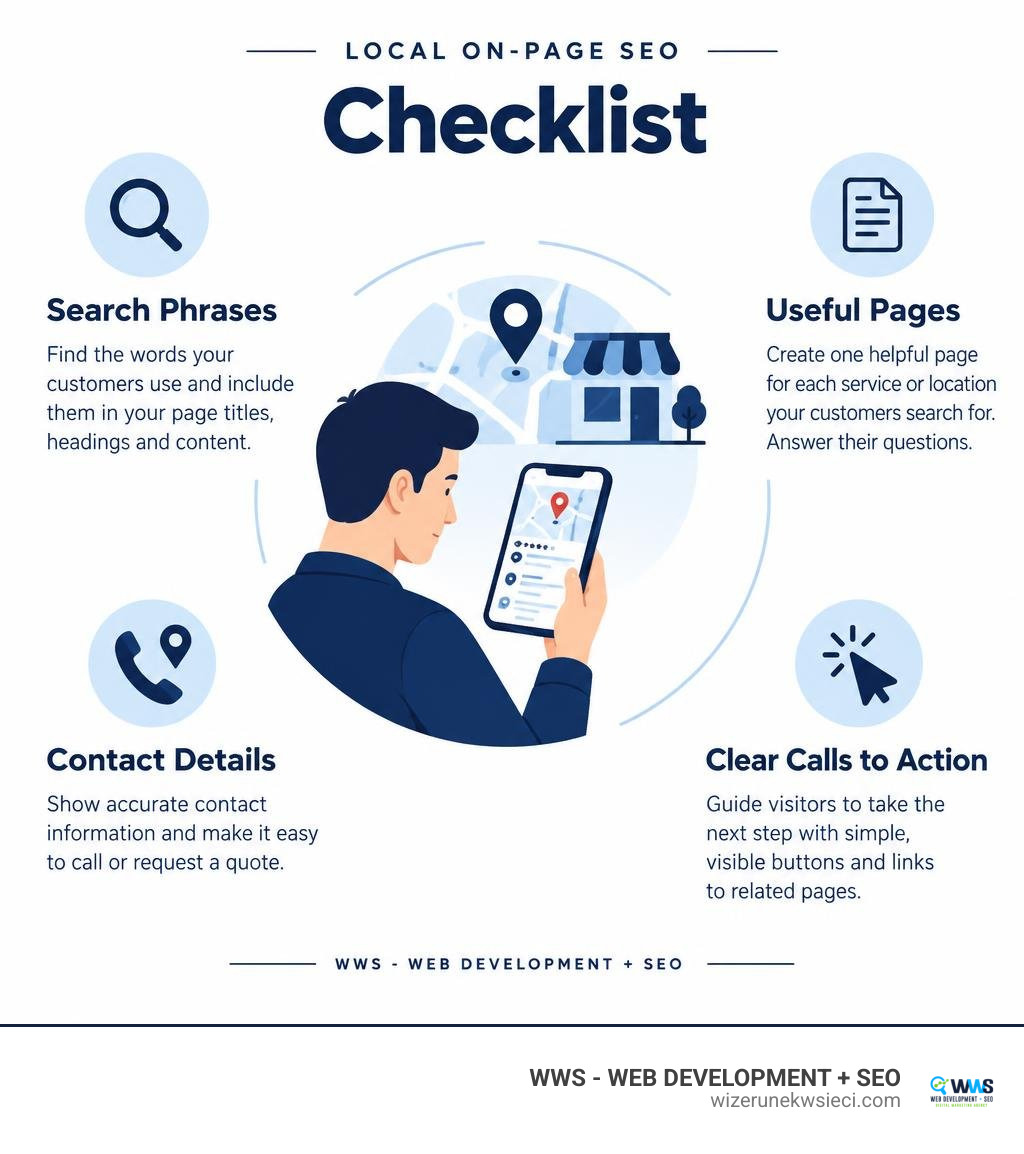
Simple guide to local on page seo:
Understanding Local On Page SEO and Its Core Ranking Impact
When a local customer searches for a professional, search engines work to deliver results that are geographically relevant, reliable, and immediately useful. On-page signals account for 36% of local organic ranking weight, making them the single largest category influencing where your business appears in organic search results. While off-page elements like directory citations and online reviews build overall authority, your website serves as the definitive source of truth that search engines crawl to understand what you do and where you operate.
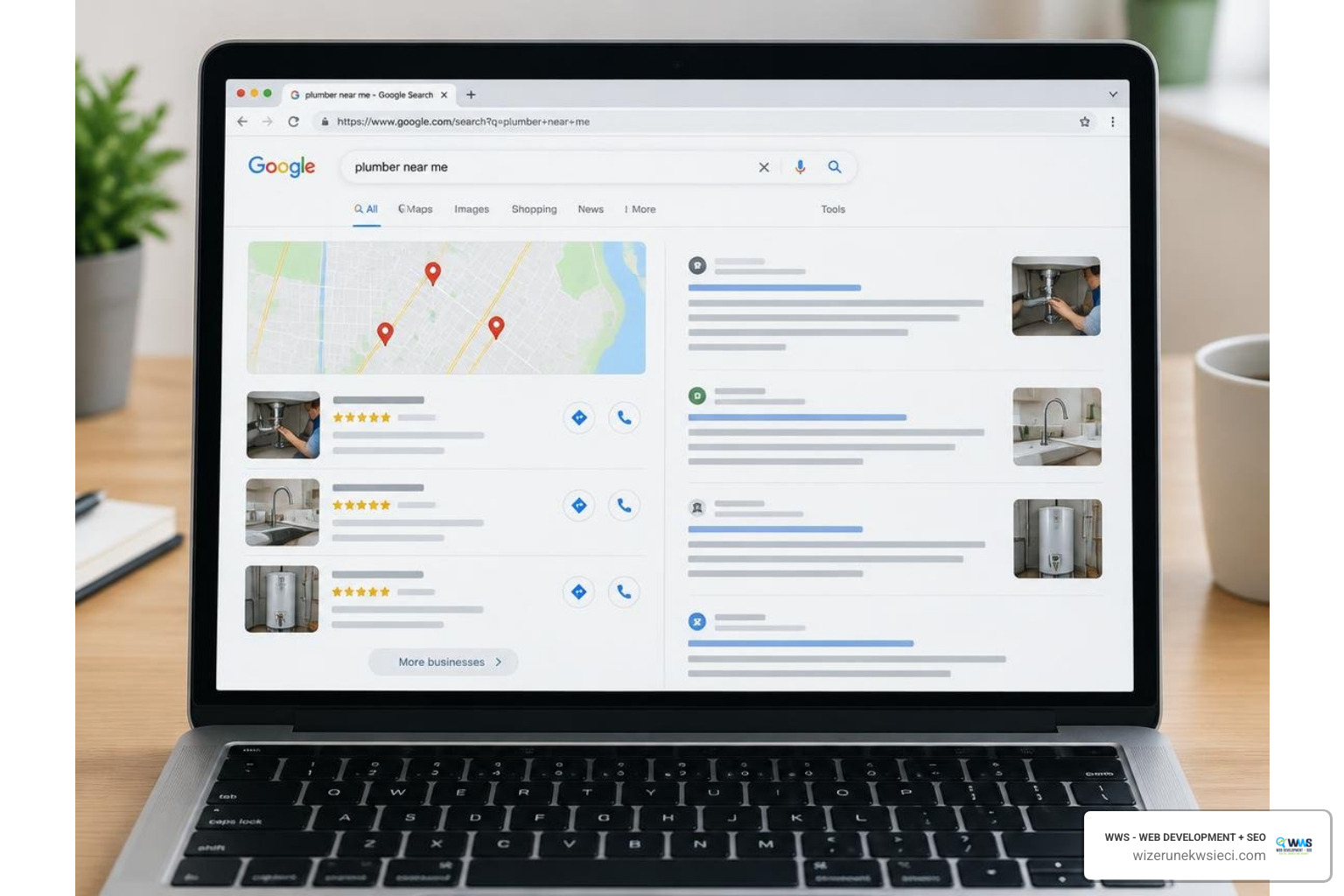
Local search queries carry immediate commercial intent. In fact, 76% of all Google searches have local intent, and 78% of local mobile searches result in an offline purchase. Furthermore, 60% of smartphone users have contacted a business directly using local search results. If your site does not present clear geographic signals and service details, search engines cannot accurately index your pages, meaning you miss out on high-intent prospective clients.
A targeted website bridges the gap between traditional organic rankings and map listings. Understanding the differences between standard web optimization and local optimization ensures your digital foundation is built properly.
| SEO Element | Traditional Organic SEO | Local On-Page SEO |
|---|---|---|
| Primary Keyword Focus | Broad informational or transactional terms | Service terms paired with explicit geo-modifiers (e.g., city, neighborhood) |
| Target Audience | National or global audience | Customers within a defined driving radius or service area |
| NAP Data (Name, Address, Phone) | Optional or limited to contact page | Mandatory across headers, footers, and schema markup |
| Key Ranking Signals | Domain authority, comprehensive topic depth, backlinks | Proximity, on-page NAP consistency, localized content, Local pack synergy |
| Structured Data | Article, Organization, Product | LocalBusiness, Service, GeoCoordinates, FAQPage |
Industry research on ranking factors from Elementor’s local SEO analysis reinforces that optimizing on-page elements establishes the structural context search algorithms need before rewarding a business with prominent search visibility.
The 3 Pillars: Proximity, Prominence, and Relevance
Google evaluates local search through three core pillars:
- Relevance: How well your website’s content matches what the searcher needs. Clear service descriptions, localized keywords, and structured data demonstrate this relevance.
- Distance (Proximity): How close your physical location or verified service area is to the user or the location specified in their query.
- Prominence: How well-known and credible your business is, measured through quality backlinks, review volume, directory mentions, and on-page authority.
When search engines determine rankings, prominence often functions as the tiebreaker among businesses with similar proximity. Implementing established local SEO best practices ensures your website excels across all three pillars.
How On-Page Signals Power Google Business Profile Visibility
Your website does not operate in isolation; it works in close coordination with your Google Business Profile (GBP). The landing page linked to your GBP profile provides search engines with context that validates your categories, business hours, and service locations.
When your website’s on-page content aligns seamlessly with your primary GBP category and services, search algorithms gain confidence in your business entity. This synergy directly impacts whether you appear in the coveted Google 3-Pack, where listings receive 200% more traffic and 93% more consumer actions compared to standard positions lower on the page.
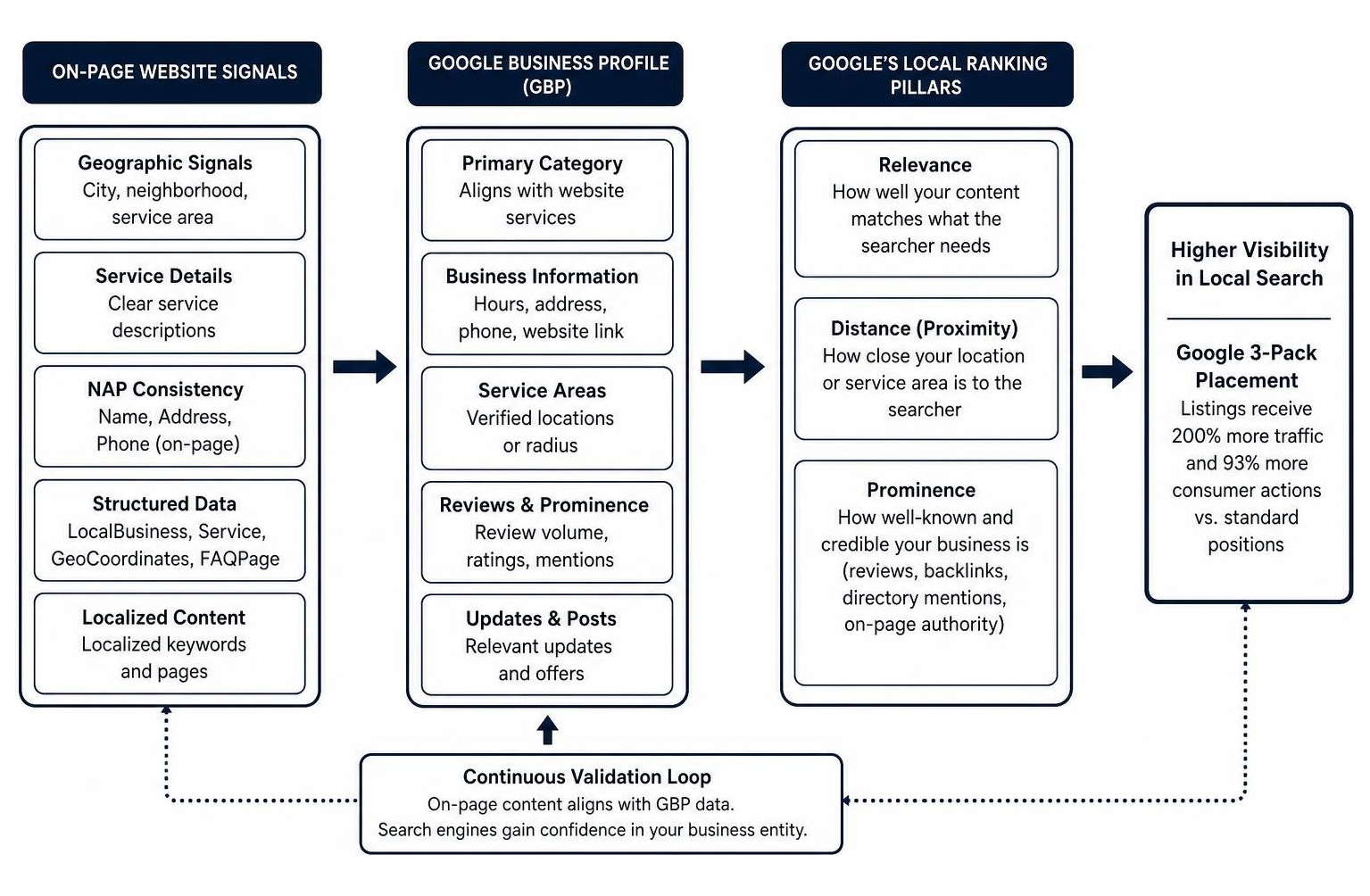
Local Keyword Research and Content Strategy for High-Intent Queries
Effective keyword research for local businesses focuses on finding the exact phrases prospective clients use when they need immediate assistance. Rather than chasing broad national search terms with high difficulty, local keyword targeting identifies search terms with clear commercial and transactional intent.
Executing Keyword Research for Local On Page SEO
To capture qualified local traffic, structure your target keywords around core services combined with regional geographic qualifiers. For example, a homeowner in the Northwest Suburbs of Chicago rarely searches for general industry terms; they search for specific solutions nearby, such as “commercial roofing contractor Arlington Heights” or “furnace repair Schaumburg IL”.
When selecting targeted website keywords, break your target phrases into three distinct tiers:
- Primary Service + City: “plumbing repair Des Plaines”, “electrician Naperville IL”
- Service + Neighborhood/County: “kitchen remodeling Cook County”, “emergency HVAC North Suburbs Chicago”
- High-Intent “Near Me” Variations: Terms that trigger geographic evaluation based on user device location, such as “dentist near me” or “auto body shop nearby”
By prioritizing low-difficulty, highly specific search terms with strong commercial intent, small service businesses can generate qualified leads faster while building sustainable organic authority across their market.
Mapping Search Intent to Local Service Offerings
Every page on your website should address a specific search intent. A prospective customer looking for emergency assistance requires a straightforward page with immediate call options, while someone planning a major commercial project needs in-depth service breakdowns, portfolio samples, and licensing verification.
Map your target phrases directly to dedicated pages:
- Transactional Landing Pages: Tailored around specific services and locations (e.g., /services/water-heater-installation-park-ridge) with prominent phone numbers and quote forms.
- Localized Informational Guides: Answering seasonal or region-specific questions (e.g., how local winter conditions affect commercial building foundations).
This structured approach ensures that every visitor lands on a page built specifically to answer their question and guide them toward taking action.
The Blueprint for High-Converting Local Service Pages
A high-ranking page must also convert visitors into paying clients. High-converting service pages balance technical optimization with clear visual hierarchy, accessible trust signals, and prominent calls to action (CTAs).
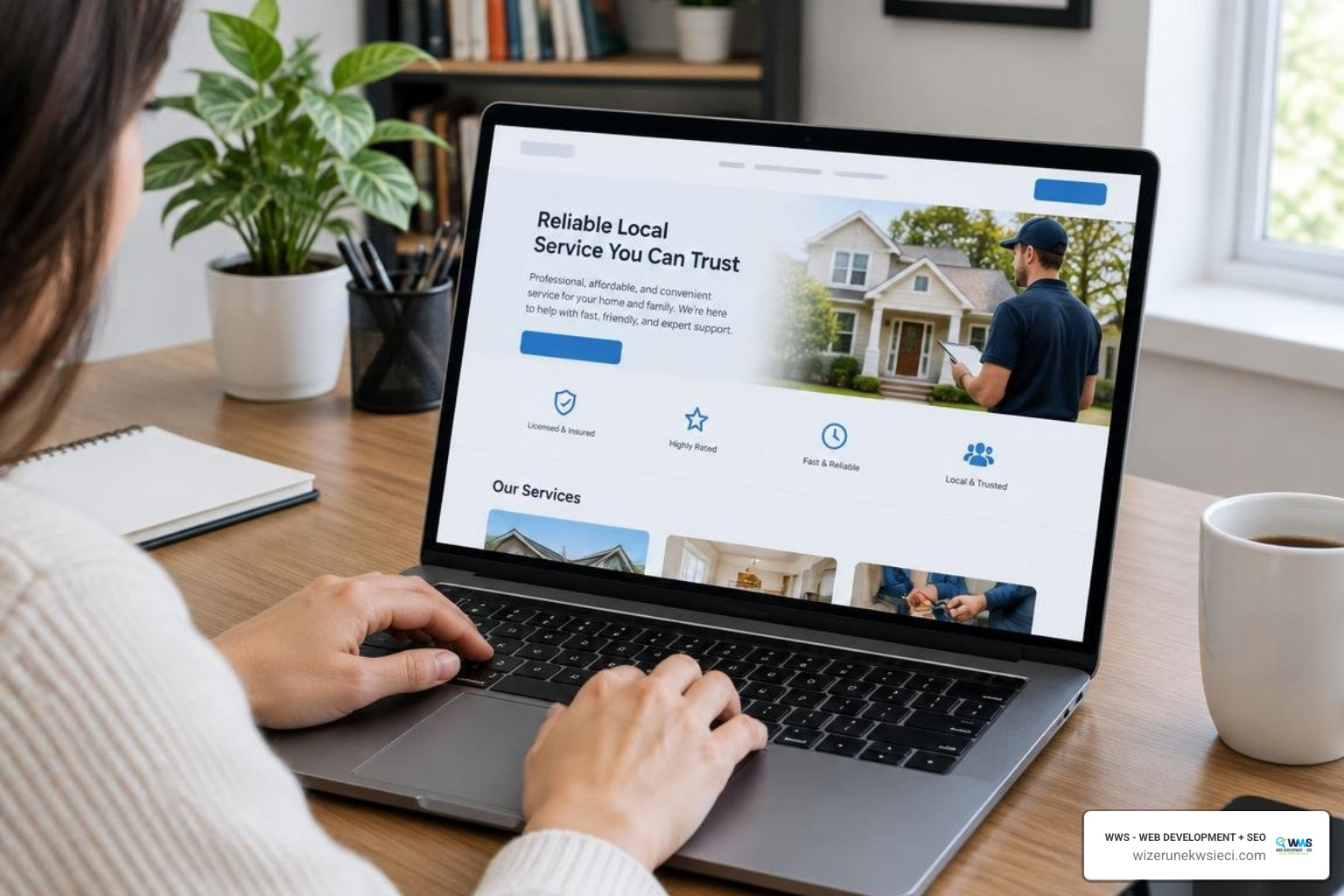
Structuring your pages effectively ensures visitors can quickly confirm your service offerings, verify your local service area, and get in touch. Exploring practical service page SEO architecture helps establish a reliable layout for these commercial assets.
Title Tags, Meta Descriptions, and Heading Hierarchy
Search engines rely on title tags and heading structures to understand page content, while users use them to decide whether to click your link in search results.
- Title Tags: Keep title tags under 60 characters to ensure clean display on mobile and desktop screens. Follow a structured formula: Primary Service in City, State | Business Name (e.g., HVAC Repair in Des Plaines, IL | WWS Mechanical).
- Meta Descriptions: Summarize your service offering in 105 to 155 characters. Include your primary keyword, city name, a clear benefit, and an actionable CTA (e.g., Looking for fast HVAC repair in Des Plaines? Licensed technicians, same-day service, and upfront pricing. Call today for a free estimate!).
- H1 Tag: Use one clear H1 tag per page that mirrors the title tag’s focus (e.g., Professional HVAC Repair & Installation in Des Plaines, IL).
- Subheadings (H2, H3): Break down specific service features, local customer benefits, warranties, and frequently asked questions using semantic heading tags.
NAP Consistency, Geo-Signals, and Conversion Elements
Your company’s Name, Address, and Phone Number (NAP) must appear in readable HTML text across your website, matching your GBP listing and external citations character-for-character. Placing this information in the global website footer and on individual contact sections establishes trust with search algorithms.
To maximize conversion rate optimization, include these essential on-page conversion features:
- Prominent Click-to-Call Buttons: Essential for mobile users looking for direct phone assistance.
- Simplified Contact and Quote Forms: Positioned above the fold so visitors can reach out without scrolling.
- Embedded Interactive Maps: Demonstrating your verified location or defined service footprint across surrounding communities.
- Authentic Local Reviews: Testimonials that mention specific projects and nearby neighborhoods (e.g., a customer review referencing a project completed in Mount Prospect or Glenview).
For businesses serving diverse regional populations, such as the Polish-American community (Polonia) across Chicagoland, offering clear bilingual contact pathways reinforces trust and accessibility.
Scaling Multi-City Location Pages Without Duplicate Content Penalties
If your business serves multiple municipalities across Cook County, Lake County, or the broader Chicago metropolitan area, creating dedicated location pages allows you to capture geo-targeted searches in each community. However, simply duplicating a single page and swapping out city names creates thin, repetitive content that search engines frequently filter out.
When planning your layout, following proven local landing page design frameworks ensures each regional page provides genuine value to users and search engines alike.
Hyper-Local Content Differentiation Strategies
To make location pages uniquely valuable, incorporate authentic regional details that cannot be replicated with automated templates:
- Neighborhood References & Service Boundaries: Mention prominent roadways, business corridors, or landmarks near your service routes (e.g., serving commercial properties along River Road, Dempster Street, or Northwest Highway).
- City-Specific Project Summaries: Highlight recent jobs completed in that specific town, detailing the problem solved and the project outcome.
- Local Client Testimonials: Feature reviews from residents or business owners located in that exact city.
- Assigned Team Details: Introduce the local service technicians or project managers who handle accounts in that service zone.
- Localized FAQs: Answer common customer questions regarding local municipal building codes, seasonal challenges, or regional permit requirements.
Technical guidelines detailed in the Whitehat Local SEO Ebook highlight that embedding authentic local signals protects multi-location websites from duplicate content penalties while improving organic conversion rates.
Clean URL Structures for Regional Hubs
An organized website structure helps search engine crawlers navigate your location hierarchy while establishing clear topical relationships.
Maintain a logical SEO-friendly URL structure using clean, lowercase, hyphenated subfolders:
- Primary Location Hub: domain.com/locations/
- Specific City Page: domain.com/locations/des-plaines/
- Service-Specific City Page: domain.com/services/commercial-roofing/schaumburg/
Include breadcrumb navigation on all child pages to improve user navigation and reinforce structural relationships for search engine bots.
Technical Foundations: Structured Data and Internal Linking
Behind your visual content lies the technical architecture that allows search engine bots to parse, render, and index your website efficiently. Maintaining strong technical health requires running a regular technical SEO audit and continuously optimizing Core Web Vitals to guarantee fast, responsive mobile experiences.
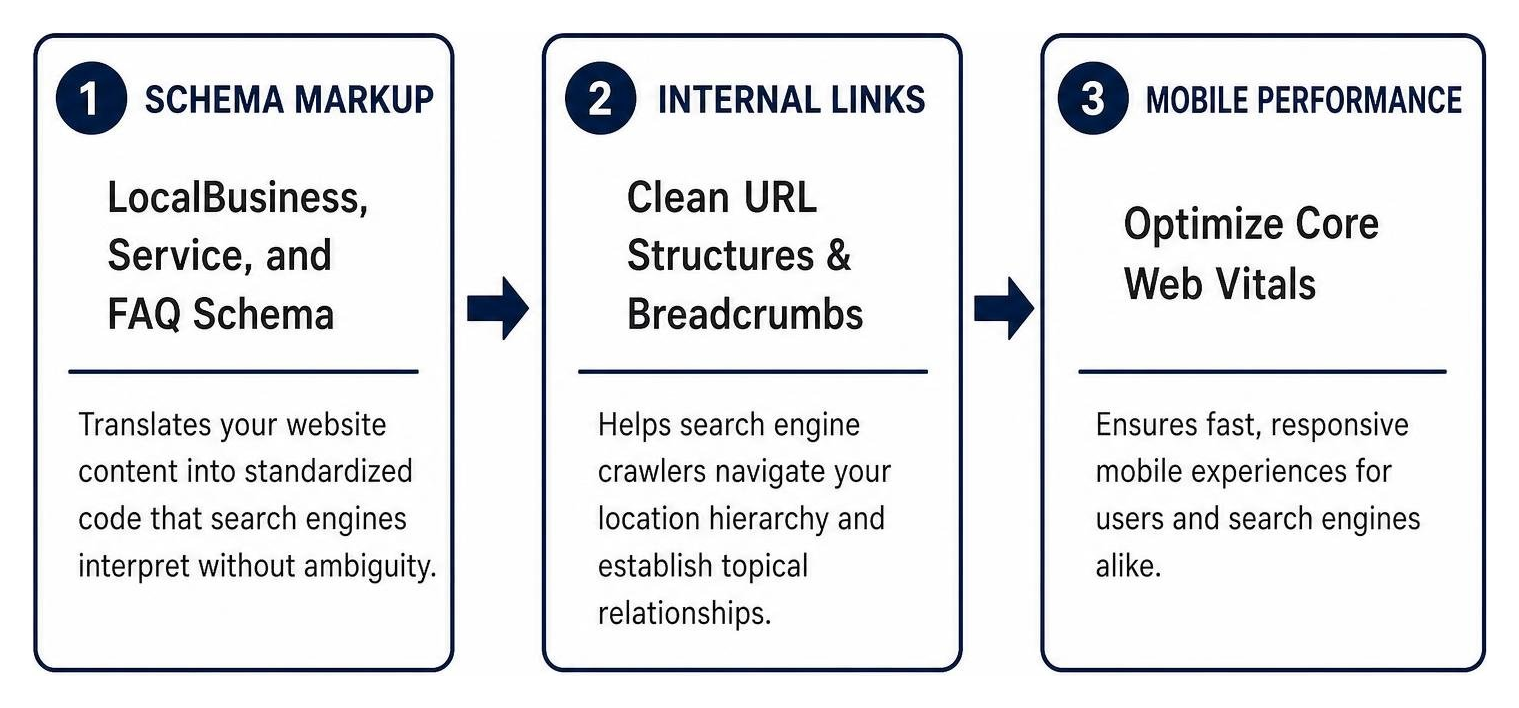
LocalBusiness, Service, and FAQ Schema Markup
Schema markup (structured data) translates your website content into standardized code that search engines interpret without ambiguity. Incorporating structured data helps search engines understand your operations and unlocks rich search results.
Key schema types for local service websites include:
- LocalBusiness (or specific subtypes like HomeAndConstructionBusiness, ProfessionalService): Defines your business entity, official name, primary address, telephone number, geo-coordinates (latitude and longitude), accepted payment methods, and operating hours.
- Service Schema: Outlines individual service offerings, describing what the service entails, service areas, and provider details.
- FAQPage Schema: Encodes structured frequently asked questions, allowing your search listing to display expandable question snippets directly on search engine results pages.
Google’s foundational SEO Starter Guide emphasizes that accurate structured data markup clarifies page context and significantly improves how listings appear across search interfaces.
Internal Linking Architecture for Local On Page SEO
Strategic internal linking distributes authority throughout your website, guiding search crawlers and users from high-authority pages to specific local service offerings.
Apply these internal linking practices:
- Hub-and-Spoke Navigation: Link primary service overview pages to specific city landing pages, and ensure those location pages link back to the core service hub.
- Descriptive Contextual Anchor Text: Use natural, descriptive anchor text containing location modifiers (e.g., linking the phrase “our commercial roofing work in Arlington Heights” directly to that city’s page) rather than generic text like “read more”.
- Topical Cross-Linking: Link complementary services together (e.g., linking a furnace installation page to a seasonal duct cleaning service page).
Practical strategies from Semrush’s local on-page guide demonstrate that a deliberate internal linking structure ensures search engines discover and index every local landing page on your domain.
Common On-Page Mistakes That Derail Local Visibility
Even well-established companies can struggle with search visibility due to simple on-page errors. Avoiding common structural mistakes keeps your website accessible and aligned with search engine quality guidelines.
Reviewing your site against an actionable local SEO checklist helps identify and resolve potential issues:
- Inconsistent NAP Formatting: Listing mismatched telephone numbers or outdated addresses across different footers and location pages.
- Missing or Generic Title Tags: Using default titles like “Home” or “Services” without service terms or geographic qualifiers.
- Slow Mobile Page Speeds: Uploading uncompressed images over 5 MB that slow down mobile load times.
- Orphaned Service Pages: Creating location pages that are not linked from your main navigation, hub pages, or sitemap.
- Keyword Stuffing: Forcing city names unnaturally into every heading and paragraph.
Keyword Stuffing and Thin City Landing Pages
Keyword stuffing is an outdated tactic that damages readability and can trigger algorithmic search penalties. Repeating phrases like “best plumber Rosemont local Rosemont plumbing” throughout your copy creates a poor user experience and violates modern quality guidelines.
Similarly, publishing hundreds of thin location pages with near-identical text and only swapped town names provides no unique value to users. Search engines easily identify programmatic doorway pages and may remove them from search indices entirely.
Disconnected Google Business Profile Signals
Your on-page content and GBP listing must provide matching signals:
- Divergent Landing URLs: Linking your GBP listing to a generic homepage when you operate a verified physical location in a specific suburb, rather than linking to that dedicated city landing page.
- Conflicting Business Categories: Highlighting core services on your website that do not match the primary or secondary categories selected in your GBP dashboard.
- Unverified Contact Numbers: Displaying phone numbers on your landing pages that differ from your verified GBP profile.
Ensuring complete alignment across your website and external profiles provides search engines with verified, reliable business data.
Frequently Asked Questions About Local On-Page SEO
How long does it take to see ranking improvements from local on-page SEO?
Initial improvements from on-page technical fixes, metadata updates, and schema implementations can appear within several weeks as search bots re-crawl your website. However, stable ranking growth for competitive local terms typically matures over a period of 3 to 6 months. Factors influencing this timeline include existing domain authority, local market competition, review generation velocity, and crawler indexation schedules.
How do I optimize location pages for multiple cities without duplicating content?
To optimize multiple location pages without creating duplicate content, ensure each page features genuinely distinct information. Include unique project descriptions from that specific town, feature localized client testimonials, highlight local landmarks and service routes, introduce team members working in that territory, and answer location-specific customer questions. A practical baseline is maintaining at least 60% to 70% unique copy across every regional landing page you publish.
What schema markup is mandatory for local service businesses?
The most critical schema markup is the LocalBusiness structured data type (or its specific industry subtype). It should include your verified business name, physical address or service area boundary, telephone number, opening hours specification, geo-coordinates, and official website URL. Pairing LocalBusiness schema with Service schema on individual service pages and FAQPage schema on question-and-answer sections provides search engines with complete technical context.
Conclusion
Dominating local search results requires combining technical on-page optimization with helpful, localized content. By structuring your service and location pages with clear headings, exact NAP data, robust schema markup, and strategic internal links, you turn your website into a reliable engine for customer acquisition.
At WWS (Wizerunek w Sieci), based in Des Plaines, IL, we provide the ideal middle ground for business owners who want more than local freelancers can offer, without the impersonal nature of large national agencies. We combine professional technical expertise with hands-on, personalized service. Whether you run a service company in Des Plaines, manage commercial projects across Schaumburg and Naperville, or serve the Polish-American community (Polonia) across Chicagoland, our team builds tailored web solutions that drive measurable business growth.
Ready to improve your search visibility and turn local searches into qualified leads? Explore our specialized local SEO services or contact WWS at (773) 814-2992 to request your free website audit today.
A Des Plaines, IL team helping local service businesses get found, get called and get booked since 2005: local SEO, Google Ads, conversion-focused websites and AI search optimization.
Meet the teamKeep reading
All articles
Site Speed for SEO: What Matters and How to Fix It
How site speed affects SEO and local rankings, which Core Web Vitals targets to hit, and the image and hosting fixes that move the numbers for Chicago-area businesses.
Marketing Attribution for SMBs: A Practical Guide
Learn which attribution model fits a small business, what to track from calls, forms and Google Maps, and how to tie marketing spend to booked revenue.

Master Organic Traffic Growth Strategy for Long-Term Website Authority
Master your organic traffic growth strategy with proven SEO tactics for long-term authority. Learn to build sustainable visibility and leads.