


Master Organic Traffic Growth Strategy for Long-Term Website Authority
Master your organic traffic growth strategy with proven SEO tactics for long-term authority. Learn to build sustainable visibility and leads.
 By WWS Team
10 min read

In this article7 sections
- Build an Organic Traffic Growth Strategy That Brings in Customers
- Understanding Organic Search and the Modern Search Ecosystem
- Core Pillars of a Winning Organic Traffic Growth Strategy
- High-Impact Tactics to Accelerate Traffic and Domain Authority
- Measuring Performance, Tracking ROI, and Avoiding Common Pitfalls
- Frequently Asked Questions About Organic Traffic Growth
- Conclusion
Build an Organic Traffic Growth Strategy That Brings in Customers
An organic traffic growth strategy starts with a website search engines can access and pages that match what your customers search for. Fix technical issues, choose relevant search terms, publish useful answers, and link related pages together. Then track which unpaid search visits turn into calls, inquiries, and sales.
The aim is not traffic for its own sake. It is steady visibility with people looking for what your business offers, even as AI answers change how search results appear.
I’m Tomasz Lasota, founder of Wizerunek w Sieci / WWS - Web Development + SEO in Des Plaines. For over 22 years, I’ve helped small businesses improve their websites and search visibility, and I build each organic traffic growth strategy around their customers, including English- and Polish-speaking audiences in the Chicago area.
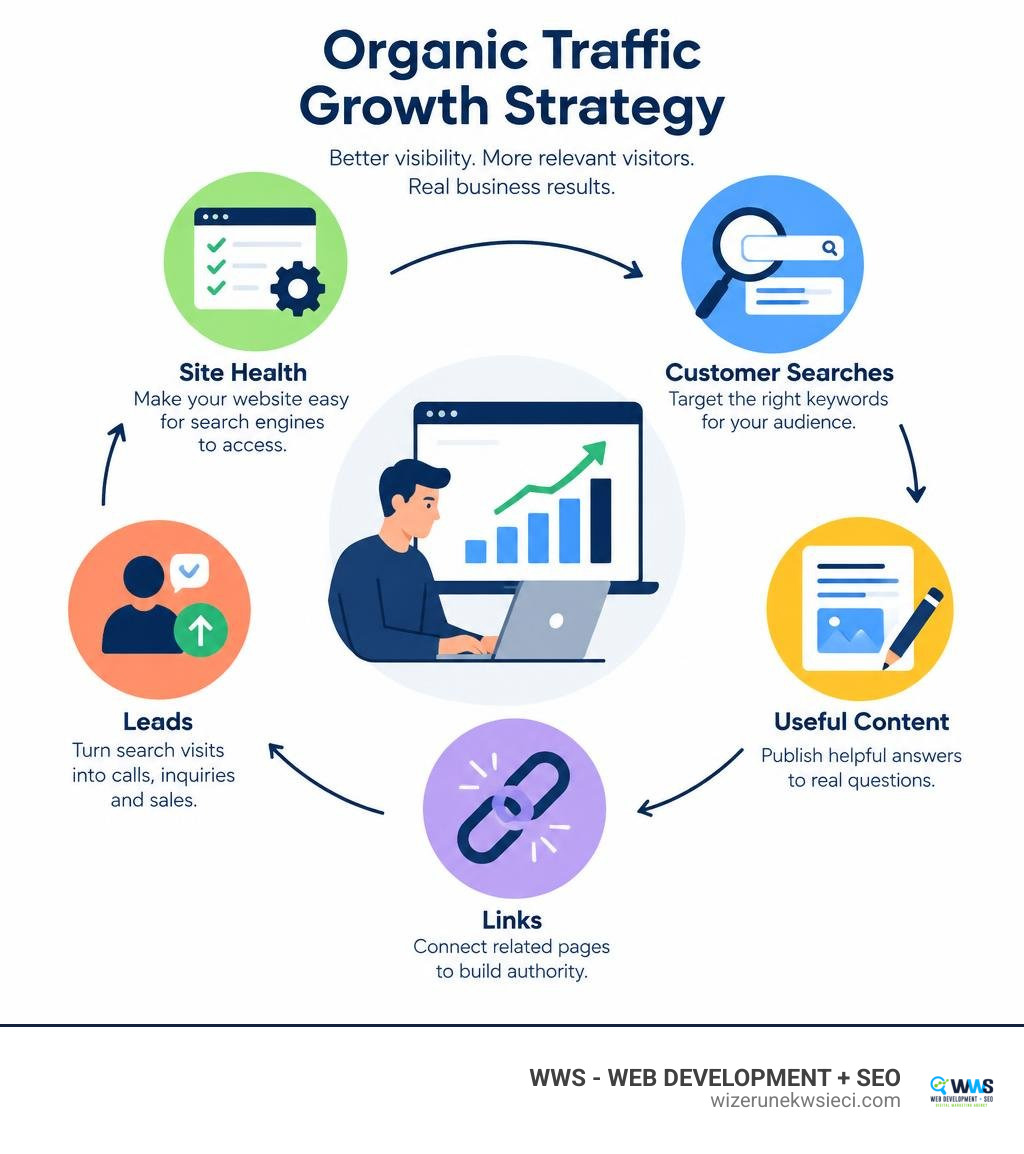
Organic traffic growth strategy terms explained:
Understanding Organic Search and the Modern Search Ecosystem
Organic search traffic consists of visitors who arrive at your website by clicking on unpaid listings returned by search engines like Google or Bing. When someone types a question, looks for a local service provider, or compares products, search engine algorithms evaluate billions of web pages to return the most relevant, reliable, and helpful results.
Unlike paid traffic, which stops arriving the moment an ad budget runs dry, organic visibility functions as an enduring business asset. When your website earns authority on a topic, it continues to capture unpaid visits and drive qualified leads for months and years. In fact, research shows that 68% of all online experiences begin with a search engine, and organic search accounted for over 1 trillion visits across the web.
Understanding how these channels work together is essential for any business leader exploring why businesses require a dedicated search strategy.
The Compounding Value and Trade-offs of Organic Traffic
The primary advantage of organic search is compounding efficiency. Producing a detailed, intent-matched service guide requires an upfront investment of time and resources. However, once that page establishes strong rankings, it continues to capture leads week after week without additional media fees. Over time, as your website earns more domain trust and publishes connected topical clusters, every new page ranks faster and attracts more qualified buyers.
At the same time, relying entirely on organic search has trade-offs. Building authority takes time - typically between 4 and 12 months for competitive terms. Organic rankings also depend on algorithm updates, meaning websites built on shortcuts or low-quality content face sudden drops in visibility. Sustainable search performance requires ongoing technical maintenance, content updates, and a firm grasp of the fundamental Factors That Drive Organic Traffic Growth.
Navigating AI Overviews and Modern Generative Search
The search ecosystem has expanded with the rise of AI Overviews in Google Search, ChatGPT, and other conversational discovery platforms. AI-driven searches generated 66% more traffic year-over-year, fundamentally changing how users access quick answers.
When a search engine serves an AI Overview directly on the results page, zero-click behavior can increase for simple definitions or surface-level queries. However, for nuanced, commercial, or local business questions, AI models extract citations directly from high-authority sources. When a user clicks a cited source inside an AI response, that visit functions as a highly qualified organic referral. Structuring your content with clear, authoritative data ensures that generative engines surface your brand as a primary source.
Core Pillars of a Winning Organic Traffic Growth Strategy

A successful search program is built on an interconnected framework: technical health, search-intent alignment, high-value content creation, and active promotion. Rather than publishing random articles and hoping for results, a structured plan coordinates every page to solve a specific customer problem and guide the reader toward contacting your business.
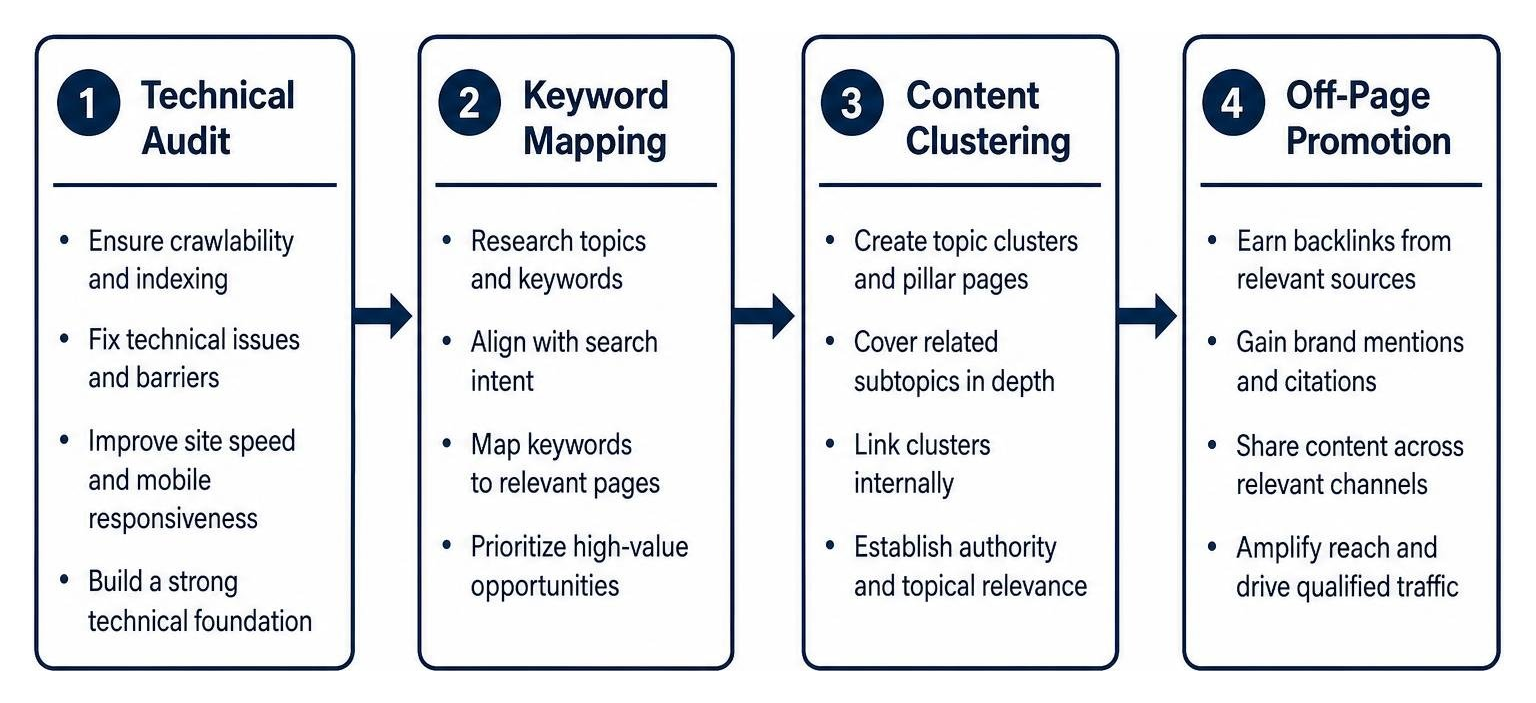
Following a cohesive strategic SEO content framework and Google’s official Search Engine Optimization SEO Starter Guide ensures that search bots and human visitors navigate your site without friction.
Technical Foundations Required for an Organic Traffic Growth Strategy
Technical optimization ensures that search crawlers can discover, read, and index your website without running into barriers. If a site suffers from broken scripts, slow servers, or poor mobile responsiveness, even well-crafted content will struggle to rank.
Key technical foundations include:
- Core Web Vitals and Page Speed: Fast loading speeds and smooth visual stability keep users engaged and reduce bounce rates.
- Mobile-First Design: Ensuring full usability across mobile devices is critical, as more than half of all search traffic occurs on phones.
- Crawl Budget and Clean Architecture: Submitting updated XML sitemaps, resolving redirect chains, fixing mixed-content security warnings, and using canonical tags prevent indexation problems.
- Schema Structured Data: Adding structured markup (such as LocalBusiness, Service, or Article schema) helps search engines and AI parsers understand your page details accurately.
If you suspect technical errors are holding back your rankings, conducting a professional technical SEO audit will uncover crawl bottlenecks. Aligning your platform with clean, modern code through custom SEO web design creates a durable foundation for long-term growth.
Aligning Keyword Research With Your Organic Traffic Growth Strategy
Keyword research is the process of discovering the exact words and phrases your potential customers use when looking for answers, services, or products. A common mistake is focusing exclusively on broad, high-volume terms that bring casual browsers rather than paying clients.
To build a high-converting search funnel, map your keywords across every stage of the buyer journey:
- Top-of-Funnel (Awareness): Educational searches where users explore a broader problem (e.g., “why does my commercial roof leak during heavy rain”).
- Middle-of-Funnel (Evaluation): Comparison and solution searches (e.g., “TPO vs EPDM roofing for commercial buildings”).
- Bottom-of-Funnel (High-Intent Conversion): Specific, localized, or transaction-ready terms (e.g., “commercial flat roof repair in Des Plaines IL”).
Targeting specific, long-tail terms with lower search competition allows you to capture buyers who are ready to make a decision. To refine your target keyword list, follow our structured guide on the strategic keyword selection process.
Building Topical Authority With Pillar Pages and Content Clusters
Search engines reward websites that demonstrate deep, organized knowledge across a subject area. Instead of publishing unrelated articles, organize your content into topic clusters built around a central pillar page.
A pillar page provides an extensive overview of a broad topic, while dedicated cluster articles explore specific subtopics in detail. Linking these articles back to the main pillar page using descriptive anchor text distributes link equity across your site and signals topical depth to search engines.
Research shows that long-form pillar content can improve organic rankings by 68%, and interlinked content structures drive 40% more page views than siloed articles. Reviewing the fundamentals of how search optimization works helps clarify how structured internal linking enhances crawlability and reader retention.
Optimizing for AI Overviews and Generative Engine Discovery
Generative Engine Optimization (GEO) involves formatting and refining your content so large language models (LLMs) like ChatGPT, Claude, and Google Gemini can readily cite and recommend your brand.
To optimize for AI visibility:
- Use Direct-Answer Formatting: Place a clear, concise 1–2 sentence summary immediately beneath your main subheadings before expanding into detailed explanations.
- Provide Original Data and Firsthand Insights: AI crawlers favor content that offers fresh facts, real-world case examples, or unique perspectives not found elsewhere.
- Maintain Clear Semantic Headings: Use clean H2 and H3 structures so machine-learning models can extract discrete answers for conversational prompts.
- Demonstrate Experience, Expertise, Authoritativeness, and Trustworthiness (E-E-A-T): Feature clear author bios, transparent business contact information, and verifiable references across your articles.
High-Impact Tactics to Accelerate Traffic and Domain Authority

Once your technical base and core content are in place, proactive authority-building tactics will accelerate your organic growth. Domain trust is built through quality inbound links, authentic customer sentiment, and strategic content updates.
Off-Page SEO, Earned Links, and Strategic Authority Building
Backlinks - links from external websites pointing to your pages - act as third-party votes of confidence in the eyes of search algorithms. A website with a healthy portfolio of relevant referring domains consistently outranks competitors with weak backlink profiles.
Ethical, high-yield ways to earn quality backlinks include:
- Original Research and Data Studies: Publishing original industry surveys, local data insights, or helpful online calculators naturally attracts organic citations from industry publications.
- Broken Link Reclamation: Identifying broken links on relevant industry blogs or local directories and suggesting your high-quality resource as an updated replacement.
- Unlinked Brand Mentions: Monitoring online directories and partner websites for mentions of your business name, then reaching out politely to request an active hyperlink.
- Industry and Supplier Directories: Claiming accurate listings on accredited business associations and local chambers of commerce.
Leveraging User-Generated Content and Social Signals
User-generated content (UGC), such as verified customer reviews and authentic testimonials, provides a steady stream of fresh, keyword-rich copy that boosts trust and conversions.
Having 100 customer reviews on a product or service page can more than double conversion rates, while displaying rich snippet review stars in search results can lift click-through rates by up to 24%.
For local businesses and online stores, reviews confirm authenticity to both visitors and search engines. If you run a digital storefront, implementing structured ecommerce SEO strategies alongside customer feedback helps product pages rank higher. For service companies, combining customer reviews with proven local business SEO ranking techniques strengthens local map pack prominence throughout your service area.
Content Pruning, Refreshing, and Multi-Platform Repurposing
A growing website inevitably accumulates outdated articles, overlapping guides, and low-performing pages. Performing an annual content audit helps you identify pages that dilute your site’s authority.
- Content Pruning: Consolidate or redirect outdated pages that receive zero traffic, have no backlinks, and target obsolete queries. Pruning dead weight concentrates your domain authority on high-performing URLs.
- Content Refreshing: Review pages ranking in positions 5 through 15 in Google Search Console. Update their statistics, improve visual layouts, add direct answers, and refine internal links to push them into top positions.
- Multi-Platform Repurposing: Adapt long-form guides into bite-sized summaries for social media channels, email newsletters, and graphic carousels. Multi-channel distribution strategies outperform single-channel efforts by 24% in lead conversions, driving secondary waves of organic interest back to your site.
Measuring Performance, Tracking ROI, and Avoiding Common Pitfalls
Growing organic traffic is an ongoing business process that requires clear performance tracking. Monitoring the right indicators ensures your search efforts translate directly into qualified leads, customer calls, and revenue.
Essential Metrics, Analytics Tools, and ROI Attribution
To evaluate your search performance, focus on metrics tied to business outcomes rather than surface-level visitor counts:
- Organic Clicks and Impressions: Monitor Google Search Console to track impression trends, average ranking positions, and click-through rates across core search queries.
- Engagement and Goal Completions: Use Google Analytics 4 to review user dwell time, bounce rates, and high-value conversion events such as contact form submissions or direct phone clicks.
- Self-Reported Attribution: Add a simple “How did you hear about us?” field on your intake forms. This captures attribution from dark social shares, podcast mentions, and conversational AI tools like ChatGPT that direct analytics might categorize as direct visits.
Revenue Return on Investment (ROI): Calculate your organic search ROI using this plain-language formula:
ROI = (Revenue generated from organic leads - Total SEO investment) / Total SEO investment
Because organic assets continue generating leads long after their initial creation, your effective acquisition cost decreases steadily over time.
Common Organic Traffic Growth Mistakes to Avoid
Avoid these frequent pitfalls when building your search visibility:
- Targeting Vanity Keywords: Chasing high-volume search terms that bring broad audiences with no intention of buying your services.
- Keyword Stuffing: Forcing exact-match search phrases into sentences where they read unnaturally, which harms readability and triggers spam filters.
- Neglecting Technical Performance: Producing quality content while ignoring broken links, sluggish page speeds, and mobile layout errors.
- Set-and-Forget Publishing: Leaving historical articles unmaintained as industry information and search intent evolve.
- Inconsistent Execution: Publishing several articles at once and then abandoning your content schedule for months.
Frequently Asked Questions About Organic Traffic Growth
How long does it take to see results from an organic traffic growth strategy?
Most businesses begin seeing measurable gains in keyword positions and impressions within 3 to 6 months of implementing technical fixes and fresh, intent-focused content. Substantial increases in organic traffic, inbound phone calls, and lead conversions typically compound between months 6 and 12 as your domain builds authority.
How has AI search affected traditional organic traffic click-through rates?
AI Overviews and conversational assistants resolve simple, informational queries directly on the search results page, which reduces click-through rates for basic definitions. However, for complex questions, service inquiries, and commercial comparisons, AI engines provide direct citation links. Websites with structured data, clear answers, and strong topical authority capture highly qualified referral clicks through these citations.
How do you measure the financial return on investment of organic search efforts?
To measure the financial return, track the total value of closed sales, signed contracts, or booked services originating from organic search visitors and compare that revenue to your total program investment. Because organic rankings compound over time, customer acquisition costs from search decrease steadily as your authority grows.
Conclusion
Building sustainable, long-term website authority is not about chasing algorithm tricks or flooding the internet with low-quality pages. It requires a disciplined, customer-focused approach that pairs technical stability with clear answers to your buyers’ real-world questions.
At Wizerunek w Sieci (WWS - Web Development + SEO), we serve as the dedicated digital partner for small and medium-sized business owners across the Chicago metropolitan area - including Des Plaines, Arlington Heights, Schaumburg, Naperville, and Cook County - as well as growing enterprises nationwide. We combine the technical capabilities and resources of a full-scale digital agency with the personal attention, responsiveness, and local market insight of a neighborhood partner. Our bilingual team (English & Polish) takes pride in supporting our vibrant Polish-American community (Polonia Chicago) and diverse business owners across the country.
Whether you need to resolve complex site errors, capture high-intent local service leads, or optimize your brand for the next generation of AI search discovery, we are here to help.
Explore our tailored comprehensive website SEO services or contact WWS today at (773) 814-2992 to schedule your free website audit at our Des Plaines office or online. Let’s build a compounding search strategy that drives real customers to your business.
A Des Plaines, IL team helping local service businesses get found, get called and get booked since 2005: local SEO, Google Ads, conversion-focused websites and AI search optimization.
Meet the teamKeep reading
All articles
Local On Page SEO Demystified: The Formula for Service and Location Pages
Master local on page SEO for service and location pages with WWS's formula to boost rankings, drive conversions, and dominate local search results.
Site Speed for SEO: What Matters and How to Fix It
How site speed affects SEO and local rankings, which Core Web Vitals targets to hit, and the image and hosting fixes that move the numbers for Chicago-area businesses.
Marketing Attribution for SMBs: A Practical Guide
Learn which attribution model fits a small business, what to track from calls, forms and Google Maps, and how to tie marketing spend to booked revenue.