



Improve Your Local Business Google Ranking Where Customers Search
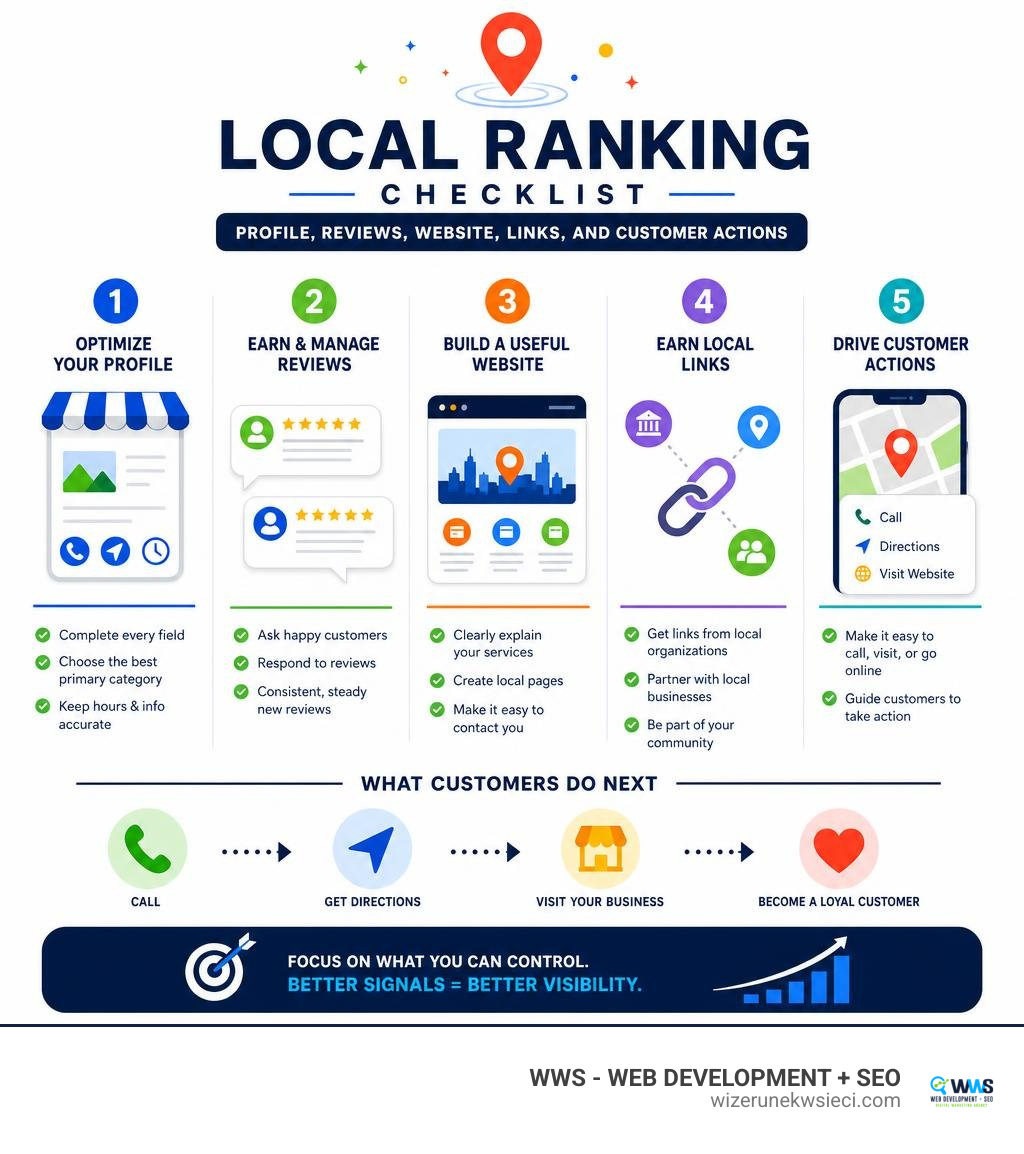
To improve your local business Google ranking, focus first on the signals you can control: verify and fully complete your Google Business Profile, choose the most specific primary category, keep hours and contact details accurate, earn new customer reviews consistently, and make your website clearly explain your services and locations.
Google says local results depend mainly on relevance, distance, and prominence. You cannot pay for a better organic Maps ranking, and distance is not fully controllable. But a well-managed profile, steady recent reviews, useful local website pages, and trusted local links can help your business appear more often when nearby customers are ready to call, visit, or request directions.
This matters because 46% of Google searches have local intent, and 76% of people who search for something nearby visit a business within 24 hours. For many Chicago-area businesses, visibility in the Google Local Pack and Maps is not just a marketing metric – it is a source of real leads and revenue.
I’m Tomasz Lasota, a digital marketing strategist and founder of Wizerunek w Sieci / WWS — Web Development + SEO in Des Plaines, Illinois. With more than 22 years in digital development and marketing, I have helped small and mid-sized businesses improve local business Google ranking through practical SEO, stronger websites, and better Google visibility.
Explore more about local business google ranking:
Core Signals That Drive Local Business Google Ranking in 2026
Achieving consistent visibility in local search requires understanding how search engines evaluate geographical intent. Local queries operate across two distinct surfaces: the Google Local Pack (the 3-map listing displayed at the top of search results) and standard localized organic results.
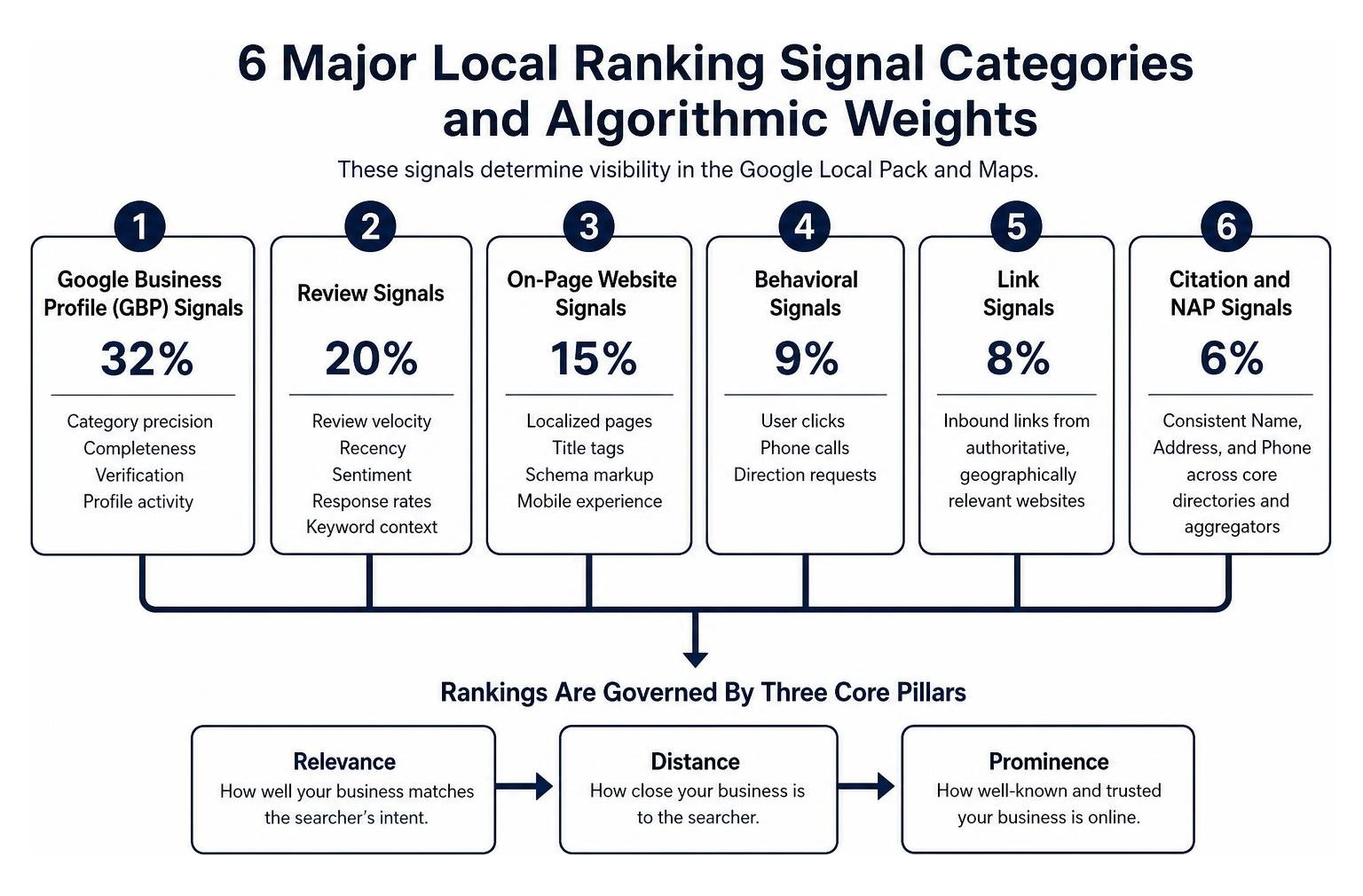
According to official guidance on Tips to improve your local ranking on Google – Google Business Profile Help, rankings cannot be bought or artificially forced. Modern search algorithms rely on six core signal groups, each carrying distinct algorithmic weight in the Local Pack:
- Google Business Profile (GBP) Signals (32%): Category precision, completeness, verification, and profile activity.
- Review Signals (20%): Review velocity, recency, sentiment, response rates, and keyword context.
- On-Page Website Signals (15%): Localized landing pages, title tags, schema markup, and mobile user experience.
- Behavioral Signals (9%): User clicks, phone call interactions, and direction requests.
- Link Signals (8%): Inbound hyperlinks from authoritative, geographically relevant websites.
- Citation and NAP Signals (6%): Consistent Name, Address, and Phone data across core directories and aggregators.
In 2026, these ranking factors operate as a multiplicative model rather than an additive checklist. A serious deficit in one foundational pillar—such as choosing the wrong category or neglecting reviews—suppresses the ranking potential of your entire digital presence. Implementing comprehensive Google Business Profile optimization ensures that your foundational relevance remains intact across all local queries.
How Distance, Relevance, and Prominence Govern Local Business Google Ranking
Every local query evaluated by Google relies on three core pillars:
- Relevance: How well your business profile and website match what the user is searching for. If a customer searches for emergency furnace repair in Des Plaines, IL, Google analyzes your primary categories, service descriptions, and on-page content to verify your ability to fulfill that specific need.
- Distance: The proximity between the searcher’s physical location (or specified geographic query) and your verified business address. Proximity drives approximately 55% of Local Pack ranking decisions. While you cannot physically move your business closer to every prospect across Chicagoland, strong prominence helps expand the radius in which you remain visible.
- Prominence: How established, well-reviewed, and reputable your business appears across the web. Prominence is calculated using third-party backlinks, total review counts, sustained positive ratings, directory mentions, and brand credibility.
Additionally, Google’s “Openness” filter actively demotes businesses that are marked as closed at the exact time of the user’s search. Maintaining accurate regular and holiday operating hours is critical to prevent sudden drops in visibility during active customer purchasing windows.
Google Business Profile Optimization and Category Precision
Your primary business category is the single most influential ranking factor on your Google Business Profile. Google provides thousands of specific categories; selecting a broad term like “Contractor” instead of “HVAC Contractor” or “Plumber” restricts your ranking eligibility immediately.
To maximize profile strength, follow these core steps:
- Select Specific Secondary Categories: Add secondary categories that accurately reflect genuine supplementary services without diluting your core offering.
- Maximize the Business Description: Utilize all 750 characters to describe your background, service capabilities, and local community focus across Cook County or surrounding areas, integrating natural keywords.
- Flesh Out Service Menu Items: Populate 12 to 18 individual services with detailed descriptions of 100+ words each. Google indexes these service entries to match long-tail consumer searches.
- Maintain Media Freshness: Profiles with 100+ photos generate up to 520% more customer phone calls than those with sparse galleries. Upload genuine job site and team photos monthly to signal ongoing business activity.
For business owners seeking advanced local visibility strategies, our guide to Map Pack Mastery Secrets To Ranking Your Google Business Profile details how to maintain listing strength against evolving search algorithms.
Review Velocity, Customer Engagement, and Behavioral Metrics
Customer feedback is no longer just a reputation metric; it represents 20% of your total Local Pack ranking calculation. In 2026, search algorithms analyze how frequently you earn reviews, the specific words customers use in their feedback, and how actively you engage with those reviews.

Maintaining a high owner response rate (aiming for 90% or higher within 24 to 48 hours) directly impacts profile stability during algorithm refreshes. When responding, acknowledge specific services performed and neighborhoods served naturally, reinforcing relevance without keyword stuffing. Utilizing streamlined tools like a free Google reviews app helps maintain consistent review collection directly after client interactions.
Velocity vs. Total Count: The Trailing 90-Day Priority
Review recency now carries 2.3x more ranking weight than static historical review totals. Google prioritizes reviews gathered over the trailing 90-day period. A business with 60 total reviews that steadily acquires 4 to 6 authentic reviews every month consistently outranks an older competitor sitting on 250 reviews with zero new feedback over the past year.
Short review blast campaigns—where a business acquires 30 reviews in a week and then stops—can trigger algorithmic spam filters. Instead, aim for steady acquisition. For newer businesses, crossing the baseline 10-review threshold yields an average ranking jump of 12 positions in local results. If an unfair or fraudulent review affects your rating, you can follow verified procedures to remove bad Google reviews through Google’s policy dispute channels.
Behavioral Clicks, Direction Requests, and Call Conversions
User engagement serves as an algorithmic feedback loop. Google tracks post-search behavioral signals to determine whether users find your listing valuable:
- Direction Requests: The strongest behavioral signal indicating direct commercial purchase intent.
- Call Clicks: Direct mobile clicks to call your business phone number from the Map Pack.
- Website Click-Throughs: Traffic routed directly to your local landing page.
- Populated Q&A Entries: Profiles with 10+ populated questions and answers generate 22% to 35% more website clicks and 18% to 28% more call clicks compared to neglected profiles.
Understanding these conversion dynamics is explained further in our comprehensive guide to local SEO for businesses.
Website Signals, Schema Markup, and High-Value Local Links
While your Google Business Profile captures local Map Pack real estate, your website establishes the organic foundation that supports long-term prominence. On-page website signals account for 15% of Map Pack weighting and over 33% of local organic search rankings.
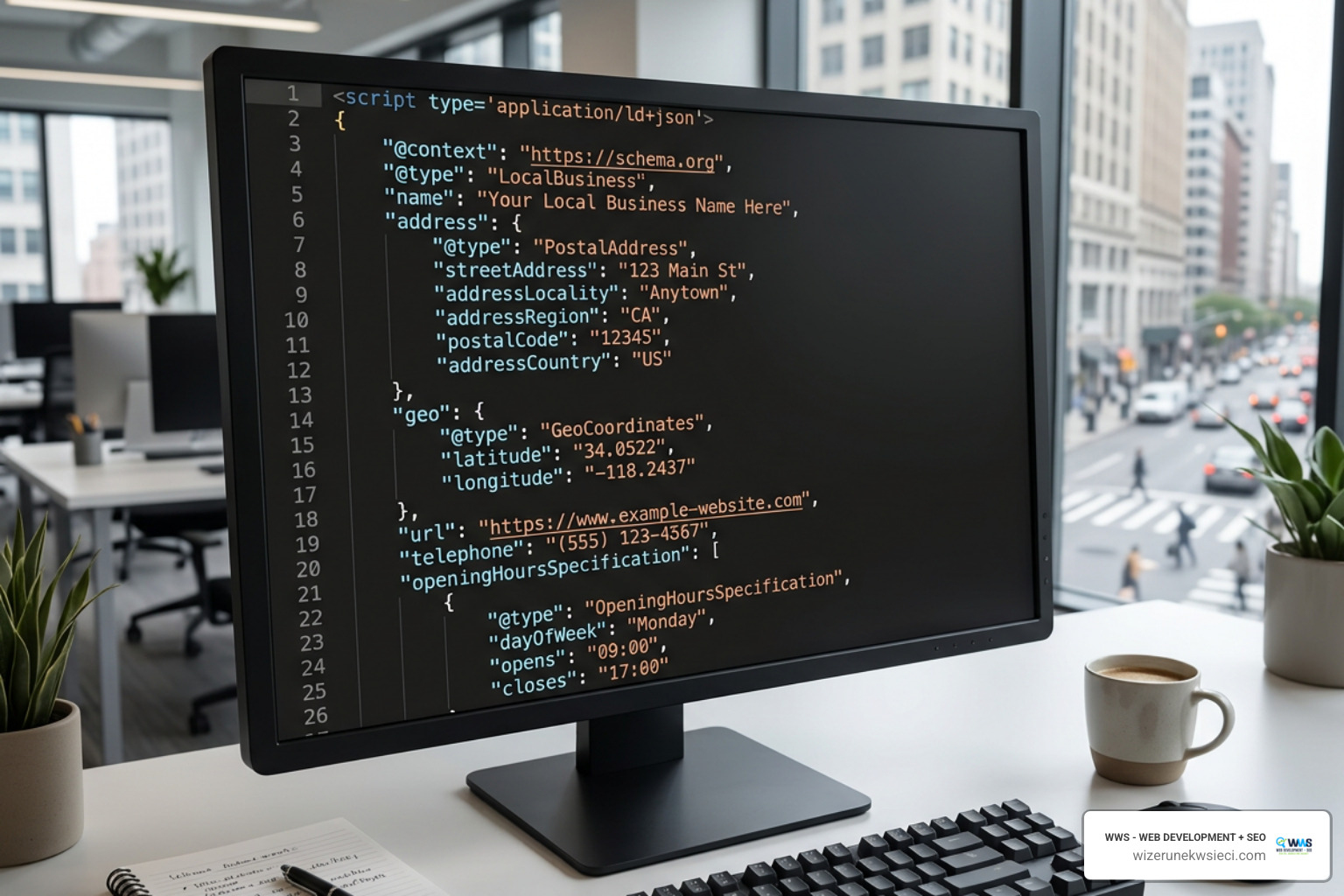
Effective on-page localization requires clean URL structures, fast Core Web Vitals (Largest Contentful Paint under 2.5 seconds), and optimized metadata. Title tags on local pages should follow a precise formula: Primary Service + City, State Abbreviation | Business Name (e.g., Furnace Installation in Schaumburg, IL | Modern Heating). Reviewing our framework on service page SEO provides the blueprints needed to optimize individual service offerings effectively.
Structured Data and AI Search Readiness
Structured data (schema markup) translates your website’s content into standardized code that search engines and AI models parse instantly. Adding LocalBusiness, Service, and FAQPage schema ensures that your physical address, service radius, contact points, and customer offerings are unambiguously understood.
Pages implementing detailed FAQPage schema appear in Google AI Overviews at a rate 2.8 times higher than standard pages. Furthermore, large language models (such as ChatGPT, Perplexity, and Gemini) rely on structured web data and review signals to generate local business recommendations. Gaining a deeper perspective on what is search engine positioning a complete guide with examples helps illustrate how structured web entities achieve organic and AI search dominance.
Authority Building: Local Citations and Geotargeted Backlinks
Citations and backlinks validate your prominence across geographic regions. However, link acquisition must prioritize local community relevance over raw domain metrics.
| Asset Type | Primary Purpose | Best Sources | Priority Level |
|---|---|---|---|
| Data Aggregators | Feeds core business data downstream to hundreds of global databases | Data Axle, Neustar/Localeze, Foursquare | Critical (Fix First) |
| Tier 1 Citations | Foundational consumer directories verifying entity identity | Apple Maps, Bing Places, Yelp, YellowPages | High |
| Local Community Links | Passes geographic relevance and local trust signals | Local Chambers of Commerce, local sponsorships | High |
| Industry Citations | Validates technical trade authority and licensing | Trade organizations, supplier directories | Moderate |
When auditing citations, always clean up major data aggregators first. Because aggregators continuously feed downstream directories, correcting an isolated directory listing without updating the aggregator source will cause outdated Name, Address, and Phone (NAP) errors to return over time. Learn more about establishing accurate NAP directory foundations in our breakdown on Des Plaines SEO building citations the right way.
Optimization Strategies for Service-Area Businesses and Multi-Location Brands
Service-Area Businesses (SABs)—such as mobile mechanics, roofers, and plumbers who travel to clients—operate under distinct algorithmic parameters. If you do not operate a staffed brick-and-mortar storefront with posted walk-in hours, Google guidelines require you to hide your physical address on your Google Business Profile.
For SABs, proximity operates as an eligibility filter. Instead of relying on a broad radius, define up to 20 specific cities, zip codes, or neighborhoods (e.g., Arlington Heights, Mount Prospect, Park Ridge, Glenview, and Palatine). To rank across multiple municipalities, build dedicated, unique service area landing pages containing at least 500 to 800 words of localized content, complete with localized schema and customer case studies.
For detailed operational guidance, explore our specialized guides on service area business SEO and managing broader regional visibility through multi location SEO.
Measuring and Tracking Local Business Google Ranking Across Service Areas
Traditional rank tracking tools that check rankings from a single, generic zip code coordinate provide an incomplete picture of your local reach. Proximity causes rankings to fluctuate significantly from block to block.
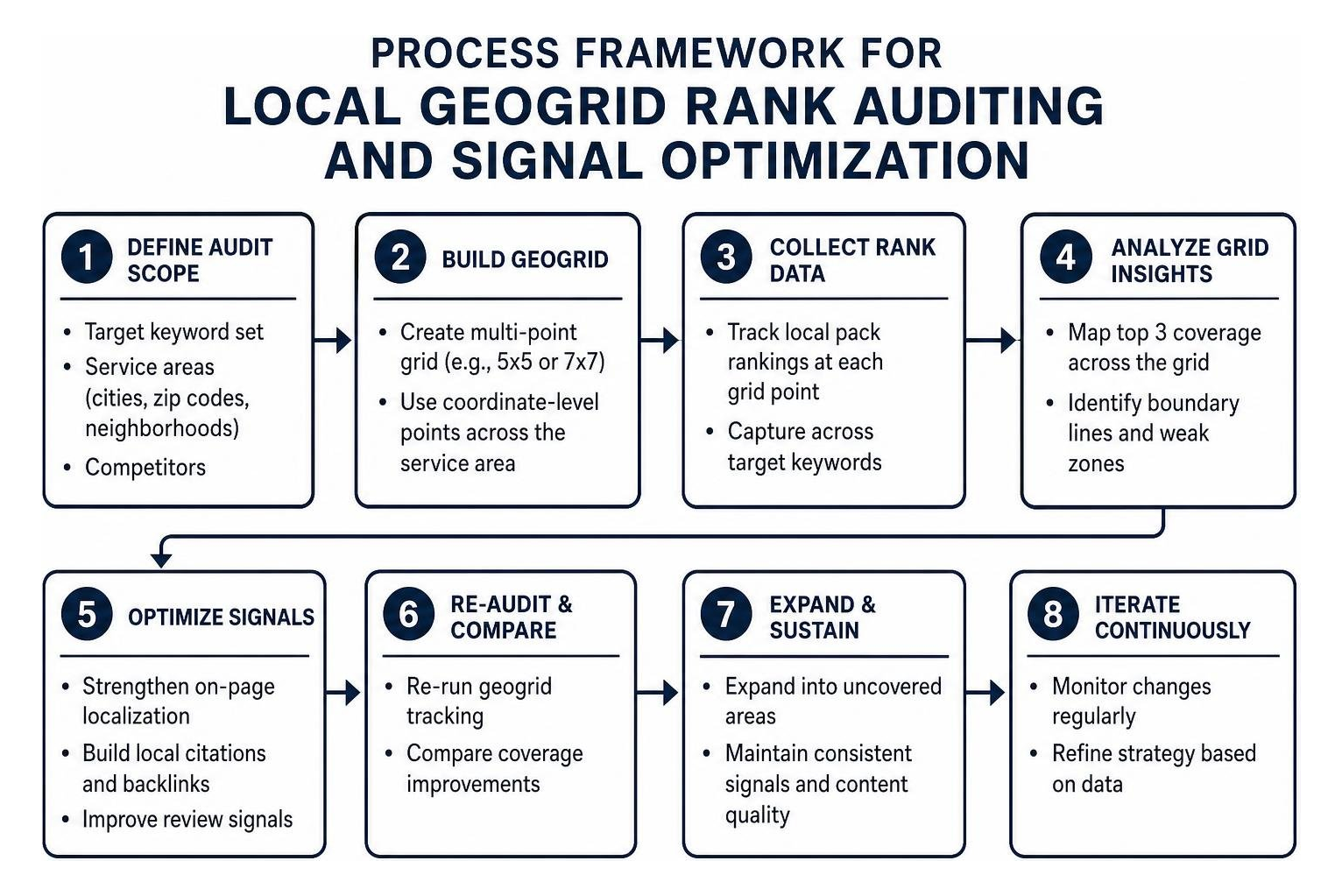
Coordinate-level geogrid rank tracking plots your positioning across a multi-point map grid (e.g., 5×5 or 7×7 matrix). This identifies the exact geographic boundary lines where your listing drops out of the top 3 spots, allowing you to target on-page localization and local backlinks to weak zones. To refine your measurement strategy, read our analysis on stop guessing and start tracking the ultimate Google site ranking tool guide.
Frequently Asked Questions About Local Business Search Visibility
What is the most impactful single field on a Google Business Profile for ranking?
Your primary business category is the single most powerful relevance factor on your profile. It dictates your search eligibility, determines which competitors you are measured against, and heavily influences how Google interprets your services and website content.
How many reviews does a business need to appear in AI search engines?
To reliably surface in AI-generated recommendations across ChatGPT, Gemini, and Perplexity, local businesses generally need approximately 150 reviews per location, paired with a 4.5+ star rating and an active owner response rate above 90%.
How does ranking in the Google Local Pack differ from standard organic search?
The Local Pack relies primarily on Google Business Profile completeness (32%), review signals (20%), and physical proximity, displaying three selected local businesses alongside interactive maps and call buttons. Standard organic results rely more heavily on website content depth, technical on-page optimization (33%), and external backlink authority.
Conclusion
Improving your local search visibility requires an integrated approach. By aligning your Google Business Profile settings, generating consistent reviews, refining structured on-page content, and building local community authority, you can build a resilient digital foundation that drives sustained customer inquiries.
At Wizerunek w Sieci / WWS — Web Development + SEO, we help small and medium-sized business owners navigate local search algorithms. Based in Des Plaines, IL, we combine technical agency capabilities with dedicated, bilingual (English & Polish) support tailored to local service providers across the Chicago metropolitan area and nationwide.
Visit wizerunekwsieci.com today to claim your free website audit and learn how our tailored website SEO solutions can help your business connect with more local customers online.