

Core Pillars of a Winning Local Business Marketing Strategy
An effective local business marketing strategy connects high-intent neighborhood customers with your company across three core pillars: an optimized Google Business Profile for Google Map Pack dominance, a fast-loading website built with dedicated service-area SEO, and precision geo-targeted advertising. By establishing clear trust signals, consistent review acquisition, and structured schema markup, local service providers and retailers capture ready-to-buy prospects at the exact moment they search for nearby solutions.
The local search ecosystem spans organic search, map listings, localized social platforms, and conversational AI search engines like ChatGPT and Google AI Overviews. According to industry data, 83% of customers use a search engine to discover new businesses, and 97% learn more about a local company online before reaching out.
To convert searchers into paying clients, your brand must deliver clear trust signals, flawless technical accuracy, and unmistakable proof of local authority across three primary visibility channels:
| Marketing Channel | Primary Discovery Method | Primary Conversion Trigger | Average Time to Impact | Core Strengths |
|---|---|---|---|---|
| Google Map Pack | High-intent proximity searches (“near me”, city queries) | Star rating, total review count, verified address | 2 to 4 weeks | Captures urgent, ready-to-buy customers with immediate phone calls |
| Organic Local SEO | Long-tail problem searches, city service queries | Hyperlocal content depth, structured data, E-E-A-T | 3 to 6 months | Delivers compounding visibility and strong positioning in AI engines |
| Geo-Targeted Paid Ads | Zip-code bounded search queries and localized social feeds | Targeted promotional offers, compelling landing page copy | 24 to 72 hours | Provides immediate lead flow while organic assets build momentum |
Businesses with a documented marketing strategy are 313% more likely to report success than those operating without one. Achieving predictable growth means connecting these digital touchpoints into an integrated, repeatable engine.
Defining Your Audience for a Local Business Marketing Strategy
Every winning campaign starts with a sharp, realistic definition of your customer base and physical trade territory. In commercial practice, a local business generally draws the majority of its revenue from within a 75-mile radius, with core service operations concentrated much closer. However, consumer perception of what is truly “local” centers heavily on community reciprocity, neighborhood hiring, and physical proximity.
To avoid wasting marketing spend on audiences outside your operational capacity, structure your geographical targeting into three distinct radius tiers:
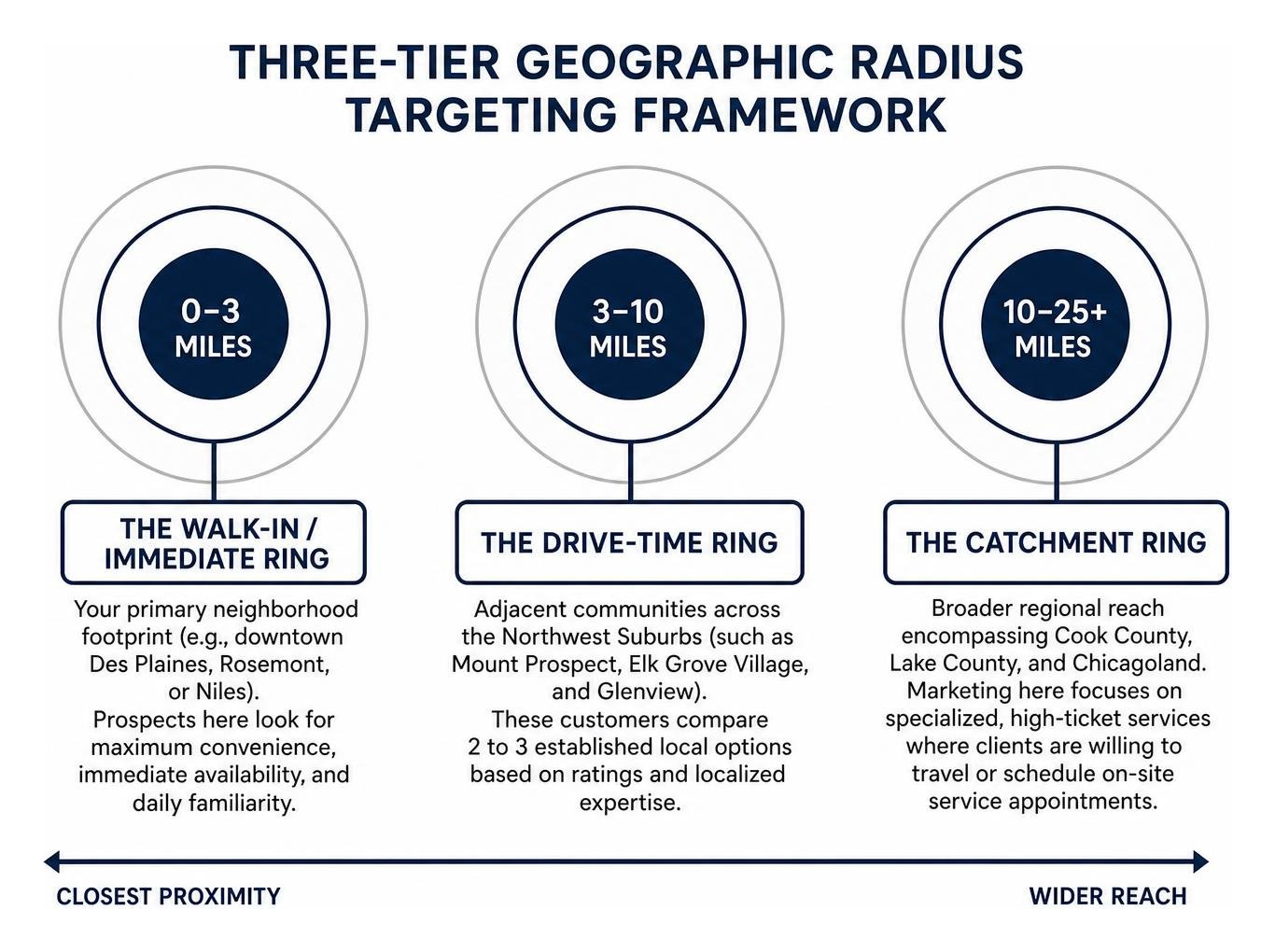
- The Walk-In / Immediate Ring (0–3 miles): Your primary neighborhood footprint (e.g., downtown Des Plaines, Rosemont, or Niles). Prospects here look for maximum convenience, immediate availability, and daily familiarity.
- The Drive-Time Ring (3–10 miles): Adjacent communities across the Northwest Suburbs (such as Mount Prospect, Elk Grove Village, and Glenview). These customers compare 2 to 3 established local options based on ratings and localized expertise.
- The Catchment Ring (10–25+ miles): Broader regional reach encompassing Cook County, Lake County, and Chicagoland. Marketing here focuses on specialized, high-ticket services where clients are willing to travel or schedule on-site service appointments.
Analyzing postal codes from your recent transactions reveals exactly where your most profitable jobs originate. This insight allows you to allocate your resources where customer density and profit margins are highest.
Optimizing Your Google Business Profile and Map Pack Rankings
Your Google Business Profile (GBP) functions as your primary digital storefront. Profile signals account for roughly 32% of overall local ranking factors, and over 80% of local search clicks concentrate directly on the Google Map Pack. A fully completed, verified profile makes a business 2.7 times more likely to be considered reputable and lifts physical visits by approximately 70%.
To maximize map pack exposure and secure zero-click search inquiries:
- Select the Perfect Primary Category: Your primary category is the single heaviest ranking factor in local search algorithms. Choose the most precise match for your main revenue driver, then add 5 to 7 relevant secondary categories.
- Build Out Custom Service Items: Add granular service items complete with 50-to-100-word descriptions, pricing parameters, and localized keywords to help AI search engines parse your exact capabilities.
- Upload Authentic, High-Resolution Media: Steer clear of generic stock photography. Search engines and consumers respond to authentic photos of your actual team, branded service vehicles, and completed local projects.
- Seed Profile Q&A Proactively: Preempt customer hesitation by publishing and answering the top 10 most common questions regarding your services, turnaround times, and local coverage areas.
- Publish Weekly Business Updates: Post regular updates detailing recent community projects, seasonal tips, and company announcements to signal consistent operational activity.
For an in-depth breakdown of ranking mechanics, review our guide to map pack mastery secrets to ranking your google business profile.
Developing a High-Converting Local Search and Content Hub
A complete profile gets you found, but your website closes the deal. When users click through to research your background, your site must provide a lightning-fast, mobile-optimized experience that turns visitors into scheduled consultations. Because more than 60% of searches occur on mobile devices, responsive layouts and rapid load speeds are essential.
To rank for competitive regional searches and establish solid E-E-A-T (Experience, Expertise, Authoritativeness, and Trustworthiness) signals, implement these foundational architectural elements:
- Dedicated Service-Area Pages: Rather than grouping multiple municipal markets onto a single generic contact page, create comprehensive, dedicated pages for key service areas like Schaumburg, Naperville, Evanston, or Northbrook.
- Hyperlocal Content Elements: Integrate authentic neighborhood context—such as regional building styles, local landmarks, and municipal guidelines—to differentiate your pages from generic automated text.
- Structured Data Schema Markup: Embed
LocalBusiness,Service,AggregateRating, andFAQPageschema code across your website. Currently, only about 30% of local businesses implement structured markup correctly, making it a major competitive advantage for local SEO and AI answer engine extraction. - Technical Performance and Core Web Vitals: Ensure your Largest Contentful Paint (LCP) loads under 2.5 seconds by compressing media into WebP formats, using content delivery networks, and eliminating bloated code.
To explore technical website foundations further, dive into a comprehensive guide to local seo for businesses.
Essential Action Steps for Local Customer Acquisition
A balanced local business marketing strategy bridges organic digital visibility with proactive lead capture and neighborhood networking. Capturing demand requires eliminating website friction so prospects can book appointments seamlessly. Designing a high-converting digital presence is critical, as detailed in our guide no more ghost towns the ultimate guide to local business website design.
Building an Automated Review and Reputation Engine
Online reviews serve as the core trust engine of local commerce. An overwhelming 97% of consumers read reviews before choosing a local company, and nearly 95% consult feedback before completing any transaction. Furthermore, 31% of consumers only consider businesses that hold a 4.5-star rating or higher.
Maintaining high visibility requires steady review velocity—the regular, continuous arrival of authentic customer feedback over time. Research shows that 74% of consumers only value reviews written within the past 3 months, and displaying customer testimonials directly on your website can increase conversion rates by up to 270%.
- Automate Post-Service SMS Requests: Send a friendly text message containing a direct Google review link within one to two hours of completing a project or purchase. Text messages achieve significantly higher open rates than standard emails.
- Request Specific Project Details: Encourage clients to mention the specific service provided and their general neighborhood location in their review text, which strengthens conversational search relevance.
- Maintain a 100% Response Rate: Respond to every customer review within 24 to 48 hours. Businesses that reply to at least 25% of their reviews earn an average of 35% more revenue. Address negative reviews calmly and constructively, offering an offline phone number to resolve issues professionally.
Executing Paid Ads and Social Media in a Local Business Marketing Strategy
Organic marketing builds long-term digital equity, while paid advertising provides immediate lead volume. With nearly 40% of small businesses planning to increase their marketing budgets in 2026, targeting ad spend precisely prevents budget waste.
- Geo-Fenced Search Ads: Set your Google Ads location settings strictly to “Presence: People in or regularly in your targeted locations” rather than the default “Presence or Interest.” This prevents ad spend from triggering for users located outside your target service towns like Oak Park, Skokie, or Rolling Meadows.
- Dedicated Service Landing Pages: Never route paid ad clicks to your generic homepage. Build tightly focused landing pages matching the specific search query, complete with clickable phone numbers and clear contact forms. For campaign setup advice, see our resource on a quick start guide to google ads for local businesses.
- Hyperlocal Social Media Engagement: 73% of consumers discover new brands on social media platforms. Focus your efforts on 1 or 2 platforms where your audience is most active (primarily Facebook and Instagram). Share behind-the-scenes project photos, employee introductions, and quick helpful tips to build familiarity across local neighborhood groups.
- Precision Retargeting Campaigns: Re-engage website visitors who left without booking by serving low-cost retargeting ads across Meta platforms, reminding them of your local reputation and seasonal offers.
Leveraging Offline Community Partnerships and Grassroots Tactics
Digital channels scale efficiently, but face-to-face community involvement builds deep brand loyalty that algorithms cannot easily replicate. Integrating digital tracking with traditional neighborhood outreach establishes a powerful multi-touch presence:
- Complementary B2B Cross-Promotions: Form reciprocal referral partnerships with non-competing professionals serving your same customer demographic. For example, a home remodeling specialist can cross-promote with local interior designers and flooring suppliers.
- Strategic Community Sponsorships: Sponsor youth sports teams, charity 5K runs, or regional cultural festivals in towns like Buffalo Grove, Wheeling, or Highland Park. Community-minded sponsorships build genuine goodwill while generating valuable local backlinks.
- Active Civic and Chamber Involvement: Connect with municipal business communities, such as resources provided by the Business | Village of Mount Prospect division or regional Chambers of Commerce across Chicagoland, to build authority and secure commercial contracts.
- Targeted Direct Mail Integration: Combine digital search campaigns with USPS Every Door Direct Mail (EDDM) postcards in specific neighborhood carrier routes, using custom QR codes and phone numbers to track lead attribution.
Measuring Performance and ROI for Local Campaigns

Managing an expanding marketing strategy requires clear visibility into which channels generate genuine revenue versus vanity impressions. Email marketing continues to produce exceptional returns—generating $36 to $42 for every $1 spent—while 46% of marketers investing in local SEO report higher long-term ROI than any other channel.
Track these primary performance metrics monthly to keep your campaigns on target:
- Google Business Profile Actions: Monitor total phone calls, direction requests, website clicks, and discovery search impressions within your profile insights dashboard.
- Local Organic Keyword Visibility: Track your rankings across geo-modified queries (e.g., “[Service] in Palatine IL” or “near me” mobile searches) throughout your primary radius tiers.
- Review Volume and Sentiment Trends: Track your monthly review acquisition pace, overall star rating average, and response rate compliance.
- Offline and Call Attribution: Deploy unique tracking phone numbers and point-of-sale promo codes across physical mailers, local sponsorships, and landing pages to measure exact cost-per-lead.
- Customer Acquisition Cost (CAC): Triangulate total monthly marketing investment against total newly acquired clients across each channel to balance budget allocations effectively.
For practical measurement strategies, explore our guide on measuring brand positioning success key metrics and analytics.
Frequently Asked Questions About Local Marketing
What is the most cost-effective local marketing tactic for small businesses?
For long-term return on investment, optimizing your Google Business Profile alongside organic local SEO is the most cost-effective approach. Unlike pay-per-click advertising, where lead flow stops the moment ad spend pauses, a fully optimized profile and authoritative service area pages generate compounding organic visibility, direction requests, and direct phone calls for years. Combining organic search optimization with automated customer review collection creates a durable inbound lead engine at a fraction of ongoing ad costs.
How long does it take to see results from local marketing?
Campaign timelines vary significantly by channel:
- Geo-Targeted Paid Search & Social Ads: Can generate qualified customer inquiries within 1 to 7 days of campaign launch.
- Google Business Profile Optimizations: Typically show noticeable gains in map pack impressions, search queries, and phone calls within 2 to 4 weeks.
- Organic Local SEO & Hyperlocal Content: Generally requires 60 to 90 days to establish indexation, schema recognition, and domain trust, compounding significantly between months 3 and 6.
How much should a small business budget for local marketing?
A standard guideline for growing small businesses is allocating 7% to 12% of gross annual revenue toward marketing initiatives. If you are starting with a lean promotional budget, begin by investing $300 to $600 per month into core organic foundations—such as website technical health, Google profile management, and review software—before layering on $10 to $20 per day in targeted local search ads to accelerate short-term customer acquisition.
Conclusion
Building a sustainable local business does not require massive national advertising budgets. By executing a structured, step-by-step roadmap focused on map pack dominance, review generation, hyperlocal search authority, and active community engagement, you can establish your company as the obvious market leader in your service area.
At WWS (Wizerunek w Sieci), we serve as the dedicated digital marketing partner for small and medium-sized business owners across the Chicago metropolitan area, the Northwest Suburbs, Cook County, and nationwide. Based in Des Plaines, IL, our bilingual team (English & Polish) combines technical expertise in custom web development, local SEO, Google Ads, and reputation management with personal, hands-on service.
Ready to grow your online visibility and drive steady phone calls? Contact WWS for custom website SEO and local growth strategies to request your free, comprehensive website and local SEO audit today. Visit us at 636 S River Rd #218, Des Plaines, IL 60016 or online at wizerunekwsieci.com.