



Building a Modern SEO Strategy: Tactics vs. Long-Term Vision
A solid SEO strategy is the difference between a business that gets found online and one that’s invisible to potential customers. In 2026, that gap is wider than ever — and growing fast.
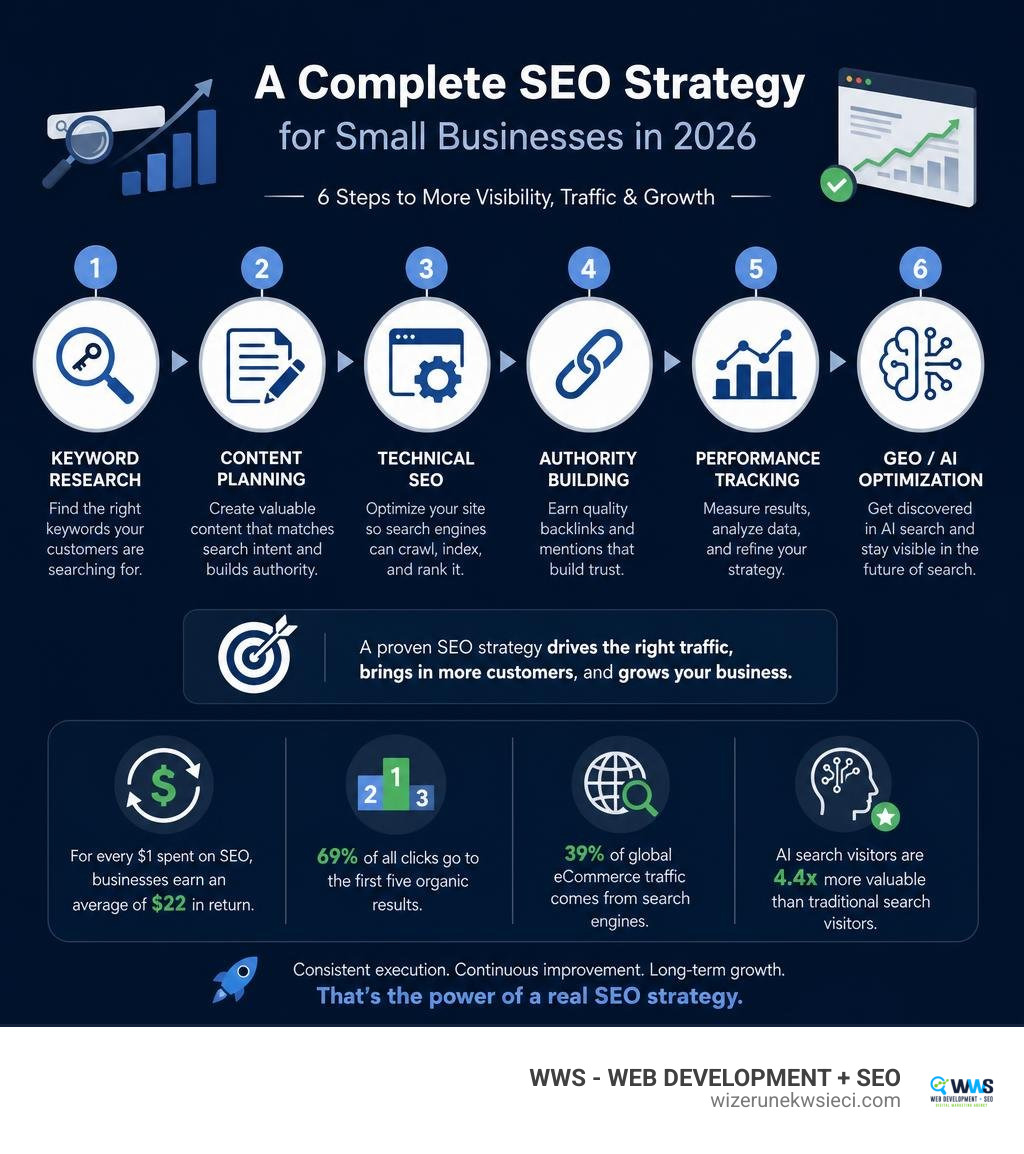
What is an SEO strategy? It’s a structured, long-term plan to improve your website’s visibility in search engines like Google. A real strategy covers:
- Keyword research — finding what your customers are actually searching for
- Content planning — creating pages that match search intent and build topical authority
- Technical SEO — making sure Google can find, crawl, and index your site
- Authority building — earning backlinks and mentions that signal trust
- Performance tracking — measuring results and adjusting over time
- GEO/AI optimization — getting cited by ChatGPT, Perplexity, and Google AI Overviews
Here’s why it matters right now:
- For every $1 spent on SEO, businesses earn an average of $22 in return
- 69% of all clicks go to the first five organic results
- 39% of global eCommerce traffic comes from search engines
- AI search visitors are 4.4x more valuable than traditional search visitors
Most small business owners know they need SEO. The problem is they’re running tactics without a strategy — publishing random blog posts, chasing keywords, and wondering why nothing sticks.
This guide walks you through exactly how to build an SEO strategy that works in the real world — one that drives leads, not just traffic.
I’m Tomasz Lasota, founder of WWS — Web Development + SEO in Des Plaines, IL, and I’ve spent over 22 years helping small and medium-sized businesses across the Chicago metropolitan area build SEO strategies that generate real, measurable growth. I’ve seen what separates businesses that dominate local search from those that never get found — and it almost always comes down to strategy, not effort.
Similar topics to seo strategy:
Many business owners confuse SEO tactics with a comprehensive SEO strategy. Tactics are the individual actions you take—like writing a blog post, adding alt tags to your images, or fixing a broken link. A strategy, however, is the overarching blueprint that connects these tasks to real business outcomes, such as leads, pipeline, and revenue.
Without a structured plan, your digital marketing efforts become disconnected. You might rank for a few random keywords, but those rankings won’t translate into phone calls or form submissions. A long-term vision ensures that every piece of content you publish and every technical optimization you make serves a specific purpose in your customer’s buying journey.
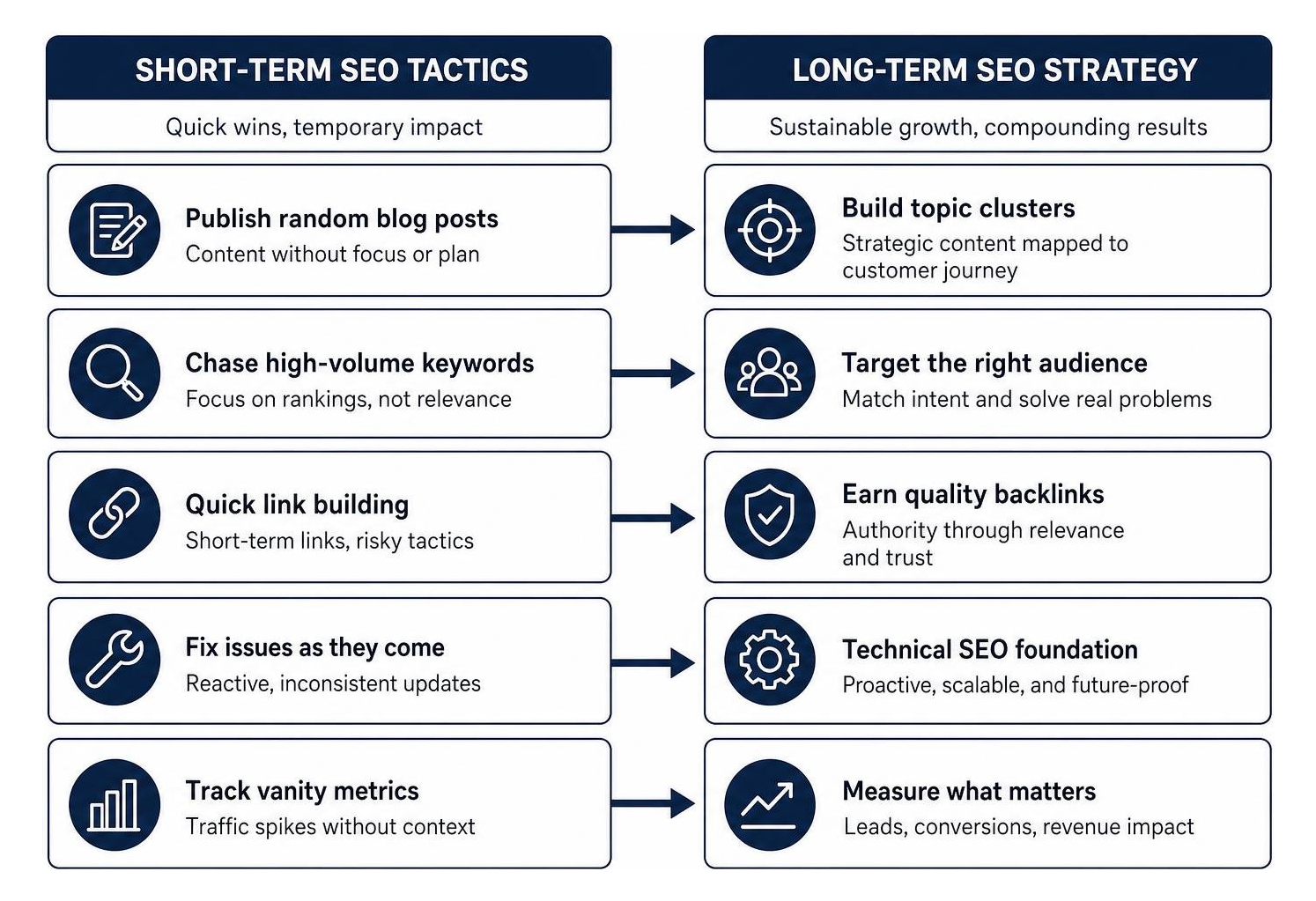
A structured approach is essential for long-term search visibility and sustainable business growth. When you invest in a cohesive plan, you build a compounding digital asset. Unlike paid ads, which stop driving traffic the moment you stop paying, organic search visibility continues to produce results over time.
Consider the financial impact: search engines are the starting point for the vast majority of online experiences. In fact, 39% of global eCommerce traffic originates from search engines, and 69% of organic clicks go to the first five search results. By aligning your business goals with search trends, you position your brand where your customers are already looking.
To explore how structured goals drive success, you can read about setting Part 1: Introduction, SEO Strategy and Unit-Level Goals to see how organizations align search benchmarks with organizational objectives. For local businesses in Chicagoland, working with a partner who understands the local landscape is key to executing these plans. If you are ready to scale your organic presence, you can explore our expert Chicago SEO services to see how we build customized search plans for local companies.
Keyword Research and Mapping: Aligning with Search Intent
At the heart of every successful SEO strategy lies keyword research. This is the process of identifying the exact terms, phrases, and questions your target audience uses when searching for your products or services. However, simply finding high-volume keywords is no longer enough. To turn searchers into customers, you must understand their search intent—the underlying reason behind their search query.
By grouping keywords into specific intent categories, you can design pages that precisely answer what the user is looking for. This alignment is critical for both user experience and search rankings.
| Search Intent Type | Description | Example Query | Best Page Type to Target |
|---|---|---|---|
| Informational | User wants to learn or find information | “How to fix a leaky pipe” | Blog post, guide, or FAQ |
| Navigational | User wants to find a specific website or brand | “WWS Des Plaines” | Homepage or Contact page |
| Commercial | User is researching options before buying | “Best roofing contractor in Chicago” | Service page, comparison, or listicle |
| Transactional | User is ready to make a purchase or hire | “Hire emergency electrician near me” | Service page with a clear contact form |
Long-tail keywords—highly specific phrases containing three or more words—are incredibly valuable here. While they have lower search volumes individually, they collectively account for more than 70% of all search queries. More importantly, they carry much higher conversion intent. A user searching for “electrician” is likely researching, whereas someone searching for “emergency residential electrician in Schaumburg IL” is ready to book a service immediately. To capture these high-intent local customers, implementing targeted Local SEO practices is essential.
Finding High-Value Opportunities with Keyword Research in Your SEO Strategy
When conducting keyword research, we look at three primary metrics to identify the best opportunities:
- Search Volume: How many times a keyword is searched for per month.
- Keyword Difficulty: How competitive the search results are for that term.
- Business Potential: A score from 0 to 3 indicating how naturally you can showcase your product or service within content targeting that keyword.
In 2026, we must also conduct prompt research. Because conversational AI search engines like ChatGPT, Perplexity, and Gemini are capturing a growing share of search traffic, we analyze how users phrase complex questions. Instead of just targeting “roofing repair Chicago,” we also optimize for prompts like, “Who is the most reliable contractor for flat roof repair in Niles IL with good reviews?” This allows us to capture high-value opportunities across both traditional and generative search surfaces.
Aligning Content with Search Intent Through Keyword Mapping in Your SEO Strategy
Once you have your list of high-value keywords, you must create a keyword map. This is a spreadsheet or document that matches each target keyword cluster to a specific, unique page on your website.
Keyword mapping prevents “keyword cannibalization”—a common issue where multiple pages on your site compete for the same keyword, confusing search engines and diluting your rankings. It also ensures a seamless user experience. When a user clicks your link in the search results, they should land on a page that immediately satisfies their intent. If they search for a transactional term and land on a generic informational blog post without a clear call-to-action, they will bounce. Proper mapping directly improves your conversion rates by guiding users smoothly down the sales funnel.
Creating a Content Plan and Building Topical Authority
Google no longer ranks pages in isolation. Today, search engines evaluate your entire website’s topical authority—how deeply and comprehensively you cover a specific subject. To build this authority, we use the “topic cluster” model.

In this model, you create a comprehensive “pillar page” that provides an overview of a broad topic. You then write several “cluster articles” (also called satellite pages) that dive deep into specific subtopics. By linking these pages together using descriptive anchor text, you signal to search engines that your site possesses deep expertise on the subject.
For example, if you run a contracting business in Naperville IL, your pillar page might be a comprehensive guide on home remodeling. Your supporting cluster content could include:
- A detailed guide on kitchen layout ideas
- An article explaining how to choose durable bathroom tiles
- A checklist for hiring local electrical contractors in Chicagoland
To ensure your content resonates with both search engines and human readers, it must align with Google’s E-E-A-T framework (Experience, Expertise, Authoritativeness, and Trustworthiness). This means attributing your articles to real, credentialed authors with bio pages, citing trustworthy external references, and providing original data, screenshots, or first-hand case studies.
For a complete look at how to structure these campaigns, you can refer to How to Create an SEO Strategy [Template Included] to download frameworks used by top marketing teams. If you operate an online store, building topical authority around your product collections is equally vital; you can read our guide on Ecommerce SEO to learn how to structure online stores for maximum visibility.
Technical SEO and Sustainable Authority Building
The most exceptional content in the world won’t rank if search engine crawlers cannot access, read, and index your website. That is why technical SEO is the foundation of any successful search campaign.
Our technical checklists focus on several key pillars:
- Core Web Vitals: Optimizing your site’s loading speed, interactivity, and visual stability. Sites optimized for speed often see immediate ranking lifts.
- Crawl Budget and Indexation: Ensuring your sitemap is clean, your robots.txt file is configured correctly, and Google Search Console shows no crawl errors.
- Mobile Usability: With 58% of global online searches coming from mobile devices, a responsive, mobile-first design is mandatory.
Once your technical foundation is secure, you must build sustainable off-page authority. Backlinks—links from other reputable websites to yours—remain one of Google’s strongest ranking signals. However, the days of buying cheap link packages or posting on spammy directories are long gone. Today, search engines prioritize editorial legitimacy.
One of the most effective ways to build authority is the Middleman Method. Instead of trying to build links directly to your commercial service pages (which other sites rarely want to link to), you build high-quality backlinks to your informational, link-worthy content—such as original research, data studies, or ultimate guides. Then, you use strategic internal links to pass that earned authority (or “link juice”) down to your commercial service pages.
If you are a business owner looking to understand how local agencies handle these technical audits and link campaigns, check out Chicago SEO Agencies: Your Guide to Ranking Up for a detailed breakdown of local industry standards. If you are a local service provider, our guide on SEO for Contractors Chicago shows how tradespeople can dominate local search results.
Measuring Success and Optimizing for the AI Era (GEO & LLMs)
An effective SEO strategy must be measurable. We use Google Analytics 4 (GA4) and Google Search Console to track performance data. Rather than focusing solely on vanity metrics like total keyword rankings, we focus on commercially grounded KPIs:
- Organic CTR: Improving click-through rates by optimizing title tags and meta descriptions.
- Conversion Rates: Tracking how many organic visitors complete a contact form or call your business.
- Assisted Conversions: Measuring how informational blog posts introduce users to your brand before they convert later.
As we navigate 2026, search is undergoing its biggest shift in decades. Generative Engine Optimization (GEO) and LLM optimization are now parallel channels to traditional SEO. AI Overviews, ChatGPT Search, Perplexity, and Gemini are capturing an expanding share of queries.
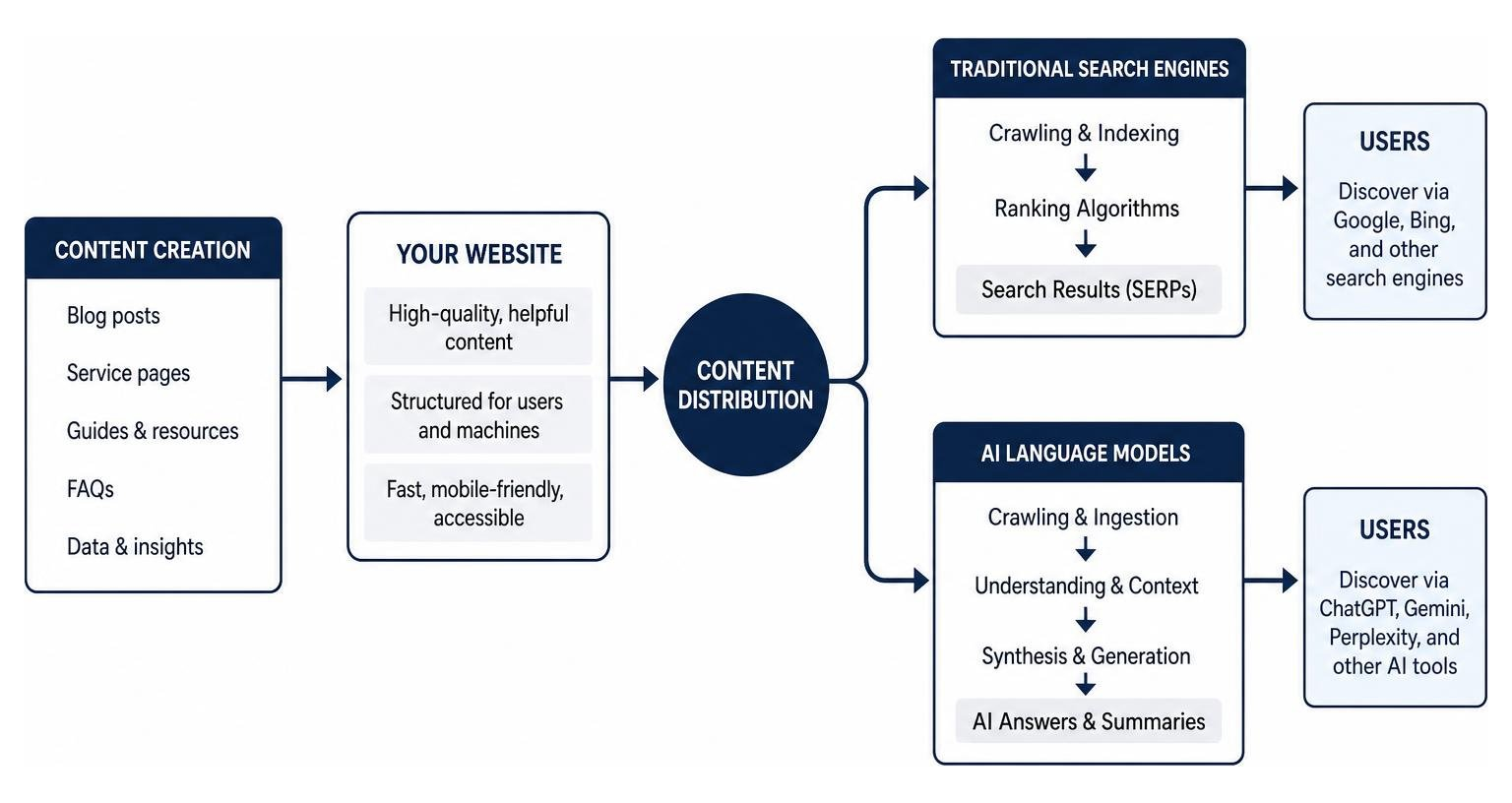
To optimize for these AI engines, your content must be structured for easy machine reading. AI search visitors are 4.4x more valuable than traditional search visitors because their queries are highly specific and carry immense buying intent. To capture this traffic:
- Place direct, factual answers in the first 200 words of your pages.
- Implement structured schema markup (Organization, Article, FAQ, and Product schema).
- Maintain an
llms.txtfile on your server to guide AI crawlers to your most authoritative content. - Build strong external mentions, as AI engines frequently recommend brands based on third-party citations and reviews.
For businesses looking to implement a comprehensive search plan, you can compare local pricing and deliverables by viewing our SEO Services Packages Chicago.
Frequently Asked Questions about SEO Strategy
How long does it take to see results from an SEO strategy?
Most businesses see initial movement in search rankings within 3 to 6 months of launching a campaign. Significant organic traffic growth and lead generation typically compound between the 6 and 12-month marks. The exact timeline depends on your website’s history, the competitiveness of your industry, and how quickly technical issues are resolved.
What is the difference between SEO and GEO?
Traditional SEO (Search Engine Optimization) focuses on ranking your website in the classic “blue-link” organic search results. GEO (Generative Engine Optimization) focuses on optimizing your content so that conversational AI models and search systems (like ChatGPT, Perplexity, and Google AI Overviews) cite your business as a trusted source in their generated answers.
Do I still need keyword research if AI search is growing?
Yes, absolutely. AI search engines still rely on crawled web data to formulate their answers. However, keyword research has evolved into prompt research and entity SEO. We look at the actual questions and conversational prompts users type into AI systems, ensuring your content is structured to answer those multi-layered queries.
Conclusion
Building a real SEO strategy in 2026 is no longer optional—it is the foundation of your digital survival. By combining deep keyword research, structured topic clusters, flawless technical optimization, and forward-looking AI visibility tactics, you can build an online presence that consistently drives leads and revenue.
At WWS (Wizerunek w Sieci), led by Tomasz Lasota in Des Plaines, IL, we treat your business as if it were our own. We specialize in bespoke web solutions, local search optimization, and AI-era positioning for small and medium-sized businesses across Cook County, Lake County, and the broader Chicago suburbs. Whether you are part of the local Polish-American community (Polonia Chicago) or an entrepreneur looking to scale nationwide, we have the bilingual capabilities and local expertise to help you win.
Don’t leave your search visibility to chance. Visit wizerunekwsieci.com to claim your free website audit. Let us show you how a customized Website SEO strategy can transform your business.